Règlement FFPJP · 5 July 2026
How to count the points in pétanque according to the official rules
Official FFPJP procedure for counting points at the end of an end: who announces, when to pick up, special cases (carreau, dead end, equal boules) and common mistakes.1.Basic principle: who scores and how
The fundamental rule is simple: only the team holding the point at the end of an end scores points. The losing team scores nothing, even if its boules are close to the jack. You then count the number of boules of the winning team that are closer to the jack than the opponent's best boule.
This principle follows from article 27 of the official FFPJP rulebook: "Once all the boules have been played, the players proceed to score the end. The team whose boule is closest to the jack scores as many points as it has boules closer than the opponent's best boule."
Concrete example: team A has 3 boules closer than team B's best boule → team A scores 3 points. Team B scores 0 points, even if it had a fine end.
An important point often misunderstood: you do NOT count all the boules of each team, you only count the winning team's boules that are closer than the opponent's best boule. The distance of the other boules is of no importance for the score.
2.The official counting procedure
In practice, here is the procedure the rulebook sets out, step by step:
Step 1 — Identify the closest boule
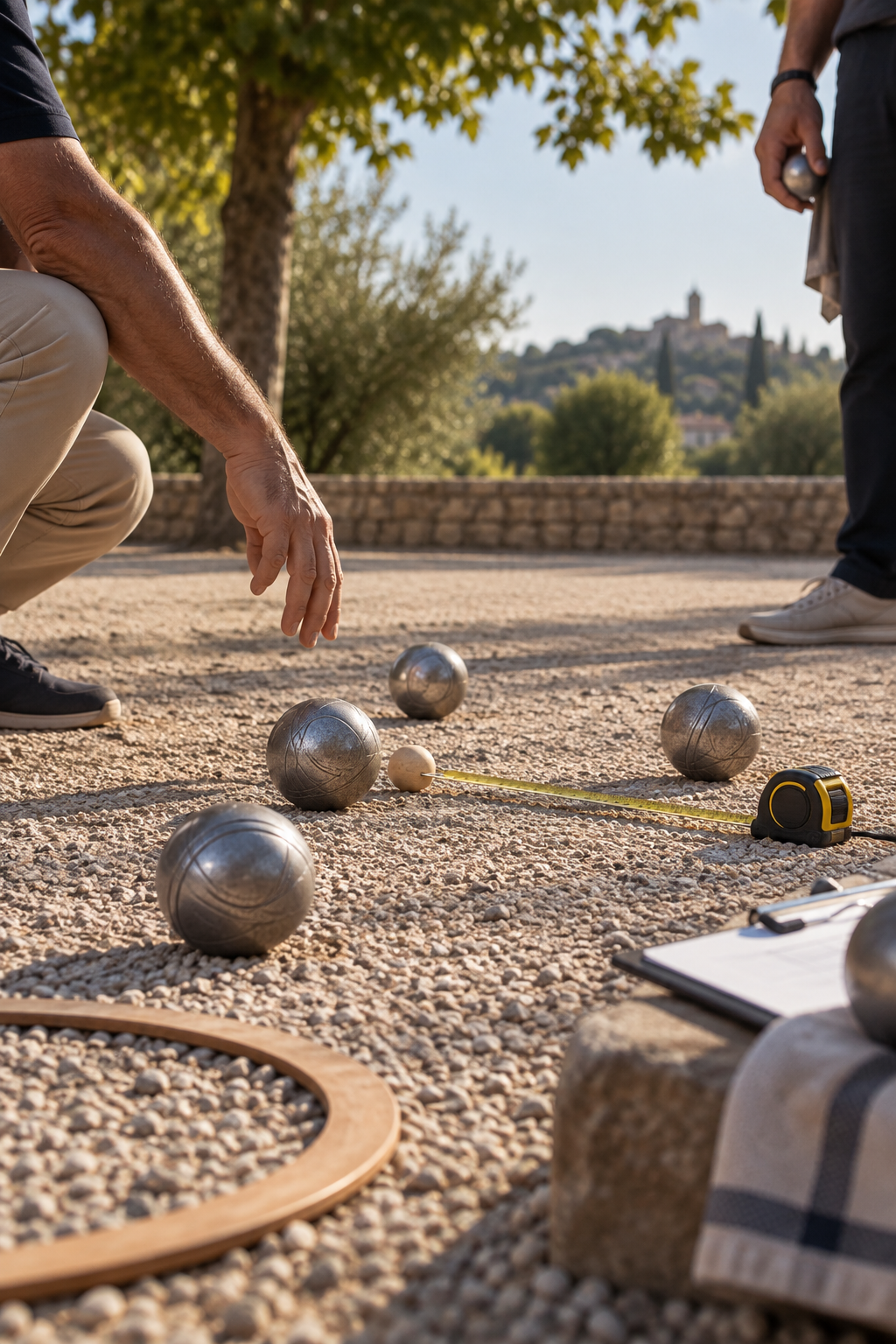
Start by identifying which team has the boule closest to the jack. If it's obvious to the naked eye, perfect. If a doubt remains, you measure (see our article on the official FFPJP measuring method). This step is essential before any counting.
Step 2 — Count the winning team's boules
Next count how many boules of the winning team are closer to the jack than the opponent's best boule. Here too, in case of doubt over the position of a borderline boule, you measure. You don't pick anything up during this phase.
Step 3 — Agreement of both teams
Both teams (or their captain) validate the number of points together. It's only after this agreement that you can pick up the boules and note the score. If the teams don't agree, you call a referee (in a tournament) or you measure again.
3.Who has the right to announce the points?
In leisure play, everyone tends to announce at the same time, which sometimes creates confusion. In an official tournament, the rulebook is clear: it's each team's captain who validates the score of their own team. Each captain confirms the number of points scored by the opponent (and not by their own team, to avoid conflicts of interest).
In amateur practice, a single neutral and respected person counts the points out loud, both teams confirm, and the score is noted. The essential thing is that both teams agree before picking up the boules.
In a tournament, before picking up a single boule, announce the score clearly out loud and wait for a visual confirmation (a nod, an ok) from the opposing team. This habit of a few seconds will save you many disputes after the fact.
4.Validation and picking up of the boules
This is where the rulebook is most often violated, including by experienced players. The rule is strict: you don't pick up the boules before the score is validated by both teams. Why? Because once the boules have been picked up, it's impossible to contest the counting — the evidence is gone.
In the event of a premature pick-up by a player on team A, if team B contests, the referee can award the points claimed by B (the benefit of the doubt goes to the wronged team). It's a severe sanction that can cost you a won end.
Likewise, moving a boule before the counting is a breach of the rules. Marking the boules on the ground before any movement is compulsory as soon as you touch the terrain.
5.Table of counting situations
| Situation | What do you do? | Regulatory basis |
|---|---|---|
| Clear gap | Direct counting | Art. 27 FFPJP |
| Doubt over the closest boule | Compulsory measure | Art. 26 FFPJP |
| Equal boules (1 from each team) | Possible null end | Art. 28 FFPJP |
| Carreau: winning boule stays, jack goes | Boule counted if closer | Art. 27 FFPJP |
| Pick-up before validation | Breach — benefit of the doubt to the opponent | Art. 27 FFPJP |
| Persistent disagreement | Call the referee | General rulebook |
6.Special cases: carreau, equal boules, null end
The carreau
When a shot makes a carreau (the hit boule goes and the shooting boule stays in its place), the shooting boule is counted at its new position. If it's closer to the jack than all the opposing boules, it's worth a point. If the jack moved during the carreau, you count from the jack's new position.
Two boules at equal distance
If, after measuring, one boule from each team is strictly at the same distance from the jack, neither has the point. If these are the two best boules of both teams and both teams have no boules left, the end is void : no point is awarded, and you replay from the same position.
The null end (article 28 FFPJP)
The end is null when no point can be awarded to a team. This is the most common case when the two best boules are at equal distance. Consequence: no points, you replay from the same spot, the same team throws the jack again. The score stays the same as before the end.
7.The 5 most frequent counting errors
Here are the most frequent pitfalls observed on the terrains, from beginner to club level:
1. Picking up the boules before validation — the most common and most costly fault. Even a boule picked up innocently can trigger a dispute. Always wait for the ok from both teams.
2. Counting all the winning team's boules — classic mistake: you count all of team A's yellow boules, without comparing to team B's best boule. Result: you score too many points. You must always identify the opponent's best boule first.
3. Moving a boule to see better — any movement before counting must be preceded by a mark on the ground. Otherwise, if the boule rolls, it's a punishable fault.
4. Not measuring in case of doubt — many players judge by eye to save time. In a tournament, this isn't allowed as soon as there's a contestation. You measure, and you measure before picking up.
5. Forgetting the opponent's closest boule — you count the winning team's boules up to the closest opposing boule, not up to the last opposing boule. If the opposing boule is 3rd in distance, the winning team scores only 2 points.
Point so precisely that no one will ever contest your score: lob, half-lob techniques, reading the ground, gauging the speed. So the opponent's boule never measures better than yours.
Discover the book