Règlement FFPJP · 26 June 2026
Incorrectly drawn circle in pétanque: what are the consequences according to the rules?
A badly drawn pétanque circle: what Article 6 of the FFPJP rules really requires. Diameter, position, penalties and official procedure.1.What the rules say about drawing the circle
Article 6 of the official FFPJP-CMSB rules is very clear on two fundamental points: the circle must have an interior diameter between 35 and 50 cm and be placed at at least 1 metre from any obstacle (wall, wire, back line, etc.). Since 2024, the approved rigid circle has become mandatory in official competition, which simplifies compliance with the diameter since it is standard at 50 cm outer.
For competitions without approved circles (local tournaments, free play, friendly games), the rules still allow drawing by hand with a spray can, a stick or even a finger — provided the diameter remains compliant and the shape is clearly circular. An oval, deformed or approximate circle opens the door to disputes.
2.Error No. 1 — Non-compliant diameter
It is the most frequent error in free play: a small 25 cm circle is drawn because the ground is hard. That is too small, and therefore non-compliant. If the deviation is noticed before the first bowl is played, the circle must be redrawn immediately. If it is noticed afterwards, it is more complex: an umpire generally tolerates the current end (for the sake of flow) but requires a compliant circle from the next end onwards.
Conversely, a circle drawn at 80 cm in diameter is just as non-compliant. It may seem harmless, but this oversized circle distorts the distance measurement to the jack (6 to 10 m from the inner edge of the circle). The rules require a precise geometry, not a vague zone.
3.Error No. 2 — Circle less than 1 metre from an obstacle
Article 6 stipulates that the circle must be at least 1 metre from any obstacle — wall, line wire, back line of the marked terrain, stop, tree, bench. This rule exists for two reasons: to allow the player to take their throwing motion freely and to guarantee safety (a slipping foot must not hit a hard obstacle).
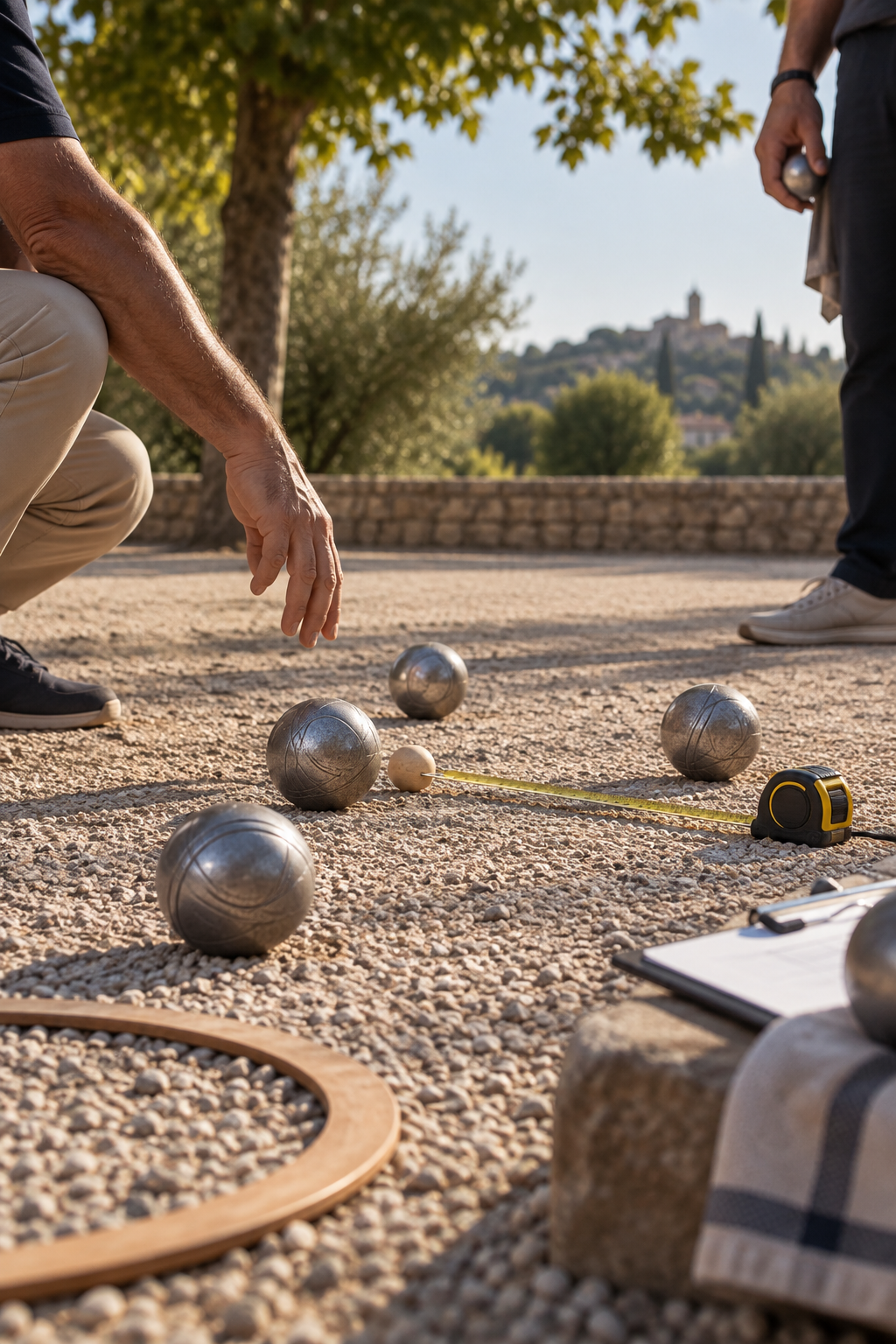
When a circle is too close to a wall, the opponent may ask the umpire — or the delegate — to have it repositioned. If the end has already begun, two schools: cancellation and replay (strict option), or continuation and correction at the next end (pragmatic option). In national tournaments, the strict option is applied.
📏On wooden pétanque courts (boards, painted lines), the 1-metre rule is applied even more rigorously than outdoors: the slightest bowl that bounces off the line can disrupt the end, and a circle too close to a board multiplies disputed bounces. International umpires are particularly vigilant on this point.
4.Error No. 3 — Position toward the centre of play
Classic error: the jack is thrown from the other end, and instead of drawing a new circle around the bowl closest to the previous throw (official rule), one is drawn anywhere. Article 6 is explicit: the new circle must be drawn around the jack played in the previous end, when it is no longer usable.
In case of a positioning error (circle too far off, in another frame, in another team's zone), the end is dead and must be replayed. It is one of the errors that opens the most conflicts, because it changes the whole angle of play.
5.Summary table: 6 errors and their consequences
Here is the evaluation grid applied by FFPJP umpires to circle drawing errors:
| Drawing error | Frequency in tournaments | Official consequence |
|---|---|---|
| Diameter < 35 cm or > 50 cm | Very frequent | Circle to be redrawn before throwing |
| Less than 1 m from an obstacle | Frequent | Reposition or cancel the end |
| Poor re-throw position | Frequent | Null end, to be replayed |
| Circle erased during an end | Occasional | Redraw at the original location |
| Circle moved during shooting | Occasional | Put back in place |
| Circle on the opponent's playing line | Rare | Cancellation and new drawing |
6.Error No. 4 — Circle erased during an end
On soft ground (gravel, sand, beaten earth), a hand-drawn circle can disappear gradually under the passage of players and the fall of bowls. The rules are clear: the erased circle must be redrawn identically at the same location, using the residual marks and the memory of both teams.
If the exact drawing cannot be reconstructed and the teams do not agree, the umpire intervenes: they cancel the current end and have the circle redrawn as close as possible to the original position, relying where possible on the footprints of the last players.
7.Error No. 5 — Circle moved during shooting
Approved rigid circles are not indestructible: a bowl shot at full speed can move them by several centimetres. The rules provide that this displacement invalidates neither the bowl nor the end. The circle is simply put back to its original position before the next shot, by the umpire if present, or by the players if the location is clear (marks on the ground).
On the other hand, if the displacement is so great that the original position can no longer be determined, the end is validated but the new circle (for the next end) must be negotiated as best as possible between the teams — often the umpire decides.
Official severity of a non-compliant circle Circle less than 1 m from a wall · Severity 9/10 Direct sanction: mandatory repositioning and end to be replayed if the error is late. Non-compliant diameter · Severity 6/10 Moderate sanction: circle to be redrawn, without cancellation if the end has already begun. Circle moved by a shot bowl · Severity 3/10 Simple replacement. No consequence on the current end.8.Error No. 6 — Circle placed on the opponent's playing line
During a tournament on marked frames (numbered terrains), it happens that a circle is placed on the line separating two games, or worse, in the neighbouring team's terrain. It is a frequent error when the jack is re-thrown toward the end of the game and the new circle is drawn mechanically. The rules then require the drawing to be cancelled and repositioned to inside the assigned frame.
If an end has already been played from this out-of-bounds circle, it is replayed. Otherwise, the circle is simply moved and the end proceeds normally. This error is rare at the top level but common in multi-game departmental tournaments.
9.The official procedure to follow when the circle is invalid
When you notice that a circle is poorly drawn, here is the procedure provided by the rules:
- Signal before the first bowl : it is the ideal moment. Calmly ask the opponent to redraw the circle.
- If the end has begun: continue to the end, then correct the next end (pragmatic option of local tournaments).
- In an official tournament: call the umpire, who will decide between immediate cancellation or deferred correction.
- Never ever redraw an opponent's circle yourself without agreement — it is interpreted as unsporting conduct.
Buy an FFPJP-approved rigid circle as soon as you play regularly: it is an expense of 8 to 15 € that eliminates 90% of disputes over the drawing. The diameter is guaranteed, the shape is perfect, and the umpire has nothing left to check. Essential for anyone who wants to play tournaments seriously.
To go further, also consult our file on the feet-in-the-circle rule and our article on offences sanctioned by umpires. Our section little-known rules and our free tools usefully complements this guide.
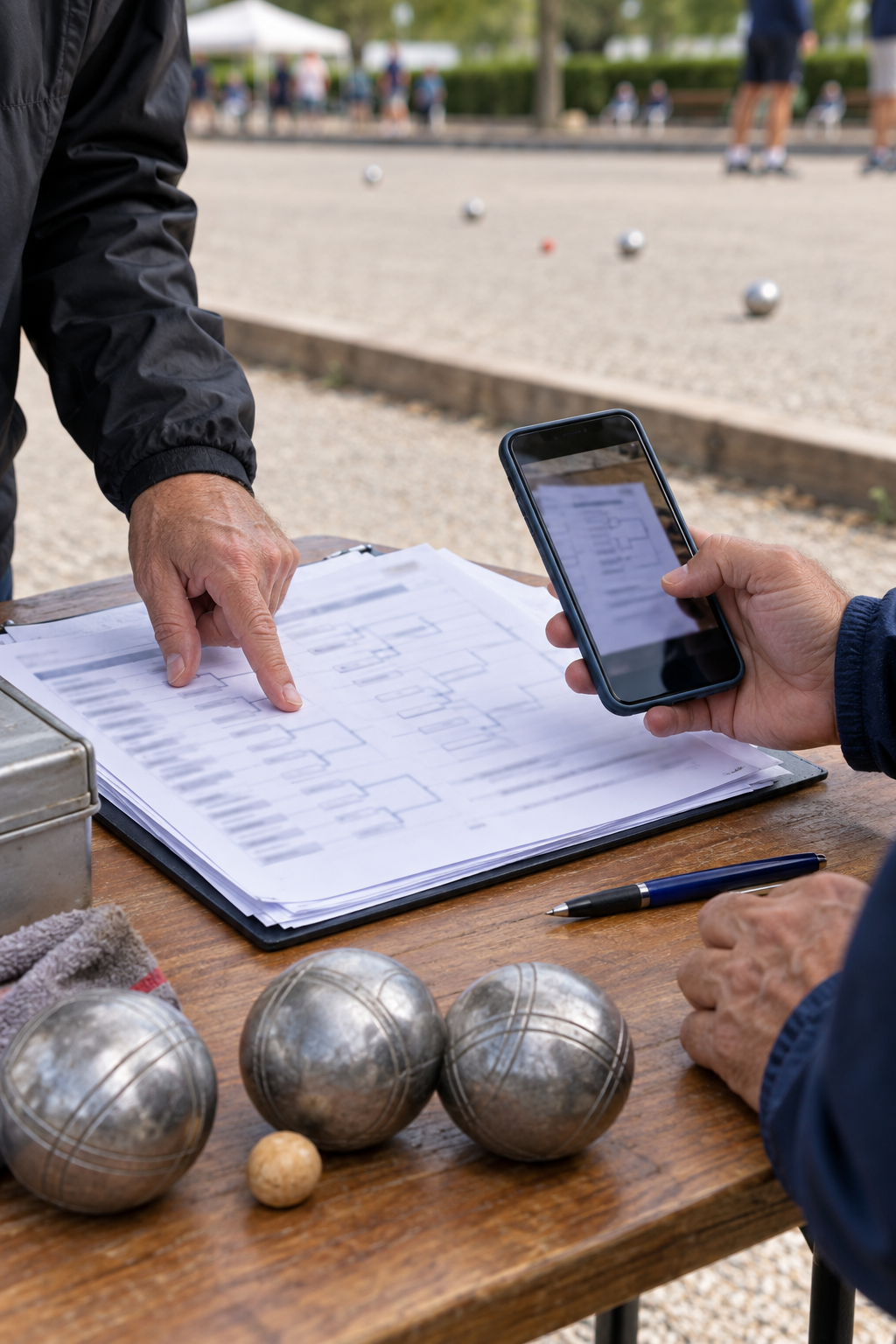
🏆 PAQUITA'S SOFTWARE The PétanqueLand tournament & mêlée softwareA compliant circle also means a compliant organisation. The PétanqueLand software manages your tournaments and mêlées: draws, rankings, brackets, right down to the match sheets. Everything you need to organise by the rules, without management errors.
💻 Discover the softwareFAQ — Your frequent questions
What to do if the opponent draws a circle that is too small?+ Report this politely before the first boule is played and ask for a trace conforming to the 35-50 cm diameter. If the round has started, wait until the end and demand a correct circle at the next round. In official competitions, call on the referee. Does a circle moved by a fired ball invalidate the shot?+ No. The shot remains valid. The circle is simply returned to its original location. There is no sanction for either the shooter or the opposing team. What is the minimum distance between the circle and a wall according to the regulations?+ The FFPJP regulations impose a minimum of 1 meter between the throwing circle and any obstacle (wall, wire, stop, bench). This distance allows free movement and guarantees the safety of the player. Can we retrace a circle during a current run?+ Yes, provided the location is kept the same. If the circle is erased by the passages, we retrace it in the same place using the residual traces. In case of disagreement, the arbitrator decides. Is an approved rigid circle obligatory in competition?+ Since 2024, the rigid circle has been compulsory in all official FFPJP competitions (nationals, championships, Coupe de France). In departmental competitions, hand tracing is still tolerated if the diameter is compliant. 📎 Related articles RulesThe feet rule: what you need to know RulesFeet offences sanctioned by umpires RulesThe little-known rules of pétanque© Pétanque by Paquita — petanqueland.fr ·
💻 Discover the PétanqueLand tournament software
Article based on the official FFPJP-CMSB rules (article 6, provisions on drawing the circle) and the observation of umpiring practices in national tournaments. To be adapted to local practices without contradicting the federal letter.