Actualités · 27 April 2026
Playing without a drawn circle: what the rules really say
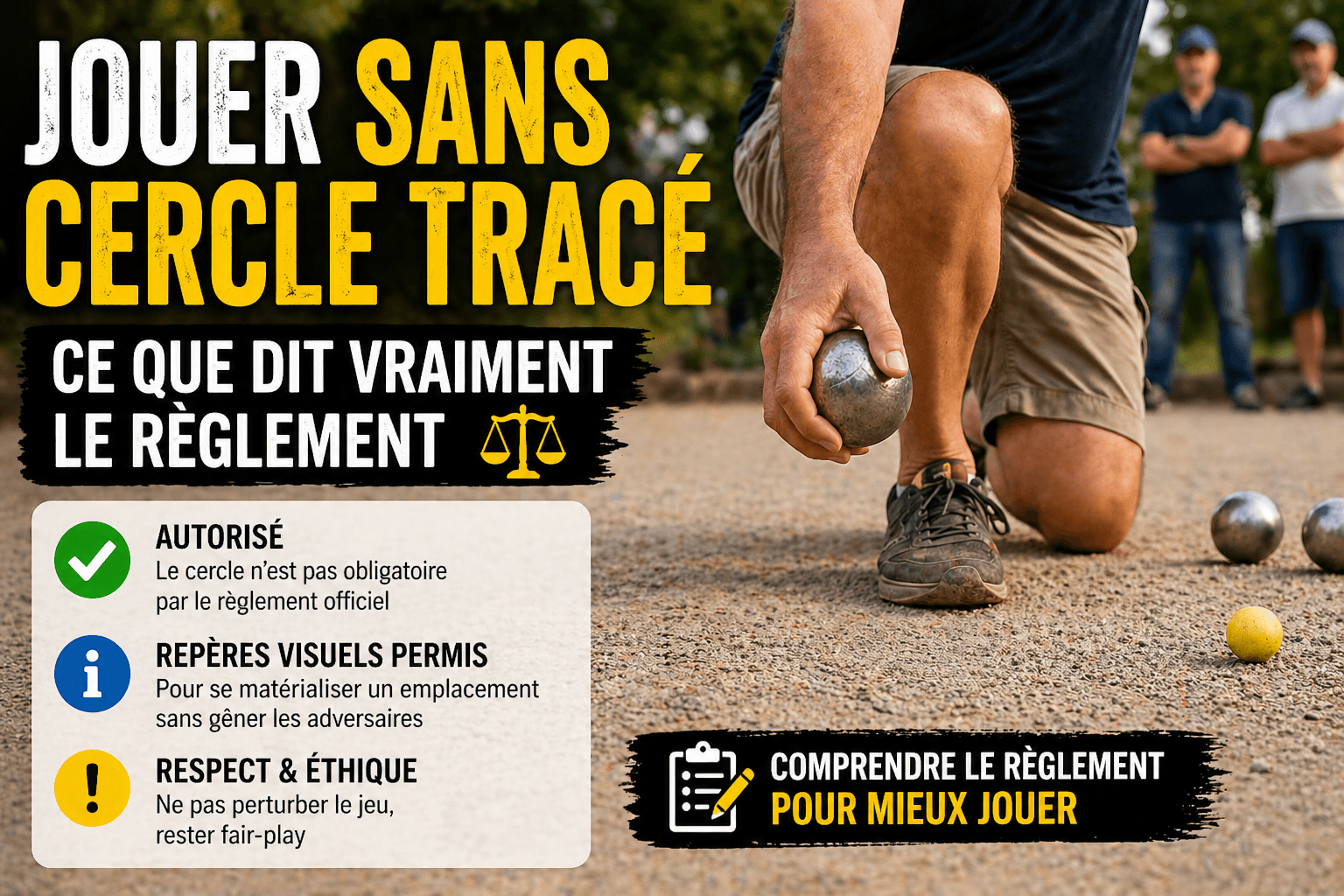
A circle drawn by hand, traced in the sand, marked with the foot — or no circle at all. WhatWhat the text of the FIPJP rulebook says
Article 6 of the FIPJP rulebook is the reference text on the throwing circle. Here is its essential content, in its official wording:
📜 FIPJP RULES — ARTICLE 6 (PARAPHRASED EXCERPT) "The player must throw their boule from a circle drawn on the ground, the internal diameter of which must be between 35 and 50 cm, and inside which the player's two feet must be, flat on the ground, without going over the line, until the thrown boule has touched the ground. The circle may be drawn by any means — including with the two feet. In international competitions and championships, however, it is mandatory to use a materialised circle (approved rigid circle)." Source: FIPJP rulebook, article 6 — formulated synthetically by Paquita. Refer to the official FIPJP text for the exact wording currently in force. 🔑Three sentences capture everything: 1) the circle must have an internal diameter between 35 and 50 cm. 2) the circle may be drawn "by any means, including with the two feet". 3) in international competitions and championships, the materialised rigid circle is mandatory. The subtlety lies in the "including with the two feet" — it is not an exceptional tolerance, it is a method explicitly mentioned in the text.
🎙️ Paquita on the circle rule "The confusion comes from an incomplete reading of the text. People remember 'the rigid circle is mandatory' — which is true in certain contexts — and turn it into a universal rule. But the rulebook says 'mandatory in international competitions and championships' — not in your local boulodrome competition. Many departmental committees have added the rigid circle requirement to their own internal rules — which is their right. But it is not a universal FIPJP requirement. The distinction is important." — PaquitaThe rigid circle — when is it mandatory?
🏆 International FIPJP competitions and world championships MANDATORYThis is the level for which the FIPJP rulebook explicitly requires the approved rigid circle. The World Championships, the official FIPJP continental competitions require each player to use a materialised circle (in plastic, metal or rigid material conforming to the dimensions) for each throw.
RULE TEXT The rigid circle is mandatory in international competitions and championships — wording of the FIPJP text. IN PRACTICE At this level, the circles are provided or checked by the organisation. No player can avoid it. The absence of a rigid circle or the use of a non-compliant circle can result in a penalty or the cancellation of a throw. 🇫🇷 National FFPJP championships (France) MANDATORYThe FFPJP has adopted the rigid circle requirement in its official national competitions — French Championship, national federal competitions. The FFPJP may supplement the FIPJP rulebook with its own rules, which it has done regarding the rigid circle for its national competitions.
IN PRACTICE FFPJP-approved rigid circles (50 cm internal diameter, compliant material) are mandatory in all competitions under the direct auspices of the national federation. Some regional leagues have extended this requirement to their own competitions. 🏅 Departmental and regional committee competitions DEPENDING ON THE COMMITTEEIt is here that the situation varies across France. Each departmental and regional committee has the possibility to impose additional rules to those of the basic FIPJP rulebook. Some committees require the rigid circle in all their official competitions — others stick to the basic FIPJP rulebook that permits drawn circles.
TO BE CHECKED Consult the specific competition rules or contact the organising committee. The phrase "according to the federal rules in force" in competition regulations can mean either basic FIPJP (drawn circle permitted) or FFPJP (rigid circle mandatory). IN PRACTICE For any official competition, ask explicitly before playing whether the rigid circle is mandatory. Do not assume — ignorance of the local rule does not protect you from a penalty. 🎉 Local competitions, "wild" competitions, friendly games BASIC FIPJP RULESFor unofficial competitions or those organised without explicit reference to the federal rules, the basic rulebook applies if no specific rule has been established — that is, the FIPJP rulebook that permits drawn circles. In practice for friendly games, the agreement between players takes precedence.
IN PRACTICE In a wild or friendly competition, the circle drawn on the ground (or with the shoe) is perfectly valid according to the basic FIPJP rulebook. The rigid circle is a good habit to adopt but not a legal obligation in this context.The circle drawn on the ground — permitted under conditions
The circle drawn on the ground — with chalk, with a stick, with a finger in the sand — is explicitly permitted by the FIPJP rulebook in contexts that do not require the rigid circle. But conditions apply.
✏️ Conditions of validity of a drawn circle VALID IF COMPLIANTFor a drawn circle to be valid, it must meet the same core requirements as a rigid circle: internal diameter between 35 and 50 cm, a drawing that is visible and recognisable by both teams, and precise enough for violations (foot outside the circle) to be detectable.
A vaguely sketched circle, too large (60 cm) or too small (30 cm), or whose edges are not recognisable is not valid — even if the text permits drawn circles. The shape must comply with the regulatory dimensions.
MANDATORY DIMENSION Internal diameter between 35 and 50 cm — this is a requirement whatever the drawing method. A drawn circle of 80 cm in diameter is not valid even if it is clearly visible. PRACTICAL TIP To draw a 50 cm circle with a string: tie a pencil/stick to a 25 cm string (radius = half the diameter), plant the other end in the ground at the desired centre, and trace the circumference. A precise and quick method.The shoe-drawn circle — the common practice explained
Drawing the circle with the tip of one's shoe is the most common practice in informal games. The FIPJP rulebook explicitly mentions "including with the two feet" as a drawing method — which in principle legitimises this practice. But practical questions arise.
👟The rulebook says "including with the two feet" — which means that the two feet together delineate the circle, not just a single foot drawing a line. In practice, this involves placing both feet in the throwing position and "marking" their outer positions to delineate the circle. This is different from a simple shoe sweep of a single foot that draws an approximate half-circle. The precision of the method remains an obligation — the diameter must be within the regulatory range even when drawn with the feet.
🤔 The practice of the "shoe circle" — on-the-ground realityIn boulodromes, the common practice of the "shoe circle" is often a simple approximate arc drawn with a single sole sweep. It is tolerated in informal games — but technically, if the drawn arc does not clearly delineate a space of 35 to 50 cm in diameter, it does not strictly comply with the rules. In an official competition without a rigid-circle requirement, a strict umpire could invalidate an overly approximate circle. In friendly play, no one makes an issue of it.
Playing without any circle — what really happens
⚠️ CLEAR RULES POINTPlaying without any circle — neither rigid, nor drawn, nor symbolic — is a violation of the FIPJP rules. Article 6 explicitly requires a circle in one form or another for each throw. In an official competition, a throw made without an identifiable circle can be cancelled by the umpire and the player warned. Repeated offences can lead to heavier sanctions according to the competition's rules.
In practice, "playing without a circle" is common in informal games where no one objects. But the contexts must be distinguished: what is tolerated between friends in a garden is not what is allowed in a competition, even a local one. As soon as a score is at stake and a rule is invoked, the circle becomes mandatory in some form or another.
Special cases — soft ground, grass, concrete
🏖️ Sandy or loose ground — drawn circle makes sense FACILITATING DRAWN CIRCLEOn sandy ground, a circle drawn with a stick, a finger or a shoe is easy, precise and durable (as long as no one walks on it). It is often more practical than the rigid circle on sand — the rigid one can slip or sink depending on the depth of the sand. Drawing in the sand is perfectly valid and often the most natural method.
TIP On fine sand, drawing the circle with the heel (deeper pressure than the toe of the shoe) leaves a more durable mark. Slightly deepening the line prevents the wind or players' footsteps from erasing it quickly. 🌿 Grass — rigid circle strongly recommended DIFFICULT TO DRAWOn grass, drawing a precise circle is difficult — the grass hides shoe or stick marks very quickly. A circle drawn on grass tends to disappear after a few throws. The rigid circle is strongly recommended on grass — it remains visible and clearly delineates the space regardless of the surface. If the rigid circle is not available, the "foot circle" (delineation by the position of both feet) is the most practical method on grass.
🏗️ Concrete or hard surface — circle drawn with chalk CHALK DRAWING RECOMMENDEDOn concrete, asphalt or synthetic surfaces, the chalk circle is perfectly effective — visible, precise, and durable for the duration of an end. Advantage of drawing on a hard surface vs a rigid circle: the circle drawn in chalk does not slip (the rigid circle can shift slightly on smooth concrete when in contact with the feet).
LIMITATION On wet concrete (rain), the chalk fades quickly. The rigid circle regains the advantage in this case. ❄️ Frozen or waterlogged ground — a difficult situation SPECIAL CASEOn hard frozen ground, drawing a circle is difficult. On muddy ground, the circle fills with water or mud immediately. In these cases, the rigid circle is the only truly practical solution. If both teams and the umpire agree, a pragmatic adaptation (symbolic marks, markers at the 4 cardinal points) can be accepted in a local competition. In competitions where the rigid circle is mandatory, no exception — the player must adapt.
Disputes relating to the circle — how they are decided
⚖️ A player places a foot outside the circle during the throw The rule is clear: both feet must remain inside the circle, flat on the ground, until the boule has touched the ground. If a foot touches the outside of the circle or the line before the boule touches the ground, it is an infringement. → Regulatory decision: the boule is cancelled and must be replayed. If the opponent was hindered by this boule (one of their boules being moved), the opponent may choose to validate the situation if it is in their favour. ⚖️ The drawn circle was erased during the end During an end, the circle drawn on the ground can be erased (opponent's foot, weather conditions). The next player can no longer precisely delineate their throwing space. → Regulatory decision: redraw the circle. If there is disagreement over the exact position of the original circle, the players may agree on a reasonable position. In the event of a persistent dispute, the umpire decides. This is an additional reason to use the rigid circle — it does not get erased. ⚖️ A player uses a circle that is too large or non-compliant A 70 cm diameter circle drawn deliberately to have more throwing space. Or a non-compliant circle (square, triangle) that is not a circle. → Regulatory decision: the circle must be corrected to the regulatory dimensions (35 to 50 cm inner diameter) before throwing. Boules thrown from a non-compliant circle can be contested. The umpire may order a re-throw. ⚖️ The rigid circle is used but moved during play A rigid circle can be accidentally moved by a foot or a boule during the end. Its original position is no longer marked on the ground. → Regulatory decision: replace the circle at its original position, reconstructed by agreement of the players or decision of the umpire. In practice, lightly marking the original position of the circle with a piece of chalk or noting its position before the end is a good habit in major competitions. ⚖️ Dispute over whether the rigid circle is mandatory in this competition One team demands that the other use a rigid circle, the other maintains that drawing on the ground is sufficient in this competition. → Regulatory decision: the umpire or organiser decides by reference to the competition's specific rules. If the competition's rules do not explicitly mention the mandatory rigid circle, the base FIPJP rules apply — drawn circle allowed. In the absence of an umpire, the two captains consult the competition's written rules.Summary table — what is permitted according to the context
| Playing context | Rigid circle | Drawn circle | Foot circle | Without a circle |
|---|---|---|---|---|
| FIPJP World Championships | Mandatory | Forbidden | Forbidden | Forbidden |
| FFPJP French Championship | Mandatory | Forbidden | Forbidden | Forbidden |
| Committee competition — FFPJP rules | Mandatory | Forbidden | Forbidden | Forbidden |
| Committee competition — base FIPJP rules | Permitted | Permitted | Valid if compliant | Forbidden |
| Local / unofficial non-federal competition | Recommended | Permitted | Permitted | By agreement |
| Friendly game between friends | Good practice | Permitted | Permitted | Tolerated |
| Training alone or at a club | Recommended | Permitted | Permitted | To be avoided (bad habits) |
Beyond the rules, the rigid circle has a practical advantage that is not regulatory: it delineates an identical space at each end, on any terrain. The drawn circle can vary slightly in size depending on who draws it and how. These minor variations subtly influence foot positioning — and therefore the gesture. Training systematically with the rigid circle guarantees a postural consistency that the drawn circle cannot fully provide. That is why the best players use it even when it is not mandatory.
📖 PAQUITA'S BOOK The complete rulebook — in all its detailsThrowing circle, the one-minute rule, players' rights, umpiring... Paquita's book covers all the rules that make the difference in a competition, with practical exercises to apply them.
📦 Order on AmazonFAQ — Your frequent questions
What is the exact difference between the FIPJP circle (35–50 cm) and the FFPJP circle (50 cm)? + The FIPJP regulations allow an interior diameter between 35 and 50 cm — a range that historically allowed smaller circles drawn by children or players with small feet. The FFPJP has standardized the rigid circle at 50 cm in internal diameter for its competitions, in practice eliminating the lower range. The approved rigid circle sold commercially in France generally has an internal diameter of 50 cm. If you draw your own circle and it is 40 cm in diameter, it is technically within the FIPJP range — but potentially non-compliant if the competition imposes the FFPJP standard at 50 cm. Can we play with the heel outside the circle if the toes are there? + No. The rules require that both feet be entirely inside the circle, flat on the ground, without extending over the line. “Flat on the ground” implies that the entire foot (toe and heel) is in the circle. Only the overhanging heel is enough to constitute an infraction if a referee notices it before the ball hits the ground. This is a rule often ignored in informal games, but applied in contests with referees. This is also one of the reasons why the 50 cm diameter circle is the norm — the two feet of an average adult in a light lunge position just fit within this diameter. Can you get up or take your feet off the ground before the ball hits the ground? + No. The rules are clear: both feet must remain flat on the ground until the thrown ball has touched the ground. Rising on the toes, lifting the heel or completely taking one foot off the ground before the ball lands is an infraction. In practice, heel lifting (involuntary lifting of the heel during the swing) is very common and rarely punished for lack of a referee — but technically it is an infraction. For shooters, a swing that causes the back foot to come completely off the ground before the ball lands is clearly non-compliant. What happens if the circle is placed on a boundary line? + If the circle is placed on or straddling the boundary line of the land, this may pose a problem with the validity of the placement. The regulations require that the circle be placed at a minimum distance from the boundary and that the player can throw normally. In general, if part of the circle extends beyond the boundary line, it must be placed entirely back inside the field. This situation especially occurs when the previous end was played very close to the edge and the player must place his circle close to the line. The referee or players must agree on a valid location. Can a child or player with a disability use a larger circle? + In official competitions, the standard regulations apply to all participants — there are no general exceptions for children or disabled people in the general FIPJP regulations. However, the FFPJP and the committees organize specific competitions (Sport Boules Handisport, youth categories) with adapted rules - in particular circles and different distances. Outside of official competitions, pragmatic adaptations are of course possible and desirable for accessibility. 📎 Related articles Rules Complete FFPJP rulebook 2026 Rules The one-minute rule — what the text really says Rules Rigid circle — mandatory in 2026? Rules The little-known rules of pétanque Rules Ground marks — what is allowed Tools Free PetanqueLand tools© Pétanque by Paquita — petanqueland.fr ·
📖 Paquita's book on Amazon
The FIPJP rules evolve periodically. The information in this article is based on the versions in force at the time of writing. For any official competition, always check the competition's specific rules and the latest version of the FIPJP/FFPJP rules on the official websites.