Actualités · 27 April 2026
A boule that moves after stopping: valid point or not?
Your bouleThe fundamental principle — the cause, not the distance
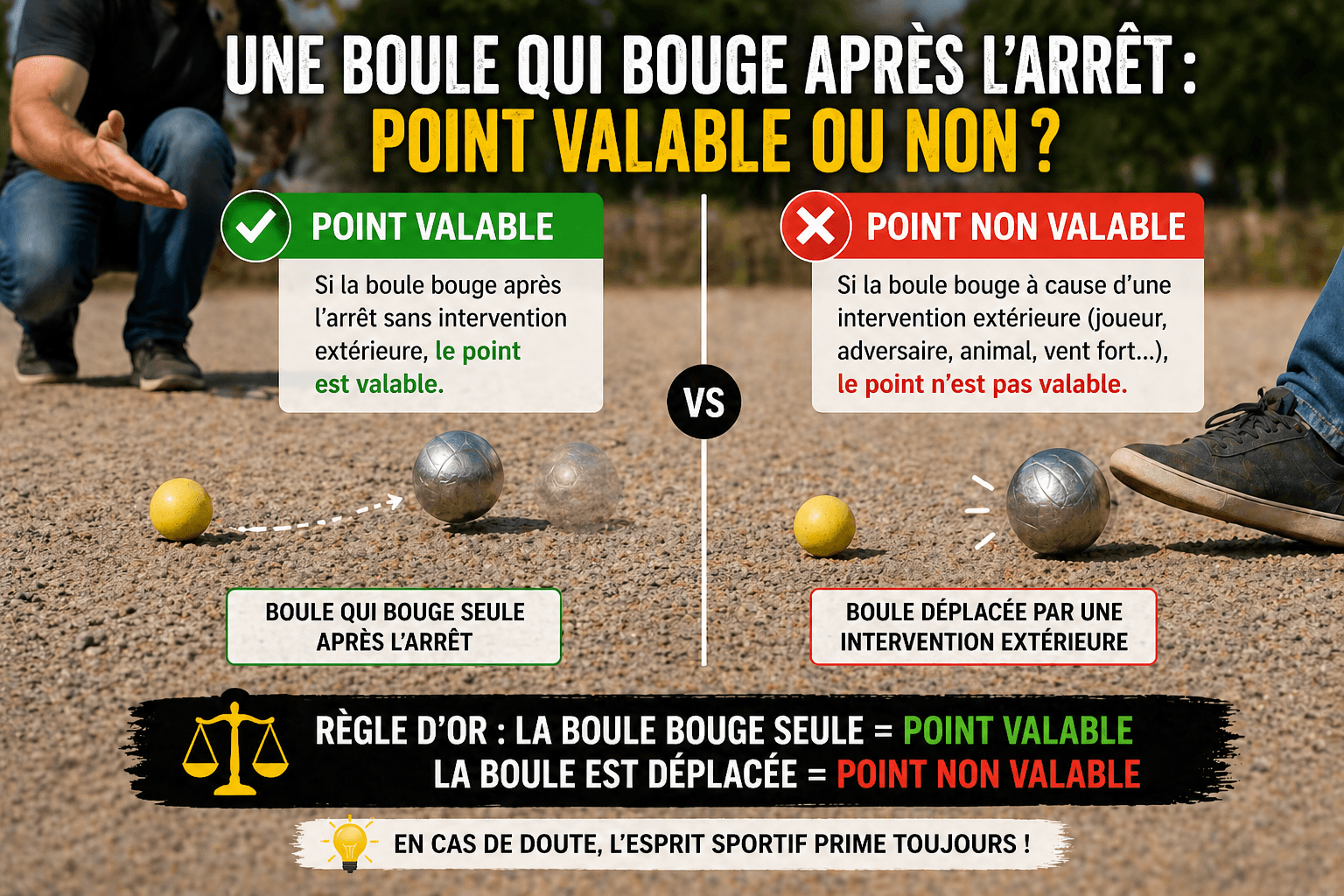
⚖️ KEY PRINCIPLE It's not how much the boule moved — it's why The FIPJP rules set no distance threshold below which a movement would be ignored. Even 1 millimetre of displacement counts — if the cause of that displacement is an action contrary to the rules. And even 10 centimetres of displacement can be of no consequence — if the cause is a natural event for which the rules require the boule to be put back to its initial position.The regulatory reasoning always starts from the same question: "Why did this boule move?". The answer to that question determines everything else:
— Natural cause (wind, sloping ground, water) → the boule is put back in its place. The new position is not valid.
— Cause = a player from the opposing team (foot, shoe, opposing boule) → the wronged team may choose to validate the new position if it is favourable to them, or to put the boule back in its place.
— Cause = the boule itself in legitimate motion (shooting, pointing) → the new position is valid. This is the normal rule of the game.
— Cause = a player from one's own team → possible heavy consequences depending on the rules. 🎙️ Paquita on the boule that moves "This dispute comes up in almost every competition. Most of the time it is resolved quickly because the cause is obvious. But I've seen ten-minute arguments over a boule that had rolled 2 cm after coming to rest on a slope. The umpire settled it in 30 seconds: natural slope, put it back to the initial resting position. The key I always teach: before arguing about the movement, identify its cause. If everyone agrees on the cause, the applicable rule is obvious." — Paquita
What Article 17 of the FIPJP rules says
📜 FIPJP RULES — ARTICLES ON DISPLACED BOULES (PARAPHRASED) "Any boule in play displaced by a player of the team that is playing, or by an object belonging to that team, is definitively lost if it goes out of the boundaries of the terrain. If it remains within the boundaries of the terrain, the opposing team may either validate it at its new position, or put it back to its initial position.""Any boule displaced by a player from their own team is put back to its position before the displacement. If a player accidentally displaces a boule of their own team, it is replaced at its original position."
"Any boule displaced by the wind or by water, or having slid after coming to rest on sloping ground, is put back to its initial resting position after the players or the umpire have noted its position. It is therefore recommended to systematically mark the boules after they come to rest." Source: FIPJP rules, synthesis of the articles relating to displaced boules. Refer to the official FIPJP text in force for the exact wording. 🔑
The most important sentence in the rules on this subject: "It is therefore recommended to systematically mark the boules after they come to rest." This recommendation reveals a fundamental practical problem: if the boule moves and its initial resting position has not been marked, it is often impossible to put it back in its true place. Marking the boules is not a paranoid precaution — it is the only way to be able to apply the rules correctly in these situations.
The 6 cases of a boule that moves after coming to rest
⛰️ Case 1 — The boule slides down a slope after coming to rest PUT BACK IN PLACEThe boule came to rest in a slightly unstable position on a slope. A few seconds later, it moves off by 5 to 15 cm downhill. This movement is due solely to gravity — no player touched anything.
APPLICABLE RULE Movement caused by a natural force (terrain, gravity) → the boule must be put back to its initial resting position. The new position (after the slide) is not the valid position. ACTION TO TAKE Put the boule back exactly where it had initially come to rest. That is why marking the position is essential — without a mark, the initial position is often disputed. If the position was not marked and nobody agrees on the spot, the umpire decides based on the testimony. 💨 Case 2 — The boule is displaced by the wind PUT BACK IN PLACEA gust of wind displaces a light boule (a plastic one during training, or even a steel boule in a windy lane) after it has come to rest. Rare but documented.
APPLICABLE RULE The wind is a natural force — same rule as for the slope. The boule is put back to its initial resting position. PRACTICAL NOTE This case is extremely rare with approved steel boules (650–800g). It can occur with light jacks on raised or windy terrain. The rule applies identically to the jack. 👟 Case 3 — The boule is displaced by an opposing player (accidentally) WRONGED TEAM'S CHOICEAn opposing player approaches to measure or observe the situation, and their foot, shoe, or the boule in their hand accidentally grazes a boule in play, which moves by a few centimetres.
APPLICABLE RULE The wronged team (the team whose boule was displaced) has the choice: either validate the new position if it is favourable to them, or request that it be put back to the initial resting position. This choice belongs exclusively to the wronged team. IMPORTANT SUBTLETY If the new position (after accidental displacement by the opponent) is closer to the jack than before, the wronged team may choose to validate it. If it is further away, they request that it be put back in place. The opponent cannot object to this choice — the rules are clear: it is the wronged team that decides. 🤦 Case 4 — The boule is displaced by a player from ITS OWN team PUT BACK IN PLACE (or penalty)A player from the team that owns the boule accidentally moves it — by stepping on it, striking it with another boule, or placing a foot on it. This is the most penalising case.
APPLICABLE RULE The boule must be put back to its original position of rest. But if the movement is caused deliberately (intentionally), sanctions may apply. For an accidental movement, it is put back in place with no additional penalty — but it is the opponent who controls the replacement (or the umpire). WARNING This is the case that causes the most tension — especially when the boule of your own team that you have accidentally moved was in a poor position. The temptation to "put" the boule back slightly better placed than before is real. The rules are clear: replace it at the exact position before the movement, not at a better position. 💥 Case 5 — The boule is moved by a shot or a throw in progress NEW POSITION VALIDA boule at rest is struck by a shot or pushed by a throw during the end. It moves from its original position of rest. This is normal play.
APPLICABLE RULE Any boule moved by another boule in legitimate play stays at its new position — this is the normal result of play. No replacement, no possible challenge on the principle. The only possible challenge is on the validity of the throw that caused the movement, not on the movement itself. CONSEQUENCE The new position is the official position of the boule for the rest of the end. It counts in the measurements and the counting of points. Even if the boule has ended up in an unexpected position (behind the jack, against the edge), that is the rule of the game. 🎯 Case 6 — The boule is moved by a boule from another court or an outside object PUT BACK IN PLACEA boule coming from an adjacent court arrives on your court during play and moves one of your boules. Or an animal, a child, an object fallen from the sky (a tree branch, etc.) moves a boule in play.
APPLICABLE RULE Any boule moved by an object or a person outside the game in progress is put back to its original position of rest. It is the same logic as a natural force — the cause is external to the game, so the new position is not valid. IN PRACTICE This case requires stopping the end and calling an umpire (or agreeing between the teams) for the replacement. If the position had not been marked and it is disputed, the testimony of the closest players carries authority.The jack that moves after coming to rest — specific rules
The rules on the jack that moves after coming to rest are similar to those for the boules but with a few important subtleties — in particular on what happens when the jack goes out of the court boundaries or becomes no longer visible.
❌ JACK — SITUATIONS THAT VOID THE END →The jack is moved by an opposing player intentionally and goes out of bounds → end voided, replay →The jack goes out of the court boundaries after a legitimate shot or throw and is no longer visible → end voided according to the specific rule →The jack is buried in the sand or mud and is no longer visible → depending on the rules, the end may be voided →The jack is broken during the end by an impact → replaced at its position, the end continues with a new jack ✓ JACK — SITUATIONS WHERE THE END CONTINUES →The jack is moved by a boule in legitimate play and remains within the visible boundaries → new position valid, end continues →The jack slides on a slope after coming to rest → put back to its original position of rest (same rule as for the boules) →The jack is moved accidentally by an opposing player → put back in place according to the same rules as for moved boules →The jack is moved by an outside object → put back to its original position, the end continues 🟡The jack that "rolls" after a powerful shot on a hard court is a very common case — and perfectly legitimate. A jack that moves following a direct hit or a powerful throw stays at its new position — exactly like a boule. Play can thus create configurations where the jack ends up very far from its initial position, even out of easy reach of the remaining players. This is normal play, not an incident.
The boule that moves during the measurement
This is the classic case that opens this article: the measurement is in progress, a measuring tape is placed, and during the measurement a boule moves slightly. The cause of the movement determines everything once again.
📏 The boule moves because of the measuring tape touching it CHOICE OF THE WRONGED TEAMThe person measuring places the measuring tape and its end lightly touches the boule, which moves by a few millimetres. It is the action of measuring that caused the movement.
APPLICABLE RULE If it is an opposing player who is measuring and accidentally causes the movement, the wronged team may validate the new position (if it is advantageous) or request the replacement. This is case 3 applied to measuring. GOOD PRACTICE To avoid this dispute: always mark the boules BEFORE measuring. If the boules are marked, a boule moved during the measurement can be put back exactly to its original position with no possible challenge. ⛰️ The boule slides down the slope while the umpire is measuring PUT BACK IN PLACEThe umpire approaches to measure. Before he even touches anything, a boule in an unstable position starts to slide down the slope. The umpire did not touch the boule — it was gravity that caused the movement.
APPLICABLE RULE Natural force → put back in place at the original position of rest. The umpire must mark the position of the boule before measuring in order to carry out a correct replacement. LESSON It is exactly for this situation that the rules recommend marking the boules after they come to rest. A rigorous umpire systematically marks before measuring to guard against this situation. ⚠️ CRUCIAL REMINDER — MARK THE BOULESThe recommendation in the rules to mark the boules after they come to rest is not a simple piece of cautious advice — it is the sine qua non condition to be able to correctly apply all the rules on moved boules. Without marking, the initial position is a matter of contradictory testimony. In competitions, get into the habit of systematically marking your boules as soon as they come to rest in areas close to the jack or liable to move (slopes, passing zones).
Summary table — valid position according to the cause
| Cause of the movement | Who is involved | Valid position | Regulatory action |
|---|---|---|---|
| Legitimate shot or throw in play | Boule in legal motion | New position | Nothing to do — this is normal play |
| Slide on a natural slope | Gravity / nature | Initial position | Put back to the original position of rest |
| Moved by the wind | Natural force | Initial position | Put back to the original position of rest |
| Moved accidentally by an opponent | Opposing player | Wronged team's choice | The wronged team chooses: validate or put back in place |
| Moved accidentally by one's own team | Player from one's own team | Initial position | Mandatory replacement at the original position |
| Moved by an outside object / boule | External to the game | Initial position | Put back to the original position of rest |
| Moved by the measuring tape during measurement | Opposing player (measuring) | Wronged team's choice | The wronged team chooses: validate or put back. Marking before measuring avoids the problem. |
| Jack pushed by a shot / stays in play | Boule in legitimate play | New position | New position valid — end continues |
Best practices to avoid disputes
✏️ Marking — the gesture that avoids half the disputesThe golden rule: mark all the boules close to the jack as soon as they come to rest, before you approach to analyse the situation. A line of chalk, a piece of adhesive tape, a retrieval ball placed behind the boule — any mark will do. This 2-second gesture eliminates almost all disputes over "where the boule was before it moved". Without marking, everything relies on memory and testimony — the breeding ground of all disagreements.
📸 Photograph in the event of a complex situationFor complex configurations (several boules close to the jack, disputed positions), getting out your phone to take a photo is a common-sense reflex. The photo shows the exact configuration before any measurement or accidental movement. It does not replace marking but complements the documentation of the situation. In the event of a dispute before an umpire, a time-stamped photo is a solid argument.
📖 PAQUITA'S BOOK Master the rules — every situation coveredMoved boules, measuring disputes, the one-minute rule, players' rights in competitions... Paquita's book covers all the regulatory situations with practical exercises to apply them without hesitation.
📦 Order on AmazonFAQ — Your frequent questions
A player touches an opposing ball to “look at it closely” and it moves slightly — what’s happening? + Touching an opposing ball without authorization from the team owning that ball is a foul — regardless of whether the ball is moving or not. If it moves following this unauthorized contact, this is case 3: the injured team can validate the new position if it is favorable to it, or ask for it to be reinstated. In competitions with a referee, the player who touches without authorization may receive a warning. The general rule is simple: you never touch an opposing ball without having previously announced the intention to measure and obtained the tacit agreement of both teams. If the opponent's boule slides down the slope and gets closer to the jack — does it stay where it arrived? + No — whether the ball is yours or your opponent's, if the movement is caused by gravity (natural sliding on a slope), the ball is returned to its initial stopping position. The principle applies to the boules of both teams without distinction. If an opposing ball slips and ends up closer to the jack, you can ask for it to be returned to its original stopping position. This is your statutory right — but the original position must be known (marked or observed by all). How long is "after stopping" — if the ball continues to roll slowly for 5 seconds, is it considered stopped when it stops? + A ball is considered “stopped” when it is no longer moving — even if this movement was very slow (residual rolling). There is no minimum time after shutdown. The official position of the ball is its position of complete immobility. If it then resumes movement due to a (gravity) slope, this new position is not valid — it will be returned to the position of immobility. If after a slow roll it hits another ball and moves them both, this is normal play — the final positions are valid. If a ball falls into a hole dug by previous throws, does it stay in the hole? + Yes — a ball that stops in a hollow in the field stays in that position. Irregularities in the field created by the game (impact holes, areas dug by previous balls) are part of the normal conditions of the field. This is not a "moving ball after stopping" — the ball has stopped in this hollow and this is its official position. If the hollow is so deep that the ball in contact with the jack moves it unintentionally, it is the jack that finds itself in the "displaced by a ball in play" situation — its new position is then valid. Can we film the balls in the event of a dispute to prove what happened? + Yes, and the FFPJP has provided specific rules on video refereeing since 2020 in its official competitions. In local competitions without formal video refereeing, a personal video or photo may be presented to the referee as evidence in a dispute — the referee is not required to accept it but may refer to it. For disputes over "did the ball move during the measurement", a video of the exact moment is a useful element. In practice, the best prevention remains the systematic marking of balls — which avoids disputes before they arise. 📎 Related articles Rules Complete FFPJP rulebook 2026 Rules Ground marks — what is allowed Rules The little-known rules of pétanque Rules The one-minute rule Rules Smartphone video refereeing in pétanque Tools Free PetanqueLand tools© Pétanque by Paquita — petanqueland.fr ·
📖 Paquita's book on Amazon
The regulatory summaries in this article are practical syntheses. For any official competition, refer to the official text of the FIPJP rulebook in force and the specific regulations of the tournament.