Règlement FFPJP · 20 February 2026
Pétanque rules: validity of the jack throw (cochonnet)
A jack too short, stopped by a spectator, touched by a partner, a late dispute... All the official FIPJP rules on the validity of the jack throw.The 4 conditions for a valid throw
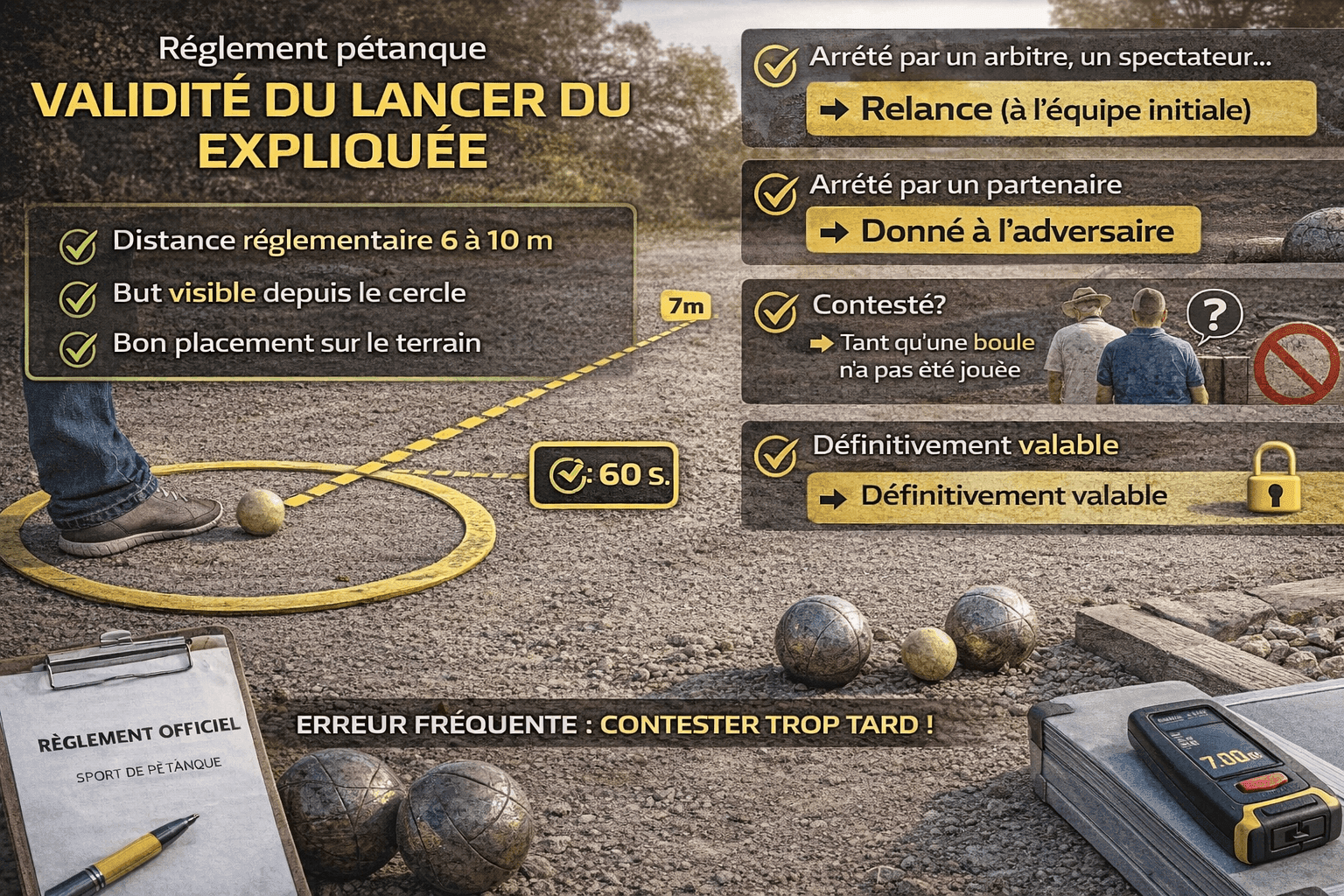
To be valid, a jack throw must simultaneously meet four regulatory conditions. If one of them is not fulfilled, the jack is not valid and must be re-thrown — or the opponent gains the right to place it depending on the context.
📏 Regulatory distanceThe jack must land between 6 and 10 metres from the throwing circle. No more, no less. See our full article on official distances.
🗺️ Good terrain placementThe jack must remain in the authorised playing area — not on forbidden terrain, not outside the limits defined for the game.
👁️ Jack visibilityThe jack must be visible from the throwing circle. A jack completely hidden behind a fixed obstacle is not valid under the prescribed conditions.
🚧 Safety distancesThe jack must be at a sufficient distance from fixed obstacles, edges and other adjacent games according to the regulatory standards.
📄 FIPJP principle The jack throw is subject to cumulative conditions of distance, visibility and placement. Failure to comply with one of these conditions makes the throw invalid, even if all the others are respected. The check must be made before the first boule is played. Source: Official FIPJP rules — Article on the jack throwJack stopped by an outside element
The rules provide for precise cases where the jack is stopped or deflected during its throw by a factor independent of both teams. In all these cases, the principle is identical: the throw is cancelled and must be replayed — no team should benefit from an advantage due to an outside event.
🦺 Referee → Jack to re-throw 👥 Spectator → Jack to re-throw 🐾 Animal → Jack to re-throw 🌬️ Unexpected moving object → Jack to re-throw 💡 Paquita's tipThis rule protects the fairness of the end: an outside event must never advantage or disadvantage a team. If a spectator accidentally stops the jack in a good position for your team, it must still be re-thrown — even if it suits you. The referee watches over it.
Jack stopped by a partner — the little-known case
It's the most poorly known point of the rules on the jack throw, and the source of many conflicts on the terrains. The logic is different from that of an outside element — and the consequence is far more penalising for the offending team.
⛔ Jack stopped by a PARTNER- Fault attributable to the team that threw the jack
- The opponent gains the right to place the jack
- They may place it in any regulatory position of their choice
- The offending team cannot dispute this placement
- Play resumes normally from this new position
- Event independent of both teams
- Jack simply re-thrown by the same team
- No advantage given to the opponent
- We start again as if the throw had not taken place
- The team keeps its right to throw
Many players think that any "disturbed" jack is re-thrown. That's false when a partner intervenes. In that case, the opponent places the jack where they wish — within the regulatory limits. It's one of the most advantageous rules for the team that knows how to claim it.
Practical scenarios on the terrain
👟 The jack lands 4.5 metres from the circle The minimum regulatory distance is not reached. The throw is not valid — even if the jack is in an authorised area and perfectly visible. It must be re-thrown by the same team. → Jack to re-throw 🐕 A spectator's dog deflects the jack in flight Uncontrollable outside element. No matter where the jack would have landed, the throw is cancelled and replayed by the same team under the same conditions. → Jack to re-throw 🤚 A teammate stops the jack with their foot to prevent it going too far This is a fault attributable to the team. The opponent immediately gains the right to place the jack in the regulatory position of their choice — with no discussion possible. → The opponent places the jack 🌳 The jack rolls behind a tree — not visible from the circle If the jack is completely invisible from the circle under the conditions prescribed by the rules, the throw is not valid. The same team must re-throw from the same circle. → Jack to re-throw ✅ The jack is at 8 metres, visible, in an authorised area All conditions are met. The jack is valid. Play can begin. If no one disputes before the first boule is played, the position is acquired. → Jack valid, we play ⏱️ The opponent disputes the distance after two boules have been played The dispute is late. As soon as the first boule has been played without dispute, the jack's position is generally considered accepted. A dispute after the fact is inadmissible. → Late dispute — inadmissibleDispute: until when can you act?
The dispute of the jack's validity is not open indefinitely. The FIPJP rules provide for a moment when the jack's position is considered acquired — and after which any dispute becomes inadmissible.
- ⚡Dispute immediately — as soon as the jack comes to rest in a doubtful position, before any other gesture.
- 🎳Before the first boule is played — once the first boule is thrown without prior dispute, the jack's position is generally considered accepted by both teams.
- ⚖️In a tournament: call the referee — don't try to measure yourself if the doubt concerns the distance. The referee is the only authority to officially validate or invalidate the throw.
- 🤝In a friendly game — agree between players before the first boule. A tacit agreement (playing without disputing) amounts to accepting the throw.
As soon as the jack comes to rest, take 5 seconds to look: distance, visibility, terrain. That's enough to detect 90% of disputed cases. If you play your first boule without checking, you lose your right to dispute. These 5 seconds avoid disputes that last 5 minutes.
The procedure before the first boule
The jack throw must be seen as a full official step in its own right, not as a simple formality. Here is the recommended procedure, applicable in tournaments as well as friendlies:
1 Check the distance from the circle Estimate by eye whether the jack is between 6 and 10 metres. In case of doubt in a tournament, ask the referee to measure before playing. Don't wait until you've played to dispute. 2 Check the visibility from the circle Stand in the circle and look whether the jack is visible. A jack partially masked by a boule remains valid — full visibility is not required in all cases. 3 Check the terrain placement and distances to obstacles Make sure the jack is in the authorised playing area and respects the regulatory safety distances from fixed obstacles and adjacent games. 4 Agree with the opponent before the first boule If both teams tacitly agree by playing without disputing, the position is acquired. This is the moment to speak — not after the fourth shot. ⏱️The jack throw is also governed by the playing-time rule: once it's your team's turn to throw, the clock applies. Consult our full sheet on the playing-time rule so you don't get caught out.
Common mistakes on the terrain
- ✗Confusing a re-throw and a jack given to the opponent — when a partner intervenes, the opponent places the jack. Many players refuse this right through lack of knowledge.
- ✗Disputing too late — playing your first boule without checking, then trying to dispute after a bad result. A post-boule dispute is inadmissible.
- ✗Forgetting to check visibility — focusing only on the distance and ignoring that the jack is partially or totally masked from the circle.
- ✗Throwing quickly without checking the distances — in a tournament, the eagerness to play quickly makes you forget the basic checks. Taking 5 seconds avoids 95% of disputes.
- ✗Measuring yourself by hand — in a refereed tournament, any disputed measurement must be made by the referee. A "homemade" measurement has no regulatory value.
- ✗Confusing a badly thrown jack and a dead jack during an end — these are two distinct situations. A badly thrown jack is resolved before the first boule; a dead jack during an end follows another procedure. See our article on the dead jack during an end.
FAQ — Your frequent questions
Who has the right to throw the goal at the start of the end? + It is the team which scored the point in the previous end which throws the goal. For the very first lead of the game, a draw determines which team goes first. If the first throw is invalid and replayed several times, it is always the same team which throws again - except in the case of the partner who intervenes, where the opponent recovers this right. What happens if the goal cannot be validly thrown from the circle? + If the team attempts several times to validly place the goal from the same circle without success (terrain too difficult, insufficient space), the regulations provide that the right to throw passes to the opposing team. If this does not succeed either, the referee or the players designate a new circle position according to the conditions of the field. In case of doubt, the referee is essential. Can a valid goal become invalid after the first ball played? + The validity of the initial throw (before the first ball) and the nullity of the goal during the lead (after balls played) are two distinct things. A valid goal on the throw can become void during the end if one of the 7 void goal situations occurs. Conversely, a doubt about the initial throw can no longer be raised once the first ball has been played. Our article on the dead jack during an end details these 7 cases. Should the jack be perfectly visible or only partially? + The notion of visibility when throwing is governed by the FIPJP regulations — the player who is about to play must be able to see the goal from the circle. A goal partially hidden by a ball (cap) is a special case treated separately, distinct from a goal completely invisible behind a fixed obstacle. See our dedicated article on hidden jack. In a friendly game without a referee, how to handle a contested throw? + Agree between players on the basis of the official regulations, before the first ball. If the doubt concerns the distance, a pocket meter is enough to decide - it is the most useful tool in the field. In the event of persistent disagreement, the wisest solution is to restart the goal to start the lead in a neutral context. The objective remains to play, not to argue. Does the throwing circle influence the validity of the goal throw? + Yes. The circle itself must be valid and placed in accordance with the regulations for the goal throw to be valid. A poorly placed circle (too close to an obstacle, in a prohibited area) invalidates the entire procedure. See our article on throwing circle and its rules in 2026. 📚 Official sources- 🔗 Official FIPJP Rules — fipjp.com
- 🔗 Official FFPJP Rules — full commented version on petanqueland.fr
© Pétanque by Paquita — petanqueland.fr
Content based on the official FIPJP rules. In case of doubt, always consult the official version in force.