Règlement FFPJP · 10 July 2026
What the rulebook says when the jack is moved toward an obstacle
The jack ends up near a wall, a string or an obstacle after a shot? Here is the official FFPJP rule, the cases of a null end and what to do.1.The classic confusion: throwing near an obstacle or being moved there
The same visual position can hide two completely different situations. At the start of an end, the team must throw the jack from a circle placed at least one metre from any obstacle. The jack must also be at least one metre from the nearest obstacle, at a distance between six and ten metres for juniors and seniors. These conditions serve to validate the opening throw.
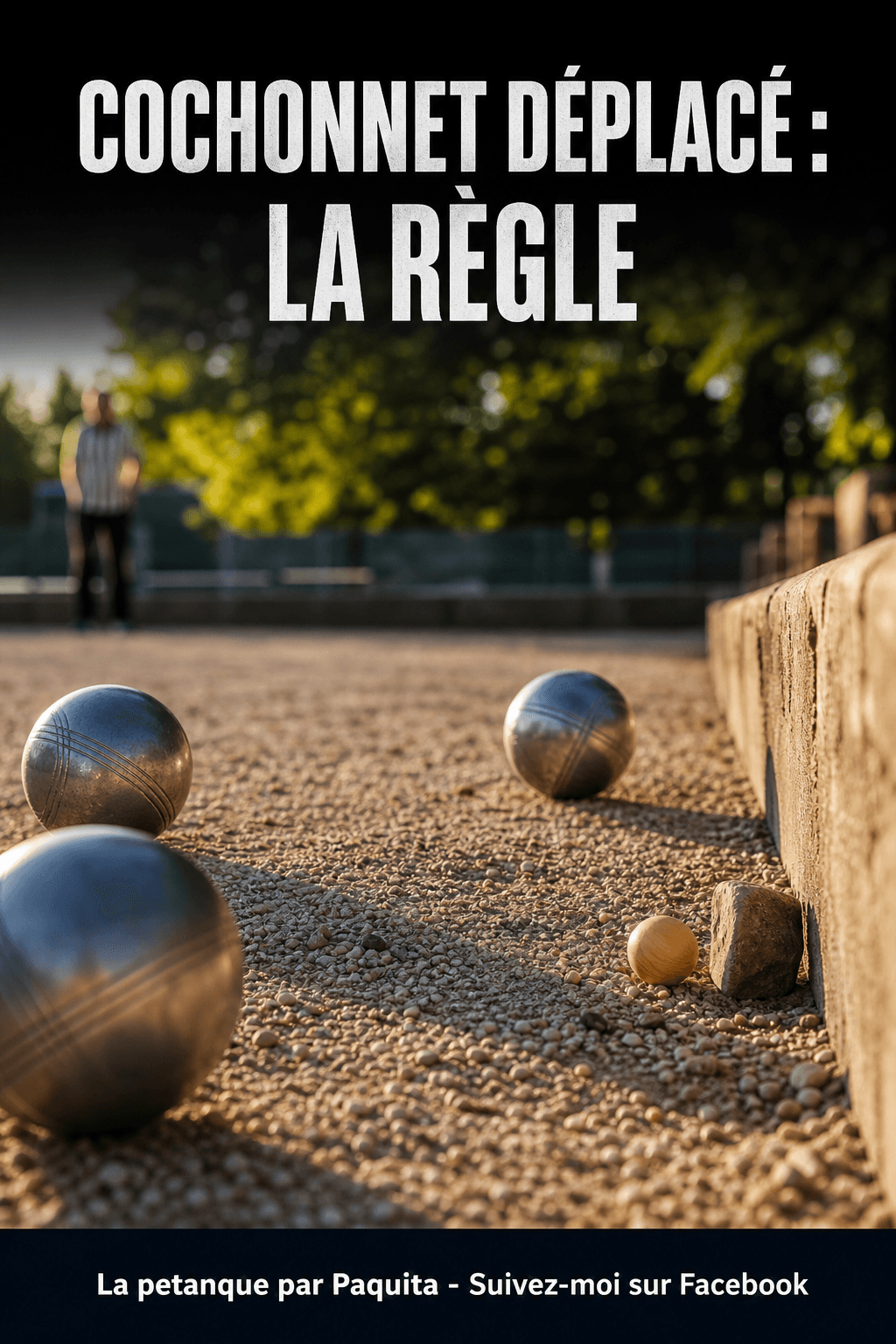
After the first shot or the first point, the jack can move. A boule in the game can push it towards a wall, a tree, an edge or a string. Article 11 of the international regulations specifies that a jack moved by the effect of a boule played in that game is valid. The metre rule must therefore not be applied mechanically to every new position.
2.The jack ends up near the wall: does the end continue?
Yes, if the jack has remained in the authorised playing area and is still visible from the circle under the conditions provided for by the regulations. A boule that has touched the jack can therefore produce a spectacular position, almost glued to an obstacle, without the referee immediately stopping the end.
The first check concerns the terrain boundary. A jack straddling the boundary of an authorised terrain remains good. It only becomes dead when it has entirely crossed this boundary, that is, when it is completely beyond the perpendicular of the dead line. The presence of a string is not always synonymous with a dead jack: it all depends on how the playing area has been defined by the organisers.
The second check is visibility. A jack masked by a boule is not considered dead for this reason alone. The referee can temporarily remove a boule in order to check visibility. On the other hand, if the jack is no longer visible from the circle while it is in authorised terrain, Article 9 can lead to it being dead.
The three-question test
3.The cases where the jack really becomes dead
The regulations provide for several scenarios. A jack moved into dead ground is dead, even if it then returns to authorised terrain. It can also be dead if it exceeds twenty metres from the circle for seniors, if it is no longer visible under the regulatory conditions, or if it is moved onto dead ground by the effect of a boule and then returns. A puddle of water on which the jack floats freely is also treated as dead ground.
In practice, the word "obstacle" is therefore not enough. A fixed obstacle located inside the terrain is not a dead line. A stump, a stone or an edge can complicate measuring and the trajectory without cancelling the jack. On the other hand, if the jack entirely crosses the boundary of a frame considered as dead ground, the situation changes.
You also have to distinguish a move from play and an accidental move. Wind, slope, spectator, referee, animal or moving object: if the marked jack moves for one of these reasons, it must be put back to its original position. Marking is essential; without a mark, no claim about the previous position will be accepted.
4.What to do at the next end if the jack is too close?
At the end of the end, the position of the jack becomes the reference point for the next circle, unless that circle would end up less than one metre from an obstacle or the throw could not respect the regulatory distances. In the first case, the team draws or places the circle at the regulatory limit of the obstacle. It cannot freely choose a point that suits it several metres away.
The jack is then re-thrown in the alignment of the previous play, with the prescribed distances. If no direction allows a regulatory throw, the player can move the circle back in that alignment, without exceeding the maximum distance. This possibility is regulated: it doesn't allow the circle to be moved sideways to take a better line.
The decision logic
The closer the situation is to the end of the end, the more you need to separate the decisions:
5.Fixed obstacle, string and boundary: don't mix everything up
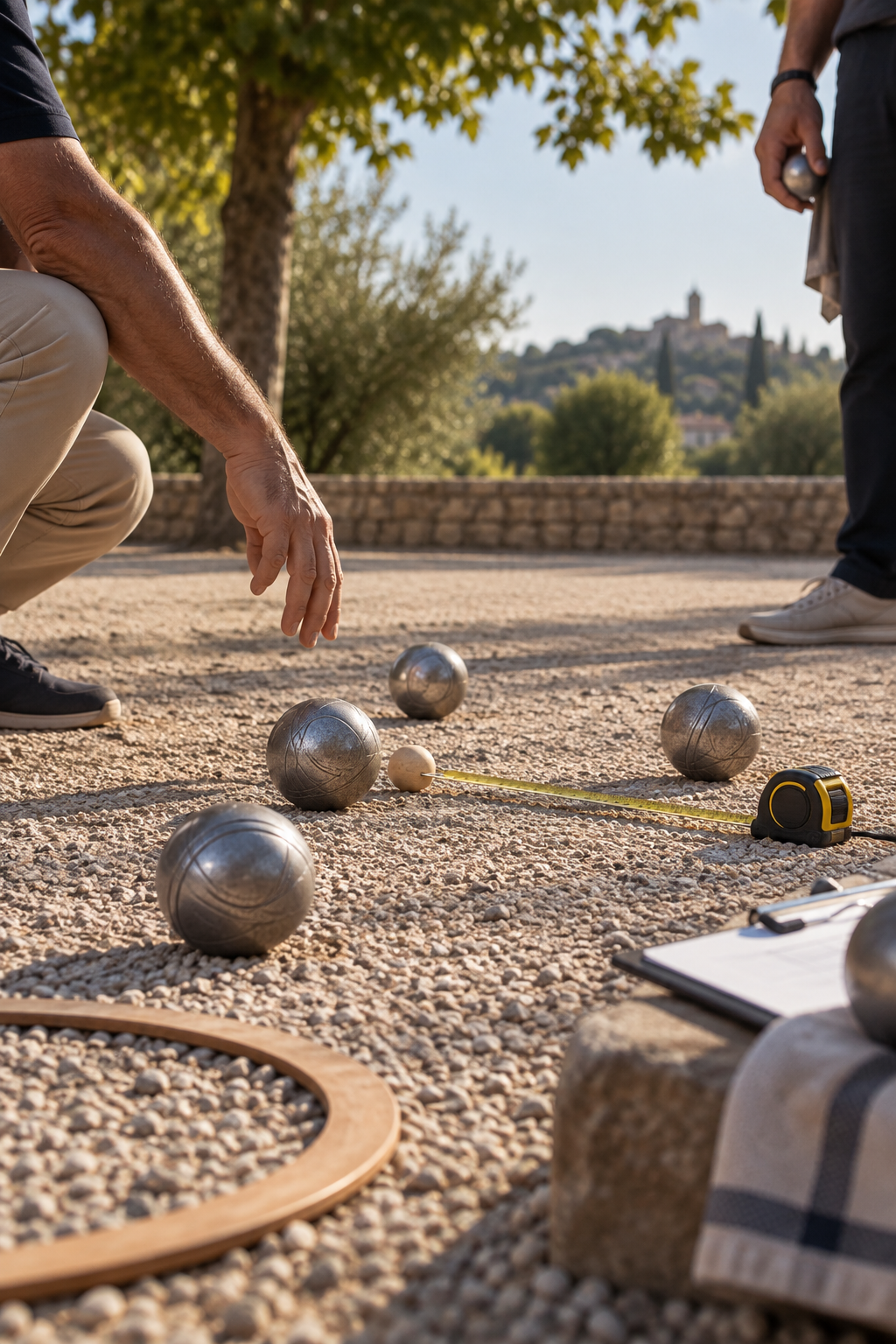
A fixed obstacle is part of the terrain's décor. Players are not allowed to move, crush or remove it to facilitate a trajectory. During a measure, the regulations authorise the temporary removal of removable obstacles located between the jack and the boules, provided they are put back afterwards. If the obstacle cannot be removed, you measure with a compass.
The string deserves special attention in competition. On an area composed of several terrains, some strings are not dead lines; the frame end lines and the outer frames can be. It is the specific regulations of the competition and the marking of the terrain that make it possible to decide. In case of doubt, ask the referee before moving anything.
| Situation | Decision of principle | Reflex |
|---|---|---|
| Boule pushes the jack near a wall | Jack valid if it remains playable and visible | Don't put it back at the old spot |
| Wind or spectator moves the marked jack | Return to the original position | Have it noted and put back |
| Jack entirely beyond a dead line | Jack dead | Apply the dead jack rule |
| Next circle less than one metre away | Circle at the regulatory limit | Resume from this new circle |
6.The right reflex in competition
When a boule moves the jack towards an obstacle, you leave the boules in place and observe. You don't touch the jack to "put it back at a distance". You spot the terrain boundary, check the visibility from the circle and call the referee if the status of the string or the obstacle is unclear. A decision taken too quickly can create a dispute that is impossible to repair once the end has continued.
The partners can mark the jack and the boules as soon as the situation is stabilised. This simple gesture protects the rest of the game: if the wind or a slope moves the jack again, the referee will have a point of comparison. The regulations favour the noted and marked position, not the players' memory.
In a tight game, don't turn an obstacle into a dispute. First ask: "was the jack moved by a boule from this end?" If yes, let it live as long as it is in authorised terrain and visible. The rule becomes much simpler when you separate the move from play from the initial bad throw.
The Ultimate Guide to Difficult Terrains helps to read the slopes, the obstacles and the zones that really change the tactics of an end.
FAQ — Frequently asked questions
Reference: official FIPJP regulations, articles 7, 9, 11, 12, 13 and 24. The FIPJP recalls that no modification of the playing regulations has been decided for 2026.