Règlement FFPJP · 24 June 2026
The foot rule in pétanque: what every player absolutely must know
The foot rule in pétanque according to the official FFPJP rules: positioning, stillness, leaving the circle, penalties. Everything about Article 6, explained step by step.1.Why is this rule so strict?
Pétanque stands out from other boules games (Lyonnaise boule, jeu provençal, la longue) precisely through its prohibition of movement before the throw. Where in jeu provençal you are allowed to take three steps before shooting, in pétanque you play with feet together, motionless, in a fixed circle. This is what gives the sport its particular technicality and its equality of chance: impossible to compensate for a bad motion with a run-up.
This foot rule is therefore not a matter of form: it is the very definition of pétanque. To break it is to play something else. The official rule reminds us of this from article 6, right after the basic definitions. All the federations affiliated to the CMSB (Confédération Mondiale du Sport Boules) apply the same rule, whether you play in Marseille, Bangkok or Madagascar.
📜The etymology reminds us of it: "pétanque" comes from the Provençal pèd tanca, literally "planted foot". Before 1907 (the date of the codification in La Ciotat by Jules Lenoir), people played "la longue" with a run-up. The motionless-foot rule was born precisely to allow an arthritic player to keep playing. Knowing the origin helps to understand why the rule is uncompromising.
2.What the FFPJP rule says exactly
Article 6 of the official FFPJP-CMSB rule states, in its updated 2026 version: "The feet must be entirely inside the circle and must not encroach on its edges. They must not leave it, nor be lifted completely, until the thrown boule has touched the ground."
Four cumulative obligations follow from this short but dense text:
1. Both feet must be entirely inside the circle (not on the line, not over it).
2. They must stay in contact with the ground from the start to the end of the throw.
3. They must not leave the circle before the end of the throw.
4. The "end of the throw" is defined as the moment the boule touches the ground, not the moment it leaves the hand.
3.Position in the circle: the 4 obligations
Let us detail each of the obligations, because it is in the detail that faults are born.
Obligation 1 — Feet entirely in the circle
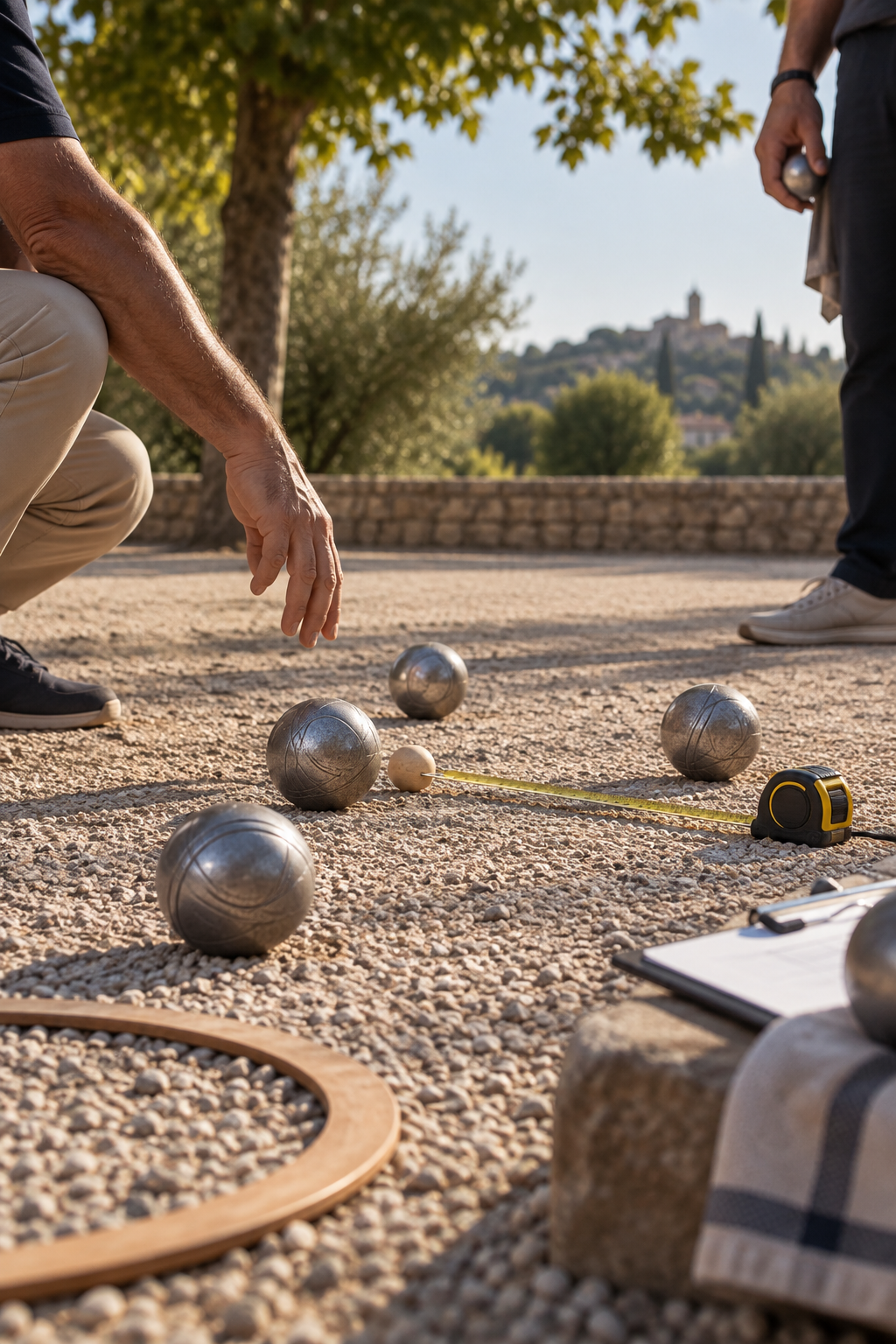
The official circle measures between 35 and 50 cm in internal diameter (article 7 FFPJP). Both your feet must fit in it entirely, without overhanging. A toe that overhangs, even by 1 cm, already constitutes a potential fault, particularly scrutinised in an official tournament.
Obligation 2 — Feet in contact with the ground
Throughout the motion, your feet stay glued to the ground. Any lifting, even half a centimetre, can be treated as a penalisable "lifted foot". Shooters who rise up on the tips of their toes take a regulatory risk (even if umpiring tolerance is generally broad as long as the foot stays "broadly" planted).
Obligation 3 — Not leaving the circle
During and just after the motion, you stay inside the circle. A step forward to "balance" your motion, a reflex movement to follow the boule with your eyes… as many faults as an umpire would spot immediately.
Obligation 4 — Until the boule touches the ground
It's the most misunderstood subtlety of the rule. Many think you can leave as soon as the boule has left the hand. Wrong: the official rule requires waiting until the boule has touched the ground, which takes a fraction of a second longer. This precision matters, because many players leave just a little too early.
4.Summary table of faults and sanctions
The FFPJP rule does not automatically invalidate the boule on the first error. Here is the official reading grid:
| Fault committed | Prescribed sanction | Boule |
|---|---|---|
| Foot slightly over the circle | Warning | Valid |
| Foot lifted during the throw (clear) | Fault | Void if moved |
| Foot leaving before the boule touches the ground | Fault | Boule cancelled |
| Repeat after 3 warnings | Disqualification | Of the player |
| Circle moved during the throw by the foot | Fault | To be replayed |
| Foot placed on the circle line | Tolerated | Often warned |
5.When can you finally leave the circle?
Authorised exit: as soon as the boule has touched the ground for the first time. Not before. And even afterwards, you must leave behind the circle (by walking backwards or sideways), never by stepping over the circle to go and pick up the boule. Leaving "forward" is frowned upon and can be penalised in certain strict tournaments.
A special case that is often forgotten: if you shoot and your boule completely misses the target (no contact with the intended target), you must still wait until it touches the ground before leaving. The rule makes no distinction between a played boule and a successful or failed boule.
Level of strictness applied by playing context Official national tournament · 10/10 Umpire present, minimal tolerance. Each overstepping foot is noted. Club friendly game · 4/10 Frequent flexibility, but serious faults remain penalised by tradition.6.Special cases and official exceptions
The FFPJP rule provides for a few exceptions to the foot rule, little-known but very real.
People with reduced mobility : a player in a wheelchair places the rear wheels in the circle. The rule adapts to the support. Player amputated or disabled in a limb : a single foot in the circle is enough, subject to medical approval recognised by the FFPJP handi-pétanque commission. Very tall players : no exemption provided. If you take a size 47, your feet must still fit entirely in a 35 cm circle — which requires using a larger circle (the authorised FFPJP rigid circles go up to 50 cm).
🦶 Paquita's tipTo check your compliance, do a simple test in training: ask a partner to film your last 10 boules in close-up on the feet. You'll be surprised to see how much you lift your heels without realising it. It is one of the quickest faults to correct… and one of the most rewarding in an official tournament.
7.Warnings and sanctions: how it works
The FFPJP rule applies a progressive scale in an official tournament: 1st warning = verbal remark by the umpire; 2nd warning = boule cancelled; 3rd warning = exclusion of the player for the rest of the game; 4th warning (repeat in competition) = disqualification of the team for the duration of the tournament.
In free or friendly play, these sanctions obviously do not apply formally, but the fair-play rule means that the basics should be respected. If your opponent politely points out a lifted foot, take it as a sign of respect for the game and correct yourself. To understand the logical continuation of this rule, also read our little-known rules and our complementary article on the the foot that extends beyond the circle.
📘 PAQUITA'S BOOK The Ultimate Shooting GuideShooting is first a stable posture. Mastering the position of the feet in the circle is the first step to becoming a reliable shooter. The complete guide to the motion, balance and millimetric precision of the modern pétanque shooter.
📗 Discover the bookFAQ — Your frequent questions
Do my feet have to be together?+ No, the official FFPJP regulations do not require the feet to be together. It only requires that they be entirely inside the circle and in contact with the ground during the throw. You can move them aside as you wish, as long as they stay in the circle. Can I raise my heel during the gesture?+ The rule speaks of foot “not raised in a complete manner”. A slight separation of the heel is generally tolerated, but a clear and visible separation may be sanctioned by the referee, especially in official competitions. The best is to keep your foot flat. What happens if I go out before the ball hits the ground?+ The referee can cancel your ball. In a friendly game, the opponent can ask to replay the ball. This rule is one of the most frequently violated by beginners, but it is explicit in article 6 of the official FFPJP-CMSB regulations. Do I have to have both feet in the circle?+ Yes, unless there is an official medical exemption (handi-petanque). The rules require that both feet be entirely inside the circle, in contact with the ground, from the start of the throw until the ball contacts the court. Is placing your foot on the circle line a fault?+ The regulations say “do not encroach on its edges”. In theory, yes it is a mistake. In practice, the referee tolerance is wide for circles drawn in sand. With rigid plastic circles, the rule is applied more strictly because the boundary is visible. 📎 Related articles RulesFoot that extends beyond the circle: fault or not? RulesThe foot infringements that umpires penalise RulesThe little-known rules of pétanque© Pétanque by Paquita — petanqueland.fr ·
📘 Discover my books on PetanqueLand
Article based on the official FFPJP-CMSB rule of pétanque (article 6). To be adapted according to local club practices, which may specify without contradicting the federal rules.