Règlement FFPJP · 27 June 2026
These edge cases with boules off the terrain that the rules settle clearly
These edge cases with boules off the terrain in pétanque that the FFPJP rules settle clearly: boule on the line, obstacle, boule that came back, shared boule.1.The basic principle: what is a bowl out of bounds?
Article 13 of the FFPJP rules defines the out-of-bounds bowl precisely: a bowl is considered out of bounds as soon as it crosses the boundary of the terrain — that is to say as soon as the entirety of the bowl passes beyond the boundary line. A bowl that touches the line or is partially on the line is in a borderline case that the rules deal with specifically.
There are three official criteria for assessing whether a bowl is in play: its position relative to the boundary line, whether it touched an outside obstacle before coming back, and whether it came to rest inside or outside the terrain. These three criteria can combine to create complex situations.
📏The boundary line is part of the terrain or the outside according to the rules. In official tournaments, the line is generally marked by a taut string. It is contact with the string (or the ground on the other side) that determines whether the bowl is out of play — not visual assessment with the naked eye.
2.The bowl on the line: does it count or not?
It is the most frequent borderline case. A bowl comes to rest exactly on the boundary line : part of the bowl is in the terrain, the other part overhangs. What do the FFPJP rules say? The official rule is that the line is part of the terrain's boundaries, and a bowl that touches the line is considered out of bounds.
In other words: for a bowl to be « in play », it must be entirely inside the boundary. If part of the bowl overlaps the line or is beyond it, it is out of bounds and does not count. This is counter-intuitive for many players who think that « on the line = in play ». That is not what the official rules say.
Practical case: bowl leaning on the line
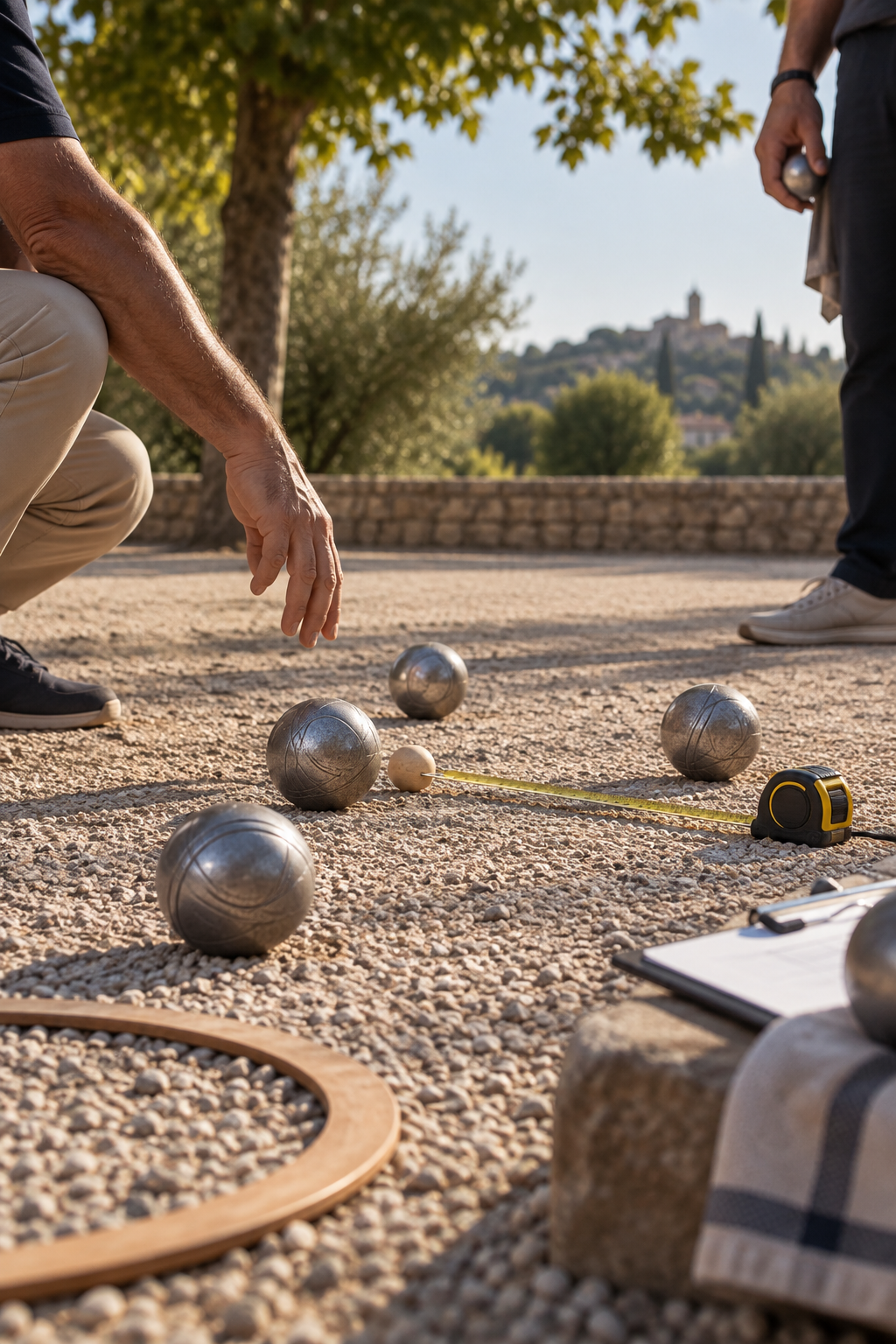
A bowl may look « on the line » but actually still be entirely on the inside side — a slight ridge or hollow in the ground can create this illusion. In case of doubt, the referee uses the string or a straightedge to check whether the bowl really touches the boundary. The rule is unambiguous: any bowl in contact with the boundary line is out of play.
🔍 Paquita's adviceIn tournaments, never touch a « borderline » bowl before calling the referee. Moving it, even unintentionally to check whether it touches the line, can be interpreted as a fault by your team. Observe first, call the referee afterwards.
3.Bowl gone out then come back: is it in play?
Here is a case that creates a lot of discussion: a bowl leaves the terrain by crossing the boundary, bounces off a wall, a fence or an edge, and comes back to rest inside the terrain. Is it in play?
The FFPJP rules' answer is no, categorically. Article 13: a bowl that has crossed the boundaries of the terrain is immediately considered dead, even if it then comes back into play. The determining criterion is the crossing of the boundary, not the final position of the bowl. As soon as the bowl has crossed the line, it is dead.
Practical consequence: if a bowl goes out, bounces and comes back, it must be removed from the terrain. Any bowl displaced by this « come-back » bowl keeps its new position (the dead bowl does not invalidate the effects it produced in coming back, because these effects occurred after its regulatory death).
4.Bowl blocked by an obstacle on the edge
On unmarked or open-air terrains, it happens that a bowl is blocked by an obstacle on the edge: a stone, a kerb, a bag left there. If the bowl is half inside the terrain and blocked by the outside obstacle, what do the rules say?
Does the obstacle belong to the terrain or not?
The rules distinguish two cases. If the obstacle is inside the terrain (a large stone on the playing ground, for example), the bowl that touches it is in play and counts. If the obstacle is outside the terrain (wall, edge, fence), and the bowl is blocked by this obstacle without having crossed the boundary, it remains in play if it is entirely on the inside side of the boundary.
The problem arises when the bowl is blocked on the boundary or against an outside obstacle while overlapping the boundary. In this case, it is the position of the bowl relative to the line that takes precedence: if it touches the line, it is out of play.
5.Summary table of borderline cases
| Situation | Bowl status | FFPJP rule |
|---|---|---|
| Entirely in the terrain | In play | Counts normally |
| Touching the boundary line | Out of bounds | Art. 13 — removed from play |
| Part beyond the line | Out of bounds | Removed immediately |
| Gone out then come back by bouncing | Out of bounds | Dead from the moment of crossing |
| Blocked by outside obstacle, inside | In play | Position counts if inside |
| Blocked by obstacle, overlapping the line | Out of bounds | Contact with line = out of play |
6.Special case: the jack leaves the terrain
The rules on a jack out of bounds differ from those on bowls. When the jack leaves the terrain, the end does not necessarily stop: the FFPJP rules (article 12) make specific provisions depending on whether it is a tournament or a leisure game, and depending on whether a team still has bowls to play or not.
The general rule: if the jack leaves the terrain during an end and both teams still have bowls, the end is dead and it is replayed. If only one team still has bowls, it scores as many points as it has remaining bowls. These rules apply regardless of the number of bowls played before the jack went out.
Frequency of these borderline cases in official tournaments Bowl on the line · Frequency: 8/10 Most frequent case — important to know the exact rule. Bowl come back by bouncing · Frequency: 3/10 Rarer but very contentious — the rule is categorical: dead from the moment of crossing.7.The referee's role in these borderline cases
In official tournaments, as soon as a borderline case arises, do not try to rule on it yourselves. The first rule is to touch no bowl and to call the referee immediately. The referee will examine the position of the bowl, the position of the line (string or marking), and will give a final decision.
What the referee checks: whether the bowl touches the string (bowl out of bounds), whether it has clearly crossed the line before coming back (dead bowl), whether the obstacle blocking it is inside or outside the terrain. His decision is based on these objective criteria, not on the teams' interpretation. See our little-known rules and free tools to go further.
📘 PAQUITA'S BOOK The Complete Series — The Bible of Pétanque Training5 volumes covering all aspects of the game, from rules to technique to strategy. A complete reference for any player who wants to progress and master the official rules.
📗 Discover the seriesFAQ — Your frequent questions
Is a ball on the line in play or out of play?+ Off the field. The FFPJP regulations are clear: a ball that touches the boundary line is considered out of bounds and must be removed. To be in play, the ball must be entirely inside the boundary. Is a ball that comes out and bounces back in play?+ No. As soon as a ball crosses the boundary of the field, it is dead, even if it then returns inside by rebound. The final position has no importance: it is the crossing of the limit that counts. What happens if a dead ball comes back and moves other balls?+ The balls moved by the dead ball during its return retain their new position. The dead ball itself is removed, but the effects it produced when returning to the field remain valid according to the official FFPJP rules. Can we touch a “limit” ball to check if it is in play?+ No. Any ball touched before the referee's decision is considered to have been moved voluntarily, which may be punished. If in doubt about a boundary ball, call the umpire without touching the balls. Is the jack on the line also off the field?+ Yes, the same principle applies to the jack: if it touches the boundary line, it is considered to have gone out of bounds. The consequences vary depending on whether there are balls left to play for each team (drawn lead or points counted for the team which has balls). 📎 Related articles RulesThe little-known rules of pétanque ToolsFree PetanqueLand tools HomePétanque by Paquita© Pétanque by Paquita — petanqueland.fr ·
📘 Discover my books on PetanqueLand
Article based on the official FFPJP rules of pétanque. To be adapted according to local club customs.