Actualités · 10 March 2026
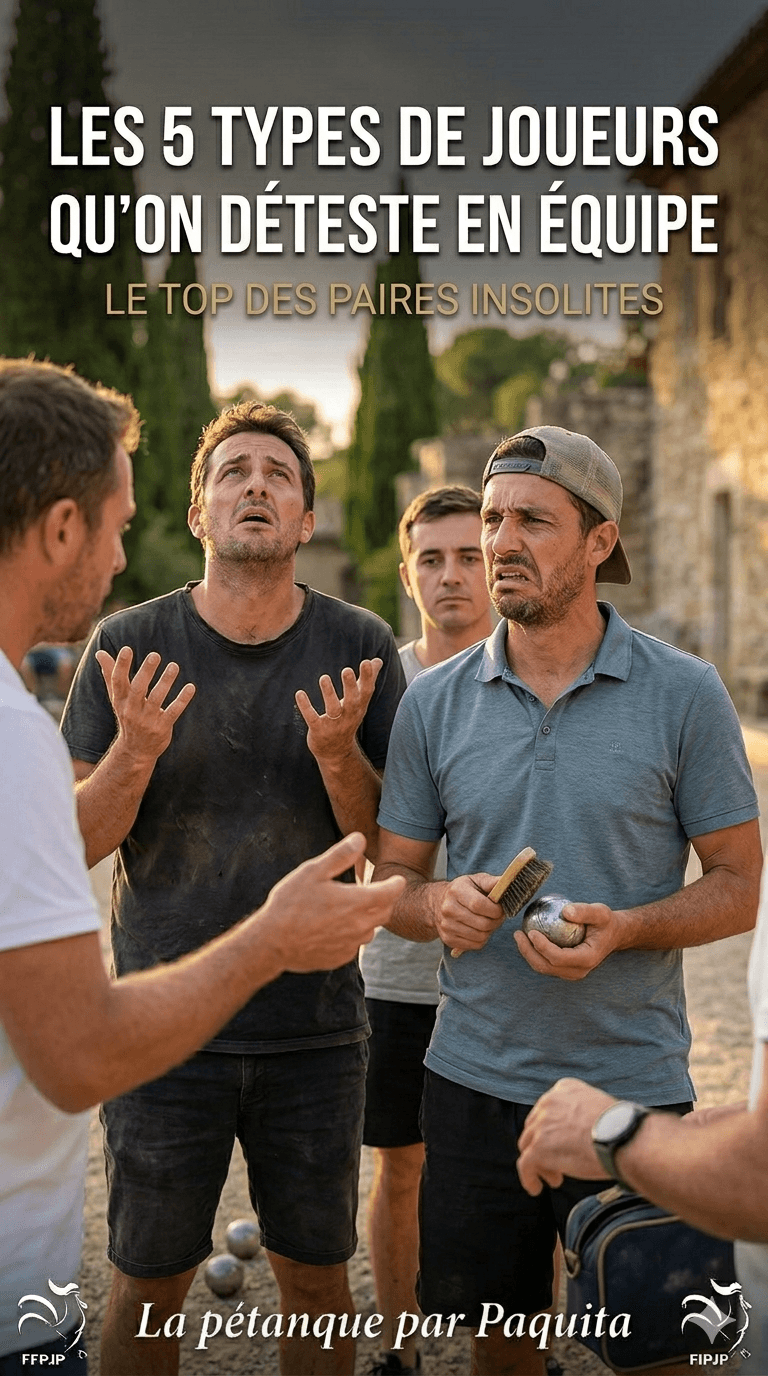
The 5 types of players you hate having on your team in pétanque.
The unsolicited adviser, the chronic slowcoach, the sore loser... Paquita draws up the ruthless portrait of the 5 profiles that poison a pétanque team. You'll recognise yourself.No.1 — The Unsolicited Adviser
🗣️ The Unsolicited Adviser aka “You should've shot”, “I'd have pointed”, “That's what I told you” ∞Tips/end 0Requests received 100%Sure of himselfHe knows exactly what you should have done. Always. After you've done it. Before you play, he is still thinking. As soon as your boule stops — wherever it ends up — he has an opinion. And he is going to give it to you. Without you asking him. Without anyone asking him.
The Unsolicited Adviser (UA to those in the know) isn't mean. That's even the problem: he's sincerely convinced he's helping you. He lives in a parallel world where his tips are expected, appreciated, and would have changed the outcome of the end if they'd been followed.
⚡ Danger to the team9 / 10 💬 SIGNATURE PHRASES “You should've shot straight away there. I've been telling you since the start of the game.” “Wait, don't move. Step back one step. No, the other foot. There. No, start again.” “That's exactly what I told you. Exactly.” “Me, if I'd been in your place, I'd have put the boule there. Right there. See?” ⚠ Recognisable symptoms- Starts his sentences with “You should've...”
- Gives a tip then a counter-tip if you followed it
- Gets up to show you where to place your feet
- Always played “this shot” in 1993 and it worked
- Brings up his tips after the end, even if you won
- Whispers while you're concentrating
- Step into the circle without looking at him
- Nod along without listening
- Ask him to point in your place — he'll stop the tips
- Put him in charge of watching the opponents “at the back”
- As a last resort: ask his opinion on any other subject
No.2 — The Chronic Slow Player
🐌 The Chronic Slow Player aka “One second”, “Coming”, “Wait let me reposition” 4 minAverage time per boule 12Foot repositionings 3Dry runsHe steps into the circle. He looks. He goes back to see more closely. He comes back. He repositions. He looks again. He performs three dry throwing motions in the air. He repositions a second time. He hesitates. He looks at his partner. He sighs. And then — then — he throws.
The Chronic Slow Player doesn't procrastinate out of bad faith. He suffers from a deep-seated pathology: the inability to throw without having considered every known possibility in the universe. Every boule is a life decision. Every end, a chess game.
In a competition, he's your silent worst enemy. The one-minute rule stopwatch? He knows it. He approaches it. He never quite exceeds it — but he's always on it. Just under. At 57 seconds.
⚡ Danger to the team7 / 10 💬 SIGNATURE PHRASES “Wait, let me just reposition for a second.” “Yeah no, I... I'll shoot. No, point. No, shoot.” “Can you stay quiet for two seconds? I feel the pressure.” “I'm going. I'm going. ... I'm going.” ⚠ Recognisable symptoms- Preparation time inversely proportional to the result
- At least three dry throws before the real one
- Asks for silence then still doesn't throw
- Goes back to look at the ground after stepping into the circle
- Changes his mind between shooting and pointing at least once per end
- Looks at his feet for 40 seconds
- Decide for him in advance what he'll do (shoot or point)
- Send him into the circle while we're playing so he “gets ready”
- Set up a code: one finger = point, two fingers = shoot
- In a competition, remind him of the stopwatch kindly but firmly
- Gift him a pocket tape measure so he keeps busy between his turns
No.3 — The Sore Loser
😤 The Sore Loser aka “It's always the same”, “This ground is useless”, “I wasn't backed up” 0Defeats accepted ∞Excuses available 3 hAverage sulk timeLosing happens. Even to the best. Even to Paquita (rarely, but it happens). The Sore Loser, never really loses — because there's always a valid reason that explains the result. The ground. The umpire. The sun in his eyes. The badly thrown jack. The lucky opponents. His partners who didn't back him up.
In reality, the Sore Loser has a fundamental problem with reality: he can't accept that he did everything well and still lost. His ego is wired to seek an external explanation for every defeat. It's exhausting for everyone — except him, who's adapted to it very well.
⚡ Danger to the team8 / 10 💬 SIGNATURE PHRASES “The ground was sloped. Did you see it or not?” “If you'd listened to me on the third end, we wouldn't be here.” “Those guys, frankly, they got lucky. End of story.” “I'm not playing with them again, that's decided.” (He plays again the following Sunday.) ⚠ Recognisable symptoms- Shakes the opponent's hand without looking at him
- Walks to the cars before the score is finished being counted
- Disputes the measurement even when he can see it's lost
- Analyses the defeat for the whole drive back
- Goes back to ends from 45 minutes ago
- Posts a message in the club's WhatsApp group that same evening
- Don't start a discussion in the 30 minutes post-defeat
- Validate his emotions without validating his theories
- Redirect towards “next time”
- Get him talking about the end he played well
- If possible: offer him a drink. It always helps.
No.4 — The Falsely Modest
🎭 The Falsely Modest aka “Oh that was a bit of luck”, “I'm not at the level”, “No no I'm not playing well” 100%False-modesty rate 3 sWait for contradiction 2Real ego / Displayed egoHe's just placed a perfect boule 30 centimetres from the jack on an uneven ground, with a slight headwind and two opposing boules to avoid. And he says: “Oh, that was a bit of luck, hey.”
Don't be fooled. The Falsely Modest knows exactly what he did. He's just waiting for you to contradict him. He needs to hear “No no, that was AMAZING!” to feel complete. If you say nothing, he'll repeat: “No really, that was luck.” He'll repeat until he gets the validation he's looking for.
His most exhausting variant: preemptive modesty. Before playing, he says “I'm going to miss, I'm in great form today.” Then he places the boule perfectly. Then he says “that was luck”. You're exhausted and we're only on the second end.
⚡ Danger to the team5 / 10 💬 SIGNATURE PHRASES “Oh it wasn't great... (pause) ... you think?” “No no, I'm not playing well at the moment. Really. (waits)” “I don't know how I did that honestly. (inner smile)” “You're too kind. Really. (asks for a 3rd compliment)” ⚠ Recognisable symptoms- Always self-deprecates right after a good shot
- Repeats his modesty until he gets a contradiction
- Vexed if no one contradicts his false modesty
- Very touchy when you take him at his word (“ok, you're not playing well”)
- Remembers all his good shots “by luck”
- His “bad” results are always his fully assumed fault
- Sincerely validate his good shots without overdoing it
- Take his modesty at face value (“ah yeah, you were below par there”)
- Send him to play without commenting — he concentrates better
- Tell him “we're counting on you” before every difficult shot
- He often plays very well: exploit that rather than managing the ego
No.5 — The Post-End Analyst
📊 The Post-End Analyst aka “Actually if we look closely”, “The real mistake was”, “Tactically speaking” 7 minAnalysis per lost end 0 minAnalysis per won end 4Pivot points identifiedThe end has just finished. You've put your boules away. You're thinking about the next one. The Analyst hasn't finished yet. He takes a deep breath and begins: “Actually, the real problem with this end, if we look closely...”
The Analyst isn't mean. He loves pétanque passionately. He reads articles on tactics. He has an opinion on the optimal placement of every boule in every configuration. Unfortunately, he expresses all that between every end, while you're trying to catch your breath for ten seconds and have a sip of water.
His great peculiarity: he never analyses the ends you've won. Only the lost ones. And every analysis lasts exactly long enough to make you doubt everything you think you do naturally well after 15 years.
⚡ Danger to the team6 / 10 💬 SIGNATURE PHRASES “Actually, if we simplify the end, the pivot point was the 4th shot.” “The real strategic mistake was that we played too defensively from the start.” “On a purely tactical level, you should've left the boule in place and pointed behind.” “I'm going to explain something to you. Listen carefully. It's important for what comes next.” ⚠ Recognisable symptoms- Speaks between every end without exception
- Uses words like “pivot”, “tactical pressure”, “reading the ground”
- His analyses last longer than the ends themselves
- Doesn't necessarily play well — but has a theory on everything
- Brings back ends from the start of the game at the end of the game
- Ends his sentences with “you see what I mean?” without waiting for an answer
- Say “yeah you're right” then change the subject immediately
- Invite him to play middle so he's busy “observing”
- Ask him to explain his theory to the opponents
- Have a parallel conversation with the partner next to you
- Acknowledge his intelligence — he calms down faster than you'd think
Paquita's definitive ranking
After careful reflection, field expertise and several seasons of clinical observation, here is the official ranking by danger to team cohesion :
1 🗣️ The Unsolicited AdviserOmnipresent, tireless, genuinely convinced he is helping 9/10 2 😤 The Sore Loser
Poisons the post-tournament mood, sometimes for several days 8/10 3 🐌 The Perpetually Slow Player
Costly in tournaments, exhausting in friendly games 7/10 4 📊 The Post-End Analyst
Mentally draining, but often well-intentioned 6/10 5 🎭 The Falsely Modest Player
The easiest to handle — and often the best player in the group 5/10 🌟 Paquita's Truth
The real question isn't “how to put up with these profiles?”. It's: which one are you? Because while you were reading this article with a smile, there's a good chance you thought of someone specific for each profile. But maybe someone, somewhere, was thinking of you.
FAQ — What if I'm the problem?
I recognize myself in several profiles at once. Is it serious? + This is actually the case for the majority of players. The profiles presented here are pure archetypes — in real life, we are often a mixture. You can be False Modest when you play well and Bad Loser when you play badly. The important thing is to be aware of it. And knowing how to have a drink with your teammates afterwards, whatever happens. How do I tell someone in my team that they are one of these profiles? + With humor, never directly. Best: share this article in the team WhatsApp group. Let people recognize themselves. Those who recognize themselves by laughing are redeemable. Those who don't recognize themselves at all are probably the most pronounced profile of the group. Don't insist. Can the Unsolicited Advisor change? + In theory yes. In practice, very rarely without being spoken to directly - and even then. The CNS is convinced to help. He is not dominating or criticizing in his head: he sees a problem, he proposes a solution, he moves on. The best approach is to tell him calmly, off the field, that it's distracting you. Some CNS really correct the situation. Can we have a good team despite these profiles? + Absolutely. The best teams aren't the ones without flaws — they're the ones that have learned to accept themselves with their flaws. The Chronic Slow can be a formidable scorer under pressure. The Sore Loser can be the fiercest competitor on the team. The important thing is that they play well together on the pitch. The rest is fodder for giggles in the bistro afterwards. Is there a profile missing from your list, Paquita? + Obviously! We could have added: the Overconfidence Player (who attempts a shot from 12 meters at 12-12), the Great Sunday Strategist (who changes tactics every 3 ends), or the Permanent Points Counter (who retotals the score after each ball). Pétanque is a sport rich in character. That's why we love him. Do you recognize one in your club? 😄Share this article with your team and let the comments run wild. We've all got a UA, a Slow Player or an Analyst somewhere. And we love them anyway — a bit.
#LaPetanqueParPaquita #PetanqueLand #PetanqueHumour #ClubLife #Petanque 📎 In the same spirit Rules The one-minute rule — for the team's Chronic Slow Player Umpiring Umpiring videos — to shut the Sore Loser up Equipment Choosing your boules in 2026 — even the Falsely Modest deserves the best Full rules Official FFPJP rules — to print and stick under the Adviser's nose 2026 rules Sweeping = card — a rule the Analyst loves to comment on Calendar Competition calendar — to reunite your crack team© Pétanque by Paquita — petanqueland.fr
Humorous article — no pétanque player was harmed in the writing of this article. Although.