Actualités · 12 March 2026
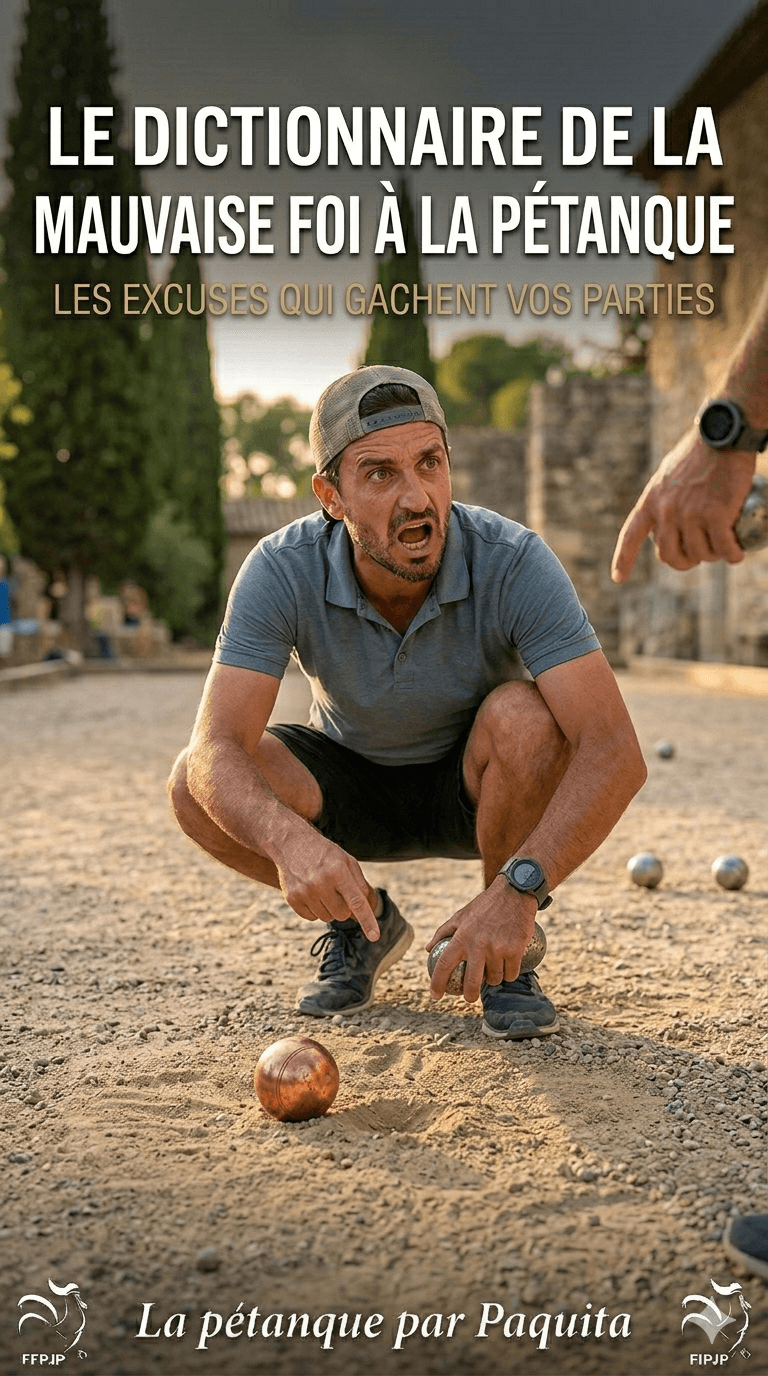
The dictionary of bad faith in pétanque
From "this ground is unplayable" to "it slipped out of my hand": the funny, clear-eyed dictionary of bad-faith excuses heard on pétanque courts.The official bad-faith scale
Not all bad faith is equal. Paquita established a rigorous four-level classification, from the harmless classic to the legendary bad faith that deserves a commemorative plaque on the pétanque court.
📊 OFFICIAL PAQUITA CLASSIFICATION — BAD-FAITH INDEX Level 1 — Classic Everyone does it, no one takes offence Light excuses, usable without shame Level 2 — Bold It starts to show, but we pretend not to notice Requires a certain nerve Level 3 — Hardcore The opponent holds back a smile, your team stares at the ground Admirable in its absurdity Legendary 🏆 Told at the bistro for 10 years Enters the oral heritage of the pétanque court 📖How to use this dictionary: each entry indicates the grammatical category, the bad-faith level, a usage example in a real situation, and the translation of what the user really means.
A 6 entries ARBITRE [aʁ.bitʁ] n.m. An omniscient figure in theory, blind in practice — but only when his unfavourable decisions go against the player invoking him. The umpire is curiously competent when he rules in your favour, and immediately suspect when he rules against you. "The umpire didn't see. Normal, he was six metres away." TRANSLATIONMy bowl wasn't the closest but I refuse to let an impartial human being confirm it. ⚠ Level 2 — Bold ATTITUDE [a.ti.tyd] n.f. The opponent's behaviour, always inappropriate, always distracting, always chronologically placed exactly before a miss. A remarkably selective phenomenon: the opponent's attitude bothers the player precisely during their swing, never during their walking time. "I was about to point and he moved his arm. Naturally." TRANSLATIONI missed my point. The opponent existed in my field of vision. ✓ Level 1 — Classic AVANT [a.vɑ̃] adv. selective temporal A mythical period during which everything worked perfectly. "Before", the player shot better, pointed better, the team got along better, the terrain was better and the opponents less lucky. "Before" is always more beautiful than now, and always vague when you ask for details. "Before, with my old triplette, I used to make that shot with my eyes closed." TRANSLATIONI never really made that shot, but the past is impossible to verify. 🔥 Level 3 — Hardcore ADVERSAIRE [ad.vɛʁ.sɛʁ] n.m/f. A paradoxical entity that is lucky when they win and plays badly when they lose. The opponent never really wins — either they got lucky, or the terrain helped them, or the opposing team wasn't up to standard anyway. "They won, yeah. But did you see how they played?" TRANSLATIONThey won. I have no other argument. ✓ Level 1 — Classic ASPHALTE [as.falt] n.m. hostile terrain A playing surface acceptable only when you're winning. In case of defeat, the asphalt becomes responsible for all the unexpected bounces, the rising heat, the bowls that "slide differently". The asphalt has the good taste of not being able to defend itself. "On a terrain like that, it's impossible to point normally." TRANSLATIONThe opponent was playing on the same terrain but pointed better than me. ⚠ Level 2 — Bold ALIGNEMENT PLANÉTAIRE [a.liɲ.mɑ̃ pla.nɛ.tɛʁ] loc. cosmological The ultimate explanation for inexplicable defeats. When all other arguments have failed, the planetary alignment covers everything that's left. Observed variants: "there was something in the air", "it wasn't our day", "the stars were against us". "I don't know, really I don't know. It just wasn't our day." TRANSLATIONI have no explanation but I refuse for it to be my fault. 🏆 Legendary B 5 entries BOULE [bul] n.f. (when it misses) A capricious object that "didn't want to go in", that "slipped", that "took a weird bounce" — never simply badly thrown. The bowl is endowed with an unfavourable will of its own, activated only during misses. During successes, it's the player. "The bowl it deviated. Did you see that? It deviated." TRANSLATIONI shot badly. But the bowl is there, it can't defend itself. ⚠ Level 2 — Bold BRUIT [bʁɥi] n.m. universal disruptor Any sound — a conversation ten metres away, a bird, a distant car, the rustle of a crisp packet — that materialises systematically at the moment of the swing. The noise bothers the player who misses but remains totally imperceptible during successes. "I could hear the guy talking behind. How are you supposed to concentrate?" TRANSLATIONThere was someone somewhere. I missed. ✓ Level 1 — Classic BRAS [bʁɑ] n.m. independent entity An upper limb that, during defeats, decides its trajectories on its own without consulting the player it belongs to. "My arm didn't follow" is the admission that the player and his arm are two distinct entities in disagreement. Curiously, during successes, the arm and the player are one. "My arm didn't follow. I don't know what came over it." TRANSLATIONI missed. My arm is a convenient excuse because it's inseparable from me. 🔥 Level 3 — Hardcore BOULES (mine) [bul] n.f.pl. privileged scapegoat Personal equipment that bears a responsibility inversely proportional to success. The more severe the defeat, the more the bowls are incriminated. The losing player often thinks about "changing their bowls" — rarely about changing their action. "I think my bowls are tired. They haven't got the same bite anymore." TRANSLATIONI'm thinking about changing my bowls. I'm not thinking about changing my technique. ⚠ Level 2 — Bold BISTROT [bis.tʁo] n.m. supreme tribunal A review body for umpiring decisions where every game is rejudged in the narrator's favour. The bistro's judgments are final but non-binding. Selective memory is its case law. "At the bistro afterwards we talked about it, and everyone said it was rubbish." TRANSLATIONMy friends, in my presence, after three pastis, validated my version of events. ✓ Level 1 — Classic C 6 entries CHANCE [ʃɑ̃s] n.f. the opponent's victory A factor exclusively responsible for the opponent's successes. Never invoked to explain your own successes — those result from talent, work and technical mastery. Luck is variable geometry: it always favours the other and never yourself. "They had shitty luck tonight. The bowl deviating like that..." TRANSLATIONThey played well. I prefer to put it down to chance. ✓ Level 1 — Classic COCHONNET [kɔ.ʃɔ.nɛ] n.m. treacherous target A little object that "moves on its own", "keeps rolling", "wasn't in the right place" — principally in the 0.3 seconds following a missed shot. The jack tends to move observably only for the player who just missed, and only in the direction that would explain their miss. "The jack it moved just before I shot. Didn't you see?" TRANSLATIONNo. No one saw. Because it didn't happen. 🔥 Level 3 — Hardcore CONCENTRATION [kɔ̃.sɑ̃.tʁa.sjɔ̃] n.f. ad hoc depletable resource A cognitive faculty that empties precisely at every important miss. Concentration is always "at maximum" before the throw and "completely gone" to explain the miss. Its lifespan is inversely proportional to the importance of the shot to play. "I wasn't concentrated at all at that moment. That's why." TRANSLATIONThat's why what. ⚠ Level 2 — Bold CAILLOU [ka.ju] n.m. universal culprit A microscopic stone, invisible to the naked eye and non-reproducible, that deflects bowls in statistically impossible directions. The stone is the missed shooter's best friend. It exists for only 0.1 seconds, then disappears. No one ever finds it again. "There was a stone. There, right there. I swear." TRANSLATIONI missed my shot. I point at the ground with my finger to create a piece of evidence. 🏆 Legendary CERCLE [sɛʁkl] n.m. variable-geometry object A regulatory device whose exact position suddenly becomes contestable after an important miss. The circle "was moving", was "badly placed", or the player "had a foot outside without knowing" — never at the moment of the throw, always afterwards. "The circle it wasn't straight. It put me off my run-up." TRANSLATIONI messed up my run-up. The circle is fixed and innocent. ⚠ Level 2 — Bold COÉQUIPIER [ko.e.ki.pje] n.m. aka "him" A partner whose mistakes are fully visible and commentable, and whose successes are the fruit of collective work. In doublette, the teammate is responsible for shared defeats to the tune of 80 to 95% depending on the intensity of the final score. "If him had pointed at the start of the end, I wouldn't have had to do everything." TRANSLATIONWe lost. It's him. ✓ Level 1 — Classic E · F 5 entries ÉLAN [e.lɑ̃] n.m. chronically disrupted The approach phase during which any external element can compromise everything: a look, a movement, someone else's breath. The missed swing is always the fault of a disruption, never of a lack of consistency in the action. "He coughed during my swing. What do you want me to do?" TRANSLATIONThe opponent has a cough. It's reasonable to hold it against them. ⚠ Level 2 — Bold ENTRAÎNEMENT [ɑ̃.tʁɛ.nə.mɑ̃] n.m. justified absence An activity the player hasn't had time to devote themselves to lately, which explains the current level. Training is invoked after the defeat as a promise of future improvement that will never be verified before the next defeat. "It's normal, I haven't played for three weeks. It shows." TRANSLATIONI've been playing at this level for ten years. The three weeks have nothing to do with it. ✓ Level 1 — Classic FORME [fɔʁm] n.f. absent since forever An optimal physical and mental state the player never reaches on tournament day, but which they describe with remarkable precision. "True form" is a mythological entity glimpsed under never-reproducible conditions, during games of which no witness exists. "There I wasn't in form. When I'm in form, it's nothing like that." TRANSLATIONI play at this level. I prefer to call it "not in form". 🔥 Level 3 — Hardcore FOND DU TERRAIN [fɔ̃ dy tɛ.ʁɛ̃] loc. cursed zone The part of the terrain assigned by the draw, systematically the worst, the hardest, the most exposed to sun, wind or glare. The opponent always plays in the "right direction". The back of the terrain is an indisputable explanatory variable because it's subjective. "We had the back of the terrain. Did you see the sun in your eyes?" TRANSLATIONThe other team had exactly the same conditions, shifted by ten minutes. 🏆 Legendary FATIGUE [fa.tiɡ] n.f. there since this morning A state of physical weariness perfectly compatible with won games but decisive for lost ones. Fatigue always arrives "since this morning" or "since last week" and mysteriously lifts if the next game goes well. "I'm shattered since this morning. I shouldn't have come, frankly." TRANSLATIONI was there at 8am, fresh and motivated. I started getting tired at the first missed end. ⚠ Level 2 — Bold L · M · N 6 entries LUMIÈRE [ly.mjɛʁ] n.f. accomplice of defeat An immutable optical phenomenon that suddenly becomes problematic during misses. The light "hits you in the eyes", "creates glare on the bowls", "changes the perception of distances". Remarkable property: the light bothers only the player who misses, never the one who succeeds in the same conditions. "The light over there is horrible. You can't see a thing." TRANSLATIONThe opponent sees very well. They just played three shots in a row. 🔥 Level 3 — Hardcore MÈTRE [mɛtʁ] n.m. two-reading instrument A measuring tool whose results are final when they confirm the player's victory and "to be verified" when they contradict it. A tape that rules against you is a badly used, badly held tape, or subject to a "parallax error" that only the player in question can detect. "Measure again. You didn't hold the tape properly." TRANSLATIONYou held the tape properly. Your bowl is behind. ✓ Level 1 — Classic MORAL [mɔ.ʁal] n.m. absent without notice A psychological factor that vanishes without warning at the first difficulties and only returns after the game. Morale is a retroactive explanation: it's never invoked to predict a miss, only to explain it. "We'd lost morale after the 8-0. It's human." TRANSLATIONWe were in the process of losing 8-0. That helps little, admittedly. ⚠ Level 2 — Bold MON NIVEAU [mɔ̃ ni.vo] loc. always higher than the result A theoretical playing standard, systematically higher than the level displayed during the tournament. "My level" is an abstract and unverifiable entity, defined retrospectively and capable of reaching any height according to the needs of the post-defeat narrative. "That's really not my level, what I showed today." TRANSLATIONThat's exactly my level. I rename it "not my level" when it disappoints me. 🏆 Legendary NERVOSITÉ [nɛʁ.vɔ.zi.te] n.f. selective An emotional state that affects only important games, and only during misses in those important games. Nervousness is invoked at the end of the game to explain errors from the start of the game — retrospectively, therefore unverifiably. "I was too nervous. Right from the start I felt it." TRANSLATIONI'd felt it since the moment we lost. ⚠ Level 2 — Bold NUL [nyl] adj. always the opponent An adjective applied to the victorious opponent to play down the defeat. The logic of "useless" is circular: if they're useless and we lost, we're even more useless — but that conclusion is never drawn. "Seriously, they play like mugs. And we lost to them." TRANSLATIONThey played better than us today. There. ✓ Level 1 — Classic P · R · S · T 8 entries PARTENAIRE [paʁ.tə.nɛʁ] see COÉQUIPIER Synonym of COÉQUIPIER, but used in a slightly more formal register before the open falling-out. Passes to the "teammate" stage after the third unforgiven mistake, and to the "him" stage after the fifth. "My partner didn't have their feet well placed on that shot." TRANSLATIONMy partner missed. I'm in the process of moving from "partner" to "him". ⚠ Level 2 — Bold REFAIRE LA PARTIE [ʁə.fɛʁ la paʁ.ti] v. post-defeat activity An intellectual exercise practised at the bistro where the lost game is replayed mentally with all the alternative choices that would have led to victory. The result is always a victory in this revised version. The exercise lasts until closing time. "If in the 5th end I'd shot instead of pointed, that would've been something else." TRANSLATIONThe 5th end finished 4 hours ago. The answer won't change. 🏆 Legendary REGARD [ʁə.ɡaʁ] n.m. optical disruptor Attention paid by a third party, opposing or even neutral, that creates destabilising pressure. "He was looking at me" is a valid excuse in pétanque culture, because the pressure of the gaze is real — but it affects everyone, not just the player bringing it up. "He was watching me shoot. It made me uncomfortable." TRANSLATIONHe was attending the game. That's allowed. ✓ Level 1 — Classic SOLEIL [sɔ.lɛj] n.m. unpunished opponent A celestial body responsible for glare, dazzle and visual disturbances that affect only the player who misses. Its effects strengthen after each miss and disappear during successes. The sun has the advantage of being legally untouchable. "The sun hit me in the eyes just as I was throwing." TRANSLATIONIt was 2pm in the south of France in July. The sun was there before the game. 🔥 Level 3 — Hardcore STRATÉGIE [stʁa.te.ʒi] n.f. plan revised a posteriori A tactical choice that, on success, was planned and deliberate, and on a miss, was "a try", "an attempt", or "a test". The losing strategy was never really the strategy — it was "seeing what it'd give". "It was to see. It wasn't my real shot." TRANSLATIONIt was my real shot. I'm testing my entourage's credulity. ⚠ Level 2 — Bold TERRAIN [tɛ.ʁɛ̃] n.m. universal culprit A playing surface that single-handedly concentrates the most unfavourable properties — unpredictable bounces, invisible slope, ghost stones, uneven surface — all activated exclusively during misses. The opponent plays on the same terrain but is inexplicably less affected. "The terrain wasn't flat. Didn't you feel how it sloped?" TRANSLATIONNo. No one felt it. Because the terrain was flat. 🏆 Legendary TIRAGE AU SORT [ti.ʁaʒ o sɔʁ] n.m. systemic injustice A random mechanism that systematically places the best teams on the opposing side and the hardest teams opposite the complainer. A statistically impossible property but experienced as a certainty. "We always get the best ones in the first round." TRANSLATIONThe best win the early rounds and end up in the same games as us. That's the principle of a tournament. ✓ Level 1 — Classic TOUCHE [tuʃ] n.f. square or else Contact between the bowl and the jack whose reality is disputed according to the result obtained. A touch that favourably moves the jack "was clean". A touch that doesn't move it as planned "wasn't really a touch". "It was a real touch. He moved, did you see?" TRANSLATIONNo. The jack didn't move. ⚠ Level 2 — Bold V · Y · Z 5 entries VENT [vɑ̃] n.m. invisible and responsible A draft whose existence isn't measurable but whose responsibility in misses is certain. The wind blows only during the flight time of the missed bowl, in the exact direction that explains the observed deviation. It ceases between successful throws. "A gust of wind just as I was throwing. Incredible." TRANSLATIONThere was no wind. We're in an indoor courtyard. 🔥 Level 3 — Hardcore VIEUX TERRAIN [vjø tɛ.ʁɛ̃] loc. active nostalgia A mythical terrain where the player once achieved their best performances, repurposed as a permanent excuse on any other terrain. "It's not like at ours here" is the standard formula for explaining any level of play without questioning your fundamentals. "At ours the terrain is completely different. I'm not used to it." TRANSLATIONI wasn't in form. My usual terrain wasn't available to me as a scapegoat. ⚠ Level 2 — Bold YEUX [jø] n.m.pl. selective organ Visual organs whose performance depends directly on the result of the game. During successes, the eyes work perfectly. During misses, they "switched off", "saw blurry", "were bothered by something". The pétanque player's eyes are the most solicited and most fragile organs in French amateur sport. "My eyes there, I was seeing the jack double. It's true." TRANSLATIONNo. It's not true. You had two pastis at lunch. 🏆 Legendary Z'AURAIENT PU GAGNER [zo.ʁɛ py ɡa.ɲe] loc. universal consolation A post-defeat consolation formula that retrospectively transforms a defeat into a potential victory. "We could have won" is true of almost every game, but its use as an exculpatory argument is a protected tradition of the French pétanque court. "We could have won that game. Really." TRANSLATIONWe didn't win. That's the definition of a defeat. ✓ Level 1 — Classic ZONE [zon] n.f. never reached A sporting state of grace during which everything succeeds, described with precision but never documented. "Being in the zone" is a permanent promise that explains the gap between the real level and the imagined level. The zone is always "just there, within reach", rarely reached, never captured in competition. "I wasn't in my zone today. But when I am, it's something else." TRANSLATIONThe zone is a horizon that recedes as you advance. That's its nature. 🔥 Level 3 — HardcoreThe podium of the most-heard excuses
Among all the entries in this dictionary, three phrases stand out by their frequency of use, their versatility and their resistance to any contrary logic. Here's the official ranking established by Paquita after years of attentive listening on the pétanque courts.
🥈 2nd most-heard excuse "It wasn't my level." Universally applicable. No proof required. 🥇 The most-heard excuse on French pétanque courts "There was a stone." Undisputed since 1945. The stone is invisible, unfindable, and perfect. 🥉 3rd most-heard excuse "The sun bothered me." Natural, solid, unassailable. Thanks, star. 🎙️ Paquita's word "This dictionary, I started it years ago in my head, at every pétanque court, every tournament, every street game. And I say it with love: we're all all in this dictionary. Me first. I've said 'it wasn't my day' at least a hundred times. Bad faith isn't a character flaw — it's the defence mechanism of the sporting ego. It's human, it's universal, and above all... it's so funny to hear in others." — Paquita, author, observer, and sometimes accused 🏆 Recognise some of them?Share this article with your teammate who says "there was a stone" — or with your opponent who invokes the sun. They won't recognise themselves. Guaranteed.
#MauvaiseFoi #PétanqueLand #YavaitUnCaillou #LeTerrainEtaitPasPlat #Paquita #HumourPétanqueFAQ — Bad faith questioned
Is there “acceptable” bad faith in pétanque? + Absolutely. Level 1 bad faith is an oral tradition of the bowling alley, just like post-game pastis. It doesn't hurt anyone, it creates conviviality and memories. “It wasn't my day,” said with a smile, it's part of the game. It's level 3 bad faith — that which disputes the measurement, accuses the partner, or sees imaginary stones — which creates tensions and transforms a game into a trial. The border? The smile. If the apology is said with a smile, it is acceptable. If it is defended tooth and nail by the meter, that's something else. Why is the rock the number 1 excuse? + The rock is the perfect excuse for three reasons. First, it is plausible — pétanque terrains have stones, that's a fact. Secondly, it's unfindable — once the bowl is placed and the game continues, no one goes looking for the incriminated stone. Thirdly, it's discreet — invoking a stone is less offensive to the opponent than invoking his look or his behavior. He is the ideal scapegoat: he does not complain, does not defend himself, and perhaps really exists. How do you respond to someone who uses an excuse from this dictionary? + The best response is complicit silence. A slight smile, a nod, and we continue the game. To engage in a debate on the reality of the stone or the light is to lose on both counts: either you are right and you come across as petty, or you are wrong and the excuse takes on value. Silence says “I heard” without validating or contradicting — and that is infinitely more effective than any response. You forgot an excuse — how to add it to the dictionary? + This dictionary is alive and incomplete by nature. The creativity of pétanque players when it comes to excuses is infinite — this is also explained in the introduction. If you have a gem heard on your bowling alley and which deserves an official entry, leave it in a comment on this page or on Paquita's networks. The best contributions will be included in the next edition of this dictionary, with mention of the source (anonymous if you prefer). Does Paquita recognize herself in this dictionary? + Paquita admits to having used, to varying degrees: BEFORE (regularly), TRAINING (often), FORM (always), NOISE (once or twice), and COULD HAVE WON (consistently). She formally denies having used THE STONE — at least, she denies having been observed using it. Which is different. 📎 Related articles Humour The 5 types of players you hate having on your team Rules — play Validity of the jack throw — so you never doubt again Rules — play The one-minute rule — is "I didn't have time!" valid? Humour & Strategy When kit becomes strategy — myth or real advantage? Video Why changing bowls does not change your level PétanqueLand All the petanque news — PétanqueLand© Pétanque by Paquita — petanqueland.fr
Any resemblance to players living or dead is purely intentional. This dictionary was written with affection, not meanness. Even you, the user of the stone.