Actualités · 16 April 2026
Playing with boules of different diameters
70.5 mm or 77.5 mm: diameter changes grip, release and accuracy. Here is how to choose a boule suited to your hand and your role.The regulatory range — what the FIPJP rules say
The FIPJP rules set the diameter limits of an approved boule between 70.5 mm and 77.5 mm. Within this 7 mm range, the player is entirely free. The accepted manufacturing tolerance is generally ±0.5 mm around the nominal diameter engraved on the boule.
📐 REGULATORY RANGE — AVAILABLE DIAMETERS 70.5 Legal minimum 71 Very small 71.5 Small 72 Small standard 73 Common range 74 Common range 75.5 Large 77.5 Legal maximum Small range (70.5–71.5 mm) Common range (72–74 mm) Large range (75–77.5 mm) 📏The diameter is engraved on each boule along with the weight — for example "720-73" means 720 grams, 73 mm. In competition, the umpire can check these data with a gauge. A boule outside the tolerance (diameter less than 70.5 mm or greater than 77.5 mm even by a tenth of a mm) is excluded from play. The check is not systematic but it can be requested by the opposing team — that is why FIPJP approval is the only real guarantee.
What the diameter changes physically
Diameter is not only a matter of comfort in the hand. It alters several physical parameters of the game — some directly, others indirectly via the grip.
🖐️ Contact surface in the handA larger diameter increases the contact surface between the boule and the fingers — and therefore the grip friction. A 77 mm boule held by large hands is more stable than a 71 mm boule for the same player. Conversely, small hands on a large boule tense up to compensate for the lack of natural grip.
Grip stability ∝ hand/diameter match 🎯 Contact point at releaseReleasing a larger boule involves more spread fingers — the boule "rolls" differently over the ends of the fingers. A boule that is too large for the hand leaves the fingers in a less centred way, creating lateral micro-deviations imperceptible throw by throw but visible over 20 throws.
Unsuitable diameter = off-centre release ⚡ Ground contact zone on impactA larger boule has a higher radius of curvature — at the moment of impact on the ground, the effective contact zone is slightly different. This effect is minimal but can affect how the boule "grips" the terrain on landing, especially on an irregular surface.
Slightly different radius of curvature 👁️ Visibility on the groundA larger boule is more visible from the throwing circle. On a dark terrain or one of a similar colour to the boule, a few extra millimetres of diameter can make the difference in the visual assessment of the position. This parameter matters mainly for the visual umpiring of close positions.
+7 mm diameter = +21 mm visible circumference ⚖️ Weight/volume ratioAt equal weight, a larger-diameter boule is less dense — the steel is more hollow or the alloy slightly different. This has practically no measurable effect on the game, but means that two boules of the same weight in the hand can feel slightly different in perceived density depending on their diameter.
Negligible effect in practice 🔄 Moment of inertia in rotationA larger boule has a higher moment of inertia — it resists changes in rotation more. This can mean that a backspin applied at release dissipates more slowly on a large boule. A very subtle effect, difficult to perceive in real play.
Effect perceptible only at a high levelSmall diameter vs large diameter — the compared effects
🔵 SMALL DIAMETER (70.5–72 mm) →Natural grip for small hands — the fingers wrap well →More precise release for players with a small hand morphology →Less visible on the ground — can complicate the visual assessment of close positions →Slightly reduced ground contact zone — less rolling friction →Unstable grip for large hands — the fingers position themselves awkwardly →When shooting: target boule harder to "cover" — smaller effective impact zone →Recommended for players with a hand circumference under 19–20 cm 🟠 LARGE DIAMETER (75–77.5 mm) →Natural grip for large hands — better stability →More visible on the ground — an advantage for visual disputes →Slightly larger ground contact surface — increased rolling friction →Tense grip for small hands — creates tension in the fingers →When shooting: slightly larger impact zone — more tolerance for imprecision →Harder to hold in hot weather (hand that swells slightly) →Recommended for players with a hand circumference over 21 cm 🎙️ Paquita on diameter and the hand "I worked for years with 74 mm boules. My release was clean but I had this slight feeling that the boule was not going exactly where my fingers wanted to send it. By testing 72 mm, I understood — my hands are small, the 74 mm forced me to spread my fingers slightly beyond their natural position. The release was micro-shifted. Switching to 72 mm fixed this problem in two sessions. Diameter is not a detail — it is the foundation of the relationship between your hand and your boule." — PaquitaMorphology and ideal diameter
The main criterion for choosing your diameter is the size of the hand — more precisely the perimeter of the palm (hand circumference) and the length of the fingers. These two measurements determine which size of boule wraps naturally in the hand without forcing.
CRITERION 1 📏 Hand circumferenceThe main measurement. Wrap a flexible tape measure around the palm, at the level of the finger joints (just below the first phalanges). Hand circumference under 19 cm → 71–72 mm. Between 19 and 21 cm → 72–74 mm. Over 21 cm → 74–77 mm.
Universal basic criterion CRITERION 2 🖐️ Finger lengthLong fingers make it easier to wrap around a large-diameter boule — the tips stay in stable contact. Short fingers tend to "fall" inside the boule on large diameters, creating an unstable release.
Short fingers → smaller diameter CRITERION 3 👫 Gender and general buildWomen statistically have smaller hands — most female players go for 71–73 mm. Large-built men towards 74–76 mm. These are only starting points — the hand circumference measurement remains the objective criterion.
Statistical starting point, not an absolute rule CRITERION 4 👴 Age and osteoarthritisWith age, fingers may swell slightly (osteoarthritis, water retention). Some veterans who played with 75 mm switch to 73 mm to regain a more comfortable grip. Finger joint stiffness can also steer towards a slightly smaller diameter.
Osteoarthritis → consider going down CRITERION 5 🌡️ Season — hands swell in summerIn intense heat, hands swell slightly — finger volume increases by about 1 to 2%. A 75 mm boule that feels comfortable in winter may seem too tight in a heatwave. Some players have a slightly smaller-diameter boule for summer.
Hot summer → consider -0.5 mm CRITERION 6 🔄 Grip feel — the final judgeNo measurement replaces the actual feel. Hold 3 boules of different diameters in your normal playing grip, perform 5 swings, and note which one offers the most natural sensation of control without conscious effort. The right boule holds without thinking.
Physical test > any measurementDiameter according to role: shooter vs pointer
The question of diameter according to role is subtle — there is no difference as marked as with hardness or weight. However, certain logic applies.
🎯 Shooter — a slight advantage to large diameterWhen shooting, the boule must strike the opposing boule precisely. A slightly larger boule offers a slightly wider contact zone — the impact error margin is larger. On a shot that passes 3 mm beside a small boule, a larger boule can still graze the target. This advantage is subtle but real for shooters who have "good but imperfect" accuracy. High-level shooters sometimes prefer to stick with a diameter suited to their hand rather than chase this marginal advantage with an uncomfortable diameter.
📍 Pointer — release precision comes firstFor the pointer, the quality of the release is the most critical variable. A diameter perfectly suited to the hand ensures a regular and precise release end after end. A diameter that is too large forces the hand to compensate — and this compensation introduces micro-variations in the release that translate into dispersion on the final distance. The pointer should prioritise hand/diameter fit over any other criterion.
Interaction between opposing diameters on impact
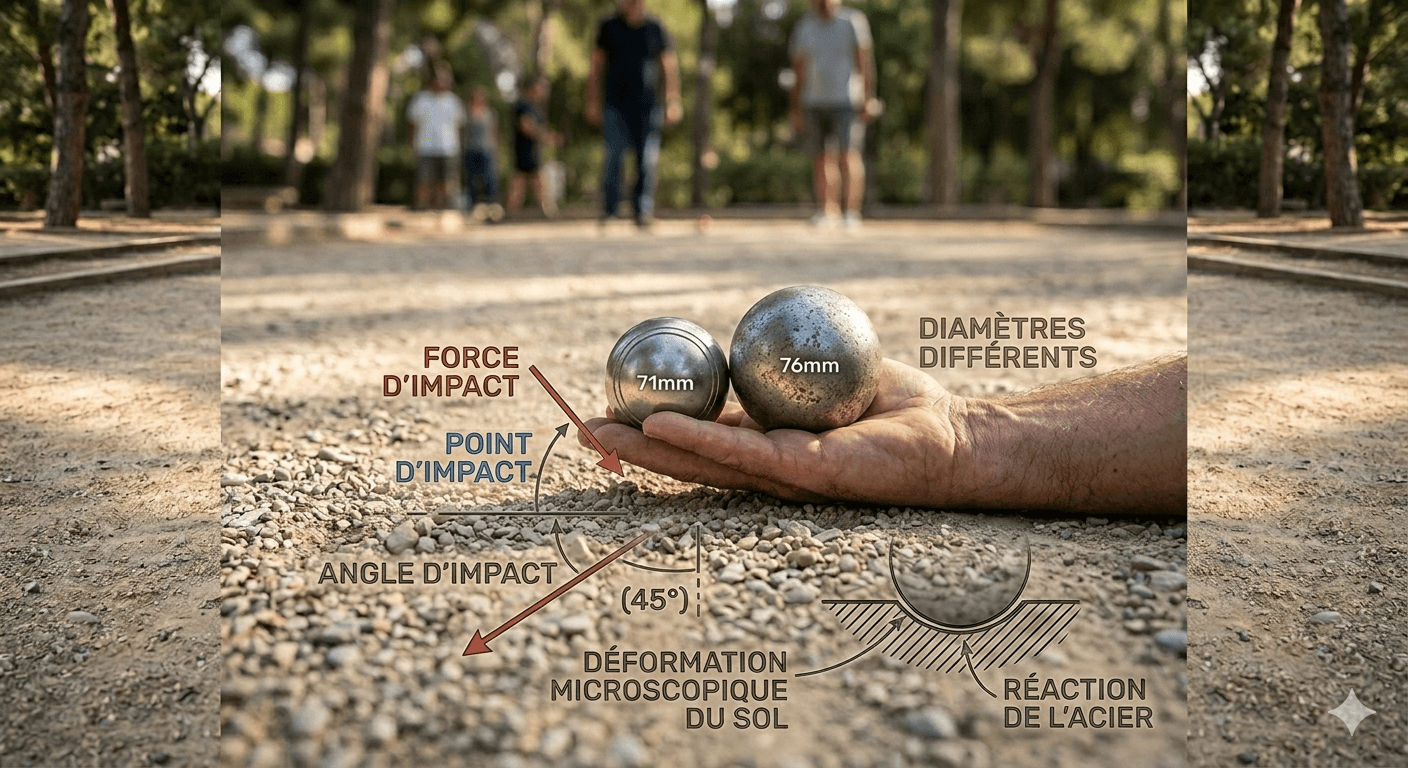
During a shot, the shooter's boule strikes the opposing boule. The relative diameter of the two boules slightly alters the geometry of the impact and the resulting direction of movement.
📐 IMPACT GEOMETRY ACCORDING TO RELATIVE DIAMETERS Same diameter75 mm vs 75 mm Symmetrical frontal impact. Predictable and stable direction of movement. Neutral Thrown boule larger
77 mm vs 71 mm Contact point slightly offset downwards. The small opposing boule may move slightly upwards. Shooter advantage Thrown boule smaller
71 mm vs 77 mm Contact point offset upwards. The small thrown boule may bounce upwards off the large target. Slight loss of efficiency These effects are subtle on differences of 2–3 mm — much more visible at the extremes of the range (71 mm vs 77 mm) ⚡
The difference in behaviour at impact between two extreme diameters (71 mm vs 77 mm) is more visible on off-centre shots (not exactly head-on) than on frontal shots. A side shot on a small opposing boule with a large boule can create a different lateral deflection effect than an equivalent shot with two boules of the same diameter. This is useful knowledge for expert shooters who anticipate the post-shot effect on nearby boules.
The grip test — finding your diameter
🖐️ TEST PROTOCOL 3 tests to identify your ideal diameter 1 Joint test — objective measurement Measure your hand circumference (flexible tape measure around the palm, below the finger joints). Use the table: under 19 cm → diameter 71–72 mm / 19–21 cm → 72–74 mm / over 21 cm → 74–77 mm. This is the objective starting point. 2 Swing test — feel of control Hold a boule of your candidate diameter in your playing grip. Perform 5 slow swings. Check: do the fingers stay in stable contact with the boule throughout the movement? Does the boule "slip" sideways in the hand during the swing? If yes — the diameter is too large. If you feel tension to maintain the grip — too large as well. The right size requires no holding effort. 3 Accuracy test over 20 throws On a jack at 7 metres, throw 20 boules with your usual diameter, note the dispersion. Repeat with a diameter differing by 1 to 2 mm. If the dispersion is clearly lower with the new diameter — you have found something. If both dispersions are similar — your current diameter is already suited. This test requires borrowing boules of a different diameter from partners.The myths about diameter
❌ MYTH ✓ REALITY ❌"Bigger is better — a larger boule is more stable." ✓Stability depends on the fit between hand size and diameter. A boule that is too large for the hand is less stable than a perfectly suited boule — even if it would be stable for someone else. ❌"Diameter doesn't matter — only weight and hardness count." ✓Diameter determines the quality of the grip, which directly conditions the precision of the release. On this criterion, it matters as much as weight for some players. It is the most often neglected parameter — not because it has no effect, but because its effect is less spectacular in the short term. ❌"Diameter influences rolling distance — a larger boule rolls further." ✓False — on a given surface, at the same speed and same angle, diameter has practically no effect on rolling distance. Rolling physics depends on speed, friction and mass — not on diameter alone. ❌"Women must always play with a small diameter." ✓Women statistically have smaller hands — but there are women with large hands who play perfectly with 74–75 mm, and men with small hands who play with 71–72 mm. Hand circumference is the objective criterion, not gender. ❌"Changing diameter is a major decision that durably disrupts the game." ✓A diameter change of 1 to 2 mm takes 3 to 6 adaptation sessions — a very short duration compared to a change of weight or hardness. Muscle memory adapts quickly to diameter because the hand immediately "feels" the right fit.Summary table by profile
| Profile | Recommended diameter | Main rationale | Also to test |
|---|---|---|---|
| Woman — standard hands | 71–73 mm | Natural grip, precise release without effort | 72 mm as a universal starting point |
| Man — average build | 72–74 mm | Comfort zone of the majority of male players | 73 mm — the most common "universal" diameter |
| Man — large hand | 74–76 mm | Grip stability on large diameter | 74 mm to start, 75 if fingers are long |
| Beginner — all builds | 72–74 mm | Versatile mid-range zone, learning without constraint | Adjust after 2–3 months of regular practice |
| Veteran with osteoarthritis | 71–72 mm | Reduce finger joint strain | Go down gradually if pain persists |
| Shooter — large hands | 75–77 mm | Slightly wider contact zone at impact | Do not exceed grip comfort for this marginal benefit |
| Pointer — precision paramount | Diameter perfectly suited to the hand | Release quality takes priority over any other criterion | Dispersion test over 20 throws to confirm |
| Youth player (minime/cadet) | 70.5–71.5 mm | Hands still developing, smaller grip | Reassess each season — hands grow quickly |
Diameter, weight, hardness, grooving — the four parameters of boule choice in their overall coherence. Paquita's book pairs the right equipment with the right technique with 100 numbered drills.
📦 Order on AmazonFAQ — Your frequent questions
Can we play with three balls of different diameters in the same triplet? + No — the three balls from the same player must be identical in weight, diameter, hardness and model, as engraved and approved. A player cannot play with two 73 mm balls and one 74 mm ball, even of the same brand. On the other hand, in a triplet team, each player can have his own balls with his own diameter - the shooter in 75 mm, the middle in 73 mm, the pointer in 71 mm. Each player plays with their own approved boules. How to measure the diameter of a ball without specialized equipment? + Three practical methods. 1) Read directly the diameter engraved on the ball — it is generally indicated with the weight (eg: "720-73" = 720g, 73mm). 2) Measure with a caliper if you have one — the most accurate measurement. 3) Frame the ball between two books or two flat surfaces and measure the distance between them with a ruler — an approximate but sufficient method to distinguish a 71 mm from a 75 mm. For an official verification (competition dispute), only the caliber of the referee is taken into account. Does the diameter of the balls change with wear over the years? + Marginally. Normal wear through friction and impacts removes a few hundredths of a millimeter over several years of intensive practice. Over 5 to 10 years, a ball used regularly can lose 0.1 to 0.2 mm in diameter — which remains within manufacturing tolerances and is not perceptible in play. What changes more visibly is the local surface geometry (impact marks, chipping) — but the average diameter remains stable. A ball presenting marks which locally reduce its diameter below 70.5 mm can theoretically be refused, but this is extremely rare in practice. Is there a correlation between diameter and weight? Are heavy balls necessarily bigger? + Not necessarily — the two parameters are independent within the regulatory range. A 750g ball can be 71mm (very dense steel) or 77mm (less dense alloy, possibly interior hollow). The weight/diameter combination is a manufacturer's choice, and within certain limits, a player's choice. Very dense balls with a small diameter exist — they are less common but completely legal. In practice, manufacturers' standard ranges often offer "logical" combinations (heavier weight = slightly larger diameter) but without physical or regulatory obligation. 📎 Related articles Equipment Choosing your boules — complete guide 2026 Equipment Stainless steel vs carbon — complete comparison Equipment Top 3 best shooter boules 2026 Equipment Checking the FFPJP approval of your boules Video Why changing bowls does not change your level Tools Free PetanqueLand tools© Pétanque by Paquita — petanqueland.fr ·
📖 Paquita's book on Amazon
The recommended diameter ranges are estimates based on average body types — the physical in-hand test remains the absolute reference for the final choice.