PetanqueLand
Search: Movie should be distinctly Please enter a search term in the search field.

Not to be missed

Search suggestions

Why do some boules veer off for no apparent reason? (Pétanque) Article Why do some boules veer off for no apparent reason in pétanque? PAQUITA ON PÉTANQUE STRIKE Video Pétanque: when you celebrate too soon… Video pourquoi il ne faut jamais celebrer avent la (1)-Couverture Boule diameter: why the wrong choice holds you back (Pétanque) Article Which boule diameter should you choose? The direct impact on your performance THE DIGESTION EXCUSE Video
Cart 0
EN▾
FrançaisEnglishEspañolItalianoDeutschPortuguêsNederlandsCatalàالعربية中文ไทย
PetanqueLand
  • Home
  • SHOP
    • Pétanque Book Shop
    • Pétanque Player Clothing
    • Pétanque Objects & Decor
    • Pétanque Gift Ideas
    • See all
  • ⭐ The Pétanque Software
  • Videos
  • 🏛️ OFFICIAL
    • Upcoming competitions
    • Results & calendar
    • Rules explained
  • FREE Zone
    • Free online software
    • Free tools
    • Lab
  • News by Paquita
Total articles: 193
📐 Rules — Scoring points

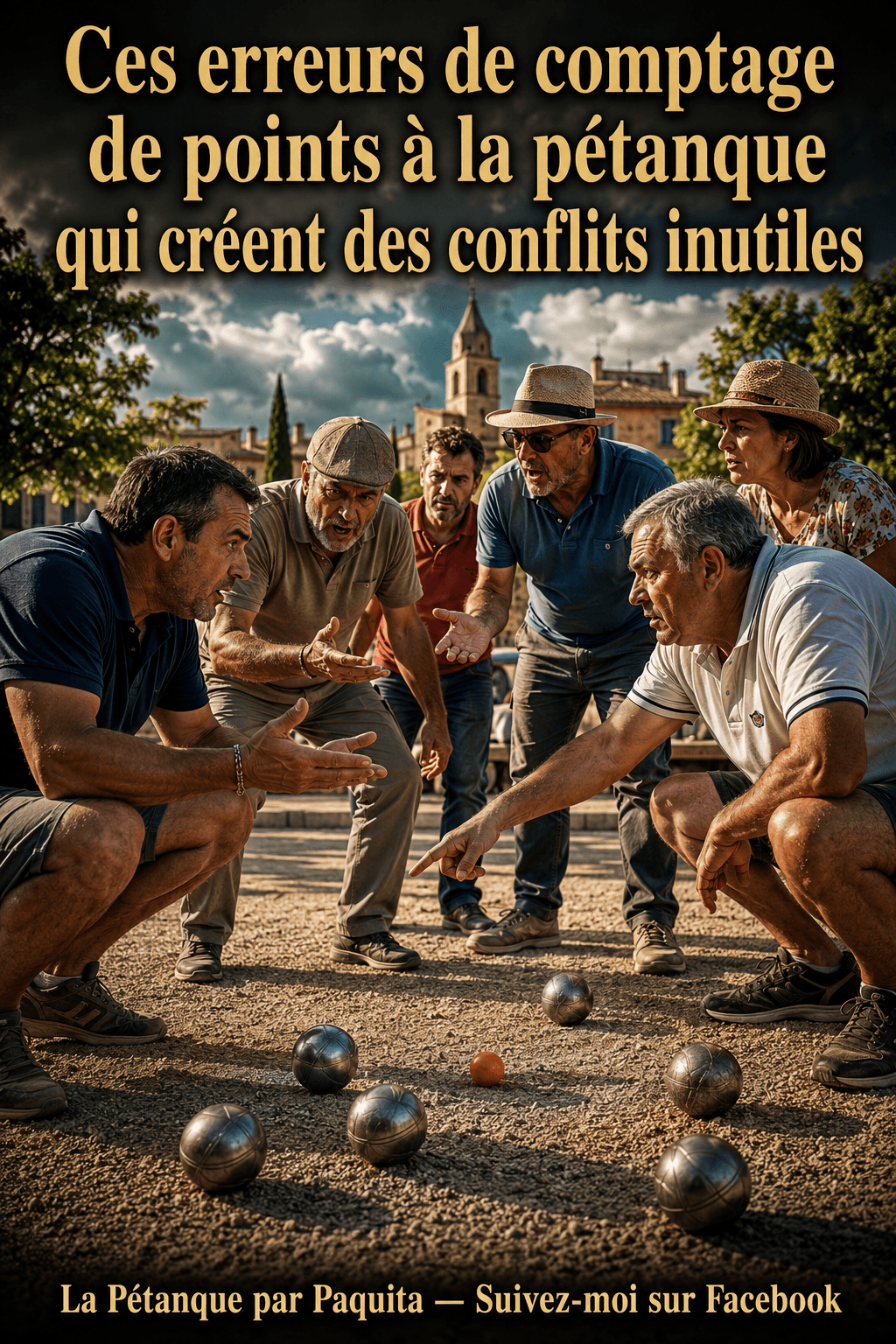
Those scoring of the points that poison your pétanque games

"We have 3 points, not 2!" — the phrase that comes up in every slightly tense game. Most score disputes don't come from a complicated rule, but from sloppy scoring. Here are the most common errors, and the official method to never get it wrong again.
FFPJP Rules Scoring & end By Paquita Reading time: 8 min
Scoring points in pétanque seems childishly simple: the bowl closest to the jack scores, and you add one bowl per gap before the opponent gets close. And yet, it is one of the moments when games derail most often. A misidentified bowl, a measurement skipped out of laziness, a score added up too quickly between two ends: these little shortcuts turn an innocuous end of game into the start of a dispute. Here are the scoring errors that come up most often on pétanque courts, and the method the FFPJP rules provide to settle things clearly.
6
mistakes
of scoring most frequent in a game
1
boule
= 1 point, never more, never less
13
points
to reach to win the game
2
players
must validate the count, never just one
In this article
  1. The scoring principle, in one sentence
  2. Error No. 1 — scoring without having identified the right bowl
  3. Error No. 2 — avoiding measurement out of laziness or overconfidence
  4. Error No. 3 — adding up the score too quickly between two ends
  5. Error No. 4 — scoring alone, without the opponent's agreement
  6. Rigorous scoring vs slapdash scoring: the gap in figures
  7. The official method in 4 reflexes
  8. FAQ — Your frequent questions

1.The scoring principle, in one sentence

The FFPJP rulebook is crystal clear on this point: at the end of the end, the team with a bowl closest to the jack scores one point per bowl closer than the opponent's best bowl. No bonus, no half-point, no "let's round it up". Each bowl counts for one and only one point, provided it is strictly closer to the jack than any bowl of the opposing team.

This simple rule only becomes a source of conflict when applied in haste, without cross-checking. That is where errors are born.

📏

Useful reminder: scoring is always done after all the bowls of both teams have been played. Scoring before the opponent has finished their bowls, even "for info", is a classic source of confusion and dispute.

2.Error No. 1 — scoring without having identified the right bowl

The first error, the daftest one, is to designate "by eye" the closest bowl without having actually checked it. On a cluster of bowls packed around the jack, the eye is easily fooled, especially from a distance or with an unfavourable viewing angle. Many disputes arise from a bowl believed to be winning when another, less visible from the circle, is in fact closer.

The right reflex

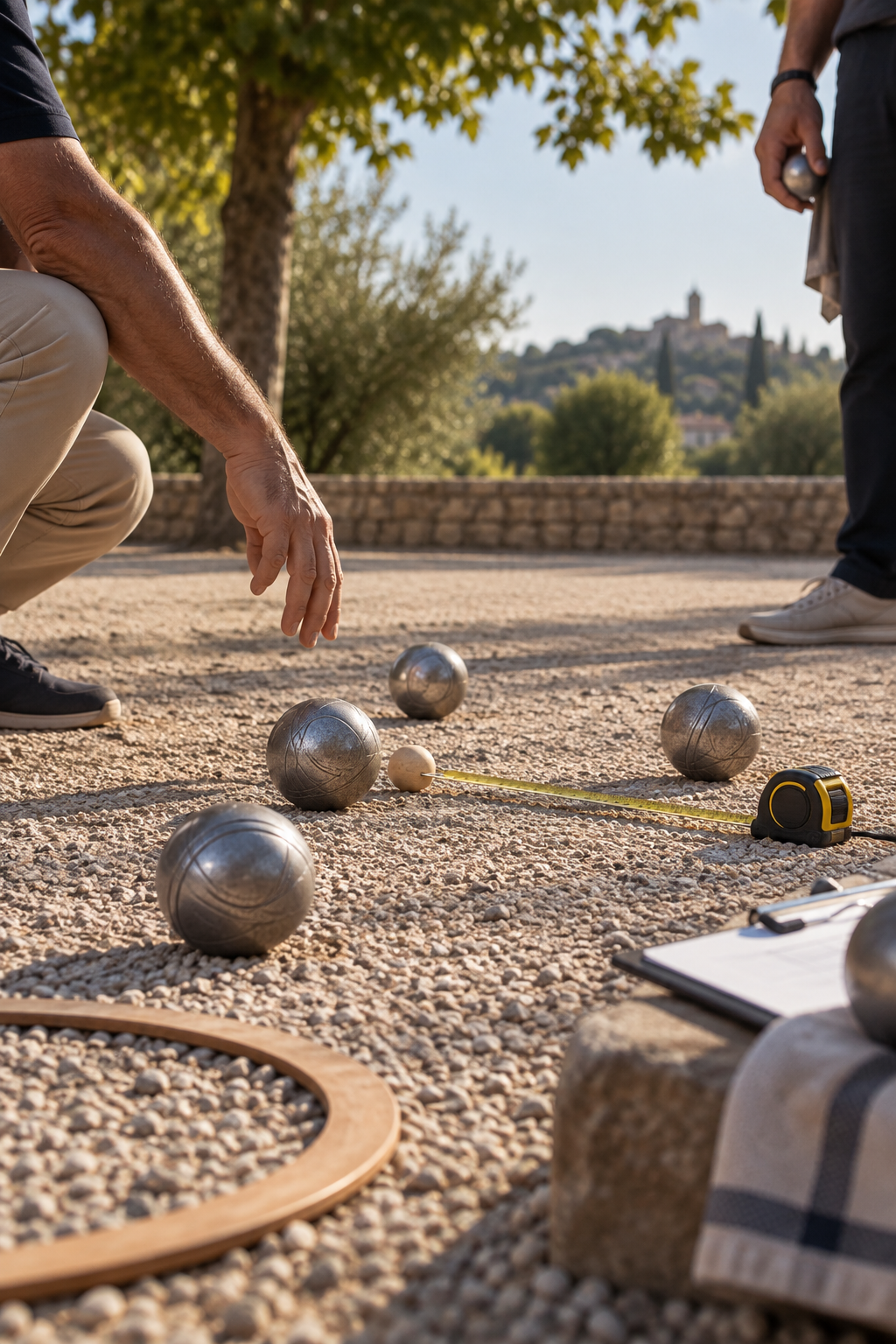
Move, look at the level of the bowls in question, and if the slightest doubt remains, get the tape measure out. A quick glance from the throwing circle never matches a physical check when the gap seems small.

3.Error No. 2 — avoiding measurement out of laziness or overconfidence

Many players avoid measuring "to save time" or because they are convinced they are right. The result: a point is awarded wrongly, often in good faith, but an error remains an error. The rulebook never requires you to guess: measuring is a right, at any time when a distance is disputed or uncertain.

Not measuring out of overconfidence is precisely the costliest error at the end of a tight game, where every point counts double.

🎯
Paquita's tip

Get into the habit of measuring as soon as the gap seems smaller than a bowl's width, even if you are "sure". This systematic reflex avoids 90% of scoring disputes — and it only takes a few extra seconds per end.

4.Error No. 3 — adding up the score too quickly between two ends

Another classic: a team announces the cumulative score before the two sides have agreed on the number of points in the end just completed. A player shouts "8 all" when the actual count of the end still had to be validated. This haste leads to disagreements that sometimes go back several ends, impossible to correct calmly.

The right reflex

Validate the end's score out loud, between the two of you, before adding it to the cumulative score. A three-second pause that saves ten minutes of hassle.

5.Error No. 4 — scoring alone, without the opponent's agreement

The rulebook does not provide for a single team to be both judge and party to the scoring. A player who announces the score alone, without the opponent confirming, runs the risk of a legitimate dispute later in the game. Scoring must always be a shared moment, not a unilateral declaration.

6.Rigorous scoring vs slapdash scoring: the gap in figures

Over a full game, the rigour of scoring directly changes the number of disputes encountered. Here is the trend observed in club games:

Score disputes avoided per end (over 6 typical ends)
Rigorous scoring
measurement + two-way validation
Slapdash scoring
score announced by eye
Scoring reliability — out of 10
Systematic measurement when in doubt · 9/10
Score validated by both, measurement at the slightest doubt.
Scoring by eye · 4/10
Points awarded by eye, without checking.
Scoring situationThe right reflexThe common mistake
Bowls very close togetherMeasure systematicallyDecide by eye
End of roundValidate the score between twoAnnounce alone, too quickly
Bowl identifiedMove to checkJudge from the circle
Cumulative scoreRecount out loudAdd up from memory

7.The official method in 4 reflexes

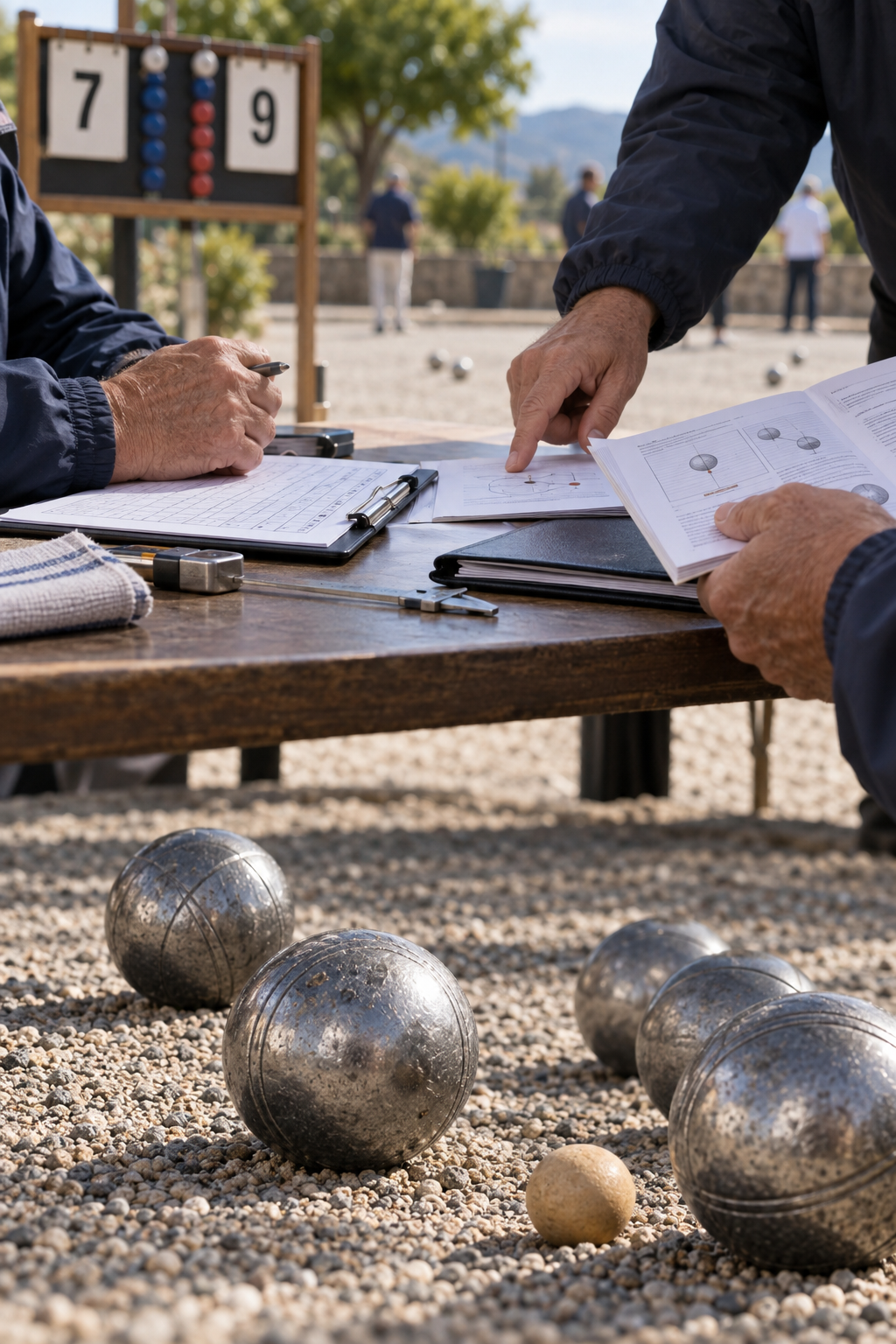
The rulebook does not impose a precise ritual, but its spirit — to settle things objectively, leaving no room for doubt — translates into a simple, reproducible method for each end.

1. Wait for the end to be fully completed

No remaining bowl must change the situation. You only count when both teams have exhausted their bowls, or by mutual agreement if the gap is deemed insurmountable (dead end).

2. Physically identify the closest bowl

Move, look at ground level if needed, before asserting anything.

3. Measure at the slightest doubt

Always better than an estimate, even for the team that thinks it is right. Find our complete method on the lesser-known rules of pétanque and our free tools to practise reading the end of an end.

4. Validate the score between two before adding it up

A count announced and confirmed by both teams avoids 9 out of 10 disputes at the end of a game.

📘
PAQUITA'S BOOK
Winning under pressure in pétanque

Staying clear-headed when the score is tight and every point counts double: this guide works on the mental side and the management of tense situations, including the delicate moment of scoring.

📗 Discover the book
FAQ — Your frequent questions

One point per bowl strictly closer to the jack than the opponent's best bowl, once all the bowls of both teams have been played. There is no bonus or half-point: each winning bowl is worth exactly one point.
Any player, from either team, may request a measurement as soon as there is doubt about the distance between a bowl and the jack. It is not reserved for the team that doubts its own advantage.
No, except by explicit agreement of both teams (the situation known as a "dead end", when the gap is deemed insurmountable). In normal play, scoring only takes place once all the bowls of the end have been played.
In a friendly game, the two teams must agree, if necessary by measuring physically. In an official tournament, the umpire is empowered to make a final decision with no appeal possible.
It is not a written obligation in black and white in the rulebook, but it is a strongly recommended practice: a score announced and confirmed by both avoids virtually all the disputes that arise at the end of a game.
📎 Related articles
GameThe little-known rules of pétanque ToolsFree PétanqueLand tools HomePétanque with Paquita

© Pétanque by Paquita — petanqueland.fr · 📘 Discover my books on PetanqueLand
Explanations based on the official FFPJP rulebook, for educational purposes. In the event of a dispute in a tournament, only the official umpire decides.

Share Follow

📬 Paquita's pétanque newsletter

New articles, videos, free tools and offers — straight to your inbox.

← Previous articleJack pushed off the court by a boule: the official rule that surprises everyoneNext article →This rule about the boule stuck to the jack that every player should know
← Return to rules

About PétanqueLand

PétanqueLand.fr is the fun, practical site devoted to pétanque: videos, humour, photos & memes, free tools and news.

Find Pétanque by Paquita and join the community!

Categories

  • ⭐ Celebrities
  • 🎥 LIVE training
  • ❓ Questions & Tips
  • 🎭 Parodies
  • 🐕‍🦺 Animals
  • ⚖️ Refereeing
  • 🍻 Refreshment bar
  • 🎬 Series
  • 😂 Pétanque humour
  • 🤯 WTF moments
  • Most viewed
  • What's new

Information

  • Home
  • SHOP
    • Pétanque Book Shop
    • Pétanque Player Clothing
    • Pétanque Objects & Decor
    • Pétanque Gift Ideas
    • See all
  • ⭐ The Pétanque Software
  • Videos
  • 🏛️ OFFICIAL
    • Upcoming competitions
    • Results & calendar
    • Rules explained
  • FREE Zone
    • Free online software
    • Free tools
    • Lab
  • News by Paquita

Follow Paquita

Find Pétanque by Paquita on my social networks:

Facebook
TikTok
YouTube
Instagram
X

📸 Photos & memes
🎯 Pétanque videos
😂 Humour & WTF moments
🧰 Free tools

© 2026 PetanqueLand — The craziest boulodrome on the web. Pétanque videos, humour, refereeing & debates. Contact · Legal notice · Privacy Join me: Facebook · TikTok · YouTube · Instagram · X