Règlement FFPJP · 24 June 2026
Foot over the circle: fault or not? The official ruling settles it
Foot over the circle in pétanque: foul, warning or tolerated? The official FFPJP rules settle it according to the degree, the context and the repeat offence.1.The question every player asks
Picture the scene: your opponent shoots from 8 metres, pulls off a magnificent carreau, and at the moment the boule strikes the target, their toe goes 1.5 cm over the circle line. You protest, they get worked up, your teammate hesitates. Who is right? The answer depends on several factors that the official FFPJP rule has anticipated. And the verdict is not always the one you'd expect.
The rule speaks of "encroachment on the edge of the circle", not of centimetres. This opens a grey area deliberately left to appreciation, because codifying "5 mm" or "1 cm" would be absurd in practice. But this flexibility also has a downside: it fuels constant conflicts between players who argue over the interpretation.
2.What the official rule says exactly
Article 6 of the FFPJP-CMSB rule states: "The feet must be entirely inside the circle and must not encroach on its edges." Three key words to remember: entirely, inside, edges.
Entirely = not a single cm outside, in theory. Inside = the opposite of outside, which rules out contact with the line. Edges = the visible circular boundary (drawn in sand or marked by a plastic circle). If you take the letter of the text, the slightest overstep constitutes a fault. In practice, the umpire assesses the intent and the scale.
📚The rule is the same for pétanque as for jeu provençal as far as the circle is concerned (the other rules differ). All countries affiliated to the CMSB apply the same wording. So you will be judged on the same criteria whether you are playing in Marseille, Geneva or Antananarivo.
3.The 3 types of foot overstepping
Not all oversteps are equal. The rule and umpiring practice distinguish three categories of increasing severity.
Type 1 — Static millimetric overstep
Your feet are in place before the motion, but one of them goes 2 or 3 mm over the inner line. It is technically a fault, but in practice it is almost never penalised by a reasonable umpire. The FFPJP guidance is to warn the player verbally without cancelling the boule.
Type 2 — Clear overstep at the moment of the throw
During the motion, one of your feet slides forward and clearly goes over the line (several centimetres). This is the most frequent fault among beginner shooters. Prescribed sanction: a formal warning on the first occurrence, cancellation of the boule in the event of an immediate repeat.
Type 3 — Foot completely outside the circle
You play the boule with one foot entirely outside the circle (for example because your circle is too small for you, or through a habit picked up in jeu provençal). This is an obvious and serious fault: the boule is cancelled and a formal warning is recorded in the umpiring log.
4.Table of situations and sanctions
Here is how a qualified FFPJP umpire assesses the various concrete cases:
| Useful response | Official sanction | Boule |
|---|---|---|
| Foot slightly on the line (2-3 mm) | Tolerated / verbal warning | Validated |
| Foot sliding 1 to 2 cm during the throw | Formal warning | Validated if first time |
| Foot clearly over (>3 cm) | Boule cancelled | Cancelled |
| Foot entirely outside the circle | Serious fault | Cancelled + warning |
| Repeat after 2 warnings | Temporary exclusion | Of the player |
| Overstep related to a recognised disability | FFPJP exemption | Validated |
5.Umpiring tolerance: from the club to the National level
The strictness of application varies enormously depending on the level of competition. The same action will be harmless in a friendly game and penalised in the final of an official National event.
Umpiring tolerance by playing context National tournament / Championship · Tolerance 2/10 Strict application. Dedicated umpire, video possible in the final. 1 mm can be penalised. Departmental tournament · Tolerance 5/10 Warning for visible oversteps, tolerance for imperceptible ones. Club friendly · Tolerance 8/10 Good-natured, only blatant faults provoke a reaction.6.Rigid circle vs drawn circle: the big difference
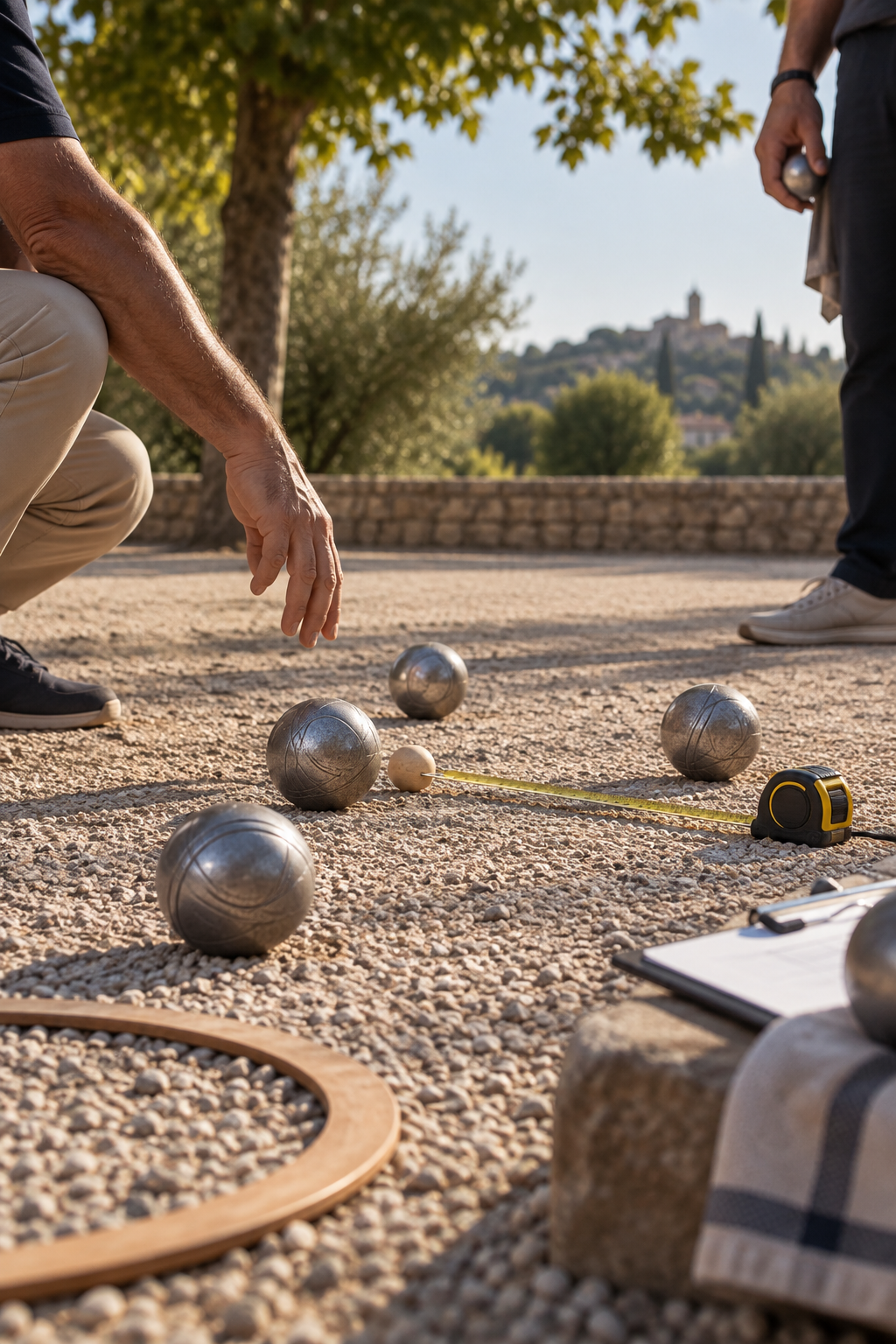
Since 2026, the FFPJP imposes the rigid circle (black plastic, 50 cm internal diameter) in national and international tournaments. This changes everything on the question of foot overstepping: the boundary is now physically marked, rather than approximately drawn in sand.
With a rigid circle, the foot placed "on the line" becomes a more precise notion — the player even feels the limit physically. Umpiring tolerance is reduced as a result, because the error is no longer excusable by an approximate marking. Always check the type of circle before assessing the degree of fault.
Precision of the rule by circle type Rigid circle Physical boundary, easy to check Drawn circle Blurred boundary, increased tolerance7.What to do when you challenge a foot over the line?
Four reflexes to adopt in the exact order in the event of a dispute:
1. Signal it immediately : if you wait for the end to finish, your challenge loses all value. 2. Ask for the position of the feet : before the player moves, fix the situation. 3. Call the umpire (in a tournament) or a neutral witness (in a friendly). 4. Accept the decision without reopening it. A challenge maintained after the ruling can be worth a warning to the challenging team, not only to the one that committed the fault.
🎯 Paquita's tipThe best way never to fall foul of the foot-overstep rule: get into the habit of checking your feet before each throw, not only when you step into the circle. It is a short ritual (1 second), but it eliminates 90% of unintentional faults. The best shooters do it systematically, even when they are not thinking about it.
To understand the full regulatory mechanics of the circle, also see our complete guide to the foot rule and our feature on offences sanctioned by umpires. Our page little-known rules also lists many subtleties.
📕 PAQUITA'S BOOK Become a formidable shooterShooting accurately starts with shooting within the rules. A shooter who doubts their position loses 20% of their success rate. The book that gives you a solid posture, in line with the rules, and turns your shooting into a reliable tactical weapon.
📗 Discover the bookFAQ — Your frequent questions
Is a foot that touches the inside line of the circle at fault?+ Strictly speaking yes, because the regulations say “do not encroach on the edges”. In practice, this is generally tolerated on a traced circle and can be warned on a rigid circle. A reasonable umpire gives a simple verbal reminder without canceling the ball. If the referee didn't see anything, can I cancel the ball?+ No, only the referee can decide. If you think you have seen an unsanctioned foul, you can politely report it to the referee who will assess it. But his word takes precedence, and insisting can earn you a warning for excessive dispute. The foot slipping while shooting: fault or not?+ If the foot slips but stays inside the circle, it is not a foul. If he slips and ends up outside the circle during the gesture, it is a serious foul. The distinction lies in the final position when the ball hit the ground. How many times can you be warned before being kicked out?+ The FFPJP regulations provide a scale: verbal warning, formal warning (ball canceled if repeat), temporary exclusion of the player, then disqualification of the team in the event of a fourth serious offense during the same competition. What if I'm too big for the 35cm circle?+ Ask for a larger circle (up to 50 cm internal diameter, FFPJP compliant). An official rigid circle has also measured 50 cm since 2026. If your feet do not fit within 50 cm, you probably need more suitable shoes or a tighter posture. 📎 Related articles RulesThe feet rule: what you need to know RulesFoot infringements that are penalised RulesThe little-known rules of pétanque© Pétanque by Paquita — petanqueland.fr ·
📘 Discover my books on PetanqueLand
Article based on the official FFPJP-CMSB rule (article 6) and current umpiring case law. Adaptable to local club practices without contradicting the federal letter.