Actualités · 6 June 2026
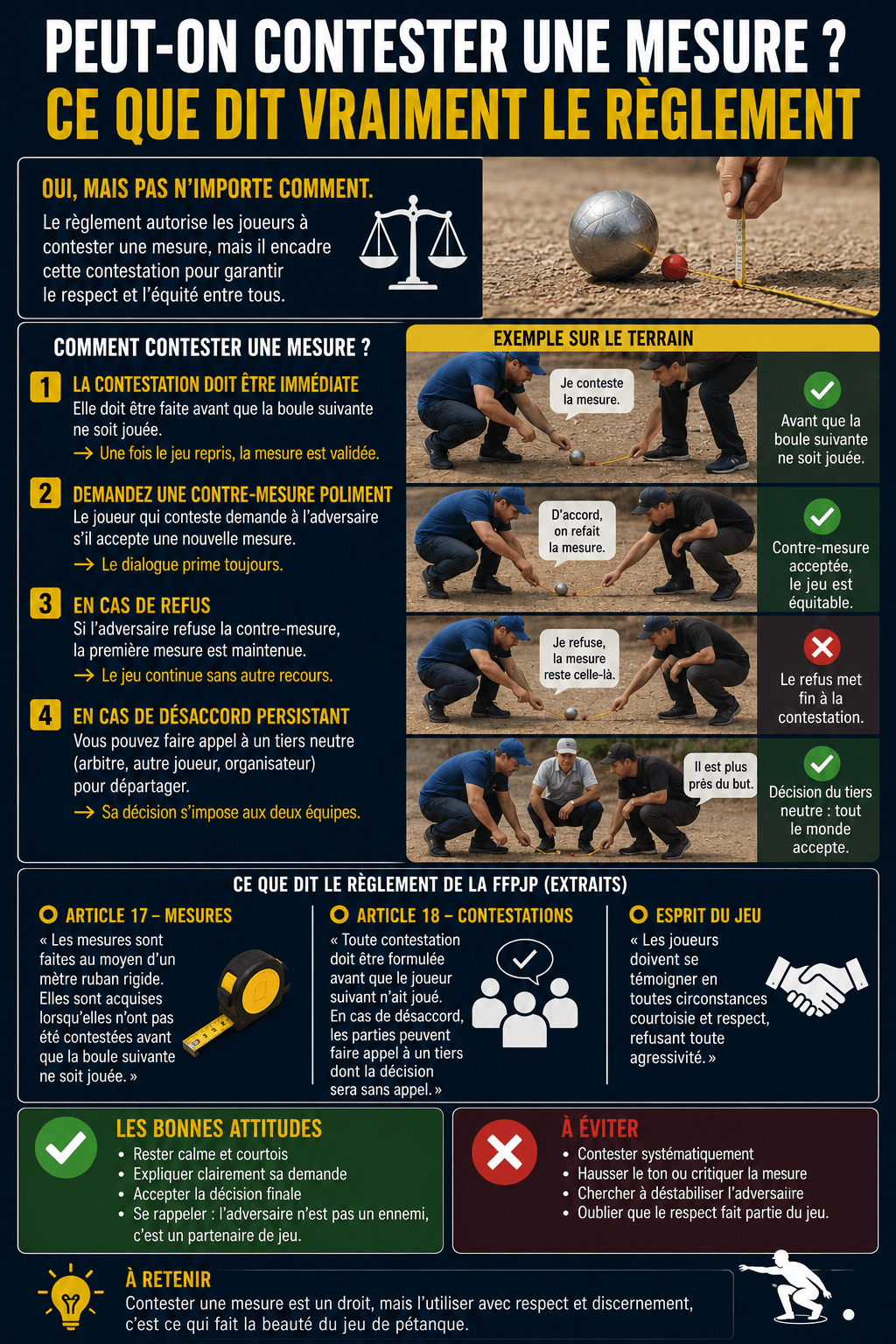
Can a measure be challenged? What the Rules Really Say
Disputing a measurement in pétanque: when itWho can request a measurement and when
📏 THE MEASUREMENT PROCEDURE FROM END TO END 🙋 REQUEST Any player from either team may request a measurement at any time during the end — not only at the end of the end. The request is not subject to any particular form. ANY PLAYER 📏 MEASUREMENT Players may measure themselves with a tape measure or a measuring compass. The measuring tool must connect the closest point of the boule to the jack. PLAYERS FIRST ❓ DISAGREEMENT If the players do not agree on the result of the measurement, an umpire may be called. No player may impose themselves by force or authority. CALL UMPIRE ⚖️ UMPIRING The umpire carries out or supervises the measurement with the appropriate tools. Their decision is final for the end in progress. The players must accept it. FINAL DECISION 🚫 DEADLINE EXCEEDED Once the jack has been thrown for the next end, any claim about the previous end is inadmissible — even if a manifest error is identified afterwards. INADMISSIBLE 🎙️ PAQUITA ON MEASUREMENT DISPUTES "Measurement disputes on the court almost always come from two things: either nobody has a tape measure, or the two teams measure differently. The rules are clear — any player can measure, with a suitable tool, and if it ends in a dispute, you call the umpire. What is not in the rules is deciding by eye, by finger, or by intimidation. And yet, that's what happens 9 times out of 10 when no umpire is available." — PaquitaHow to measure correctly according to the rules
📋 FIPJP RULES — BASIC PRINCIPLES OF MEASUREMENT What the rules say about measuring distances The measurement must be carried out between the point of the jack and the closest point of the boule to be measured. The measuring instrument (tape measure, measuring compass or any other graduated rule) must be placed without moving the boules or the jack. In the event of a perfect tie (neither boule is closer), the rules provide that the end is void — no team scores a point, and it is the team that threw the jack that replays the next end from the same spot. ✅ WHAT IS ALLOWED BY THE RULESRequesting a measurement at any time: any player from either team may request a measurement at any time during the end — not only at the end of the end when all boules have been played.
Measuring yourself: players may carry out the measurement themselves with their own measuring instrument. Both teams may check the result with their own instruments.
Calling an umpire in case of disagreement: if the two teams do not agree on the result of a measure, any player may request the intervention of an official umpire.
Contesting a measure carried out incorrectly: if a measure has been carried out without following the procedure (boule moved, unsuitable instrument), it is possible to request a new measure or the intervention of an umpire.
→ These rights belong to all players — not only to captains or designated players. ❌ WHAT IS NOT ALLOWEDMoving a boule to measure: any boule or jack moved to facilitate the measure must be put back in place exactly — and if this replacement is uncertain, the umpire decides. A boule moved with no certain possibility of replacement may be neutralised.
Contesting after the jack is thrown: once the jack has been thrown for the next end, any claim regarding the points awarded in the previous end is definitively inadmissible.
Physically opposing a measure: refusing to let the opponent measure, covering a boule, or preventing access to the terrain for the measure constitutes a breach of the rules that may result in penalties.
Settling a disagreement by authority: no player, captain or "veteran" may impose their decision against the opponent's view — only an umpire has that authority.
→ These prohibitions apply in official competitions. In friendly games, practices vary — but the rules remain a useful reference. 📋 THE CORRECT MEASURING PROCEDUREInstrument: rigid tape measure, measuring callipers with points or graduated rule. The "by finger" or "by eye" measure has no official value in the event of a dispute — it cannot be imposed.
Point of measurement: from the closest point of the boule to the closest point of the jack. The measure is taken between the surfaces of the boule and the jack — not between their respective centres.
Without moving: the measuring instrument must be placed and read without moving the objects being measured. In the case of a difficult terrain (hollows, roughness), the umpire may supervise the measure.
Simultaneous reading: in case of doubt, both teams read the result at the same time — to avoid post-measure disputes over what had been observed.
→ The correct procedure protects both teams — including the one that "thinks" it is winning the end. ⚠️ THE CONSEQUENCES OF A POORLY CARRIED-OUT MEASUREBoule moved during the measure: if a boule is moved by a player from their own team during the measure, the boule stays in its new position unless the opponent agrees or an umpire intervenes and may declare it dead.
Jack moved during the measure: if the jack is moved during the measure, it must be put back in place according to the available reference points. In the event of certain impossibility, the umpire may declare the end dead.
Measure carried out with an unsuitable instrument: a measure carried out with an unsuitable instrument (slack string, hand estimation) has no official value. The opponent may request an instrumental measure.
→ An incorrect measure is an invalid measure — the opponent has the right to request a new one, properly carried out.The 6 key rules on measurement in pétanque
⏰ 1. The claim window — before the next jack is thrown FIPJP RULES TIME LIMIT THE RULE The contestation or the request to re-measure an end must be made before the jack is thrown for the next end. Once the jack has gone for the next end, the result of the previous end is definitively confirmed — even if a manifest error is identified afterwards. This time limit is strict and applies in all cases, including errors made by the umpire themself on the previous end. → FIPJP principle: the points of an end are final from the moment the jack is thrown for the next end. Any late claim is inadmissible. WHY THIS RULE EXISTS Without a time limit, a game could be called into question at any time — including at the decisive moment of victory. The claim window rule protects the flow of the game and the legal certainty of acquired results. It also places a responsibility on players: if you think a measure is incorrect, you must say so immediately — not 2 ends later. This rule is also an incentive not to "let slide" doubtful measures on the pretext of not wanting to create tension. → Common trap: accepting a doubtful measure "to avoid creating a conflict", then complaining later when the match is tight. It is too late — the window is closed. → Recommended practice: if a measure seems incorrect to you, state it immediately and clearly — before play resumes. Silence is tantamount to acceptance. 📏 2. The measuring instrument — what is valid and what is not EQUIPMENT RULES ACCEPTED INSTRUMENTS Any rigid or non-deformable measuring instrument is valid: tape measure, graduated rule, measuring callipers with points, sliding calliper. The instrument must allow a precise measure without distorting the result through its own weight or its flexibility. A slack wire or string is insufficient. In official competition, the organiser may impose a specific type of instrument — often the callipers with points or the official measuring rule. → Good practice: always have a tape measure in your boules bag. In competitions, umpires have official instruments — but between rounds or during ends with no umpire present, a personal tape measure is indispensable. WHAT HAS NO OFFICIAL VALUE The "by finger" measure (sliding the finger between the boule and the jack) is a common practice in friendly games — but it has no official value in the event of a dispute. The opponent may always request an instrumental measure to contest a conclusion drawn from a by-finger measure. Likewise, a "by eye" measure can never be imposed as a definitive result. The argument "you can see with the naked eye that it's my boule" is admissible as an opinion but not as proof. → Trap: shooting your boule before having measured, based on a visual estimate, then contesting when the measure reveals that the opponent was right. → To remember: in competition, never accept a "by eye" or "by finger" measure as definitive when the stakes are high. Demanding a measuring instrument is a right, not a provocation. 🎯 3. The dead end — perfect equality between the best boules FIPJP RULES SPECIAL CASE WHEN AN END IS DEAD When the best boules of each team are at equal distance from the jack — after instrument measure and verification by an umpire if necessary — the end is dead: no team scores any point. It is the team that benefited from the initial draw (or the same team that had thrown the jack) that throws the jack again for the next end, from the same circle. This rule applies regardless of the score situation. → FIPJP rules: in the event of a confirmed equality, the end is dead. The team that threw the jack for the dead end throws again for the next end. HOW TO ESTABLISH A CERTAIN EQUALITY A perfect equality between two boules is rare but possible — it is established by instrumental measure and must be confirmed by both teams or by the umpire. A measure that gives identical results on the two respective instruments of the teams constitutes proof of equality. In the event of a disagreement on the equality itself, the umpire decides — either by declaring a boule the winner, or by declaring the end dead. → To remember: a dead end is not a "draw" nor a "reset to zero" — it is simply an end with no point awarded. The overall score does not change, but the team that throws the jack again remains determined by the dead-end rule. 🚧 4. The boule moved during the measure — replacement rules DISPUTE PROCEDURE WHAT HAPPENS IF A BOULE MOVES? If a boule or the jack is accidentally moved during the measure, the main rule is replacement. If the initial position is certain (a witness present from both teams, a mark on the terrain, a trace), the boule or the jack is put back to its original position. If the initial position is uncertain, the consequences depend on who caused the move: if it is a player from the team that was measuring, the opponent may require that the boule stays in its new position or request the intervention of an umpire. → Practical rule: never touch a boule or the jack during the measure without the agreement of both teams. In the case of a difficult terrain, call the umpire rather than risking an accidental move. THE GOOD PRACTICE TO AVOID THIS PROBLEM Before measuring in a crowded area, mark the positions of all the boules involved with a chalk pencil or a small stone — with the agreement of both teams. If an accidental move occurs, the replacement is then certain. This precaution is systematic among experienced players, particularly in areas with several boules close to the jack where the measure may be delicate. → Practical advice: in a complex measuring situation (several boules very close together, irregular terrain), take the time to mark the positions before introducing the measuring instrument. 30 seconds of precaution avoid a 10-minute dispute. ⚖️ 5. The umpire's role — when to call, what authority UMPIRING OFFICIAL WHEN AND HOW TO CALL THE UMPIRE The umpire may be called in two situations: disagreement between the teams on the result of a measure, or an ambiguous situation that goes beyond the scope of a simple measure (moved boule, jack out of bounds, playing infringement). Any player may call the umpire — not only the captain or the best player. The call must be made before play resumes. In the absence of an available umpire (friendly games, village competitions), the players must reach an agreement or ask the opinion of a neutral person accepted by both teams. → The umpire has authority over all regulatory decisions. Their decision is final for the situation concerned and cannot be contested by the players — it may be appealed to the official jury according to the competition rules. WHAT THE UMPIRE CAN AND CANNOT DO The umpire may: measure, correct an incorrect measure, move a boule to measure and put it back in place, declare a boule or a jack dead, decide in the case of a situation not provided for by the rules. The umpire cannot: modify a decision already confirmed on a previous end (unless the claim was made in time), intervene without having been called in situations that do not fall within their direct competence, or deliberately favour a team. The umpire's neutrality is an obligation — and a player may contest it before the jury if it is manifestly compromised. → To remember: calling the umpire is not an aggression towards the opponent — it is the use of a right provided for by the rules to cleanly resolve a disputed situation. An opponent who refuses umpiring puts themself outside the regulatory framework. 🔢 6. Counting the points — who decides and how PROCEDURE RULES HOW POINTS ARE AWARDED The team that has the boule closest to the jack scores as many points as it has boules closer to the jack than the opponent's best boule. The rule is clear in principle: only distance counts, not the relative position of the boules among themselves. Each boule of the winning team that is closer to the jack than the opponent's best boule counts for one point. The counting is carried out by the players themselves, in a contradictory manner — one announces, the other verifies. → Concrete example: team A has 3 boules at 5 cm, 8 cm and 12 cm. Team B has one boule at 10 cm. Team A scores 2 points (the boules at 5 cm and 8 cm are closer than the opponent's boule at 10 cm; the boule at 12 cm is further away and does not count). THE MOST FREQUENT COUNTING ERRORS Counting a boule that is not closer than the opponent's best boule — through inattention or because the precise measure was not made. Counting the opponent's boules by mistake. Forgetting to count a boule because its "turn" in the measuring sequence was skipped. These errors are frequent in situations with several close boules and are resolved by a methodical measure of each boule in order of proximity, validating each one before moving on to the next. → Recommended counting method: start by identifying the best boule of the winning team, then successively compare each boule of the winning team with the opponent's best boule. Stop as soon as a boule is further away than the opponent's best boule. 📏 Always have a tape measure in your bagThe "by finger" measure has no official value in the event of a disagreement. Neither does the "by eye" measure. A simple tape measure in the boules bag resolves 90% of measuring disputes on the terrain — because it gives an objective and incontestable result that both teams can verify. The player who measures with a precise instrument cannot be accused of "cheating" — they are applying the rules. The player who refuses to use an instrument and measures "their own way", on the other hand, is in approximation.
The most frequent disputed situations
🎳 Boule touching the jack — is it the closest? A boule is in direct contact with the jack. Is this boule automatically the closest? Can it be contested by an opponent's boule that is also very close? → Rules: a boule in contact with the jack is measured like any other — from the closest point of contact. If another boule is also in contact with the jack or closer by its surface, an instrumental measure must be carried out. The boule in contact is not automatically the winner if another boule may also be in contact. 📍 Jack out of bounds after a shoot After a shoot, the jack leaves the terrain or exceeds the authorised limits. What happens? Is the end dead? Does the team that shot lose the end? → Rules: if the jack leaves the terrain or exceeds the limits (too close or too far), the end is dead — no team scores. If marks had been placed by the players and if conditions allow, the umpire may declare the end dead as soon as the jack leaves the terrain. The team that had thrown that jack throws again for the next end. ⛔ A boule touches the boundary of the terrain A pointed boule touches or exceeds the boundary of the marked terrain. Is it valid? If it bounces and comes back into the terrain, is it playable? → Rules: any boule that touches the boundaries or limits of the marked terrain (ropes, pegs, boards) and that is partially out of bounds is dead and must be removed from the terrain. A boule that entirely leaves the terrain and returns by bouncing is also dead. Only boules entirely within the limits of the terrain are valid. 🤝 The teams do not agree on the measure Each team measures with its own instrument and obtains a different result. One says "it's my boule", the other says "no, it's mine". What to do? → Rules: in the event of a persistent disagreement between the teams after respective measures, an umpire must be called to decide. If no umpire is available, the players may agree on a new measure carried out in a contradictory manner (both teams observe at the same time), with an instrument accepted by both sides. 👁️ Opponent measuring without warning An opposing player measures the distances on their side, alone, without your team being present or warned. Can they do so? Is their result valid? → Rules: any player may measure at any time — they are not obliged to wait for the opponent's agreement to start a measure. However, a unilaterally carried-out measure is not enforceable: the other team has the right to request a contradictory re-measure. The good practice is to announce "I am measuring" and wait for the representatives of both teams to be present. 🎲 Disagreement on the number of points scored One team thinks it has scored 3 points, the opponent says 2. The measure of all the boules has not been done exhaustively. How to resolve? → Rules: both teams must agree on the counting before the next end begins. If the disagreement persists, measure each boule of both teams in order of proximity, contradictori-ally. In the event of impossibility, the umpire is the only person who can definitively decide the number of points. A team's silence on a count is tantamount to acceptance.Frequent errors in measurement
👉Measuring by finger and imposing the result Sliding the finger between the boule and the jack and concluding "it is further" or "it is closer" — then presenting this result as definitive. The by-finger measure is only an approximate indication. The opponent has the right to demand an instrumental measure. Imposing a result drawn from a by-finger measure is contrary to the rules as soon as the opponent contests. → Solution: announce "I think it's my boule, do you want us to measure?" rather than "it's my boule, I measured by finger." 🏃Throwing the jack before having resolved the dispute Picking up the jack and throwing the next end while the counting of the previous end is not yet resolved. This throw definitively closes the claim window — which may be used strategically by a team to lock in a contestable result. The rules are formal: the result of an end must be settled before throwing the next one. → Solution: never throw the jack as long as the counting of the previous end is not validated by both teams or by the umpire. ⚡Shooting a boule "because the opponent is closer to the eye" Deciding to shoot an opponent's boule by visually estimating that it is closer — without measuring. The shot boule leaves the jack in a position that, after measure, reveals that the estimate was wrong. It is impossible to go back once the boule has been shot. This error combines a poor reading of the game and a lack of awareness of the importance of measuring before shooting. → Solution: in any shooting situation where the question "who is closer?" is relevant, measure first — then decide whether to shoot or not. 🤫Accepting a doubtful measure "to not make a fuss" Silently accepting an incorrectly carried-out measure or a debatable point count to avoid a conflict — then complaining when the score is tight. The claim window cannot be reopened after tacit acceptance. The rules protect players who claim their rights in time — not those who wait to be in a bad situation to remember a past injustice. → Solution: contest immediately and calmly what seems incorrect. "Can you measure with a tape measure?" is not an aggression — it is the application of the rules. ⚖️Knowledge of the rules on measuring is a weapon of balance — it protects teams that play correctly against approximate or manipulative practices. A player who knows the rules cannot be intimidated by a false "by-finger measure" imposed with assurance. They know they have the right to demand an instrument, to call an umpire and to contest within the regulatory window. This knowledge transforms a source of conflict into a clear and fair procedure.