Actualités · 27 April 2026
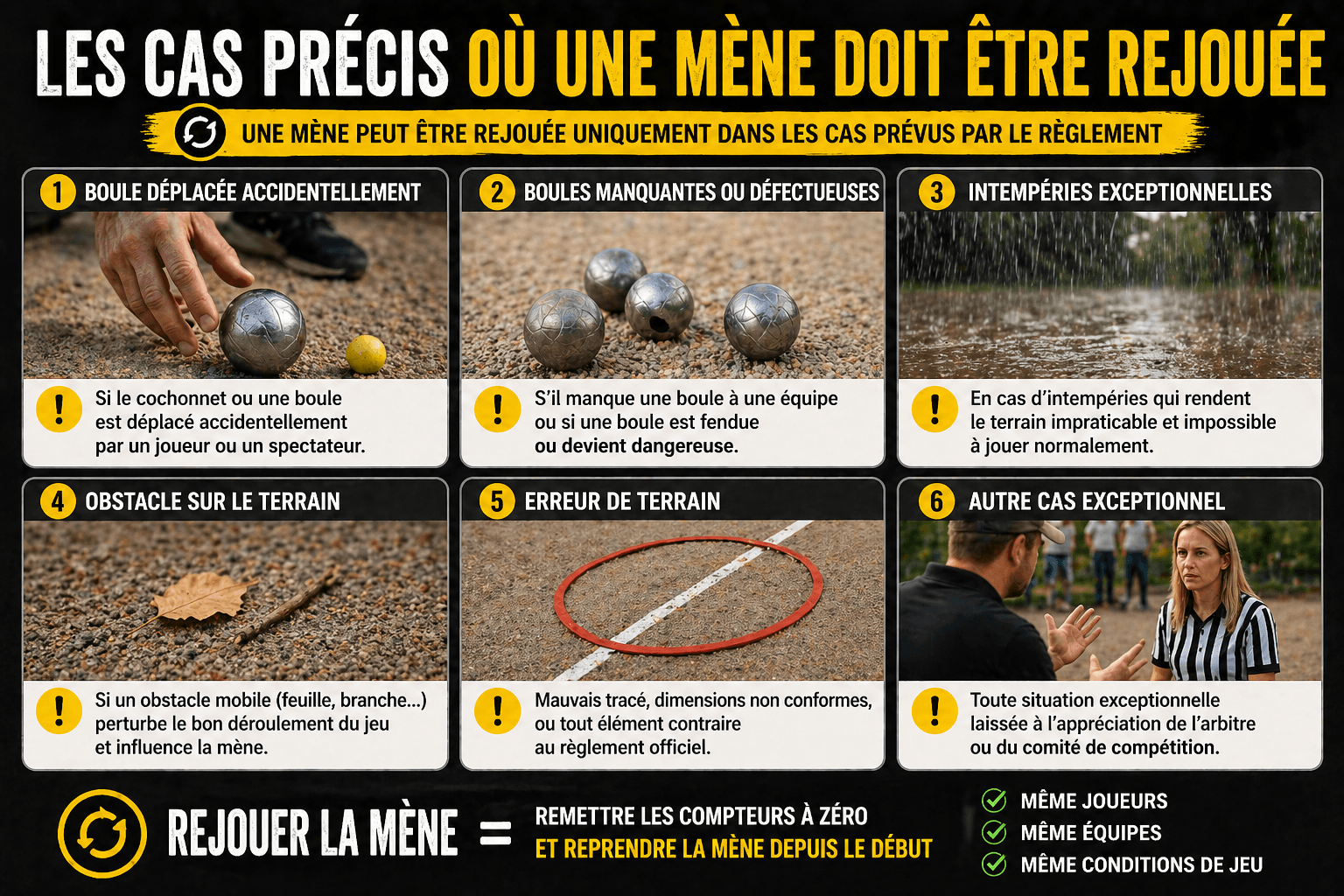
The specific cases where an end must be replayed
Jack out, a dead boule, a disrupted terrain... Not every end counts. There are specific regulatory situations where an entire end must be cancelled and replayed. Paquita lists them all with the FIPJP rule articles.Replayed end vs dead bowl — the fundamental distinction
⚖️ KEY DISTINCTION Two levels of cancellation in the rulebook The FIPJP rulebook provides two distinct levels of cancellation, often confused:The dead bowl — cancellation of a single throw. The bowl is removed from play or must be replayed individually. The other bowls already played remain in place. Play continues from the current situation.
The cancelled and replayed end — cancellation of the entire end from its beginning. All bowls played are removed, the jack is put back in the same place, and the end starts over completely as if it had never happened. No point is scored for the cancelled end.
The key to the distinction : the dead bowl applies when the incident affects only a specific throw. The cancelled end applies when the incident affects the end as a whole — either because its foundation (the jack) is invalid or has disappeared, or because the terrain has been disrupted beyond repair to the point that a fair result cannot be determined. 🎙️ Paquita on replayed ends "The replayed end is the most frustrating decision in the rulebook — especially for the team that was winning that end. I have seen players absolutely furious when an end with five good bowls close to the jack is cancelled because the jack rolled out of bounds. Legally it is correct — but humanly it is hard. What helped me accept it: understanding that the replayed end protects fairness. If the foundation of the end (the jack at a valid distance, visible, in play) is compromised, the result of that end is not reliable. Cancellation, however frustrating, is the only fair decision." — Paquita
The 8+ cases that require an end to be replayed
1 🟡 The jack goes out of bounds during the end END REPLAYEDDuring the end, a shot or a powerful drive sends the jack beyond the boundaries of the terrain. The jack is no longer in play — it is outside the regulatory limits. The end cannot finish normally without a jack in play.
APPLICABLE RULE When the jack goes out of bounds during the end, the end is cancelled. The jack is put back in its original position (or at the throwing position of the initial jack if the spot is disputed), and the end starts over completely. SUBTLETY If both teams agree (or if the tournament's specific regulations provide for it) that a player who "knocked" the jack out of bounds automatically loses the end — this alternative rule may apply in some local tournaments. But under the standard FIPJP rulebook: cancellation and replay. 2 🔍 The jack becomes invisible from the throwing circle END REPLAYEDDuring the end, the jack is buried in the sand or mud, hidden behind a bump, fallen into a hollow or pushed into an area from which it is no longer visible from the throwing circle. The rulebook requires the jack to be visible from the circle for the throw to be possible.
APPLICABLE RULE If the jack is no longer visible from the throwing circle and its position cannot be restored, the end is cancelled. Exception: if all the bowls have already been played and the result can be determined despite the invisibility (all the bowls are counted), the end may stand at the umpire's discretion. COMMON CASE Sandy terrain after heavy rain — the jack gradually sinks in. Or terrain with dense vegetation where the jack disappears into the grass after a shot. In such cases, the umpire may decide to stop the end immediately to avoid playing in non-compliant conditions. 3 📏 The jack was thrown outside the regulatory distances — discovered late DEPENDS ON WHEN IT IS DISCOVEREDThe jack was thrown less than 6 metres or more than 10 metres from the circle (standard regulatory distances). This was not challenged immediately. It is noticed after several bowls have been played.
APPLICABLE RULE DEPENDING ON TIMING If the non-compliance is challenged before any bowls are played → the jack is put back at a compliant distance. If the non-compliance is discovered after bowls have been played → the rule varies according to interpretations and umpires, but in most cases: cancellation and replay of the end from the start. PRACTICAL LESSON Check the jack's distance BEFORE playing the first bowl. Once the first bowl is played without challenge, the teams have often implicitly accepted the validity of the jack throw. But this is not an absolute rule — a strict umpire may cancel even after several bowls if the non-compliance is proven. 4 🚫 The jack is thrown dead by the player who had the right to throw it RE-THROW THE JACK / END REPLAYEDThe team with the right to throw the jack (winner of the previous end) throws the jack but the throw is dead — too short, too long, out of bounds, not visible. The team that had the right to throw has missed its valid jack. What happens?
APPLICABLE RULE Under the FIPJP rulebook: if the team throwing the jack makes a dead throw, the opposing team has the right to throw it instead, within the regulatory zone. If the opposing team also throws dead, the end is replayed from the same circle, but it is the team that originally had the right to throw that throws the jack again. IMPORTANT POINT The "replayed" end in this case keeps the same player to throw the jack — the one who originally had that right. The right to throw the jack does not change just because the end is replayed due to a dead jack from both teams. 5 🐕 The terrain and the bowls are disrupted by a third party (animal, outsider) END REPLAYEDA dog runs onto the terrain and moves several bowls and the jack. A child comes onto the terrain. A bowl from an adjacent terrain arrives and moves several bowls at once. The original situation cannot be faithfully restored.
APPLICABLE RULE If the positions of the bowls and the jack cannot be restored to their exact positions before the incident (because they were not marked, or because the movement was too great), the end is cancelled and replayed. If the positions can be faithfully restored (everything was marked), put them back and continue the end. THE KEY: marking If the bowls and the jack had been marked before the incident, restoring them is possible and the end continues. Without marking, the original situation is unrecoverable → end replayed. Once again, marking avoids an unwanted replay. 6 ⭕ The entire end was played from the wrong circle END REPLAYEDThe players got the wrong terrain or played from a circle that was not the one for the end in progress — for example the circle of a previous end still visible on the ground, or on an adjacent terrain. All the bowls were thrown from the wrong spot.
APPLICABLE RULE An end played from a non-compliant circle (wrong location) is dead in its entirety. It must be replayed from the correct circle. The discovery may be made during or after the end — in both cases cancellation applies. PREVENTION This case mostly arises on pétanque courts with several adjoining terrains and unclear boundaries. Systematically check at the start of each end that the circle used matches the correct terrain and the correct end. 7 🧑⚖️ The umpire or the organisation made a mistake during the end DEPENDS ON THE SEVERITYThe umpire made an incorrect announcement that led a player to change their behaviour (for example falsely announcing that a bowl was dead when it was valid). The organisation incorrectly placed the jack or created an invalid playing condition through its action.
APPLICABLE RULE The umpire has the power to have an end replayed if their error compromised the fairness of the result. This decision is a matter of their judgement. If the error significantly influenced the players' behaviour during the end (a player did not play a bowl because they thought their previous bowl was dead), a replay may be justified. SENSITIVE CASE Umpiring errors do not automatically lead to a replay — only if the error materially affected the end beyond repair. The umpire has a responsibility to make this decision with discernment. 8 ⛈️ Weather interruption with loss of positions during the end DEPENDS ON WHETHER THEY CAN BE RESTOREDA storm forces the end to be interrupted. During the interruption, the bowls and the jack are moved by the rain, picked up by the players, or their positions can no longer be identified with certainty when play resumes.
APPLICABLE RULE If the positions can be faithfully restored (marked before the interruption, photos taken), the end resumes from the state of interruption. If the positions cannot be restored, the end is cancelled and replayed in full from the start. In official competition, the umpire decides case by case. GOOD PRACTICE In case of threatening clouds or unsettled weather, taking a photo of the layout during the end is a precaution that can avoid a cancellation. 9 🔄 "Blank end" situation — both teams have all their bowls in play with a perfect tie END REPLAYEDThe end finishes and it is impossible to designate a winning bowl — either because two bowls from the two teams are exactly the same distance from the jack (strictly equal measurement, confirmed by the umpire), or because a situation creates a technical deadlock on awarding the point.
APPLICABLE RULE In the event of a perfectly equal distance confirmed by the umpire (the measuring instruments cannot decide), the end is dead — it does not count and is replayed. No point is awarded for this end. A very rare case but documented in top-level competitions. RARE IN PRACTICE Millimetre-level measuring generally settles close situations. A blank end from perfect equidistance is exceptional but possible — particularly on a perfect terrain between very high-level players with identical bowls.Who throws the jack for the replayed end?
📜 FIPJP RULEBOOK — WHO THROWS THE JACK ON THE REPLAY "When an end must be replayed, the jack is thrown by the team that had the right to throw it during the cancelled end. If the end is cancelled because both teams threw a dead jack (case 4), it is the team that had the right to throw first that throws the jack again." Summary of the FIPJP rulebook. Refer to the official text for the exact wording. 📌Replaying an end does not put the rights back into play. The team that had the right to throw the jack (because it won the previous end) keeps that right for the replay. A cancelled end is not a lost end — it is as if it had not taken place. The rights arising from the even earlier end remain.
What does NOT justify replaying an end
As important as knowing the cases for a replay: knowing the situations that do not entitle you to one. Many players invoke a replay in situations where the rulebook does not provide for it.
❌ A bowl deflects off a stone or a natural irregularity A stone deflects a bowl in a totally unexpected way and changes the result of the end. The bowl that could have been close to the jack ends up far away. ✓ What really happens: the result stands. Natural irregularities of the terrain are part of the game. They justify neither a dead bowl nor a replay of the end. ❌ A player missed their decisive shot at the end of the end "I wouldn't have missed if I'd known the end was this important." Or "I wasn't focused." The result of a miss never justifies a replay. ✓ What really happens: the end counts. Players' technical errors are part of the game — no individual error justifies cancelling an end. ❌ An opposing bowl that looked dead was actually in play A bowl everyone believed was out of bounds was actually inside. It influenced the end's strategy. Discovered after the fact. ✓ What really happens: if the bowl is confirmed in play, it counts at its position. Game decisions made on wrong information from the opponent belong to the opponent — they should have challenged at the right time. ❌ The opponent played making noise or putting the player off An opponent talks, moves or makes noise during a player's throw. The throw is missed. Request to replay the end for "outside noise". ✓ What really happens: the individual bowl may possibly be replayed if the disturbance was deliberate and noted by an umpire. But not the whole end. Deliberate disturbance is sanctioned differently (warning, point awarded). ❌ The jack changed position between two throws with no identifiable cause Nobody saw anything but the jack seems slightly different from its previous position. Suspicion but no proof of movement. ✓ What really happens: without proof or witnesses of a movement, the jack is at its current position. Mere suspicion does not justify cancelling an end. Prevention is systematically marking the jack. ❌ The counting of the bowls seems wrong but no one can prove which Disagreement over the end's score — one says 2 points, the other says 3 points. Without agreement, one asks for the end to be replayed. ✓ What really happens: the umpire decides the score. If the bowls are still in place, they measure and count them. If they have been picked up without agreement, the lower score is kept (benefit-of-the-doubt principle according to local regulations). The end is not replayed over a counting disagreement. ⚠️ ABUSE OF THE REQUEST TO REPLAYRequesting the replay of an end without solid regulatory grounds is a waste of time and a source of unnecessary tension. In tournaments with umpires, an unfounded request for a replay can lead to a warning for obstructing the smooth running of play. Knowing the legitimate cases avoids abusive requests — and allows you to vigorously defend legitimate requests when they genuinely arise.
Summary table — replay or not?
| Situation | End replayed? | Condition | Who replaces the jack |
|---|---|---|---|
| Jack goes out of bounds during the end | Yes — always | As soon as confirmed out of bounds | Team that had the initial right |
| Jack not visible from the circle | Yes — unless all bowls played | If impossible to restore or make visible | Team that had the initial right |
| Jack thrown outside the regulatory distance | Depends on timing | Before 1st bowl → replace; after → generally replay | Team that had the initial right |
| Both teams threw a dead jack | Yes — always | As soon as both throws are dead | Team that had the initial right |
| Irreparable outside disruption | If positions cannot be restored | Prior marking = no replay | Team that had the initial right |
| End played from the wrong circle | Yes — always | As soon as the error is discovered | Team that had the initial right |
| Serious umpiring error | Depends on severity and impact | Umpire's decision | Depending on the umpire's decision |
| Blank end (perfect tie on measurement) | Yes — always | After confirmation by the umpire | Team that had the initial right |
| Natural irregularity of the terrain | No | Natural terrain = normal playing conditions | — |
| A player's individual miss | No | Individual errors = part of the game | — |
| Score disagreement after the bowls are picked up | No | Umpire decides — minimum score kept | — |
The tactical impact of a replayed end
A replayed end is not tactically neutral. It creates a new situation that can advantage or disadvantage teams depending on their profile.
♟️ TACTICS Who is advantaged by the replay? The team that was losing the end is mechanically advantaged by the replay — it gets back an end that was going against it. This is not a bias of the rulebook, it is simply the nature of cancellation: an end in progress is more often in a state favourable to one team than the other.The psychological reaction to a replay is a real factor. The team that "loses" its good bowls on a replay decision may be destabilised and perform less well on the replay. The team that benefits from the replay gets an extra boost of motivation. These psychological factors are real but unpredictable.
Strategy on a replayed end : the team that had the right to throw the jack throws it again — and may choose a slightly different placement from the first to change the conditions in its favour for the replay. Within the regulatory limits, choosing your jack wisely takes on its full meaning on a replay. 🧘 Managing the frustration of a replay
Your team was leading 5 bowls to 0 in the end and a replay decision wipes it all out. How to react? The mental rule I apply: the replayed end is a new end — not the lost end. Fighting the replay decision (which is regulatory) in your head during the replay means playing with a mental disadvantage. Accept the decision, breathe, and approach the replay as a new end with the same calm as any other. Teams that have mentally trained for this win replayed ends more often than those that stay stuck on the cancelled end.
📖 PAQUITA'S BOOK The rulebook mastered — from A to ZReplayed ends, dead bowls, measuring disputes, the one-minute rule, players' rights... Paquita's book covers every regulatory situation with practical exercises to apply them without hesitation.
📦 Order on AmazonFAQ — Your frequent questions
If the jack goes out of bounds at the very end of the end — when all the boules have been played — is the end still replayed? + This is one of the most complex and debated situations. If all the boules have been played before the jack goes out — for example, the last shot sends the jack out of bounds after all the boules of both teams have been thrown — the strict application of the rules generally provides for the cancellation of the end because the jack is no longer in play. However, some umpires and certain local rules allow the end to be considered complete at the time of the last throw, with the positions noted at that moment. This is a case where asking the referee immediately is the best decision — not trying to resolve this between players. If an end is replayed and the score was close — do the previous ends still stand? + Yes — replaying a lead only affects that lead. All previous ends which were played normally and whose points were counted and validated remain in the score. Replay only clears the current lead, not the game history. If the score was 7-5 and the current lead is canceled, we return to 7-5 and we replay the current lead. Can we refuse to replay a match if both teams agree to validate the result? + In informal games and competitions without a referee: yes, the agreement of the two teams can validate a result even under conditions which would theoretically have required a replay. Pétanque is a conventional game and players can agree on adaptations by mutual agreement. In official competitions with referees: no — the referee applies the rules regardless of the wishes of the players. If the rule requires a replay, the referee can order it even if both teams agree to validate the result. The regulations take precedence over player agreements in official competitions. How many times can the same play be replayed? + The FIPJP regulations do not set a limit to the number of times a lead can be replayed. Theoretically, if each replay itself produces a cancellation situation (two successive zero jacks, for example), the end can be replayed several times. In practice, in the case of a draw for both teams, after the second replay the lead must generally be ended with a jack placed at the minimum regulatory distance. The referee often has the latitude to find a pragmatic solution to avoid an infinite loop of replays. 📎 Related articles Rules Complete FFPJP rulebook 2026 Rules The little-known rules of pétanque Rules The one-minute rule Rules Ground marks — what is allowed Rules Smartphone video umpiring Tools Free PetanqueLand tools© Pétanque by Paquita — petanqueland.fr ·
📖 Paquita's book on Amazon
The regulatory summaries in this article are practical syntheses. For any official competition, refer to the official text of the FIPJP rulebook in force and the specific regulations of the tournament.