Règlement FFPJP · 5 July 2026
Boule out of bounds in pétanque: does it still count under the rules?
Official FFPJP rule on boules off the terrain: open terrain, delimited terrain, edge cases. The method to never doubt again.1.What Article 19 of the rules actually says
Article 19 of the official FFPJP-CMSB rules defines the void boule and specifies the circumstances in which a boule that leaves the playing area ceases to count. It distinguishes between two very different situations: open ground (friendly games, unmarked areas, gardens) and a marked playing area (competitions, marked lanes, boulodromes with lines).
The general rule is simple: a boule that goes out is dead. But the definition of out changes completely depending on the type of playing area. On open ground, a boule remains valid as long as it stops within the permitted area (often an informal boundary extending 1 m around the intended landing area). In a marked playing area, the rule is stricter: crossing the dead-ball line completely makes the boule dead.
2.Open ground: the permitted-area rule
On open ground, the rules provide for a minimum permitted playing area. Common sense and friendly-play conventions dictate that a boule remains valid as long as it has not left this area, which often takes the form of an imaginary boundary around the jack. If you are playing in a garden with no lines, your boule is valid unless it has clearly left the playing area agreed with the opposing team.
When in doubt, the rule is in favour of the boule : a boule that stops 5 metres from the jack without crossing any marked boundary remains valid. This tolerance disappears as soon as there is a line on the ground.
3.Marked playing area: the dead-ball line rule
In a marked playing area (official competition, boulodrome with lines, numbered lanes), it is the dead-ball line that determines whether the boule is dead. The official rules state that a boule is dead as soon as it completely crosses the dead-ball line, meaning that the whole boule passes beyond it.
This rule also applies while the boule is moving: if it goes completely out and then returns to the playing area (after rebounding off an obstacle, for example), it remains dead. This is what is known as crossing the dead-ball line. The boule does not become valid again if it comes back in.
The rule differs depending on whether the boule is still moving or has already come to rest. While moving, crossing the line completely makes the boule dead, even if it comes back. At rest, the boule is dead only if it is entirely beyond the line - if even the smallest part is still in play, the boule remains valid.
4.Summary table: open terrain vs marked-out terrain
Here are the main situations encountered on the terrain and the rule that applies for each type of playing area:
| Situation | Open terrain | Marked-out terrain |
|---|---|---|
| Boule at rest 5 m from the jack | Valid | Valid if within the boundaries |
| Boule straddling the dead-ball line | N/A | Valid |
| Boule completely across the line | Dead if outside the area | Dead |
| Boule that went out and came back in | Valid | Dead |
| Boule struck by a displaced object | Valid | Depends on the situation |
| Boule that rebounded off an obstacle | Valid | Depends on the obstacle |
5.Case no. 1 - The boule stops on the line
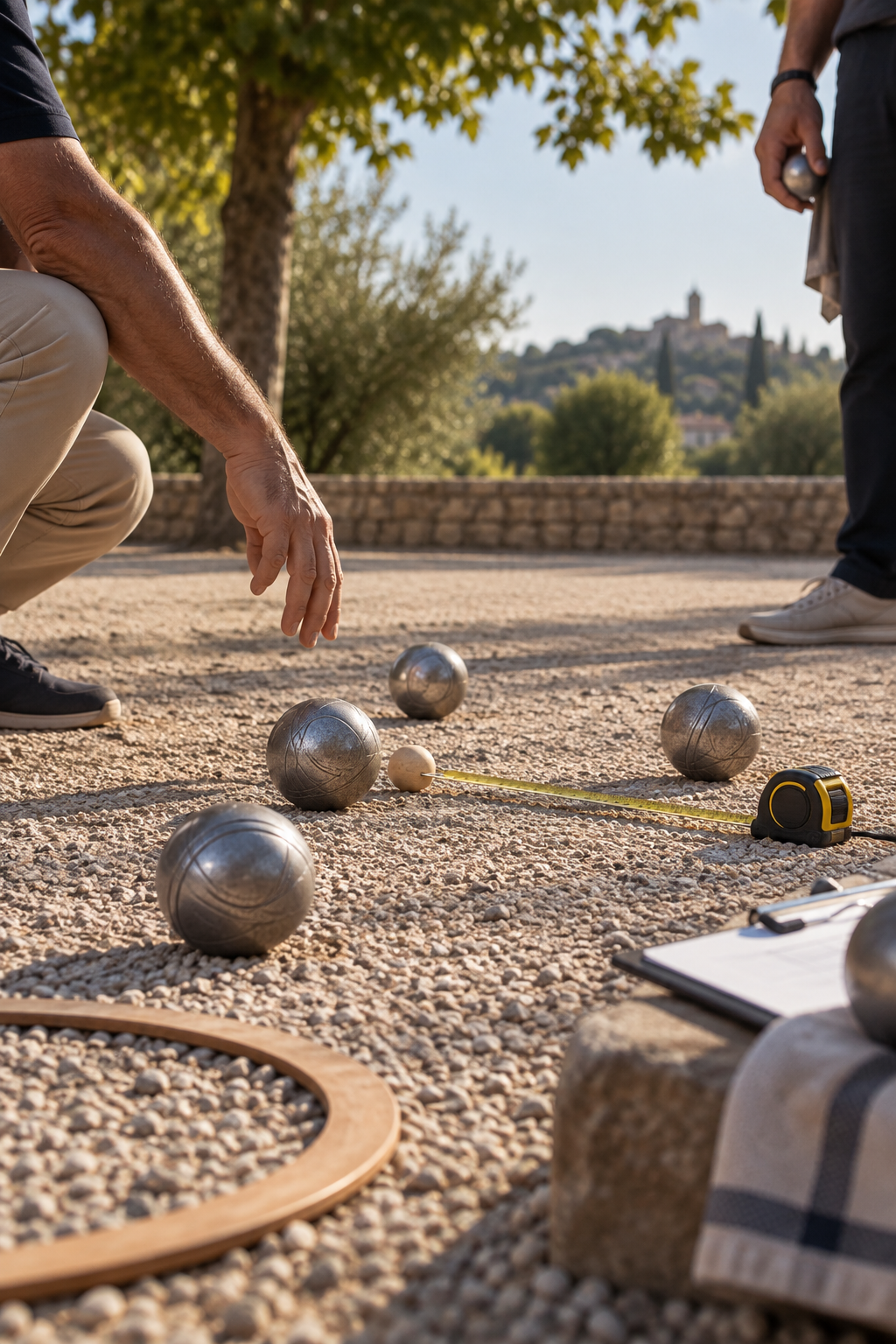
Your boule comes to rest straddling the dead-ball line : half in play and half out. Does it count? YES. The rules are explicit: the boule is dead only if it has completely crossed the line. Even the smallest part of the boule remaining inside is enough for it to be valid.
In practice, this rule causes plenty of debate on the terrain. It is best to agree on how to judge it: stand perpendicular to the line and check whether the boule's footprint on the ground is completely beyond it. If in doubt, call the umpire or rule that the boule is valid.
6.Case no. 2 - The boule goes out and then comes back
You hit an opponent's boule on the full and it shoots away, crosses the dead-ball line while still moving, then rebounds off an obstacle (wall, backstop or bag) and comes back onto the terrain. Is this boule valid? NO, it is dead on marked-out terrain.
The rules refer to reaching the dead-ball line in the sense that the boule has crossed it completely, even if only temporarily. At that point it is permanently dead and must be removed from play. This rule may seem harsh, but it prevents arguments over whether a miraculous rebound should count.
7.Case no. 3 - The boule crosses in the air and then hits the ground
Your boule goes out through the air (without ever touching the ground on the terrain), lands out of bounds, then rolls back and finishes on the terrain. It is dead because its first contact with the ground was outside the marked-out terrain. Under the rules, a boule must have touched the ground within the permitted area first in order to be valid.
This rule surprises many beginners. The principle is that where the boule lands matters more than where it comes to rest. A boule that comes in over the wall is not considered to have been played legally.
8.Case no. 4 - A playing area with no lines
How should this be judged on a village terrain with no marked lines? The rules leave it to the agreement between the teams before the game: set the boundary at the hedge, the wall or the row of boules from the previous end. If no prior agreement has been reached, the principle is that only a reasonable playing area is valid - a boule that clearly travels too far away (5 or 10 metres beyond it) is considered dead as a matter of common sense.
To avoid these situations, the rules recommend marking a dead-ball line whenever there is any doubt: use a visible object (bag, board or rope) to mark the boundary. This guarantees there will be no disputes during the game.
Before every game on open terrain, reach an agreement 30 seconds with the opposing team to define the playing area. Point out the limits: as far as the bench, the hedge or the row of paving stones. This habit prevents 99% of arguments about boules going out - and keeps the game friendly.
To learn more, read our article on the throwing circle and how to mark it and our feature on the rule on foot position. Our section little-known rules and our free tools provide further information.
Marked-out terrains, uneven surfaces and dead-ball areas: every configuration requires its own adjustments to your game. This guide shows you how to read a terrain and adapt your strategy, from departmental competitions to National finals.
Discover the guide