Actualités · 6 February 2026
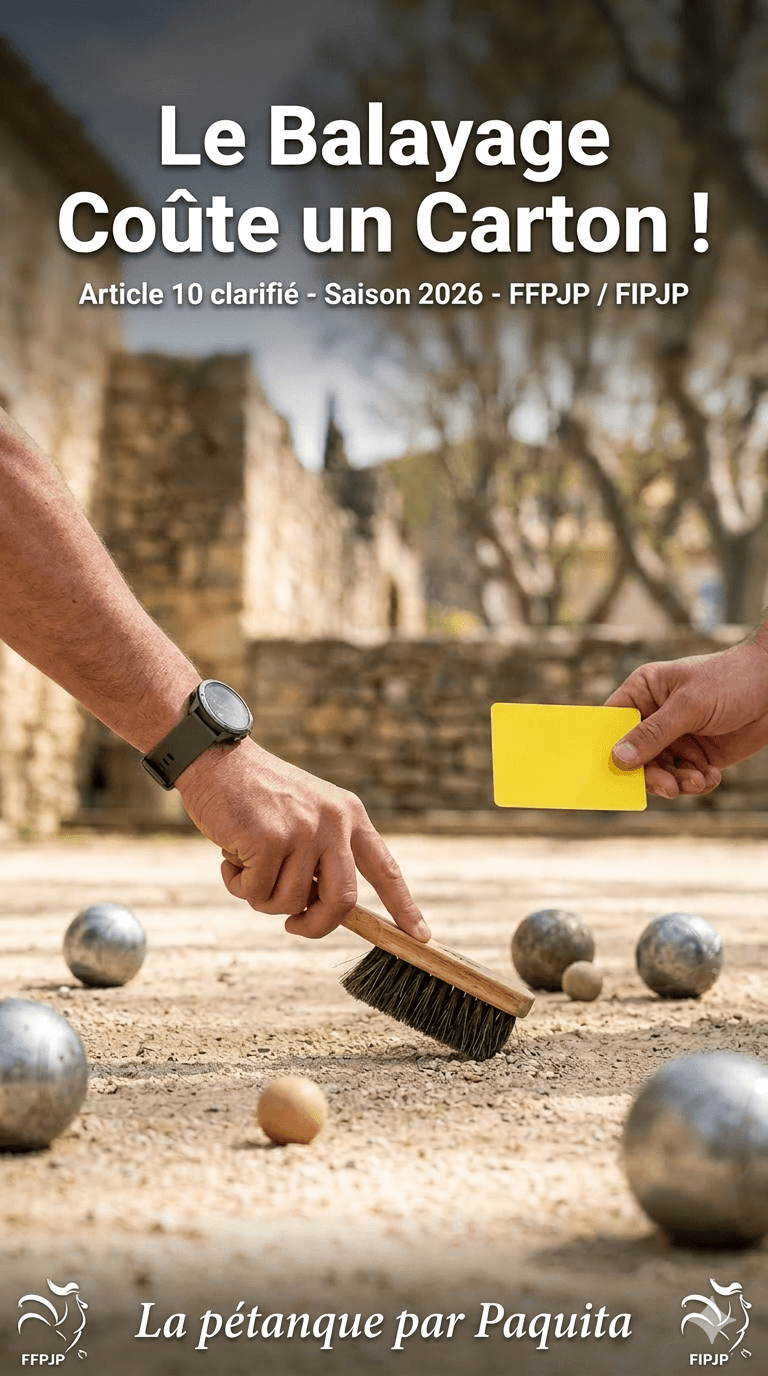
2026 Pétanque Rules Alert: Sweeping Costs a Card!
FFPJP alert: From 2026, Article 10 toughens the penalties for sweeping the terrain. Discover how to avoid a card and stay within the rules this season.Why the FFPJP changed Article 10
For several seasons, umpires had faced a recurring difficulty: the interpretation of sweeping. Some players took advantage of a grey area in the text to discreetly level the terrain before shooting, without it formally constituting an offence. This ambiguity generated repeated disputes on competition terrains.
The FFPJP (Fédération Française de Pétanque et de Jeu Provençal) has therefore decided, for the 2026 season, to rewrite Article 10 in order to remove any ambiguity. The aim is twofold: to standardise the application of the rules across all terrains in France, and to strengthen sporting fairness between teams. This shift is part of a broader movement back towards a rougher, less "arranged" pétanque — a movement we analysed in detail in our article on the 2026 rules and the return to wild pétanque.
This change doesn't come alone: it's part of a package of 2026 reforms that also affect the rigid circle now made mandatory and the marking of the jack now strictly regulated.
📌For an overview of all the new regulations, see our FFPJP rules explained page — all the rules in detail, article by article.
What the new rule actually says
Article 10 of the Official Rules is now worded categorically. In short:
📜 Art. 10 — Key principle (reworded 2026)It is strictly forbidden to alter the state of the terrain by sweeping, raking or watering before shooting or pointing, wherever this action changes the configuration of the playing surface. The player's intent is not required to establish the offence: it is the observed result that prevails.
The key concept here is that of "alteration of the surface". The text does not penalise the gesture itself, but its concrete result on the terrain. In other words, even an unintentional sweep that slightly hollows the ground can be deemed an offence.
This logic is consistent with other measures in the 2026 rules. For example, the ground markings are also subject to tighter regulation this season. The general spirit is the same: the terrain is accepted as it is, and any attempt to adapt it to one's game is punishable.
What's allowed vs what's forbidden
To avoid nasty surprises, here are concrete examples of situations you'll encounter on the terrain:
✓ ALLOWEDGently pushing a dead leaf out of your line of sight, without applying pressure to the ground.
✗ FORBIDDENSweeping a cluster of gravel and leaving a slight hollow in the ground, even of just 2 mm.
✓ ALLOWEDPicking up a thin branch lying on the surface without brushing the ground or leaving a mark.
✗ FORBIDDENWatering a dry patch to help the bowl grip, even slightly and discreetly.
✓ ALLOWEDObserving and analysing the terrain at length without touching it before shooting.
✗ FORBIDDENFlattening a small bump on the path with your foot before pointing, even "by reflex".
✓ ALLOWEDAsking the umpire whether a particular piece of debris can be removed before acting.
✗ FORBIDDENRaking with your hand or foot to create a smoother shooting lane in the gravel.
From now on, doubt must systematically favour inaction. In case of hesitation, the golden rule is simple: don't touch anything, ask the umpire. To go further on the umpire's role and tools, read our article on laser measuring and video umpiring which is making its way into clubs.
The sanctions: From White to Red, beware!
Umpires now have precise guidelines on the escalation of sanctions linked to Article 10. Three card levels, three levels of offence:
! White CardFirst minor offence. The alteration of the terrain is minimal and clearly unintentional.
Example: brushing the ground while removing a stone. !! Orange CardRepeat offence or a more significant alteration. May result in the loss of a bowl or a point for the team.
Example: a second incident in the same game, or a visible hollow in the ground. !!! Red CardSerious and deliberate offence. Exclusion of the offending player or the entire team from the competition.
Example: a visible and intentional raking just before a decisive shot.Summary table of sanctions
| Situation | Type | Applicable sanction |
|---|---|---|
| First offence, minimal alteration, unintentional | White Card | Simple warning — the bowl played remains valid |
| Repeat offence in the same game | Orange Card | Loss of the bowl played or a point for the team |
| Significant but not blatant alteration | Orange Card | Loss of the bowl + a collective team warning |
| Deliberate and blatant offence | Red Card | Exclusion of the player — the game continues without them |
| Collective offence or attempt to conceal | Red Card | Exclusion of the entire team — forfeit for the match |
Before your first competition, make sure your licence is in order! The FFPJP has introduced a new digital system in 2026: everything you need to know about the new FFPJP licence with QR code.
The strengthened role of umpires in 2026
The clarification of Article 10 comes with a stronger umpiring body. Umpires have been instructed to apply the new rules without excessive leniency during the final phases of competitions, while remaining educational during the preliminary rounds.
In practice, umpires are now trained to actively observe players' behaviour before their throw, and not only at the moment of the shot. The sweeping gesture that precedes entering the circle is now within their field of attention.
With the arrival of new tools such as laser measuring, umpires have more and more means to document and settle disputes. The era of "he started it" is slowly coming to an end. Videos of real umpiring situations are available in our Umpiring category.
Let's also remember that umpires apply other strict rules in parallel: the regulated playing time, the compliance of the rigid circle, and the valid jack throw. The 2026 season demands overall discipline.
Our practical tips to avoid getting a card
Good news: with the right reflexes, this rule doesn't change anything about your game. Here are four habits to adopt right now:
- Observe without touching Take 5 to 10 seconds to read the terrain visually before acting. Identify potential obstacles without putting your hands down. A good shooter analyses first, then acts.
- Consult the umpire beforehand If a large piece of gravel or a branch seems troublesome to you, report it to the umpire before before acting. They may authorise you to remove it, or advise against it. It's your best protection against an unfair card.
- Adopt a minimal and precise gesture If a piece of debris can clearly be removed without altering the ground, use two flat fingers — never a wide sweep. Every square centimetre touched is a potential risk. The less you move, the better.
- Build this constraint into your training Play your training sessions with this rule active. It's the best way to turn it into a natural reflex before competitions. Your brain adapts quickly when the constraint is repeated.
While we're on the subject of respecting the rules: do you know the new rule on clothing? Jeans are now banned in official competition. And on the subject of bowls, check out our guide to choosing the best bowls in 2026.
FAQ — Your frequently asked questions about Article 10
Can you remove a dead leaf before shooting? + Yes, as long as you do it without putting pressure on the ground. If the sheet is placed on the surface and your action leaves no trace, it is tolerated. If in doubt, ask the referee before acting. Is the offense upheld even if it is involuntary? + Yes, this is the great novelty of the 2026 text. The intention is not necessary: it is the observable result who counts. If the pitch is modified, even by reflex, the infraction can be upheld - the white card remaining the usual sanction for a first unintentional incident. Is a white card erased at the end of a round? + No. In the majority of competitions, the white card remains recorded in the match record. A second incident in the same meeting is therefore automatically treated as a repeat offense, even if the first was considered minor. Does Article 10 also apply to recreational games? + Officially, the FFPJP regulations only apply to approved competitions. During leisure games, it is the understanding between players that takes precedence. That said, adopting good training habits will protect you from bad reflexes in competition. Can a teammate sweep instead of the shooter? + No. The rule applies to the entire team, not just the player making the throw. If a teammate modifies the field before another plays, the infraction is held against the team. Mandatory collective vigilance! Where to read the full text of Article 10? + The official regulations are published by the FFPJP on its website. On PétanqueLand, we have also identified and explained all the official rules in plain language to help you find your way quickly. 📎 Related articles 2026 Rules The return to "wild" pétanque — what it really changes 2026 Rules The rigid circle: the definitive end of the hand-drawn circle 2026 Regulations 30 seconds on the clock: the pressure rises for pointers 2026 Rules The end of the "hidden jack": you can no longer mark the jack Refereeing Laser measuring: video refereeing is coming to your clubs 2026 Rules The great return of ground marks: habit or drift? Administrative New paperless FFPJP licence with QR code Equipment Which boules to choose to dominate the 2026 season? Videos All the Refereeing videos by Paquita© Pétanque by Paquita — petanqueland.fr
Informational content based on the 2026 FFPJP rules. Unofficial.