Règlement FFPJP · 23 June 2026
Measuring dispute in pétanque: who is right according to the rules?
Measuring disputes in pétanque: what the official FFPJP rules say, who measures, who settles it, and how to avoid conflicts on the terrain.1.The golden rule: “the one who disputes must measure”
It's the first non-negotiable rule of the official rules: when two teams disagree on the point, it is up to the disputing team to carry out the measurement. The team claiming to have the point does not, in theory, have to prove it — it is up to the doubting opponent to show otherwise. In practice, the roles are often reversed out of politeness, but the rule remains the original one: the burden of proof falls on the one who disputes.
Why this rule? It aims to make accountable the players. Without it, anyone could raise a dispute at every end without ever bothering to check. The FFPJP rules thus preserve the flow of the game: you dispute, you measure; you don't dispute, you accept. That already defuses 80% of conflicts.
⚖️Practical consequence: if you can see the gap is clearly in your favour, say so calmly and wait. It is up to the other team to measure if they want to dispute. Measuring without being asked is not forbidden, but it can be seen as a lack of trust in the game.
2.The official hierarchy for resolving disputes
The FFPJP rules organise the resolution of a dispute in several successive steps, to be followed in order. As long as a step does not settle the matter, you move on to the next.
Step 1: measurement by the disputing team
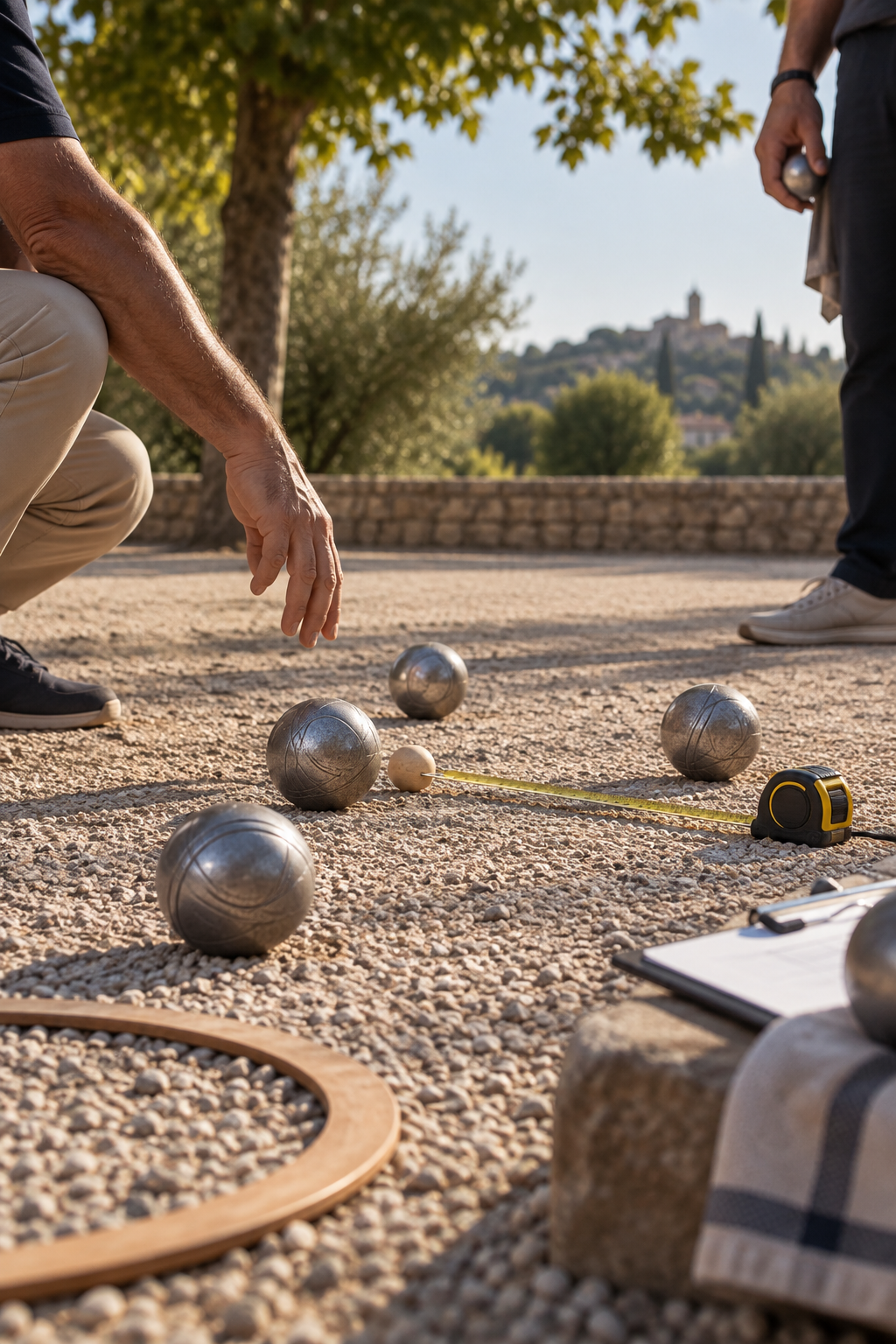
The first team to have doubts takes its tape measure or callipers. It measures the two boules in question against the jack, calmly, in front of the other players who can observe the procedure. If the result is accepted by both sides, it's over.
Step 2: counter-measurement by the opposing team
If the opposing team does not agree with the reading, it has the right to measure in turn, with its own tool. The official rules encourage double checking on very small gaps.
Step 3: measurement by a neutral third party
In friendly play, if the disagreement persists, a player from another team or a neutral spectator is designated to measure a third time. Their reading prevails. It is the informal equivalent of the umpire.
Reliability scale of decision-makers (possible sources)
Official FFPJP umpire10 / 10 Designated neutral player8 / 10 Disputing team (1st measurement)7 / 10 Team holding the point (self-measurement)5 / 103.The decisive role of the umpire in competitions
In an official competition (departmental, regional, national, championship), any dispute unresolved after two contradictory measurements must necessarily be referred to a federal umpire. It is he — and he alone — who decides. The rules specify that his decision is without appeal : no complaint can be made about the result of an umpired measurement.
The umpire has calibrated callipers, sometimes a federal gauge, and applies the same procedure as a player, but his neutrality and experience prevail. He also has the power to sanction abusive behaviour: insults, continuous disputing, refusal to play, deliberate time-wasting. The FFPJP rules provide for warnings, then temporary or permanent exclusion from the game.
💡 Paquita's tipIn a competition, never try to measure an important dispute yourself when an umpire is available. You will save time, avoid emotional escalation, and the decision will be respected by everyone. Raise your hand, call the umpire politely, and let him do his job.
4.Comparison: friendly vs official competition
The FFPJP rules apply in full as soon as it is an official competition. In friendly play, customs are more flexible. The table below summarises the fundamental differences:
| Situation | Friendly play | Official competition |
|---|---|---|
| Who measures first? | Whoever wants (often the one holding) | The one who disputes, strict rule |
| Persistent disagreement | Neutral player / informal vote | Federal umpire, mandatory |
| Final decision | Consensus or compromise | Without appeal |
| Tool used | Tape measure, callipers, sometimes improvised | Calibrated FFPJP callipers |
| Possible sanctions | None | Warning, exclusion |
| Appeal after decision | Re-measurement if everyone agrees | None |
5.When measuring is impossible: the null end
An extreme case, but one clearly covered by the rules: if, after all the measuring, no difference can be established between the two boules closest to the jack, the end is declared null (article 28 of the official FFPJP rules). In practice, this means:
no team scores any points for that end; all the boules are picked up; you start over from scratch at the next end. The throwing circle is awarded to the team that threw the jack of the null end.
This situation remains very rare with calipers used correctly: calipers measure differences to the nearest tenth of a millimetre. A genuine perfect tie is exceptional, unless the two boules touch each other and touch the jack in exactly the same way — which is more akin to the "bouchon" case (boules against the jack).
📐If both boules are stuck against the jack ("kissing bouchons"), it is physically impossible to measure. In that case, the end is null by default, and it is quick to spot visually. No need for an umpire to decide.
6. How to avoid disputes before they happen
The best dispute is the one that never happens. Here are the best practices drawn from the official rules and the habits of good players:
Mark your boules on the ground
Before any measuring, draw a line with your finger or a stick in front of each boule concerned. The rules (article 13 FFPJP) state that an unmarked boule that has been moved is lost for its team. Marking is how you avoid this classic trap.
Do not touch the boules while the end is in progress
As long as the end is not over, nothing is moved. No "little adjustment", no boules picked up in anticipation. This is a major cause of avoidable arguments.
Ask before measuring
A simple "may I measure?" sets a calm tone. The opposing team agrees, watches, and the operation becomes a shared technical act, not a provocation.
Accept defeat with grace
When the measurement goes against you, simply say "well played". 90% of disputes arise from refusing to accept an objective result. The rules are neutral — your attitude should be too.
FAQ — Your frequent questions
What should I do if the adversary refuses my measure?+ Ask him to take his turn measuring with his tool. If the disagreement persists, call on a neutral player in a friendly, or the referee in a competition. The FFPJP regulation provides for this gradual escalation. Can we challenge an arbitrator's decision?+ No. The official FFPJP regulations specify that the decision of a federal arbitrator is final. Any dispute may result in a warning or even a sporting sanction depending on the seriousness. What if the referee is obviously wrong?+ Human error exists, but the regulations protect the principle of authority: the decision remains valid. You can report to the competition committee after the game, but the result of the round will not be changed. How many times can you remeasure?+ In a friendly manner, as much as necessary to obtain agreement. In competitions, the referee generally limits to two contradictory measures before deciding himself. Repeated measurements without justification are considered a waste of time. What happens if a ball moves during measurement?+ If the ball had been marked on the ground, it is returned to its original position and the measurement continues. Otherwise, the moved ball is lost for his team according to article 13 of the FFPJP regulations. 📎 Related articles RulesHow to measure the boules: official method RulesThe little-known rules of pétanque HomePétanque by Paquita© Pétanque by Paquita — petanqueland.fr ·
📘 Discover my books on PetanqueLand
Article based on the official FFPJP pétanque rules. Local club customs may add details without contradicting the federal rules.