Actualités · 16 April 2026
The psychology of the jack: Throwing it far or near to break the opponent?
Placing the jack is a major tactical decision that 80% of players improvise. Near or far, central or off-centre, against the boundary or in open terrain — every choice is a weapon. Paquita breaks down the psychology of the jack.What the rules say exactly
📋 FIPJP RULES — JACK PLACEMENT The jack must be thrown by the team that won the previous end, at a distance between 6 and 10 metres from the throwing circle — unless otherwise provided by the competition's specific rules. It must be visible from the circle (not hidden by a boule or an obstacle). If the team fails the regulatory placement twice, the opposing team gains the right to place it.The jack can be placed anywhere in the valid zone — in the centre, on the edges, in any lateral configuration, as long as it respects the distances and is visible. No rule imposes a "natural" or "central" position. All tactics start from there. ⚠️
See our complete article on distances: Regulatory playing distances 2026. The rule of the one-minute rule also applies to jack placement — you have a maximum of one minute to throw it after regaining the right to do so. See: The one-minute rule.
Distance — far or near: the tactical consequences
This is the first and most obvious of the decisions. It directly determines the comfort or discomfort zone of each player — yours and the opponent's. There is no absolute "right" distance — there is the distance that advantages you in the current configuration.
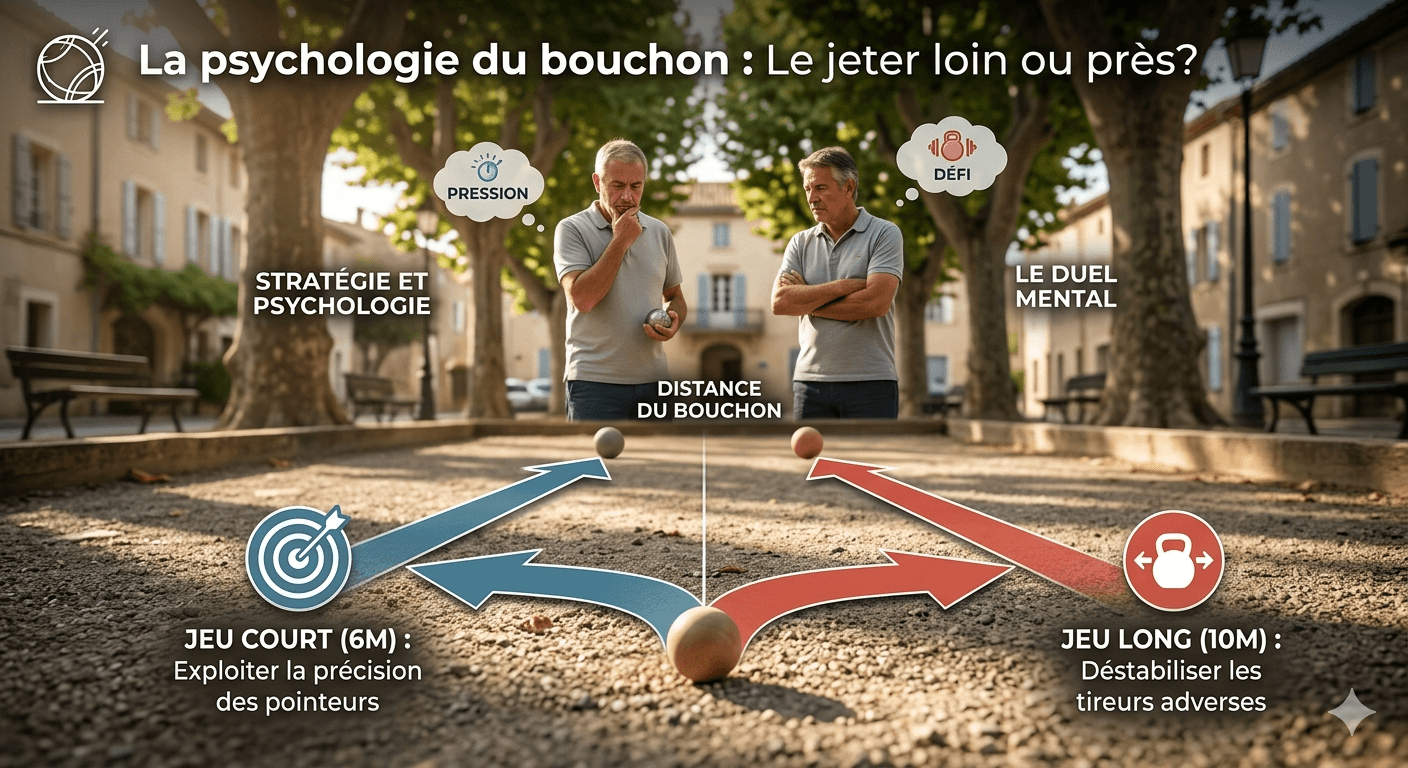
📐 THE 3 DISTANCE ZONES — TACTICAL EFFECTS 6–7m Short jack Compact play. Small margin of error for both teams. Advantage to the precise short-distance pointer. The shooter has less room for the fer. A zone of pure precision. Demanding in precision 7.5–8.5m Median zone ⭐ Comfortable distance for most players. Balance between pointing accuracy and feasibility of the fer. A "neutral" zone where both teams are on equal footing if their levels are equivalent. Balanced terrain 9–10m Long jack Extended play. Advantage to the long-distance pointer and the powerful shooter. Pointing accuracy decreases for everyone. Shooting au fer requires high speed. A zone of endurance and power. Advantage power/strength 🎯 Place short — the precision strategy Advantage precise pointer Risk if the opponent is equally preciseThe short jack (6 to 7 metres) creates a compact playing zone where every centimetre counts more. The boules are naturally closer to each other — disputes are more frequent but the margins of difference are also finer. At this distance, the quality of the release is paramount: a 5 cm variation in the action translates into a 15 cm difference on the boule. It is a distance that favours players whose action is deeply ingrained and who have fine precision at short range.
On the shooting side: the fer at 6 metres is harder to master for some shooters — the angle of attack is too short, the boule arrives almost vertically. This can benefit your pointer if the opponent has a shooter who is less comfortable at short distance.
WHEN TO PLAY SHORT Your pointer is excellent at short distance. The opponent has a powerful but imprecise shooter at short range. The terrain is irregular at long distance. You need to stabilise the end by securing a close point. ⚡ Place long — the power and endurance strategy Advantage powerful shooter Reduced precision for everyoneThe long jack (9 to 10 metres) radically changes the nature of the game. Pointing becomes less precise for everyone — the boules stop less often exactly where you would want them. This can suit a team whose shooter is excellent at long distance and who prefers a more aggressive than precise game. On long, open terrains, the 10-metre jack is also a declaration of intent: "we're playing for power".
Beware of fatigue: at the end of a long competition, long jacks tire the arms out faster. A long-distance strategy over 10 consecutive games can turn against you if your team tires before the opponent.
WHEN TO PLAY LONG Your shooter is dominant at 9–10 metres. The opponent is an excellent short-distance pointer but loses their precision at long distance. The terrain is regular and flat. You want to avoid ends that are too tight in the compact zone.Lateral position — centre, left, right, edge
Distance is the first dimension of placement. Lateral position is the second — and it is just as decisive. Each lateral position creates different angles of attack for the two teams, different obstacles, and different comfort zones.
⬆️ Centre of the terrainSymmetrical angles of attack for both teams. Neutral zone — no lateral advantage granted. This is the default placement, the least risky but also the least tactical. Suitable when you want balanced play.
Neutral / No surprise ↙️ Near the left boundaryForces right-handed players to point from an uncomfortable lateral angle. Advantage to players who master the left hand or the oblique angle from the right. It can also favour a shooter whose natural trajectory comes from the left.
Asymmetric / Tactical ↘️ Near the right boundaryThe reverse of the previous case. Favours right-handed players whose natural throwing axis is towards the left. Disadvantages players whose trajectory starts too far to the right. Useful if you know the opponent's deviation tendencies.
Asymmetric / Tactical 🏔️ On a terrain irregularityDeliberately placing the jack on or after a bumpy, stony area or one with a slight slope. Your team knows this irregularity (you have observed the terrain). The opponent will have to discover it during the end.
Knowledge advantage 🌿 In a shaded / different zoneThe texture of the terrain changes with humidity, sunlight, vegetation. Placing the jack in a terrain zone slightly different from what the opponent has calibrated can disrupt their read without them knowing why their boules aren't doing what they expect.
Subtle disruption ↩️ In the trace of the previous endPlacing the jack exactly in the traces left by the boules of the previous end (holes, ruts). These ground disturbances can deflect the opposing boules unpredictably — and you played there, you know these disturbances.
Double-edgedAdapting your placement to the opponent's profile
The best placement tactic is the one that maximises your advantage by taking into account the precise profile of the opposing team — not a general rule applied mechanically.
🎯 Against the precise mid-distance pointer Excellent at 7–8 metres, loses precision at the extremes Strategy: alternate a very short jack (6 m) and a very long one (9.5 m). Take them out of their comfort zone. Never give them two consecutive ends at their ideal distance. 💥 Against the dominant shooter Formidable shooter at all distances, weaker pointing Strategy: place short (6–7 m). At this distance, the fer is harder. Build up boules quickly so the shooter doesn't have enough clear targets. Play on volume, not on quality. 🤚 Against a known one-handed player Can only point with one hand, strictly right-handed or left-handed Strategy: place the jack systematically on the side of their non-dominant hand. Force angles that are unfavourable to their strong hand. Create situations where they must either point awkwardly or choose a sub-optimal angle. 😤 Against a nervous or frustrated team Reacts badly to changes of pace and the unexpected Strategy: vary systematically — short, long, left, right. Never be predictable. Variation itself is a weapon against a team that needs consistency to reassure itself. 🧊 Against a solid and consistent team Good at all distances, hard to destabilise Strategy: play at your preferred distance and optimise for yourselves rather than trying to disadvantage them. Against a balanced team, your best game is worth more than an opposing strategy. 🏃 Against a team that is slow to settle Takes time to analyse, deliberates at length Strategy: play at your fastest pace — within the one-minute rule — to stop them finishing their deliberations. The short jack also reduces the distance to walk to measure, speeding up the tempo. 🎙️ Paquita on reading the opponent "Before every competition, I watch the opposing teams for 5 minutes. I look at what distance they play their best ends, which side of the terrain they favour, whether their pointer holds their precision at long distance. This information is worth its weight in gold when it comes to placing the jack. Most teams have very readable habits — they always play at 7–8 metres, always in the centre. When you start playing at 6 metres on the left side, you see their faces change. That change of face is already a point won in their head." — PaquitaAdapting your placement to the score
The same player should place the jack differently depending on the score. The placement tactic is not fixed — it must evolve with the state of the game.
SCORE RECOMMENDED PLACEMENT LOGIC Well ahead (3–10+) Jack at your favourite distance. Known and mastered position. Avoid unnecessary risk-taking. Why: you're winning — play your best game, not the cleverest game. Let the opponent adapt to you. Tight match (close score) Find the distance and position that maximise your specific advantage against this particular opposing team. Why: close games are won on details. Every tactical choice counts more. Trailing (–4 or more) Change your habits — if you were losing at 7 metres, try 9 metres or 6 metres. Break your opponents' rhythm. Why: what wasn't working at that distance won't work any better if you carry on. Change is necessary. Decisive end (10–x) Play at your most consistent distance, the most central position, the most predictable ground. Minimise the variables. Why: under maximum pressure, safety takes priority over tactics. Your most ingrained action, on ground you know. Needing several points A long jack in an open area — it favours ends worth several points rather than a single well-defended point. Why: at short distance, a well-defended boule costs a lot to dislodge. In an open long area, the boules cluster together and several points are possible.Using the ground — irregularities, slopes and zones
🗺️ Reading the ground before placing — the 3 most profitable minutes Ground observation Knowledge advantageBefore the first end of a competition, or as soon as you get the jack back for the first time, take 30 seconds to observe the whole ground from the circle. Look for: the irregular areas (bumps, holes, stones), areas of different ground (wetter, sandier, grass), any longitudinal or transverse slopes, the areas where previous ends have left deep marks.
Then ask yourself the question: which area of the ground is best for me and worst for them? The answer determines where to place the jack. It's not complexity — it's deliberate observation that 80% of players don't do.
CONCRETE EXAMPLE You notice that the left side of the ground has a slightly bumpy area between 7 and 8 metres. Your pointer has a low skimming throw that passes over the bumps. The opposing pointer has a high lobbed throw that bounces unpredictably off these bumps. You place the jack at 7.5 metres on the left side. It's a 10-second decision that can change the end. 📍 The known-areas ruleAn area of ground you've already played is an area whose behaviour you know. An area you haven't yet played is an unknown. At an equal level, placing the jack in an area you've already tested (during the warm-up or a previous end) gives you a real advantage over the opponent who's discovering it. Ground knowledge is capital — don't squander it by always playing in the same spot.
The 5 placement mistakes to avoid
1 Always placing at the same distance and the same spot The most common mistake. You always place at 7–8 metres in the centre because "that's where you're comfortable". Result: the opponent knows exactly where to prepare. After two ends, they're as comfortable as you are at that distance. ✓ Vary the distance and position deliberately. Create unpredictability even within your lesser advantage. 2 Placing without considering your own team You choose a distance to disadvantage the opponent — but that distance is yours too. A jack at 9.5 metres to hinder the opponent that your pointer can't reach with precision either is counter-productive. The opposing tactic is only worthwhile if it doesn't penalise your own play. ✓ Work out the impact on your team before the impact on the opponent. The priority is to advantage yourselves, not only to disadvantage them. 3 Placing too close to the boundary (too off-centre) A jack 5 cm from the boundary seems tactically clever — it forces difficult angles. But it often turns against you: the opposing boule touches the boundary, complex rules, a dispute with the umpire, and above all your own team suffers from the same angles. ✓ Leave 30 to 50 cm of margin from the boundary. Off-centre enough to create an advantage, far enough away to avoid regulatory complications. 4 Ignoring the wind for placement A side wind deflects the boules in flight. A jack placed on the side the wind comes from forces the boules to fight the aerodynamic deflection throughout their flight. Placing the jack on the "downwind" side lets the boules use the wind naturally. ✓ Observe the wind direction before every placement. Place the jack on the "downwind" side — your boules will fly better than the opponent's if you're used to this wind. 5 Placing identically despite an unfavourable score You're losing 4–9. You place the jack exactly as in the 9 previous ends. The opponent knows your game perfectly in this configuration. Carrying on doing the same thing hoping for a different result is the definition of counter-productive stubbornness. ✓ An unfavourable score demands a change of configuration. New distance, new side, new tempo. The risk of a change is less than the risk of carrying on losing.The psychological dimension — forcing the opponent to think
Beyond pure tactics, jack placement has an underestimated psychological dimension. An unusual placement forces the opponent out of their automatic pilot — they have to analyse, decide, adapt. During that time, you're already in your routine.
🧠 Placement as a cognitive disruptor Psychology Mental initiativeWhen you place the jack at 9.5 metres whereas all the previous ends were at 7 metres, something happens in the opponent's head. Their captain consults. The players mentally recalibrate their action. They have a quiet conversation. During those 30 to 60 seconds of adaptation, you're calm, ready, in your routine.
This asymmetry — you've planned the placement, they have to adapt — is a measurable psychological advantage. It's not manipulation — it's strategy. In competition, imposing your rhythm and your configurations is a form of tactical domination that the best teams exercise systematically.
THE "I KNOW WHAT I'M DOING" EFFECT A deliberate, owned placement — off-centre, unusual, at an atypical distance — sends a signal to the opponent: this team has a strategy. This signal alone can create doubt in the opposing team. "Why did they put the jack there?" That question in their heads is mental energy spent before the first boule is even thrown. 🔄 Getting the jack back after a lost end — the tactical reset Mentality Managing defeatWhen the opponent places the jack and wins the end, then you regain the right to place — that's the most important moment. You have two options: play again at the same distance and configuration (passive comfort) or change deliberately (active initiative). The second option is almost always better if you've lost the previous end. Carrying on in the same configuration means leaving the opponent in their comfort zone.
THE PRACTICAL RULE If you've lost two ends in a row in the same configuration → change. If you've won → carry on in the same area until the opponent forces the change. 📖 PAQUITA'S BOOK Complete tactics — from the jack to the winning bouleJack placement, ground reading, score management, competition mentality... Paquita's book covers both dimensions of the game — technique and tactics — with 100 numbered exercises and complete protocols.
📦 Order on AmazonFAQ — Your frequent questions
What happens if the cap is placed invalid twice in a row? + If the team which has the right to place misses twice in a row (cork outside the legal distances, jack not visible from the circle), the right to place passes to the opposing team. That team can then place him wherever they want in the legal zone — which represents a significant tactical advantage. In competitions, the two-down rule is often used deliberately: some teams voluntarily place out of bounds the first time to "test" the opponent's reaction, then place where they want if the opponent lets them — which is not allowed but not always sanctioned. See: Validity of the jack throw. Can we place the jack exactly at the limit — exactly 6 meters? + Yes, 6 meters is the legal minimum distance — there must be at least 6 meters between the circle and the jack. A jack at exactly 6 meters is valid. In practice, the measurement is never made to the millimeter - the referee judges by eye or with a meter if the distance is disputed. Placing at 6 meters is a valid but risky tactic: the opponent can contest and if the measurement reveals 5.90 meters, the placement is invalidated. To secure a "short cap", aim for 6.3 to 6.5 meters. Does the captain decide the positioning or can any player on the team do it? + Regulationally, it is the player designated to point the next end who throws the jack — not necessarily the captain. In practice, in the vast majority of club teams, the captain decides the placement and communicates it to the point guard or throws it himself. There is no regulatory requirement that it be the captain — it’s a team organization. The key is that the placement decision is deliberate and communicated to the team before the launch, so everyone is aligned on the strategy. Should you announce your investment strategy out loud or keep it to yourself? + Within your team, minimal communication is helpful — the captain can simply say "we're playing long tonight" or "we're going to stick the left boundary." This is enough to align the pointers on their deal marks. On the other hand, avoid lengthy discussions or visible deliberations before the placement — this signals to the opponent that you are calculating, which can either alert them or inform them of your strategy. Ideal decision-making is quick and discreet. 📎 Related articles Regulations 2026 regulation playing distances Regulations Validity of the jack throw — the exact rules Regulations The one-minute rule — deciding fast Rules Complete FFPJP rulebook 2026 Equipment Choosing your boules — adapting to the terrain Tools Free PetanqueLand tools© Pétanque by Paquita — petanqueland.fr · 📖 Paquita's book on Amazon