Règlement FFPJP · 24 June 2026
These foot infractions in pétanque that referees often penalize
The 7 foot faults most penalised by FFPJP umpires in official pétanque competitions: lifting the foot, leaving early, moving and more.1.The regulatory framework for penalties
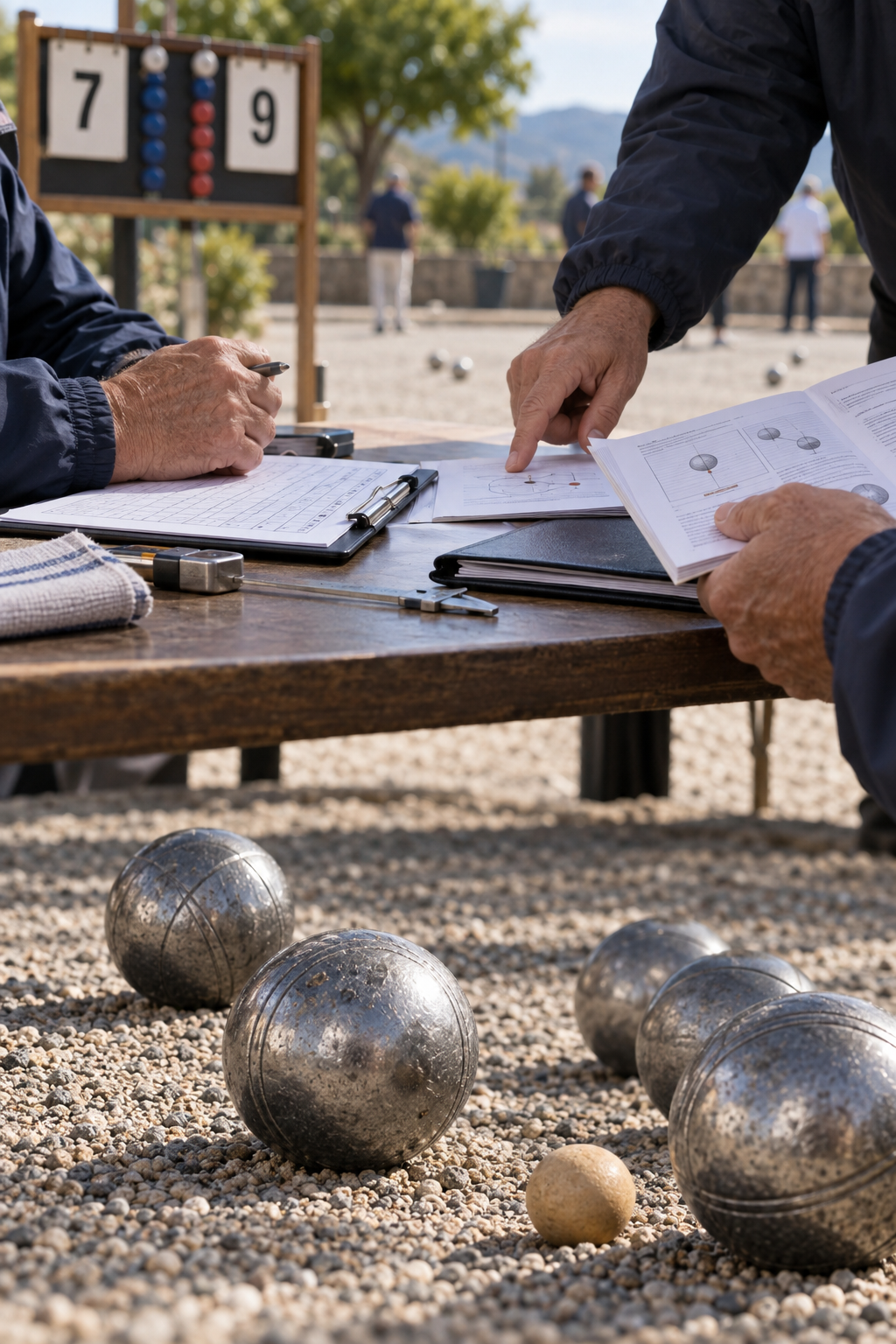
The FFPJP referee does not penalize based on his mood: he applies a graduated scale defined by article 35 of the official rulebook. This scale distinguishes four levels of severity: verbal warning, formal warning (equivalent to a yellow card), temporary exclusion (orange card) and team disqualification (red card). Each foot infraction falls into this grid according to its extent and recurrence.
Before each official competition, referees receive a technical briefing that reminds them of the points to watch particularly closely. The foot rule is systematically included, because it accounts for the majority of disputes on the court. Knowing these priorities means avoiding unnecessary cards.
2.Infraction n°1 — Foot lifted during the throw
It's the n°1 fault among shooters, whose explosive motion naturally causes the rear heel to lift, or even both feet in extreme cases. The referee pays particular attention to shooters who slightly "jump" at the moment of release.
Planned penalty: formal warning on the first occurrence if the lift is clear. The boule may be validated if it has already touched the ground at the moment of lifting. Immediate recurrence: cancellation of the boule.
3.Infraction n°2 — Leaving the circle early
Very common among pointers, who tend to step forward half a step to follow their boule with their eyes. Article 6 is explicit: you do not leave the circle until the boule has touched the ground. Leaving "to see where the boule rolled" is forbidden before this signal.
The referee often positions himself behind the circle to better judge this infraction. Penalty: boule cancelled if the exit occurs before ground contact, formal warning if the exit is just a little too quick.
👁️FFPJP referees are trained to observe the foot by peripheral vision, without taking their eyes off the boule's trajectory. It is a technical skill acquired on the court: a good referee sees the foot even when his gaze is elsewhere.
4.Infraction n°3 — Foot placed on the circle
The rulebook speaks of "not encroaching on the edges". Foot placed on the line = encroachment = fault. On a rigid circle, it is immediately visible: the referee observes whether the foot rests on the plastic rim. On a drawn circle, the tolerance is greater but a trained referee sees the imprint trace in the sand.
Penalty: generally a formal warning, without immediate cancellation, unless the infraction is blatant (foot half on the line).
5.Infraction n°4 — Movement during the throwing motion
You start your motion at the back of the circle, and you step forward half a foot at the moment of release to "add power". It's a throwback to jeu provençal where the run-up is allowed. In pétanque, it is strictly forbidden.
This fault is very common among former jeu provençal players who take up pétanque. The referee spots it immediately: the rear heel leaves a clear mark in the circle. Penalty: boule cancelled if the forward movement is clear (more than 5 cm), warning otherwise.
6.Summary table of the 7 infractions
Here is the complete evaluation grid applied by FFPJP referees in official competitions:
| Infraction | Frequency in tournaments | Typical penalty |
|---|---|---|
| Foot lifted during the throw | Very frequent | Formal warning |
| Leaving the circle early | Very frequent | Boule cancelled |
| Foot placed on the line | Frequent | Warning |
| Movement during the throwing motion | Frequent | Boule cancelled |
| Foot entirely outside the circle | Rare | Boule cancelled + warned. |
| Circle moved by the feet | Occasional | Boule to be replayed |
| Exiting through the front of the circle | Frequent | Warning |
7.Infraction n°5 — Foot entirely outside the circle
Rare but serious case: a player playing with a foot completely outside of the circle. This sometimes happens on an invisible circle (erased by sand), or by a habit picked up in free play. It is the most penalized infraction because it is the most blatant: systematic cancellation of the boule and formal warning.
The referee does not even have to hesitate: the foot not being in the circle, the rule is violated without any possible nuance. The penalty is immediate and without appeal.
8.Infraction n°6 — Circle moved by the feet
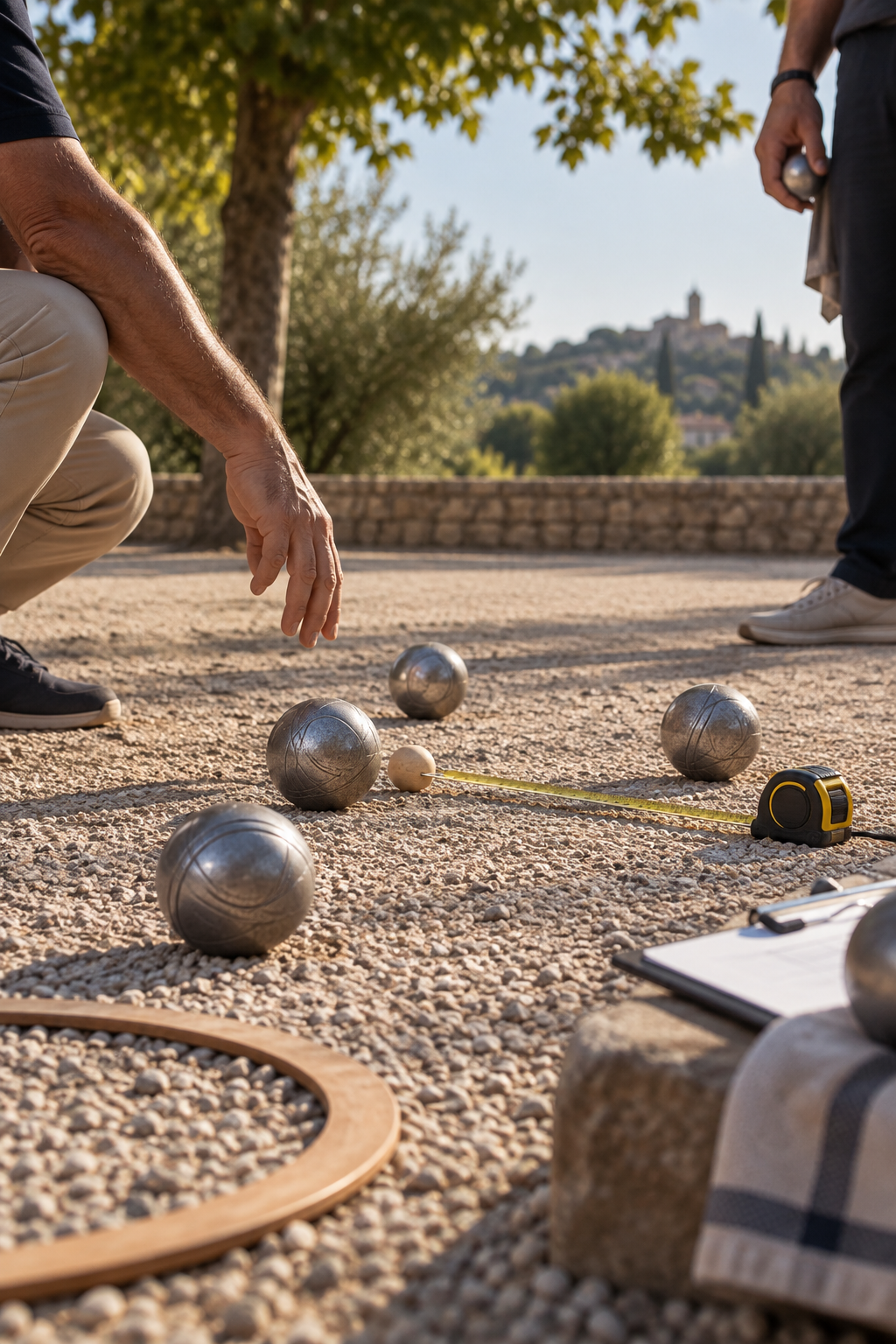
During the motion, your heel pushes the rigid circle back a few centimetres. It is an infraction recognized by the rulebook, because it distorts the distance measurement of the jack. Article 7 provides that the circle must remain stable until the end of the mène.
Penalty: the boule may be replayed if it has not yet left the hand at the moment of displacement. Otherwise, the referee repositions the circle and gives a warning. Recurrence results in cancellation.
Severity perceived by FFPJP referees Foot entirely outside the circle · Severity 10/10 No possible ambiguity. Automatic penalty. Leaving early · Severity 7/10 Penalized if visible. Tolerance for imperceptible exits. Foot on the line · Severity 4/10 Warning, rarely direct cancellation.9.Infraction n°7 — Exiting through the front of the circle
You have played your boule, it has touched the ground, and you leave the circle going through the front (over the circle, toward the front). It is a breach ongoing of the exit protocol. The FFPJP rule requires that you exit behind the circle, walking backward or sideways, so as not to disturb the playing area.
Penalty: generally a verbal warning, formal in case of recurrence. The infraction is less serious than the others, but it is frequently recalled to preserve the spirit of the game and the concentration of the opposing team.
🧐 Paquita's tipHalf an hour of specific work on the feet is enough to correct 80% of infractions recurring ones. Do a simple exercise: 20 boules with your teammate watching only your feet. Ask them to flag every deviation, every lift, every early exit. It's tedious, but it's one of the most worthwhile drills there is.
To go further on the subject, also consult our guide on the foot rule in detail as well as the article dedicated to the foot that extends beyond the circle. Our section little-known rules and our free tools usefully complement this information.
🏆 PAQUITA'S SOFTWARE The PétanqueLand tournament & mêlée softwareYou organize competitions in your club? A perfectly respected rulebook starts with impeccable organization. The PétanqueLand software manages draws, melees, rankings and refereeing charts — everything you need for a compliant and smooth competition.
💻 Discover the softwareFAQ — Your frequent questions
What is the most penalized foot infraction in competition?+ Premature exit from the circle: the player leaves before the ball has touched the ground. Very common among pointers who want to follow their ball with their gaze. Usual sanction: formal warning, cancellation in the event of immediate recurrence. Can a referee sanction without having directly seen the fault?+ No, the FFPJP regulations require that the referee must have personally noticed the infraction. He can rely on the trace on the ground (moved circle) or the video in the National final, but cannot sanction solely on the basis of opposing testimony. How many warnings before being excluded from the competition?+ The FFPJP scale provides: 1 verbal, 1 formal, 1 temporary exclusion of the player, then disqualification of the team. But an isolated serious fault (complete exit, unsportsmanlike gesture) can lead directly to a higher level without going through the previous ones. My opponent commits an infraction, what should I do in the absence of a referee?+ Report it politely immediately, without canceling the ball on your own. In a friendly game, understanding between players takes precedence. In competitions without a designated referee, call on the competition delegate who can decide on a case-by-case basis. Do foot infractions always result in cancellation of the ball?+ No. The regulations distinguish between several levels: verbal warning (the ball remains valid), formal warning (often the ball remains valid the first time), cancellation (clear fault). It is the referee who qualifies according to the severity observed. 📎 Related articles RulesThe feet rule: what you need to know RulesFoot that extends beyond the circle: fault or not? RulesThe little-known rules of pétanque© Pétanque by Paquita — petanqueland.fr ·
💻 Discover the PétanqueLand tournament software
Article based on the official FFPJP-CMSB rulebook (articles 6 and 35) and the observation of refereeing practices in national competitions. To be adapted to local customs without contradicting the federal letter.