Actualités · 7 May 2026
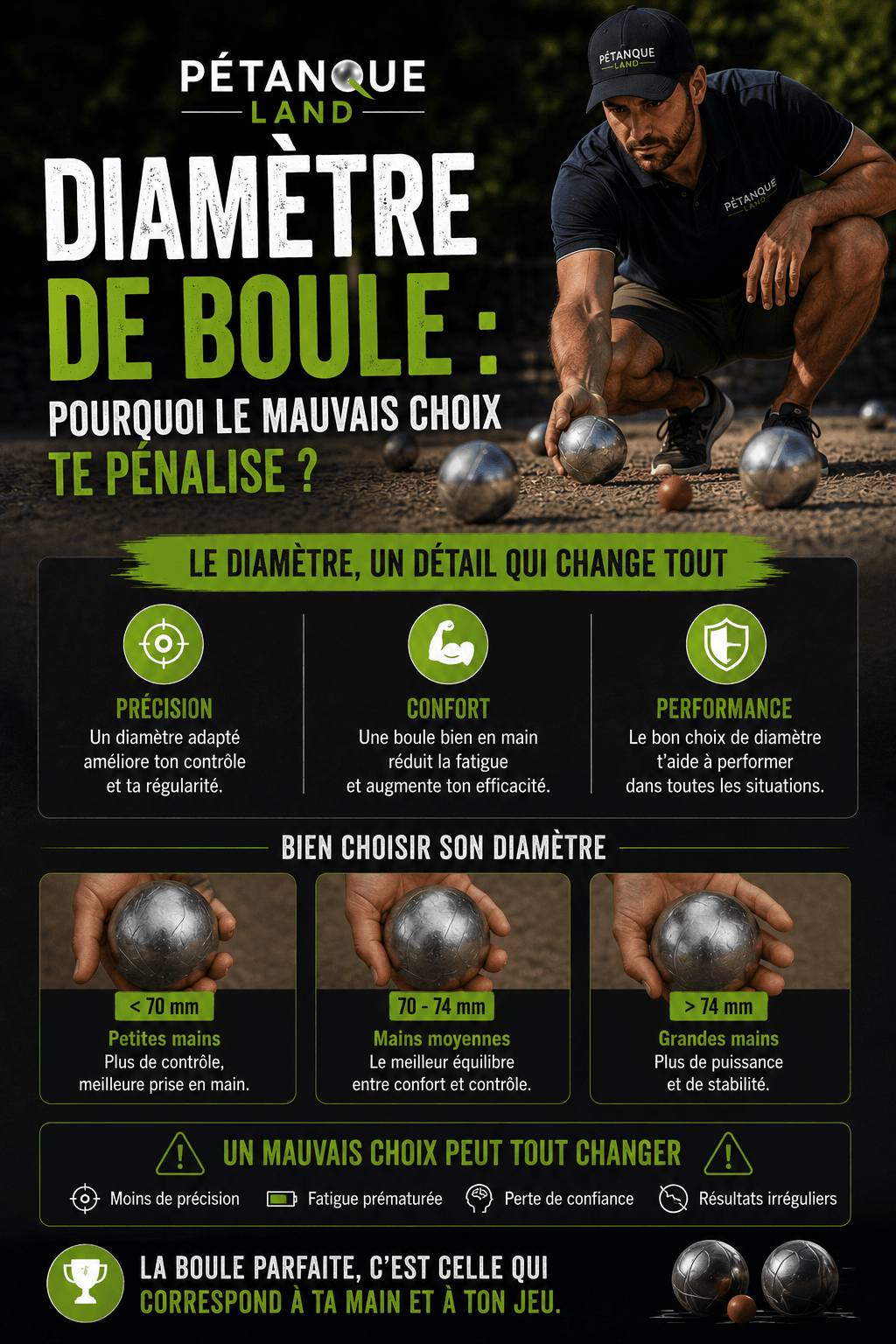
Ball diameter: why does the wrong choice penalize you? (Petanque)
Between 70.5 mm and 80 mm, theWhat the rules say — the official limits
How to test your diameter — practical protocol 📋 FIPJP RULES — ARTICLE 2 Pétanque bowls must have a diameter between70.5 mm and 80 mm 650 g and 800 g, and a weight between. Any bowl outside these limits is non-regulatory and cannot be used in official competition. These parameters apply to approved metal bowls — not to leisure plastic bowls.
Within this 9.5 mm interval, the commonly marketed sizes are found in practice: 71, 72, 73, 74, 75, 76, 77, 78, 79 mm. Every millimetre counts in the hand — not dramatically, but cumulatively over hundreds of throws.9.5mmamplitudethe total gap between the smallest (70.5 mm) and the largest (80 mm) regulatory diameter — 9.5 mm that changes everything in the hand 700gregulatory maximumthe maximum weight of a bowl according to the FIPJP — diameter and weight are linked but not necessarily proportional depending on the material Hand= referencethe size of the hand is the main criterion — not the level of play, not the style, not the brand. The hand commands everything else 1 onlyvalid testholding the bowl in the playing hand with the usual grip — this is the only test that counts, before any other criterion
🎙️ Paquita on the choice of diameter "Most players do not know what diameter they play with. They know they have 700 g or 680 g bowls, sometimes the brand, but rarely the exact diameter. And yet it is that figure that determines whether the bowl sits well in the hand or slips, whether it releases at the right moment or too early. I have seen players significantly improve their consistency just by going from a 75 to a 73 — not because they had changed technique, but because their hand could finally hold the bowl correctly without compensating." — Paquita 📐 REGULATORY DIAMETER SCALE — 70.5 MM TO 80 MM 70.5 71 72 73 74 75 76 77 78 79 80 70.5 — 72 MM Small hands — women, teenagers, slim builds. The bowl sits naturally in the hollow of the hand. Stable grip without squeezing effort. 73 — 76 MM Intermediate zone — the largest range of players. Covers the majority of average adult male hands. Versatile pointer/shooter compromise. 77 — 80 MM Large hands— heavy builds, players with long fingers. The bowl must be able to be held without excessive tension in the fingers. 🔑 The 73–76 mm zone concentrates the vast majority of sales — but that is no reason to settle there without checking. A player with a small hand who plays at 75 mm compensates unconsciously on every throw
The scale of diameters and what it covers
— and this compensation accumulates fatigue and imprecision over the course of the game.
These symptoms are rarely attributed to the diameter by the players who experience them — they look for an explanation in technique, the terrain, or concentration. Yet they have a distinctive physical signature. ⚠️ DIAGNOSIS — SIGNS OF AN UNSUITED DIAMETER What the body signals when the bowl is wrong 😣 Fatigue of the fingers or forearm during a game The flexor muscles of the fingers work constantly to hold a bowl that is too big — or to compensate for the lack of support with a bowl that is too small. This chronic tension translates into localised fatigue that appears after 30 to 45 minutes of play anddegrades precision in the second half of the game . → Probable cause: diameter too big (squeezing effort) or too small (holding tension without support) 🎯 Bowl release systematically too early or too late The release point is a sensation — when the bowl does not sit correctly in the hand, this point shifts. Too early: the bowl leaves before the complete impulse of the arm, short and imprecise trajectory. Too late: the bowl rises with an involuntary rotation effect. These two faults are often attributed to a motion problem when they are linked to the grip. → Probable cause: unsuited diameter that shifts the centre of gravity of the grip outside the natural control of the fingers 🔄 Involuntary rotation of the bowl on the throw — unwanted effect A bowl that is too big that does not sit naturally in the fingers tends to roll in the palm at the moment of the throw, creating a parasitic rotation. It is not a rotation technique problem — it is an artefact of the lack of control due to the diameter. When pointing, this unwanted rotation deflects the trajectory unpredictably. → Probable cause: diameter too big — the bowl exceeds the natural control space of the fingers 💥 Shots with less punch than expected — bowl that "leaves soft" On shooting, the transmission of power from the arm to the bowl depends on the quality of the grip. With a diameter that is too small, the fingers squeeze but without sufficient support surface — the energy is lost in slippage. With a diameter that is too big, the hand cannot accelerate properly at the end of the motion. In both cases, the shot lacks sharpness on impact. → Probable cause: grip poorly suited to the diameter that reduces the efficiency of power transmission 📉 Unexplained inconsistency between sessions — good bowls then bad ones with no apparent reason A slightly unsuited diameter does not hinder constantly — it hinders when the hand is slightly more swollen (heat, effort), when tired, or when concentration drops and the involuntary compensation stops working. This inconsistency linked to physiological conditions is a strong signal of unsuited equipmentThe symptoms of a wrong diameter — recognising them
— not a mental problem. → Probable cause: diameter at the tolerance limit — works in good conditions, reveals its limits under fatigue or heat
The style of play interacts with the diameter — not in the same way depending on whether you point or shoot. These recommendations are starting points, not absolutes: the build of the hand always takes precedence.🎯 POINTER
Pointing demands fine control of the trajectory and a precise release. A bowl slightly smaller than the maximum tolerable by the hand favours the sensation of control — the fingers wrap around the bowl better and the release point is more reproducible.−1 to −2 mm relative to the tolerable max Example: hand tolerating up to 75 mm → play at73 or 74 mm
. The slight margin improves control at the expense of a small surplus of weight.→ Reason: the precise release of pointing is more sensitive to the grip than shooting — the control margin takes precedence over the impact surface 💥 SHOOTER
Shooting demands power and stability at high speed. A bowl closer to the maximum of the hand ensures a better transmission surface and reduces parasitic rotations at the moment of the final acceleration of the arm.Max or −1 of the tolerable diameter Example: hand tolerating up to 76 mm → play at75 or 76 mm
. The stability of the grip improves the sharpness of the impact.→ Reason: on shooting, the transmitted power depends on the contact surface — a diameter close to the maximum makes better use of the hand at high speed ⚖️ ALL-ROUND PLAYER
Neither exclusively pointer nor exclusively shooter — regular alternation of the two roles. The intermediate diameter is the best compromise, slightly below the maximum of the hand to maintain versatility.Middle of the tolerated range Example: hand tolerating 73 to 76 mm → play at74 or 75 mm
. The compromise favours the consistency of both motions.The right diameter by player profile
→ Reason: no type of throw benefits from extreme optimisation — consistency in both registers takes precedence over specialisation
The diameter is not chosen in isolation. It interacts with weight, grooving, material and temperature — ignoring these interactions sometimes produces contradictory choices. ① Diameter and weight — the indirect relationship For the same material, a bowl of larger diameter is generally heavier — but this is not always true. Some alloys allow large-diameter but low-weight bowls, and vice versa. Do not assume that choosing a large diameter implies a high weight — check both parameters separately. → The optimal weight is chosen according to distance and type of play. Neither the heaviest nor the lightest by default — the weight that releases naturally at the right distance with the right dosage. ② Diameter and grooving — grip in the hand The grooving (the grooves engraved on the bowl) modifies friction in the hand. A heavily grooved bowl of a slightly too large diameter can be held correctly thanks to the extra grip. A smooth bowl of a too small diameter slips more easily. Grooving is a variable of partial compensation — it does not replace the right diameter but can attenuate a 1 mm gap. → For players whose hands perspire, pronounced grooving compensates for the slippage effect — but the diameter remains the primary factor to correct. ③ Diameter and temperature — the often ignored effect In strong heat, hands swell slightly — which can turn an acceptable diameter into a too large diameter. Some players play correctly in spring with their usual diameter and struggle in summer under the same conditions. It is not a drop in form — it is a physiological interaction with the equipment. A diameter suited to the usual climatic conditions of play is more relevant than a diameter suited to ideal conditions. → If you play mainly in summer or in hot regions, choose a diameter 1 mm smaller than your comfortable maximum in cool conditions. ④ Diameter and length of play — how the hand evolves A player's hand changes over the years of practice — the muscles of the palm and fingers develop, which can change the optimal size.A diameter chosen 10 years ago may no longer be the right one todayThe other criteria that interact with the diameter
| . The check is simple and takes 5 minutes — but few are the players who do it after having "found their bowls". → Recalibrating the diameter every 3 to 5 years is a good practice — especially if technical progress stagnates without an obvious reason. | Hand profile | Style of play | Recommended diameter |
|---|---|---|---|
| Sign of unsuitability | Pointing | Small hand (woman, teen, slim build) | 70.5 — 72 mm |
| Bowl that spins in the palm, unstable release | Small hand | Shooter or all-round | Shooter or all-round |
| Soft shots, lack of punch on impact | Pointing | Average hand (standard adult) | Average hand (standard adult) |
| Fatigue of the fingers, release too early at the end of the game | Shooter | Average hand | Average hand |
| Fatigue of the fingers, release too early at the end of the game | Parasitic rotation, bowl that leaves with involuntary effect | All-round player | All-round player |
| Pointing/shooting inconsistency with no identifiable cause | Pointing | Large hand (heavy build) | Large hand (heavy build) |
| Lack of sensation — bowl "too small" in the hand | Shooter | Large hand | Large hand |
| Excessive squeezing, forearm fatigue, imprecise shots | Play in summer / usual heat | All styles | −1 mm / usual diameter |
📐 The 30-second test Take the bowl in the playing hand with the usual grip — neither tighter, nor forced. If the fingers can comfortably wrap around the bowl without visible tension in the wrist, the diameter is in the right zone.
Selection table — hand, style, recommended diameter
If the fingers extend completely without being able to grip naturally, the bowl is too big. If the bowl "floats" in the hand without finger support, it is too small. This test takes precedence over any general recommendation.01 The comparative grip test — 3 diameters in 20 minutes 📍 At a retailer or at the pétanque court ⏱️ 20 min 🎯 Identify your optimal diameter through direct feel
The only valid test is the physical test with real bowls — not a measurement of the hand with a tape measure, not a correspondence table. The feel in the playing hand is the primary data. Borrow or test 3 bowls of different diameters spaced 2 mm apart — for example 73, 75 and 77 mm. Same weight if possible, or close weights. Hold each bowl in the playing hand with the usual grip for 15 seconds without throwing it. Observe: is there tension in the fingers? Is the bowl naturally stable or does it have to be actively held? Throw each diameter over 10 bowls at the usual distance — pointing for pointers, shooting for shooters. Assess after each series: did the release happen at the right moment? Is there a parasitic rotation? Is the trajectory regular? Do not look for precision on these 10 bowls — look for consistency of the motion. After the 3 series, compare the feelings. The question is not "with which diameter did I make the best bowls?" — it is"with which diameter did my motion seem the most natural and the least constrained?". The consistency of the motion takes precedence over the one-off result. Useful variant: repeat the test after 30 minutes of intense play — fatigue reveals the unsuitabilities that freshness masks. A diameter that seems correct on the first throw but hinders after 30 minutes is not the right diameter for the complete game. 02 The diagnostic session — identify where the problem comes from 📍 Solo training ⏱️ 30 min 🎯 Distinguish technical error and unsuited equipment
Before changing diameter, make sure the problem really comes from the equipment and not from a technical error — the symptoms sometimes look alike. Play 20 bowls with the current equipment under normal conditions. Count the number of "badly felt" releases — bowls that left too early, too late, or with a sensation of instability in the hand. If this figure exceeds 8 out of 20, it is a significant signal to investigate. Then play the next 20 bowls by consciously forcing the grip —squeeze slightly harder than usual . If the quality improves clearly, the current diameter is probably too big — the hand instinctively looks for more grip. If it gets worse, the diameter is probably too small — squeezing even more does not compensate for the lack of support. Observe the location of the fatigue after this session. Fatigue in the phalanges and the first fingers → diameter too big. Fatigue in the palm and the thumb joint → compensation for the lack of support, diameter potentially too small. These locations are not certainties, but they provide direction. Compare these results with a partner who has a different diameter: borrow their bowls for 10 throws.If the motion becomes immediately smoother with the partner's bowlsFAQ — Your frequent questions
Do you have to measure your hand to choose its diameter?+ Hand/diameter correspondence tables (palm measurement in cm → recommended diameter) are a useful starting point — they avoid testing sizes that are frankly out of range. But they do not replace the physical test. The morphology of a hand depends on many variables that the flat measurement does not capture: length of the fingers, flexibility of the joints, tendency to sweat, grip habit. Use the table to define a range of 2 to 3 sizes to test, then choose by direct feeling — this is the most reliable approach. Can we play with different diameters in the same game of 3 balls?+ Regulations, the 3 boules of the same player must have the same diameter (and the same weight) according to the FIPJP regulations — they must constitute an approved game. In friendly practice without strict regulations, some players experiment with different weights but the diameter is generally the same in an original game. Playing with 3 balls of different diameters breaks the regularity of the grip — adapting to each ball consumes attention that would be better spent concentrating on the target. Should women systematically play with smaller diameters than men?+ Hand shape is the criterion — not gender per se. On average, women have smaller hands than men, which statistically skews towards smaller diameters. But there are women with large hands and men with small hands — the recommendation does not change: the physical test takes precedence over any generalization. What is true: the range of balls historically marketed as "feminine" often covers diameters 70.5–73 mm, which corresponds to the majority of female profiles - without making it an absolute rule. Does changing diameter disrupt the game during the adaptation period?+ Yes — an adaptation period of 2 to 4 weeks is normal when changing diameter, even 1 mm. The gesture was built over years with the usual ball — the sensory cues are keyed to this precise grip. The new diameter requires a recalibration of these marks, which may temporarily degrade accuracy. This is a reason not to change diameter as an important competition approaches. This is also a reason not to give up on change too early if the first assessment at 1 week is disappointing — 2 weeks is often insufficient to observe the real benefit. 📎 Related articles EquipmentChoose your boules according to your level and style TacticsAttack or secure: making the right choice at the right time TacticsPlaying against a stronger opponent: the mistakes to avoid TerrainAdapting your play to an uneven terrain RulesRegulatory playing distances 2026 ToolsFree PetanqueLand tools© Pétanque by Paquita — petanqueland.fr · 📖 Paquita's book on Amazon