Actualités · 6 March 2026
How to check whether your boules are FFPJP / FIPJP approved?
Mandatory markings, FIPJP dimensions, umpire checks, permitted brands: everythingYou arrive at the terrain for your first competition of the season, the referee approaches, examines your boules and announces: "Sorry, these boules are not allowed." The season starts with a red card. To avoid this cold shower, here is everything you need to know.
Not all boules are equal. Between leisure boules and competition boules, there is a regulatory gap defined by the FIPJP. Unreadable markings, out-of-standard diameter, boule too light, homemade modification: the reasons for refusal are more common than one might think. This guide lets you check each point before heading to a competition.The 3 mandatory markings
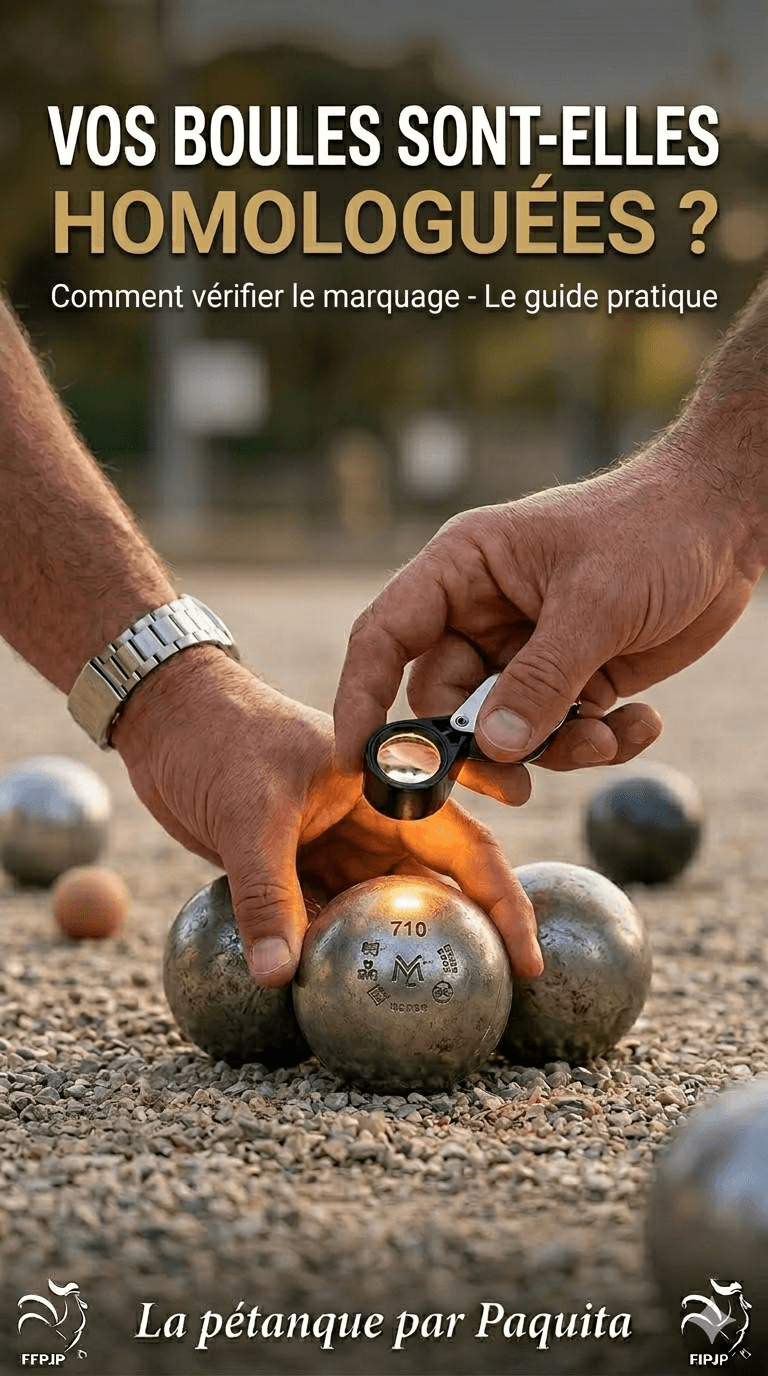
To be approved by the FIPJP and accepted in official competition, a boule must imperatively carry three readable engravings. Wear, rust or a homemade touch-up that erases these markings makes the boule immediately non-compliant — even if it belongs to a well-known major brand.
1 Manufacturer Label The brand name or logo must be engraved directly into the steel, readable to the naked eye. E.g.: OBUT · MS · JB 2 Weight in grams The engraved nominal weight must be between 650 g and 800 g. The wear tolerance is a maximum of 15 g. E.g.: 700 · 710 · 720 3 Serial number A unique alphanumeric code that identifies the triplet and allows the referee to verify the approval. E.g.: A3247 · 0512B 📝Good to know: the player's first name, initials or licence number may be engraved on the boules, but do not replace the three official markings. They are a complement, never a substitute.
If you have any doubt about the readability of a marking, expose the boule to grazing light or use a magnifying glass. A marking that is readable under favourable lighting but illegible in normal conditions may be enough for a fussy referee to refuse it. With the new refereeing tools in 2026, inspections are faster and stricter.
Dimensions and physical criteria
Beyond the engravings, the boule must comply with precise physical criteria defined in the FIPJP rules. These standards apply to all boules, regardless of brand or how old the model is.
📏 Diameter 70.5 — 80 mmMeasured across the entire sphere. A deformed or split boule is refused.
⚖️ Weight 650 — 800 gThe actual weight must not drop more than 15 g below the engraved weight.
🔄 Unbalance Max 1.3%The mass imbalance must not exceed 1.3% of the boule's total weight.
🪨 Min. hardness 35 HRCThat is 110 kg/mm². Below this, the boule is too soft to be approved.
🔩 Material Steel onlyStainless or carbon steel. No other material (plastic, wood, resin) is allowed.
✨ Surface UnmodifiedNo coating, treatment or modification after manufacture is allowed.
What is strictly prohibited
The FIPJP rulebook is categorical on this point: any modification of a boule after its manufacture leads to immediate and definitive disqualification of the boule. No second chance, no warning.
- ✗Re-annealing — heating the boule to alter its hardness. An old practice sometimes used to "soften" a shooting boule, totally prohibited.
- ✗Drilling — creating a hole or cavity, even a tiny one, in the boule to alter its balance or weight.
- ✗Filling — injecting a material into an existing crack or cavity to "repair" a damaged boule.
- ✗Unofficial coating — applying a paint, varnish or unapproved surface treatment to alter the slide or grip.
- ✗Homemade re-grooving — touching up the grooves with a file or grinder to "renovate" a worn boule. The boule immediately becomes non-compliant.
- ✓Personal engraving allowed — the player's first name, initials or licence number may be added, provided the existing official markings are not altered.
Unlike other offences (sweeping, playing time) which are subject to a progressive card system, a boule modification leads to definitive exclusion of the boule — and depending on the context, of the player. No white card possible on this point.
Approved vs banned brands in 2026
The official FIPJP approval list is updated regularly. In 2026, here is the status of the main brands and ranges available on the market:
| Manufacturer / Range | FIPJP status | Typical use | Note |
|---|---|---|---|
| OBUT (all competition ranges) | ✓ Approved | All levels | Market benchmark, the most checked |
| MS Pétanque | ✓ Approved | Pro competition | New anti-vibration ranges 2026 |
| Boulenciel | ✓ Approved | High performance | Terre range highly appreciated in 2026 |
| JB Pétanque | ✓ Approved | Club & competition | Excellent value for money |
| La Franc-Comtoise | ✓ Approved | Club & advanced leisure | Check the exact model on the FIPJP list |
| Supermarket boules (Decathlon, etc.) | ⚠ Depending on model | Leisure | Some basic Obut models are approved, check imperatively |
| Plastic / resin boules | ✗ Banned | Garden / Beach | Non-compliant with FIPJP — unauthorised material |
| Boules without readable marking | ✗ Banned | — | Systematic refusal regardless of the original brand |
The official and complete list of approved boules is published by the FIPJP. Before any purchase or before an important competition, consult our guide how to check FFPJP / FIPJP approval for the detailed procedure.
How to check yourself before the competition
Do not let the referee be the first to discover a problem. Here is the checking procedure to carry out at least one week before your first competition of the season — to have time to remedy a possible problem.
- Examine the engravings under direct light Place each boule under a directional lamp and check that the manufacturer label, weight and serial number are effortlessly readable. If you have to search, it is borderline.
- Weigh each boule on a precision scale The actual weight must not be more than 15 g below the engraved weight. Example: a boule engraved 700 g must weigh at least 685 g. A kitchen scale accurate to 0.1 g is sufficient.
- Check for the absence of deformation or crack Run your thumb over the entire surface. Any crack, bump or visible deformation can lead to a refusal for non-compliance of the diameter or unbalance.
- Check the model's approval on the FIPJP list Note the exact model engraved on your boules and check that it is indeed on the official list currently valid for the 2026 season.
- For carbon steel boules: check for the absence of deep rust A superficial rust mark cleans off. Deep rust may have eaten into the metal beneath the engraved weight and dropped the actual weight below the tolerance. See our guide carbon vs stainless maintenance.
Buying a second-hand triplet: the pitfalls
The second-hand market (Leboncoin, Facebook Marketplace, club boot sales) is full of good deals… and potential pitfalls. Before any second-hand purchase, here is what you must imperatively check.
💡 Paquita's adviceBefore buying a second-hand triplet on Leboncoin or Facebook, always ask for a clear photo of the engravings under direct lighting. If you cannot clearly see the weight and serial number, walk away. You will not be able to play in a club with them — and the argument "but they were like that when I bought them" will not hold up against the referee.
- ✓Ask for a photo of the engravings under grazing light before any price agreement.
- ✓Demand the exact model (not just the brand) to verify the approval on the FIPJP list.
- ✓Weigh the boules on receipt — an honest seller will not refuse.
- ✗Beware of boules offered at an abnormally low price without explanation — often out of standard or worn beyond tolerances.
- ✗Never accept boules when the seller tells you "the grooves have been touched up" — it is a prohibited modification.
- ✗Avoid "pretty but old" boules without readable engravings — age does not replace compliance.
The referee inspection: how does it work?
In official competition, the referee can inspect your boules at any time — before the game, during, or after. The standard procedure comprises three steps:
- Visual inspection of the markings The referee examines each boule to ensure the three mandatory engravings (brand, weight, number) are readable without a tool. This is the most frequent and fastest step.
- Weighing on a calibrated scale In case of doubt over the weight, the referee uses an official scale. Since 2026, many competitions have high-precision digital scales. The result is immediate and without appeal.
- Diameter measurement with a gauge A go/no-go gauge is used: the boule must pass through the "80 mm" gauge but not through the "70.5 mm" gauge. Fast, precise, incontestable.
With the new digital FFPJP licence, referees can now cross-check your boule's serial number against the approval database in real time via their mobile app. No room for "borderline" boules in 2026.
If a boule is refused during a game, the player can finish the current end with the remaining boules of their triplet, but the non-compliant boule is definitively excluded for the rest of the competition. Consult our article on refereeing videos to see real situations documented by Paquita.
FAQ — Your frequently asked questions about approval
Are my Obut balls purchased 8 years ago still valid? + Maybe. The approval of an Obut model does not automatically disappear over time. What matters is that (1) the model is still on the current FIPJP list, (2) the engravings are still legible, and (3) the actual weight has not dropped more than 15g. Check these three points before any competition. Can we play competitively with balls of different brands? + Yes. No FIPJP text requires that the boules of the same player be of the same brand or model. Each ball is rated individually. On the other hand, for the consistency of your game, having identical balls is strongly recommended. Is a cracked ball with legible engravings accepted? + No. A crack almost systematically leads to a deformation of the diameter or unbalance beyond regulatory tolerances. Even if the engravings are perfect, a cracked ball will be rejected by caliber or unbalance weighing. Don't risk the competition. Can the referee refuse my boules without having weighed them? + Yes, for reasons that do not require weighing: illegible markings, non-compliant material (plastic), visible modification (restriction, blocked crack). Weighing is only required to check weight or unbalance. Refusal can occur on simple visual inspection. Can we challenge an arbitrator's decision regarding approval? + Yes, in competitions with an appeal jury. But the burden of proof is on you. If you think you have been the victim of an error, remain calm, ask to see the measurement results and send a written complaint to the organization before the end of the tour. See also our refereeing videos to understand the procedures. Is an identical serial number on several balls a problem? + No, within the same triplet the balls often have the same serial number (that of the triplet). This is normal and desired. On the other hand, if two different players present balls with the same number, this can trigger a thorough provenance check. 📎 Related articles Equipment Guide Which bowls to choose to dominate the 2026 season? Test & Comparison Stainless steel vs carbon balls: the secret of champions revealed Test & Ranking Test: the 3 best balls for shooters in 2026 2026 Regulations Sweeping costs a card — Article 10 clarified Refereeing Laser measuring: video refereeing is coming to your clubs Administrative New paperless FFPJP licence with QR code Videos All the Refereeing videos by Paquita Rules The complete FFPJP rulebook explained article by article© Pétanque by Paquita — petanqueland.fr
Informative guide based on the 2026 FIPJP/FFPJP rulebook. Not affiliated with the brands mentioned.