Actualités · 23 June 2026
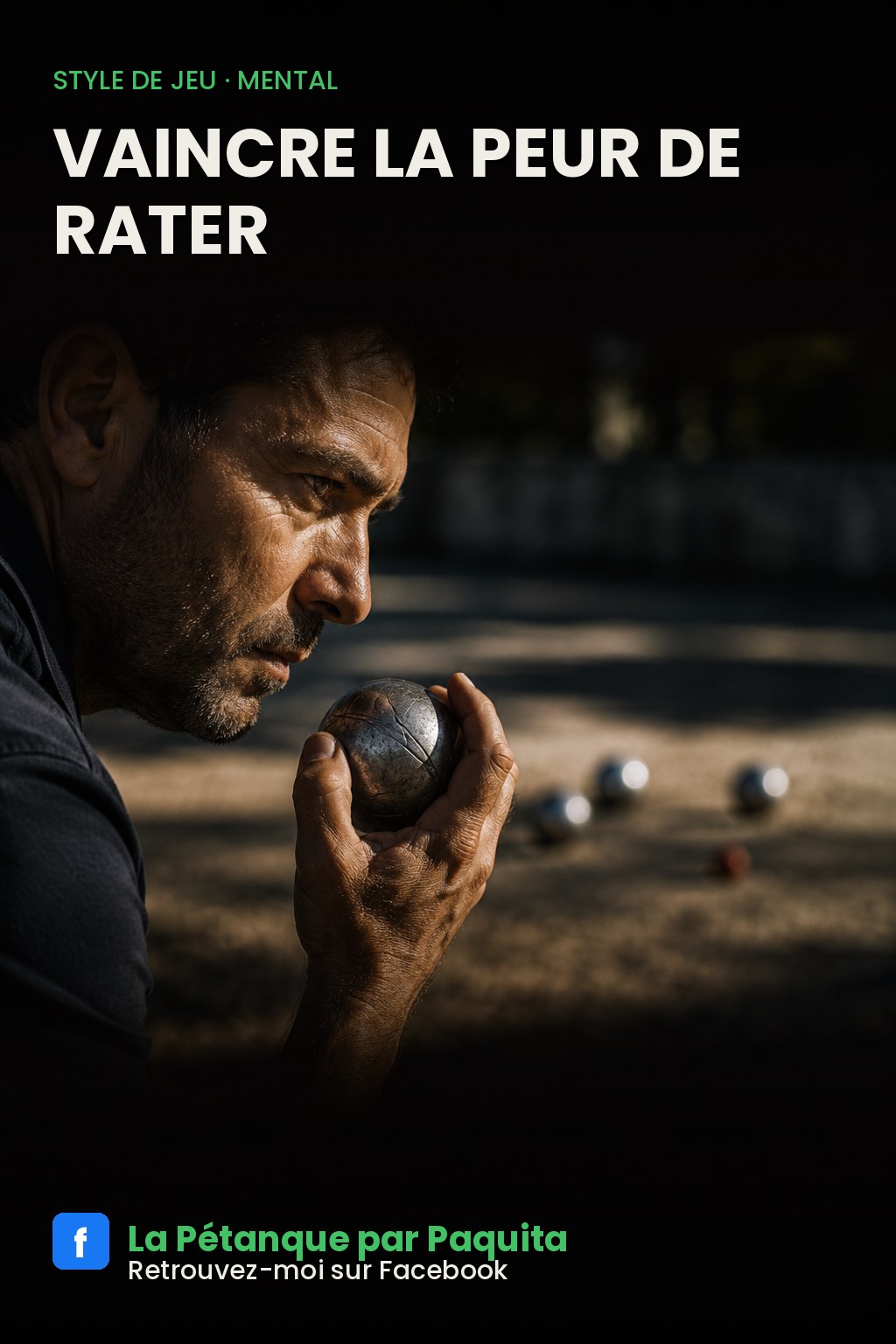
How the fear of missing destroys thousands of pétanque players
The fear of failing blocks thousands of pétanque players every year. How it sets in, its signs, and the method to break free from it.1.The mechanism: how fear sets in
The fear of missing never appears on day one. It sets in gradually, end after end, miss after miss, especially when the player attaches value to their image (at the club, in front of friends, in tournaments). The brain starts associating the important bowl with a threat — shame, disappointment, the mocking comment. Over time, the stakes trigger an avoidance reaction even before the arm goes: the breathing locks, the routine rushes, the throwing motion stiffens. Fear is no lack of courage; it's an unconscious learning that the brain has ended up recording.
🧠The mental trap: the fear of missing makes you focus attention on the risk ('the bowl mustn't go through') instead of centering it on the goal ('I want it to stop there'). Yet attention directed toward the negative clearly increases the probability of getting it.
2.The vicious cycle that destroys progress
That's where fear becomes destructive: it feeds itself. A player who fears missing does in fact miss more often — stiff throwing motion, botched routine. Each miss then reinforces the initial fear. The brain records: 'I was afraid, I missed → I was right to be afraid'. The next time, the loop closes one notch tighter. It's this mechanism that explains complete collapses on shots the player used to pull off effortlessly in training.
3.Three signs that the fear of missing is there
Three concrete signals, to observe in yourself.
1. Avoiding important bowls
You'd rather 'leave it to the other one' for the decisive bowl, you pick a simpler shot when the situation calls for a committed one. It's the clearest signal.
2. The routine that distorts
The pre-bowl ritual gets shortened or lengthened abnormally. You wipe the bowl three times instead of once, you hesitate, you wait.
3. Negative self-talk
'Above all don't go through', 'don't send it into the bank': these phrases loop just before the throw. They direct attention to exactly the wrong place.
🌱 Paquita's tipWhen you catch yourself thinking 'I mustn't miss', immediately turn the phrase into a positive goal: 'I want the bowl to stop 20 cm behind the jack'. This rephrasing, over a few weeks, concretely changes how the brain prepares the throwing motion.
4.The real cost of fear over a season
Over a pétanque season, the fear of missing doesn't cost you three or four bowls — it costs you dozens of points. On the decisive shots where it sets in, the success rate can drop by 15 to 25%. Multiplied by all the tight ends of a tournament, that's easily two or three games lost per season for this single cause. That's more than many players would gain by working only on their technique over the same period.
5.How to get out of it: the 3-pillar method
Getting out of the fear of missing takes three consistent actions, to be practiced together.
Pillar 1 — Rephrase the goal
Always describe what the bowl should do (positive), never what it should avoid. Attention follows the phrasing: what you say is what you aim at.
Pillar 2 — Breathe to break the spiral
A long exhale (5-6 s) cuts the stress cascade before it stiffens the throwing motion. Repeat between every difficult bowl.
Pillar 3 — Replay the sequence in training
Stage 'important' shots in training (with a symbolic stake) to get the brain used to functioning under pressure. A throwing motion that has never been tested under stress doesn't hold up in a tournament.
6.Freed player vs paralyzed player — comparison
Let's visualize the behavior gap between the two profiles:
Behavior under pressure — comparison Freed player routine › positive aim › breathes › throws Paralyzed player hesitates › 'don't miss' › stiffens › rushes| Situation | Freed player | Paralyzed player |
|---|---|---|
| Decisive bowl | Asks to play | Leaves it to the other one |
| Thought before throwing | 'I want it to go there' | 'Above all don't miss' |
| Routine | Identical | Botched or lengthened |
| After a miss | Starts again calmly | Sinks |
7.How to train to test it
Mental work alone isn't enough: it has to be confronted with the terrain. Create 'high-stakes' situations in training: three consecutive shooting bowls where each miss imposes a forfeit, a decisive bowl that determines who tidies the piste, a simulated end with a tight score. The goal isn't performance, buthabituation : the more the brain encounters the feeling of pressure in a safe context, the less it will surprise it in a tournament. To structure this progression, see our free tools and the page little-known rules.
📘 PAQUITA'S BOOK Winning under pressure in pétanqueThis book is entirely dedicated to the player's mental management: how to defuse the fear of missing, rebuild a routine that holds, and learn to play as well in a tournament as in training. Step-by-step method, concrete exercises, lived examples.
📗 Discover the bookFAQ — Your frequent questions
Why do I miss easy balls in competitions that I play in training?+ Because the pressure of the competition pushes the fear of failure to a level that tenses the gesture. In training, the stakes are zero and the arm remains flexible. The solution is not technical but mental: positive reformulation, breathing, identical routine. Is fear of failure a sign of lack of talent?+ No. It also affects very technical players. It’s unconscious learning that the brain has recorded through failures and challenges. It is unlearned in the same way, with mental tools practiced regularly. Do you have to force difficult balls to get rid of them?+ Not in competition straight away. Start in training, in progressively higher stakes situations. It is controlled habituation that works, not brutal confrontation which often reinforces fear if it results in a failure. How long does it take to get rid of it?+ The first effects appear within a few weeks of serious practice (reformulation, breathing, routine). Deep and stable change takes a few months. The progression is not linear: there are passages, sometimes relapses, that's normal. Is a good routine enough to eliminate fear?+ It takes up a lot of it — maybe 60 to 70 percent — but not all of it. Add positive goal rephrasing and deep breathing, and you have the trio that truly defuses fear. Routine alone treats the symptom, not the cause. 📎 Related articles GameThe lesser-known rules of pétanque ToolsFree PetanqueLand tools HomePétanque by Paquita© Pétanque by Paquita — petanqueland.fr ·
📘 Discover my books on PetanqueLand
Educational article based on observing the game and sport psychology. The proposed methods should be adapted to each person.