Règlement FFPJP · 9 February 2026
The carbon jack: Goodbye to boxwood?
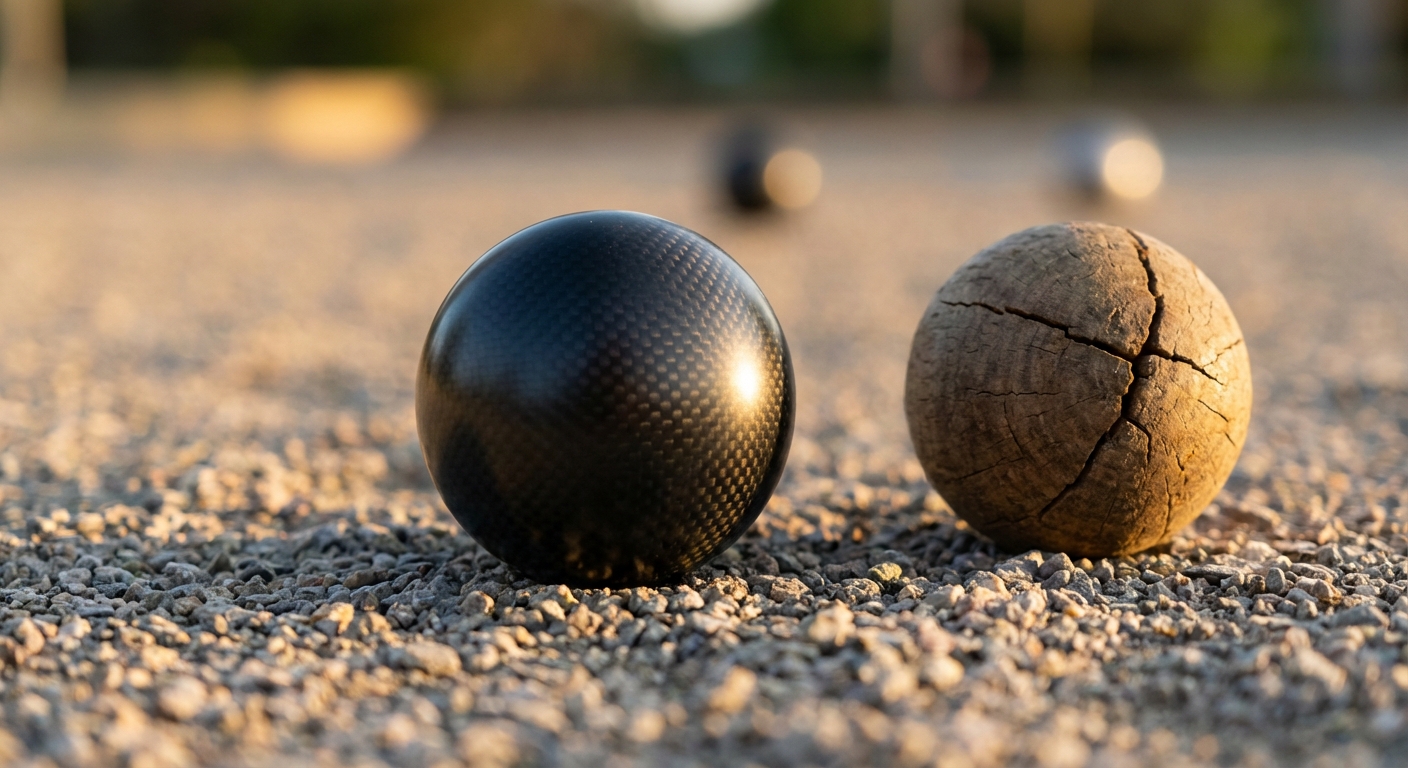
Boxwood vs high-density carbon: Paquita compares the two types of jack. Resistance, visibility, umpiring fairness, ecology... This little piece of the future is landing on our boulodromes.Boxwood vs carbon: the showdown at a glance
🪵 Boxwood cochonnet Tradition, feel, the soul of pétanque- Natural material — boxwood or composite wood
- Warm feel, recognisable sound
- Sensitive to moisture and heat
- Can warp slightly over time
- Classic colours (white, natural, marked)
- Heritage and tradition of pétanque
- High-density carbon or composite material
- Stable to the micron — unaffected by weather variations
- Undeformable over its entire lifespan
- Guaranteed constant weight (no variation)
- Neon / phosphorescent colours available
- Compatible with high-precision laser umpiring
Why switch from wood to carbon?
Wood has an invisible enemy: time and the weather. A boxwood cochonnet left in a damp bag over winter, baked in the blazing July sun or struck hundreds of times on a hard gravel court is no longer quite the same cochonnet it was on the first throw.
- 💧Moisture makes it move — wood absorbs and releases water. In damp conditions, a boxwood cochonnet can gain a few grams. In dry heat, it can lose some. To the naked eye in classic umpiring, that's invisible. To a laser measuring to the tenth of a millimetre, it's significant.
- ☀️Heat alters the roundness — in summer, open-air courts baked in the sun heat up. A boxwood cochonnet exposed for several hours can warp slightly, losing its perfect sphericity. Again, imperceptible in play, but problematic for precision measurement.
- 💥Impacts gradually crack it — a cochonnet struck repeatedly by steel boules eventually dents, splits at the surface or even cracks. These alterations slightly change its bounce behaviour and its response when shooting at the jack.
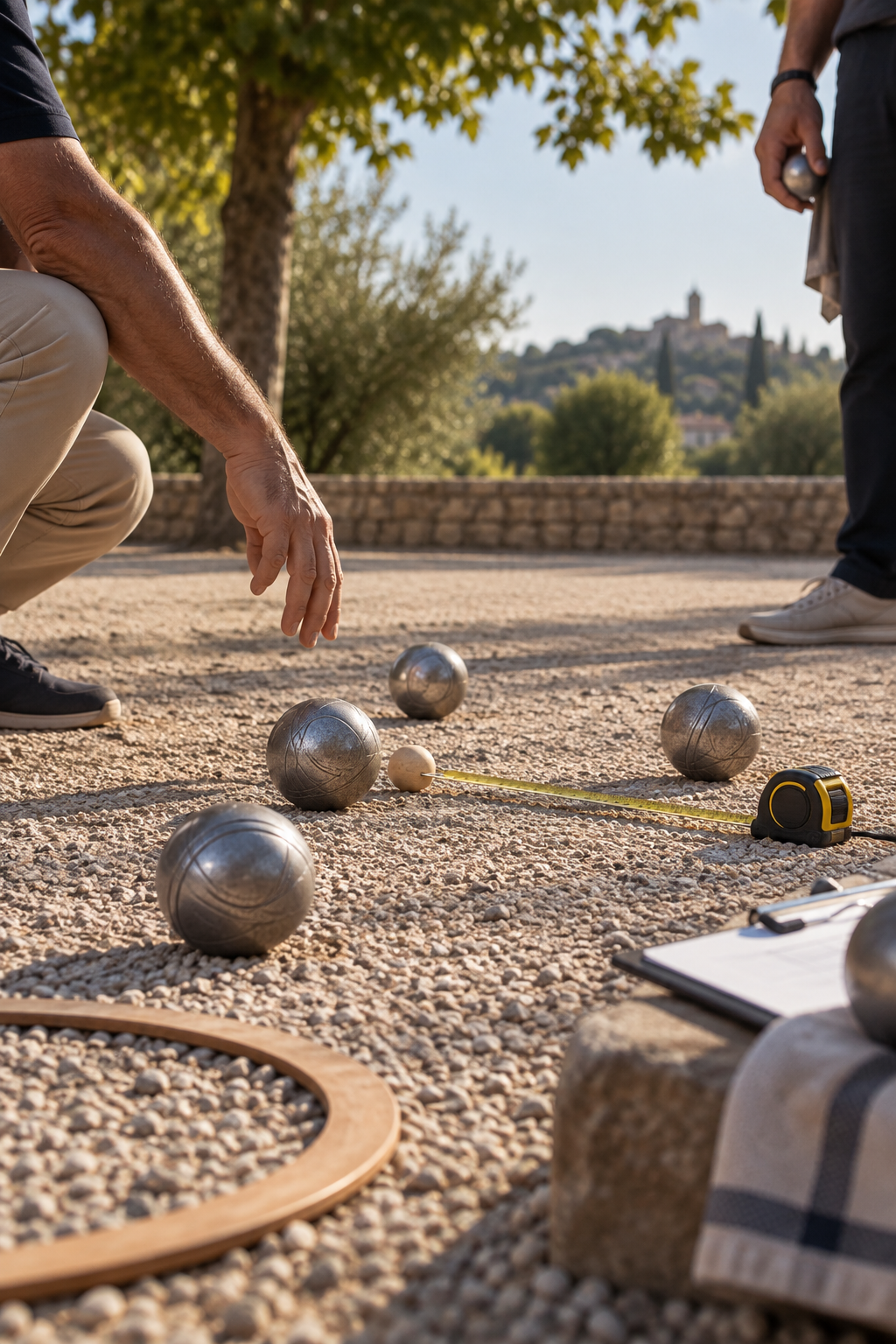
- 🎯Laser umpiring demands absolute stability — the ultra-precise measuring tools now used in top-level competitions measure distances to the tenth of a millimetre. A slight deformation of the cochonnet can skew the measurement and create an inequality between games played in different conditions.
The 5 concrete advantages of the carbon cochonnet
The carbon cochonnet doesn't just solve the deformation problem. It brings new playing properties that genuinely change the on-court experience.
📐 Absolute dimensional stabilityMoisture, heat, cold, sun — carbon doesn't react. Its diameter, weight and sphericity stay identical from the first throw to the last, in all weather conditions.
👁️ Increased visibilityOffered in phosphorescent, neon or high-contrast colours, the carbon cochonnet never gets lost sight of — even against the light, on a dark court or at the end of the day. No more 'I didn't see where it went'.
🎯 Predictable bounceCarbon's homogeneous density gives a drier, more regular bounce when shooting at the jack. The post-impact trajectory is more consistent than with a boxwood cochonnet whose surface has been damaged by impacts.
🔬 Compatible with precision umpiringHigh-level laser measuring and video umpiring tools require a perfectly spherical surface and a constant weight. The carbon cochonnet is the only option that guarantees this stability over time.
🌿 An ecological argumentBoxwood is a species under threat in Europe from the box tree moth. Reducing the pressure on this natural resource by using synthetic materials for cochonnets is a serious, well-documented argument.
🌳The box tree moth (Cydalima perspectalis) has been ravaging French box groves since it appeared in Europe in the 2010s. The production of cochonnets from genuine boxwood — a rare, slow-growing resource — is directly affected. Carbon isn't just modern: in this context, it's also a response to a concrete ecological reality.
In defence of boxwood: what we'd really lose
Paquita is modern, but Paquita is honest. The boxwood cochonnet isn't just sentimental nostalgia. It has qualities that carbon doesn't replace like for like.
🪵 The purist's argument — and it's a valid oneThe boxwood cochonnet has a feel, a sound on impact, a warmth in the hand that carbon doesn't reproduce. For millions of players, this sensory experience is part of pétanque just as much as steel boules, the gravel of the court or the smell of dust after the rain. It's not nostalgia — it's a real playing experience that has value.
- ✓The natural feel — boxwood has a density and texture that give specific playing sensations, particularly for pointers who 'read' the court through the cochonnet's behaviour.
- ✓The acoustics — the sound of a jack shot on boxwood isn't the same as on carbon. For seasoned players, this acoustic feedback is playing information, not a curiosity.
- ✓Accessibility and price — a boxwood cochonnet costs very little. Approved high-density carbon equipment is more expensive — a potential barrier for small clubs and young players.
- ✓Cultural identity — pétanque is a sport that carries a Provençal history and culture. Boxwood is part of that. Its gradual disappearance deserves a debate, not just a silent switch to plastic.
Criterion-by-criterion comparison
🔬 COMPARATIVE ANALYSIS — BOXWOOD VS CARBON Boxwood Carbon Dimensional stability (weather resistance) Boxwood: 3/10Carbon: 10/10 Durability / impact resistance Boxwood: 4.5/10Carbon: 9.5/10 Laser umpiring compatibility / precise measurement Boxwood: 4/10Carbon: 9.5/10 On-court visibility Boxwood: 5.5/10Carbon: 9/10 Playing feel / touch Boxwood: 9/10Carbon: 5.5/10 Price accessibility Boxwood: 8.5/10Carbon: 5/10 Ecological impact (resource preserved) Boxwood: 3.5/10Carbon: 7.5/10What the FIPJP rules say
The cochonnet's characteristics are governed by the official FIPJP rules. Material isn't the only variable — the weight and diameter must strictly comply with the standard, whatever technology is used.
| Characteristic | FIPJP regulatory value | Boxwood | Carbon |
|---|---|---|---|
| Diameter | 25 to 35 mm | Compliant | Compliant |
| Material | Not specified (wood, synthetic material...) | Permitted | Permitted |
| Dimensional stability over time | Required (reliable measurements) | Variable | Warranty |
| Approval required in competition | At the organiser's discretion | Classic | High precision |
If you want to use a carbon cochonnet in an official competition, check with the organiser that no specific restriction on the cochonnet's material or colour is imposed in the competition's particular regulations. Some local regulations may require a 'standard' cochonnet for the sake of uniformity across courts.
⚖️ Paquita's verdictBoxwood and carbon aren't competing — they meet different needs. In official competition with precision umpiring : carbon is the obvious choice. In friendlies and village competitions : boxwood remains perfectly valid and provides an irreplaceable sensory experience. The ideal 2026 kit bag? Both.
🛍️ The practical tipKeep a boxwood cochonnet for your Sunday games — its feel and price remain unbeatable. And invest in an approved carbon cochonnet for your official competitions. It's not betraying tradition: it's having the right tool for each situation. Paquita has been doing it since this season.
FAQ — Your frequent questions
Is the carbon jack allowed in all competitions? + The FIPJP regulations do not prohibit jacks made of synthetic or composite material as long as the regulatory dimensions are respected (25 to 35 mm in diameter). In practice, always check the specific regulations of each competition: some organizers impose a jack provided by them, or define specific characteristics. If in doubt, contact the organizer before the competition. Does carbon really change the game in any noticeable way? + For the majority of players in friendly games: no, the difference is not noticeable on a daily basis. For highly technical players who shoot regularly, the slightly drier and more predictable rebound of carbon can impact trajectory after impact. It's subtle — but for a high-level shooter, subtle matters. In arbitration, on the other hand, the difference is objective and documented. What is the price of an approved carbon jack? + Entry-level synthetic or composite jacks are available from 2 to 5 euros. High-density versions approved for high-level competitions with precision refereeing can exceed 10 to 20 euros per unit. It is significantly more than a classic boxwood jack (often less than 1 euro per set), but the durability and stability over time partly compensate for this difference. Will boxwood disappear from pétanque? + Not in the short term. The boxwood jack remains the standard in the overwhelming majority of friendly games, village competitions and even many official competitions which have not yet adopted high precision refereeing. What is emerging is more of a coexistence: boxwood for everyday play, carbon or synthetic materials for high-level competitions. The same evolution we saw with steel balls decades ago — the tradition has survived. What color carbon jack should I choose? + The phosphor colors (neon yellow, neon orange, lime green) are the most practical in terms of visibility — on all types of terrain, against the light, and at the end of the day. White remains the classic, clearly visible on gravel or sand. Please note: in official competition, if the special regulations impose a specific color of jack (to standardize all courts), your personal fluorescent color may not be accepted. Check before the competition. Can we use an “ordinary” plastic jack purchased in a supermarket? + Partly friendly: yes, provided that it respects the regulatory diameter (25 to 35 mm). In official competition: it depends on the specific regulations. A large surface jack is generally not approved by the FIPJP or FFPJP, and its dimensional stability is not certified. For any approved competition, the use of a jack approved or provided by the organizer is recommended or even obligatory. 📚 Sources and references- 🔗 Official FIPJP rules — cochonnet characteristics (diameter, material)
- 🔗 Commented FFPJP rules — petanqueland.fr
© Pétanque by Paquita — petanqueland.fr
Article based on the official FIPJP rules and developments in pétanque equipment. If in doubt about a cochonnet's approval, consult the competition organiser.