Actualités · 16 April 2026
Choosing the weight of your pétanque boules: The dilemma between fatigue and precision
650g or 800g? The wrong weight costs you points — either through a lack of control or through accumulated fatigue. Paquita explains the science of weight and how to find the boule that exactly matches your build and your style of play.The regulatory range — 650g to 800g
The FIPJP rules define the weight limits of an approved boule: between 650 grams and 800 grams. Within this 150-gram range, the player is entirely free to choose. It's not a cosmetic detail — it's an interval that represents a 23% difference between the minimum and maximum weight. For the muscle that holds and swings the boule for hours, this difference is anything but negligible.
⚖️ THE WEIGHT SPECTRUM — FIPJP REGULATORY RANGE 650g Legal minimum 660g Very light 670g Light 680g Optimal light 700g Golden zone 720g Optimal heavy 740g Heavy 750gFairly heavy 770g
Heavy 790g
Very heavy 800g
Legal maximum Light zone (650–675g) Average optimal zone (680–720g) Heavy zone (730g+)
What weight changes physically
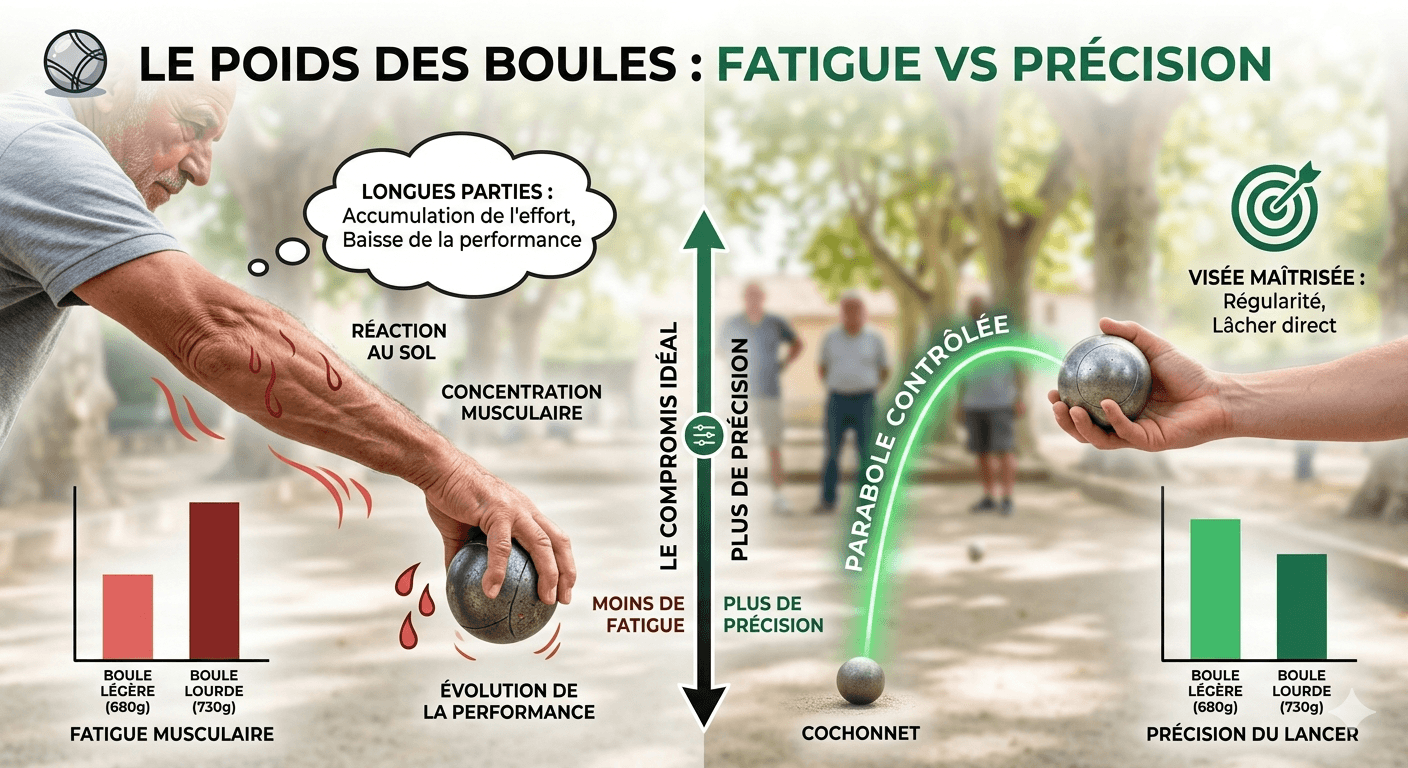
⬆️ HEAVY BOULE (730g+) ⚡More inertia — the boule carries on its trajectory more easily despite obstacles 💥Stronger impact on the opposing boule — more marked displacement 🌬️More wind-resistant — the mass absorbs aerodynamic disturbances better ⬇️Longer roll on hard ground — more energy to dissipate 😓Faster muscular fatigue — 300 throws at 750g vs 700g is 15 kg of cumulative difference 🎯Harder release control — the mass amplifies gestural errors ⬇️ LIGHT BOULE (–680g) ⚡Less inertia — deflects more easily against obstacles and irregularities 💥Weaker impact on the opposing boule — less decisive displacement 🌬️More sensitive to wind — slight trajectory deviation in strong wind ⬇️Shorter roll — brakes faster after ground impact 😊Less muscular fatigue — greater endurance over a long competition 🎯More precise release control — less mass to manage, errors less amplified 🔬The weight paradox: a heavier boule can feel "better" early in a game — it gives an impression of power and solidity. But from the 5th–6th game of a competition onward, the cumulative fatigue of a too-heavy boule starts to measurably affect the accuracy of your motion. The right weight isn't the one that feels best on the first throw — it's the one that preserves the quality of your motion right through to the last.
Muscular fatigue — the enemy of the last point
💪 THROWING PHYSIOLOGY 300 throws — what it costs the muscle depending on weight A standard triplette competition comprises between 6 and 8 games, each of around ten ends. If you throw an average of 4 boules per end, you make about 240 to 320 throws over the day. With a 750g boule, that's 180 to 240 kg of total load lifted and thrown. With a 700g boule, that's 168 to 224 kg. The 50g difference per boule represents 12 to 16 kg less cumulative load over the day — a significant reduction in fatigue for the throwing muscle groups (shoulder, elbow, forearm). ESTIMATED ACCURACY OVER THE GAMES (too-heavy boule) Games 1–2 100% Fresh — full capacity Games 3–4 90% Slight, imperceptible fatigue Game 5 75% Noticeable fatigue — less stable motion Games 6–7 58% Marked decline Final 40% Severe fatigue — the weight costs you the final Illustrative estimates — values vary depending on build, temperature and physical preparation 🎙️ Paquita on fatigue and weight "I played for 8 years with 730g boules. I pointed well early in the competition and systematically missed the last ends of the 6th or 7th game. I thought I had a concentration problem. Switching to 700g, the problem disappeared. I pointed less 'hard' — but I reached the final with the same motion as at the start of the morning. Accuracy isn't about strength — it's about maintaining muscular freshness right to the end." — PaquitaBuild and ideal weight — the objective criteria
There's no "universal right weight". There's the weight that matches your precise build — hand size, grip strength, arm length, overall build. Here are the criteria that guide the choice.
CRITERION 1 🖐️ Hand sizeA large hand can comfortably cradle a heavy boule and keep a stable grip. A small hand struggles to hold a 730g+ boule naturally — which creates tension that affects the release.
Large hand → higher weight CRITERION 2 💪 Strength and buildA larger build with developed musculature naturally handles higher weights without premature fatigue. A lighter build or less developed musculature benefits from a lighter boule to maintain quality over time.
Average build → 680–710g CRITERION 3 👴 Age and physical conditionWith age, grip strength and muscular endurance naturally decline. Many veterans maintain their level of play by reducing their boule weight by 20 to 40g — compensating for muscle loss with a preserved motion.
Veterans → rather 650–690g CRITERION 4 🔄 Arm lengthA long arm creates a longer swing — which multiplies the torque exerted on the shoulder by the mass of the boule. A tall player with long arms can sometimes benefit from a slightly lighter boule than expected for their overall build.
Long arm → check the shoulder CRITERION 5 🏃 Playing frequencyA player who plays 3 times a week has developed specific muscular endurance. A player who plays once a month must make up for the lack of training by choosing a more conservative weight to avoid accidental fatigue during a competition.
Occasional player → lighter CRITERION 6 🩺 Joint conditionsElbow tendonitis, shoulder problem, finger osteoarthritis — any existing joint or musculotendinous condition justifies dropping to the lightest comfortable weight. Weakened joints never benefit from extra load.
Condition → as light as possibleWeight by role: shooter vs pointer
| Role | Recommended weight | Rationale | Avoid |
|---|---|---|---|
| Pointer — lofted technique | 680–710g | Release accuracy is crucial. A medium weight preserves fine control over time. | Too heavy = hand tension, release affected under fatigue |
| Pointer — rolling technique | 670–700g | The rolled point requires a very gentle motion. A light weight makes the subtlety of the release easier. | Too heavy = impossible to gauge the force over short distances |
| Direct-hit shooter | 700–740g | Inertia helps maintain the trajectory over a long distance. The power of the throw compensates for the load. | Too light = boule deflected by obstacles, less decisive impact |
| Middle (pointer-shooter) | 690–720g | A compromise between pointing control and shooting power. A versatile middle range. | Extremes in either direction degrade one role or the other |
| Shooter in a long competition (7–8 games) | 700–720g | Even for a shooter, slightly reducing the weight preserves the shoulder over the course of a competition. | 750g+ over 7 games = risk of motion decline in the final |
The simplest practical test to know whether your weight is right: hold the boule in your usual playing grip for 5 seconds without throwing it. If you feel a slight tension in your fingers or wrist to maintain the grip, the boule is probably too heavy. The ideal grip is the one that requires no holding effort — the boule "rests" in the hand naturally, without tension. This test often reveals that you're playing with 20 to 30g too much without knowing it.
The practical test — finding your weight in 3 steps
🧪 WEIGHT TEST PROTOCOL — 3 STEPS 1 Grip test — before throwing Hold 3 boules of different weights (e.g.: 680g, 700g, 720g) in your normal grip, 5 seconds each. Which one holds without conscious effort? Which one requires a slight tension? The first is your candidate. If you can't tell the difference, start with 700g — it's the middle range that suits the majority of builds. 2 Accuracy test cold vs hot On each candidate weight, throw 20 boules "cold" (start of session) and measure the success rate. Then throw 80 boules simulating a game and do another 20 boules "hot". If accuracy drops by more than 20% between cold and hot — the weight is probably too heavy for your endurance. If accuracy is stable — the weight is in your range. 3 Full competition test — day simulation The ultimate test: play a full competition (6–7 games) with the candidate weight. Observe the quality of your motion at the end of the day compared to the morning. If you don't notice any marked decline over the last 3 games — the weight is right. If you feel your boules are "less responsive" in the late afternoon — reduce by 10 to 20g. Note: mental fatigue can mask or amplify muscular fatigue — stay objective.The 5 most common weight-choice mistakes
1 Choosing the weight "to play like the pros" A national champion who plays with 720g has 20 years of regular practice and musculature adapted to that weight. A club player who takes up that weight without that physical base will suffer it — not master it. A model's weight isn't a target, it's a result of their physiology. ✓ Choose according to your own build and your own endurance, not according to an external model. 2 Never reconsidering your weight as you age At 40, you played with 730g. At 65, you still play with 730g "because you've always played that way". Muscular strength declines naturally — a weight suited to 40 can be too heavy at 65. This resistance to change costs veterans points invisibly and progressively. ✓ Reconsider your weight every 5 to 7 years, or as soon as recurring joint pain appears. 3 Choosing "heavier" after a good run After a successful end with a 700g boule, some players think a 720g boule would give them "even better results". That's a cognitive bias. The accuracy of a successful end comes from the motion, not the weight — going heavier adds fatigue without adding accuracy. ✓ The right weight isn't "heavier than what works". It's the weight that works, sustained over the whole day. 4 Playing with a different weight in training and in competition Training with 700g boules and playing in competition with 720g boules — or the reverse. Muscle memory adapts to the exact weight it works with. A different weight in competition creates a subtle gestural disorientation, especially in force calibration. ✓ Train with exactly the weight used in competition. If you change weight, plan an adaptation period in training before using it in competition. 5 Blaming your misses on everything but the weight "My swing is off", "I'm tired", "the ground is difficult" — all these explanations may be true. But a too-heavy weight can be the unidentified underlying cause. Before looking for a motion problem, check whether the problem isn't simply the mass you're managing. ✓ Systematically test a 20g lighter weight when late-game misses become recurring.Summary table — which weight for which profile
| Player profile | Recommended weight | Priority | Note |
|---|---|---|---|
| Beginner — all builds | 700g | Learning the motion without fatigue | Universal starting point, to adjust afterwards |
| Woman, standard build | 670–690g | Generally lower grip strength | Use the 5-sec grip test as the main indicator |
| Man, average build, pointer role | 690–710g | Balanced accuracy and endurance | Comfort zone for the majority |
| Man, large build, shooter role | 710–730g | Inertia and impact, adapted musculature | Check at the end of a long competition |
| Veteran 60–70 years | 660–690g | Preserve endurance and joints | Reduce if joint pain appears |
| Veteran 70+ years | 650–670g | Minimize fatigue to play through to the final | The legal minimum can be the best choice |
| Young player (minime/cadet) | 650–670g | Developing musculature | Progress towards higher weights over the years |
| Player with tendonitis or a condition | 650–680g | Reduce joint strain | Medical advice recommended in case of persistent pain |
Weight, grooving, hardness, diameter, role... Paquita's book explains how to choose your equipment AND how to use it — 100 numbered drills, full biomechanics, level-based programs.
📦 Order on AmazonFAQ — Your frequent questions
Do all three balls in a triplet have to have exactly the same weight? + Yes. To be played together by the same player in an official competition, the three balls must have the same engraved weight and belong to the same FIPJP approved model. In practice, there may be very slight manufacturing variations (±2g) between two balls from the same batch — which is tolerated and does not create any practical problems. What you can't do: play two 700g balls and one 720g ball, even from the same brand. The engraved weight must be the same for all three. Can you lose real weight while playing — do the balls wear out? + Yes, very marginally. The wear of the steel during impacts and rolling takes off a few grams over several years of intensive practice. In practice, a quality ball (treated steel) rarely loses more than 3 to 5 grams over 5 to 10 years of regular play. This is not a factor in weight selection — but it does explain why old, often-used balls may deviate slightly from the engraved weight. If an referee check reveals a significant deviation (more than 5g outside manufacturing tolerance), the ball may be refused. Does heavier weight really improve iron shooting? + Yes, to a certain extent. A heavier ball has more inertia — it deflects less upon contact with an obstacle, it disrupts the opposing ball more upon impact, and it resists wind better. But beyond a threshold linked to the morphology of the shooter, these advantages are canceled by the accumulated muscular fatigue which degrades the precision of the movement. A shooter who plays at 750g and loses 15% accuracy on games 6–7 would often be better off at 720g with accuracy maintained until the final. The mechanical advantage of heavier weight is only useful if it is bearable over time. How to adapt the weight if you play both in summer (heat) and in winter (cold)? + Good question, often ignored. In cold weather, muscles are less flexible and grip strength is slightly reduced — cold hands have less sensitivity and strength. In very hot weather, dehydration and perspiration affect the grip (sweaty hands). Some players who play at 710g in normal conditions go down to 700g for winter competitions or games in full July sun. This is a fine adjustment that is justified among regular competitive players. For occasional club players, maintaining a fixed weight and adjusting through movement is simpler than regularly changing balls. 📎 Related articles Equipment Choosing your pétanque boules — complete guide 2026 Equipment Stainless steel vs carbon — complete comparison Equipment Top 3 best shooter boules 2026 Equipment Checking the FFPJP approval of your boules Video Why changing bowls does not change your level Tools Free PetanqueLand tools© Pétanque by Paquita — petanqueland.fr ·
📖 Paquita's book on Amazon
The recommended weight ranges are estimates based on field observations and general physiological principles. They vary between individuals — the practical test remains the absolute reference.