Actualités · 4 April 2026
Shooting the iron or "in front": What's the best strategy to win?
A clean carreau is the dream, but the "rafle" wins. Should you always aim for the top of the boule or play it safe by landing in front? A technical and tactical analysis to choose the winning shot according to the terrain and the stakes.Clear definitions — fer, devant, demi-portée
Before comparing, let's clarify. These three terms cover distinct technical realities that many players partially confuse.
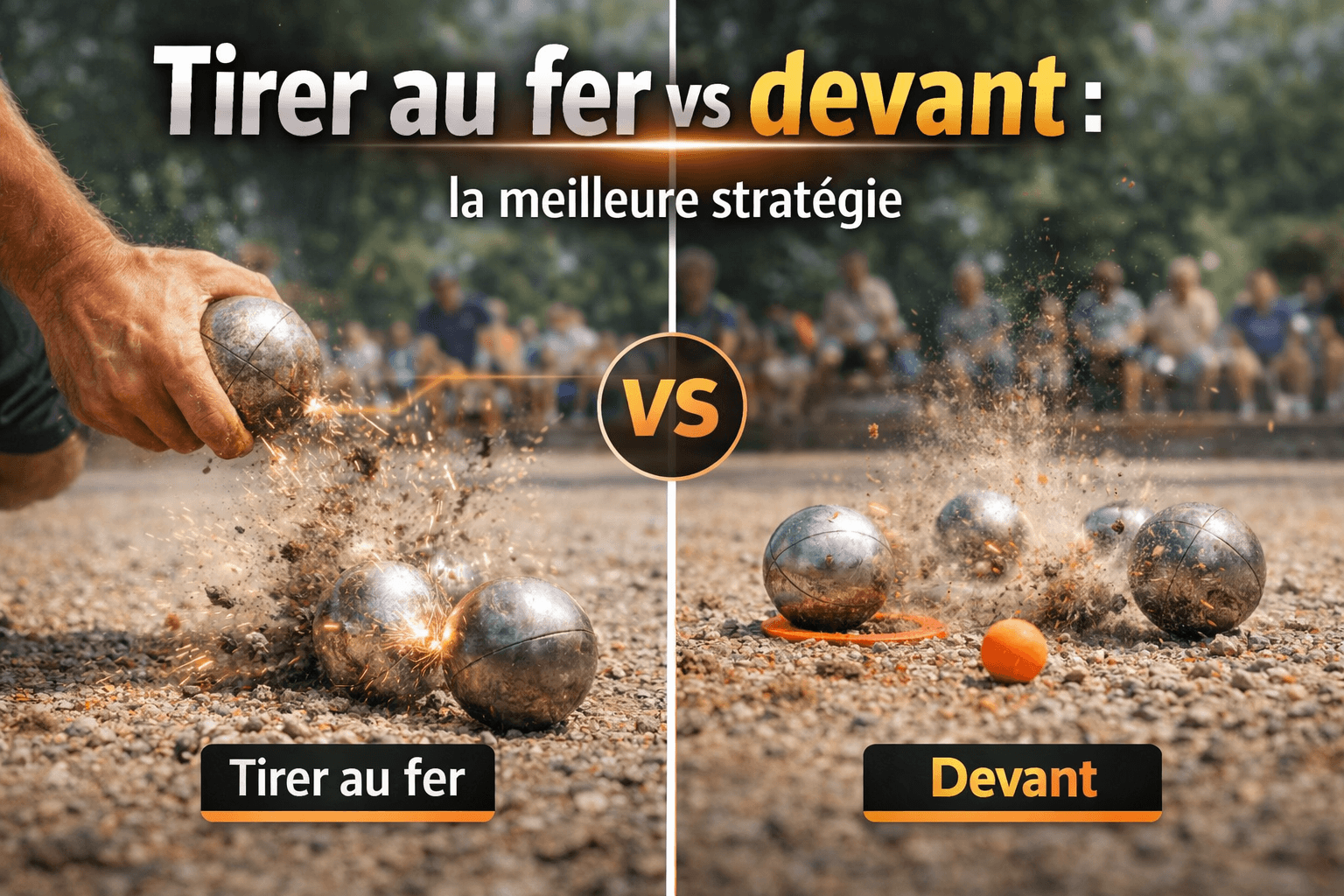
🔥 Shooting au fer The boule touches the opposing boule directly in flight, without a prior bounce on the ground. The trajectory is taut, the impact is direct. The throwing height is calculated to reach the opposing boule in flight. It's the precision shot par excellence — all the difficulty lies in calculating the height and angle. Direct contact Taut trajectory No ground bounce VS 💧 Shooting devant The boule lands in front of the opposing boule (between 20 cm and 1 m depending on the type), bounces and strikes the target. The landing point is on the ground, not on the opposing boule. The main difficulty is controlling the bounce — which depends on the terrain. Most common variant: the demi-portée shot (bounce halfway). Ground bounce Landing point in front Terrain-dependent 📐 SIDE VIEW — COMPARED TRAJECTORIES C — Shooting au fer (direct flight) - - Shooting devant (bounce) ↑ opposing boule ● jack Shooting au fer — direct contact in flight Shooting devant — bounce then impact 📌The half-lob is a variant of the devant shot where the landing point is halfway between the circle and the target. It's used on hard terrains where too short a bounce deflects the boule, and allows control of the angle of attack. It follows the same choice rules as the devant shot — they're variants of the same principle, not separate techniques.
Criterion-by-criterion comparison
Criterion 🔥 Shooting au fer 💧 Shooting devant 📐 Lateral precision Better — no bounce = no lateral deviation linked to the terrain Depends on the bounce — an irregular surface can deflect right or left 📏 Distance precision Harder — the height calculation is demanding, especially at long distances Easier to manage — the landing point is more natural to calculate 🌍 Terrain dependence Minimal — the bounce doesn't play, the terrain only slightly influences the trajectory in flight Strong — a soft, sandy or irregular terrain completely alters the bounce 🚧 Obstacle in front Can pass over if the trajectory is high and precise enough Often blocked — the boule bounces before the obstacle or hits it 💥 Effect after impact Carreau possible, rétro possible — the opposing boule goes in the axis of the shot Different impact — the bounce angle alters the direction of the opposing boule afterwards 📚 Difficulty to learn Longer to master — the height calculation is precise and not very intuitive More accessible to beginners — the gesture is more natural 🌦️ Weather conditions Little affected — the wind can slightly deflect but it remains the most stable More sensitive — rain, humidity and wind change the bounce unpredictably 🎙️ Paquita on the fer vs devant debate "I often hear: 'I shoot au fer, it's more beautiful.' Or its opposite: 'I shoot devant, it's safer.' Neither holds up in a real situation. The 'more beautiful' shot that misses is less useful than the 'less elegant' shot that hits. And the 'safer' shot on a terrain that bounces at an angle is only safe in the shooter's head. The question is never which of the two techniques is better — it's which is best for THIS precise shot, right now, in these conditions." — PaquitaThe impact of terrain on the choice
The terrain is the first decision criterion — before the distance, before the position of the opposing boule, before your technical level. A good choice of technique on the wrong terrain systematically gives bad results.
| Terrain type | 🔥 Shooting au fer | 💧 Shooting devant |
|---|---|---|
| Hard and compact clay | Both — predictable bounce | ✓ Effective — regular bounce |
| Fine gravel | ✓ Preferable — the bounce can deviate | Risky — the gravel absorbs and deflects |
| Deep sand | ✓ Clearly better | Poor — the boule sinks at the bounce |
| Concrete / synthetic | Possible | ⚠ Unpredictable bounce — very strong |
| Wet terrain / after rain | ✓ Preferable | Inconsistent — variable absorption |
| Sloping terrain | To adjust according to the slope | ⚠ Bounce skewed by the incline |
| Short lawn | ✓ Better — grass absorbs the bounce | Generally poor |
Before the first game on an unknown terrain, always do a bounce test : throw a boule at half power onto the terrain and observe how it bounces. High and clean = hard terrain, the devant shot is viable. Flat and absorbed = soft or sandy terrain, prefer the fer. Irregular and unpredictable = chaotic terrain, the fer is more reliable. This test takes 30 seconds and conditions your whole shooting strategy for the game.
8 game situations — what to choose and why
🚧 Opponent's ball with a ball in front (obstacle) An allied or opposing ball is between you and the ball to be drawn. Shooting ahead is impossible or very risky — the bounce would hit the obstacle before the target. Iron shooting allows you to go above provided you calculate the correct height. → Iron shooting — this is the only clean option 🎯 Opponent's ball well cleared, hard and regular ground The target is directly accessible, the terrain is compact and the bounce is predictable. In this ideal configuration, the front shot is easier to master and gives a greater margin for error in distance — your ball can hit 20 to 60 cm in front of the target and still achieve the result. → Shot in front — the margin of error is on your side 🌧️ Soggy or very sandy ground A court that absorbs the ball on the rebound completely cancels the effect of the shot in front. The ball sinks, loses speed and never reaches the target with the necessary energy. On this type of surface, iron is the only viable option — the energy of the shot is transmitted directly, without loss on rebound. → Iron shot — rebound is unusable 📏 Short distance (6 meters) on standard terrain At short distances, iron shooting requires a tight trajectory and a precise height — the margin is very fine. Shooting in front offers a more natural trajectory and a greater margin for error. For shooters who are proficient in both, the short distance is often more suited to shooting up front. → Shooting in front generally preferable at 6m 📏 Long distance (9–10 meters) At long range, the trajectory of the shot ahead is more difficult to control — the bounce is more unpredictable because the ball arrives with less energy and a different angle. Iron shooting remains accurate at long range if the technique is mastered — just adjust the height. → Iron shooting often more reliable at 9–10m 🎱 Several grouped balls — “clear the pile” When the opponent has several balls grouped around the jack, the shot in front (or the diamond) allows a wider attack that hits several balls at once. A precise iron only hits one ball — the shot in front can shake up the whole group if the bounce is well placed. → Shot in front or diamond for maximum impact 🎯 Opponent's ball very close to the jack (< 15 cm) When the opposing ball is stuck to the jack, the shot in front risks hitting the jack before the ball, or causing both to go in an unpredictable direction. The iron allows you to precisely target the opposing ball by ignoring the jack — the trajectory passes over it. → Iron shot so as not to risk the jack ⚖️ Balanced situation — playing your dominant shot When the two options are truly equivalent (standard terrain, well-cleared ball, medium distance), the best decision is to play your dominant shot — the one you master best. A 65% iron is better than a 55% front, and vice versa. Confidence in your technique is a factor of success. → Play your dominant shot without hesitationThe quick decision tree — 4 questions in 3 seconds
Applying this tree mentally before each shot takes less than 3 seconds once it's integrated. The 4 questions follow in order — the first "blocking" answer is your decision.
🌳 DECISION TREE — IRON OR FORWARD? ❓ Question 1 — Is there an obstacle between me and the opposing ball? YES → Mandatory iron shooting. The shot in front is blocked or too risky. NO → Go to question 2 ❓ Question 2 — Is the ground soft, sandy or irregular? YES → Iron shooting highly recommended. The rebound is unpredictable. NO → Go to question 3 ❓ Question 3 — Is the opposing ball stuck to the jack (< 15 cm)? YES → Iron shot — avoids the risk of hitting the jack while bouncing. NO → Go to question 4 ❓ Question 4 — Which of the two shots do you have the best success rate? Fer dominant → Shoot au fer. Play your strength without hesitation. Devant dominant → Shoot devant. Play your strength without hesitation. ⏱️ Decision in 3 seconds — no moreA shooting decision that takes more than 10 seconds is already a bad decision. Prolonged hesitation consumes cognitive energy that should go into execution. Practise applying the tree mentally to fictional situations — "sandy terrain, obstacle, target at 8m" — until the answer comes automatically. When the tree is integrated, the decision even precedes the conscious question.
What shooter are you — finding your dominant shot
All shooters naturally have a dominant shot — not by aesthetic preference, but by learning history, morphology and feel for the gesture. Identifying it objectively allows you to make better tactical decisions.
🔥 The au fer shooterLearned on varied terrains, often natural terrains. Taut throw, fluid pendulum gesture, good reading of the height. Their weak point: perfectly flat terrains where the devant would be more effective but they rarely resort to it.
💧 The devant shooterOften learned on hard and regular terrains. Natural and precise gesture for the landing point. Very effective in standard conditions. Weakened by irregular or soft terrains — can lose their bearings quickly.
⚡ The mixed shooterHas worked on both consciously and applies the decision tree systematically. It's the hardest profile to reach but the most formidable — they have no weakness exploitable by the opponent depending on conditions.
❓ The undecided shooterChanges technique according to mood or their partners' advice. Has never objectively measured their success rate per technique. Result: bad decisions under pressure and chronic lack of confidence.
📊To objectively identify your dominant shot: during your next 3 training sessions, note each shot in a notebook — technique used (fer or devant) + result (hit / miss). After 60 to 80 shots, your success rate per technique is statistically reliable. This figure is worth more than 10 years of subjective feeling.
The 5 most common choice mistakes
🎨 Choosing to "look good" The fer is perceived as more elegant. Some shooters choose it in all circumstances for the image it projects — even when the terrain or the situation makes the devant far more effective. ✓ Effectiveness always takes priority over aesthetics. The beautiful missed shot scores no point. 💬 Following partners' advice "Shoot au fer, it's safer!" — says the pointer from the side. The shooter changes their decision at the last second. They miss. It's not the advice's fault — it's the fault of an unowned decision. ✓ The decision belongs to the shooter. It's made before entering the circle, not during the routine. 🔁 Changing technique after a miss After a missed fer, switch to devant. After a missed devant, switch back to fer. This alternation produces no useful information and sabotages the consistency of both techniques. ✓ Analyse why the shot missed (gesture or choice?) before changing. Two consecutive misses with the same technique don't mean the technique is bad. 🌍 Ignoring the terrain Arriving on a new terrain and systematically shooting devant "as usual" without checking whether the bounce is exploitable. This is the no. 1 cause of incomprehensible series of missed shots. ✓ Always test the bounce at the start of a game on unknown terrain. Adapt the strategy accordingly. 🎯 Aiming at the opposing boule with the devant A classic beginner's mistake: with the devant shot, you don't aim at the opposing boule — you aim at the landing point on the ground. Looking at the opposing boule during the swing of a devant shot is a guarantee of a miss. ✓ Identify and fix the precise landing point on the ground. That point is your visual target — not the opposing boule. 📖 PAQUITA'S BOOK All shot types — detailed and drilledFer, devant, demi-portée, recul, au bouchon... Paquita's book covers each shot type with its biomechanics, its dedicated exercises and its mastery criteria. 100 numbered exercises, 3 levels, structured programmes.
📦 Order on AmazonFAQ — Your frequent questions
Should you master both techniques or specialize in just one? + The answer depends on the level and ambitions. For a recreational or local competition player, master perfectly a single shot is more effective than approximately mastering both. Focus on the one that works best for you and learn to create the conditions to use it (reading the terrain, positioning). For a player who aims to progress significantly in regional or national competition, both techniques become necessary because the opponent and the terrain impose constraints which do not always allow the dominant shot. Is the front shot really less precise than the iron or is it a preconceived idea? + This is partly a preconceived idea. The shot in front is no less precise — it is precise differently. Its lateral precision is indeed less reliable on irregular terrain, but its distance precision is often better than iron because the drop point is more intuitive to calculate. On hard and even terrain, a good forward shooter can achieve success rates identical to iron. What is true is that iron is more consistent between different terrains — its accuracy does not vary depending on the surface, making it the natural choice for serious competitors who play on varied terrains. Can we shoot irons over all distances or are there limits? + Technically, the iron can be used over the entire regulatory distance range (6 to 10 meters). In practice, each shooter has a optimal fer distance — generally between 7 and 9 meters — where calculating height is most natural for him. Below 6 meters, the trajectory of the iron is very tight and the height calculation is very fine. Beyond 10 meters (exceptional distances on long terrain), the iron remains viable but requires a more marked arc of trajectory. Distance is not an absolute criterion for choosing iron or front — it is the combination of distance + terrain + obstacle that takes precedence. My captain always tells me what to shoot — how do I have a say? + Tactical communication is normal and useful in pétanque — the captain has an overview that the circle shooter doesn't always have. But the final technical decision rests with the shooter. Good practice is for the captain to communicate the tactical objective ("this boule needs to go") and for the shooter to choose how reach it. If your captain systematically prescribes the technique ("shoot the iron there"), an out-of-game conversation is in order: explain your respective success rates on each technique, and establish a clear rule — the captain decides what, the shooter decides how. Is forward shooting allowed in official competition? + Yes, totally. The FIPJP regulations do not prescribe any shooting technique — they only define the constraints on the thrower (feet in the circle, ball thrown in one movement), not on the trajectory or point of impact. Shooting in front, shooting with iron, shooting in diamonds, behind the back – all these techniques are authorized in official competitions. What is regulated is the thrower's gesture, not the mechanics of the ball. See our article on the complete FFPJP rules for all the details. 📎 Related articles Equipment Top 3 best shooter boules 2026 Equipment Stainless steel vs carbon — what impact on your shot? Rules Complete FFPJP rulebook 2026 Rules The one-minute rule — what every shooter should know Video Refereeing videos — game situations Tools Free PetanqueLand tools© Pétanque by Paquita — petanqueland.fr · 📖 Paquita's book on Amazon