PetanqueLand
Search: Movie should be distinctly Please enter a search term in the search field.

Not to be missed

Search suggestions

Why do some boules veer off for no apparent reason? (Pétanque) Article Why do some boules veer off for no apparent reason in pétanque? PAQUITA ON PÉTANQUE STRIKE Video Pétanque: when you celebrate too soon… Video pourquoi il ne faut jamais celebrer avent la (1)-Couverture Boule diameter: why the wrong choice holds you back (Pétanque) Article Which boule diameter should you choose? The direct impact on your performance THE DIGESTION EXCUSE Video
Cart 0
EN▾
FrançaisEnglishEspañolItalianoDeutschPortuguêsNederlandsCatalàالعربية中文ไทย
PetanqueLand
  • Home
  • SHOP
    • Pétanque Book Shop
    • Pétanque Player Clothing
    • Pétanque Objects & Decor
    • Pétanque Gift Ideas
    • See all
  • ⭐ The Pétanque Software
  • Videos
  • 🏛️ OFFICIAL
    • Upcoming competitions
    • Results & calendar
    • Rules explained
  • FREE Zone
    • Free online software
    • Free tools
    • Lab
  • News by Paquita
Total articles: 193
FFPJP Rules — Game accidents

These situations accidental in petanque that the rules provide for

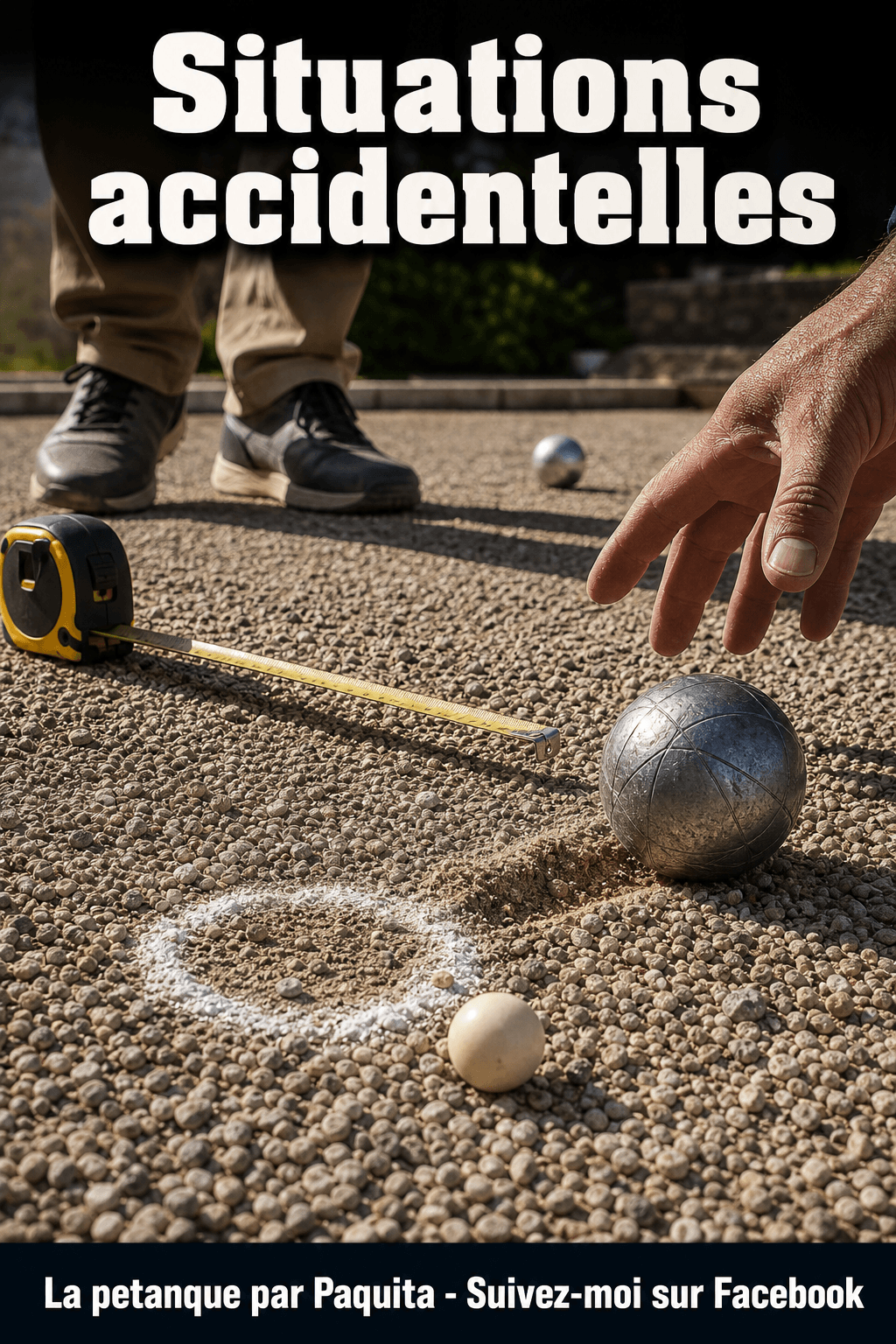
A boule touched by a foot, the jack moved by an object, a spectator crossing through, a boule stopped by mistake: these accidents are not settled by instinct. The rules give a clear logic.
FFPJP RulesBy PaquitaReading time: 8 min
Moved boule, touched jack, spectator, object, involuntary gesture: what to do in accidental situations according to the official petanque rules. This article explains the official logic, the common mistakes and the good reflexes to adopt in competitions as well as at the club.
1
marking
often saves the decision
3
actors
player, umpire, outside element
0
panic
observe before replacing
1
proof
the initial position matters
In this article
  1. Accident or foul: the distinction that changes everything
  2. Boule moved by a player
  3. Boule or jack moved by an outside element
  4. Why marking positions is crucial
  5. When the umpire must decide
  6. Paquita's method after an accident
  7. FAQ

1.Accident or foul: the distinction that changes everything

In pétanque, many discussions start with a simple phrase: “whose turn is it to play?” or “is this boule valid?”. The FFPJP rules were not written to complicate games, but to prevent each club from inventing its own answer. The right approach is to identify the real situation, then apply the official logic without adding any makeshift arrangement.

The first reflex is therefore to slow down. As long as the next boule has not been thrown, you can check the point, observe the boundary, recall the order of play or request a measurement. Once the throw is on its way, the situation becomes more delicate, because the court has changed. That is why experienced players never rush in borderline cases.

2.Boule moved by a player

Errors rarely come from obvious bad faith. They are born rather of habit: you think you know the rule, you apply what is done at the club, or you confuse a leisure rule with a competition rule. On a cramped court, with noise around and a tense score, this approximation is enough to trigger a conflict.

Key point: the rules protect the continuity of the end. You do not replay because the situation inconveniences a team; you act only if the rule provides for a correction or a decision.

3.Boule or jack moved by an outside element

Before announcing a penalty or a replacement, three questions must be answered: was the initial position known? was the action voluntary or accidental? was the boule or the jack moved by a player, by a played boule, or by an outside element? These three answers guide almost the entire decision.

When in doubt, measuring and marking are your best allies. A boule marked on the ground, a jack whose position is known, or a line checked before the throw avoid contradictory accounts. Conversely, when no one has observed the starting position, the referee often has to decide with incomplete information.

4.What the practical cases show

The diagrams below summarise the difference between a well-controlled game and one played on instinct. They do not replace the umpire, but they set the right mental order: observe, check, decide, and only then resume play.

Correct reading vs poor application
Official reflex
fewer disputes, more continuity
Improvised reflex
discussion, error, dispute
Dispute risk level
Controlled situation · 3/10
The boules are identified, the distances are visible, everyone knows who is to play.
Confused situation · 8/10
No one has marked, the order of play is disputed, the terrain has not been read.
Frequent caseGood reflexMistake to avoid
Marked bouleReplace if the rule allowsArgue without reference points
Outside elementNote the originBlame the opponent
Unknown positionCall the umpireReplace at random

5.When the umpire must decide

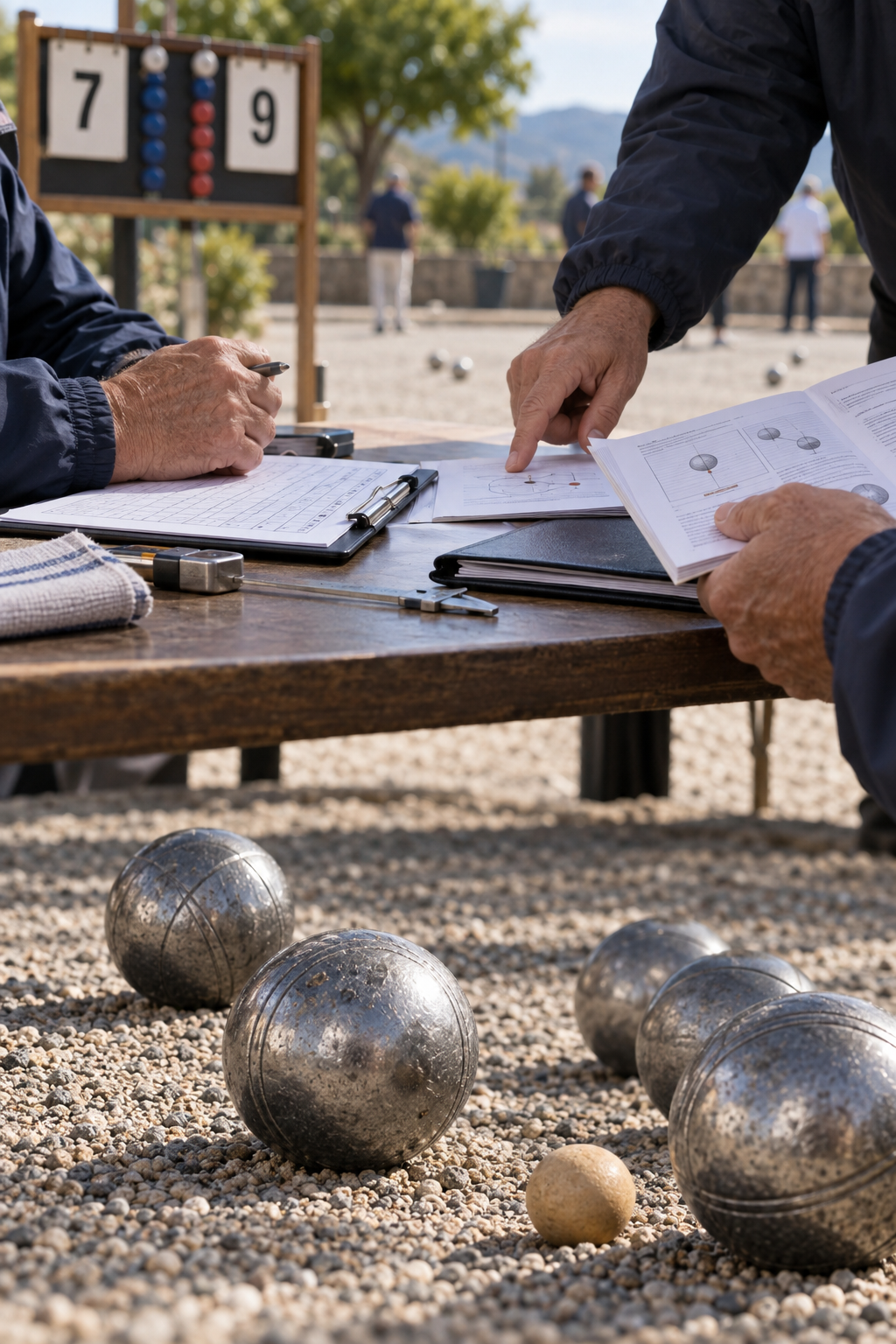
In an official competition, the umpire is not called only when everyone is shouting. They step in as soon as a regulatory decision goes beyond a simple agreement between the teams. Their role is not to “prove right” the most self-assured player, but to restore a consistent application of the rules.

A good player makes this work easier: they do not touch the boules before the decision, they point out the marks if there are any, and they explain the facts without replaying the whole game. This calm attitude saves time and prevents a technical dispute from turning into a personal conflict.

Paquita's tip

If you sense a collective hesitation, simply say: “let's check before we play”. This short sentence avoids 80% of the mess, because it comes in before the end has been altered.

6.Paquita's method after an accident

The most reliable method comes in four steps. First, stop play without touching anything. Next, identify what has actually moved or what is in question. Then check the available reference points: marks, lines, distance to the jack, order of play. Finally, resume only once the decision is shared or umpired.

This method seems simple, but it transforms the atmosphere of a game. Players stop arguing over impressions and come back to the facts. To progress in this reading, also consult the official dimensions of the terrain and the rule for a boule accidentally displaced.

PAQUITA'S BOOK
The Complete Series — The Pétanque Training Bible

Understanding the rules, reading the situations and keeping a clean routine: the full series supports players who want to improve without getting lost in bar-room habits.

Discover the series
FAQ — Your frequent questions

If the teams agree and the rule is simple, they can resume play. In a competition, as soon as a disagreement persists or a regulatory decision is required, the umpire must be called.
It is strongly recommended in every sensitive case. Marking allows the boule to be put back correctly if the rules permit it and avoids discussions over an approximate position.
No. The rules distinguish the origin of the displacement, knowledge of the initial position and the effect on the end. An accident is not treated as a deliberate fault.
Not automatically. Replaying is only possible in the cases provided for. Otherwise, the end continues with the situation resulting from play or with the official correction.
Because they often arise at the worst moment: tight score, uncertain point, pressure. A checking routine before the throw greatly reduces these disputes.
Related articles
RulesBoule played by the wrong player: regulatory consequencesTerrainTerrain in an official competition: what the rules requireAccidentBoule accidentally displaced: what do we do?

© Pétanque by Paquita — petanqueland.fr. Educational article based on the logic of the official FFPJP rules; in competition, the umpire's decision prevails.

Share Follow

📬 Paquita's pétanque newsletter

New articles, videos, free tools and offers — straight to your inbox.

← Previous articleBoule played by the wrong player in pétanque: the regulatory consequencesNext article →These petanque terrain rules that even umpires sometimes forget
← Return to rules

About PétanqueLand

PétanqueLand.fr is the fun, practical site devoted to pétanque: videos, humour, photos & memes, free tools and news.

Find Pétanque by Paquita and join the community!

Categories

  • ⭐ Celebrities
  • 🎥 LIVE training
  • ❓ Questions & Tips
  • 🎭 Parodies
  • 🐕‍🦺 Animals
  • ⚖️ Refereeing
  • 🍻 Refreshment bar
  • 🎬 Series
  • 😂 Pétanque humour
  • 🤯 WTF moments
  • Most viewed
  • What's new

Information

  • Home
  • SHOP
    • Pétanque Book Shop
    • Pétanque Player Clothing
    • Pétanque Objects & Decor
    • Pétanque Gift Ideas
    • See all
  • ⭐ The Pétanque Software
  • Videos
  • 🏛️ OFFICIAL
    • Upcoming competitions
    • Results & calendar
    • Rules explained
  • FREE Zone
    • Free online software
    • Free tools
    • Lab
  • News by Paquita

Follow Paquita

Find Pétanque by Paquita on my social networks:

Facebook
TikTok
YouTube
Instagram
X

📸 Photos & memes
🎯 Pétanque videos
😂 Humour & WTF moments
🧰 Free tools

© 2026 PetanqueLand — The craziest boulodrome on the web. Pétanque videos, humour, refereeing & debates. Contact · Legal notice · Privacy Join me: Facebook · TikTok · YouTube · Instagram · X