PetanqueLand
Search: Movie should be distinctly Please enter a search term in the search field.

Not to be missed

Search suggestions

Why do some boules veer off for no apparent reason? (Pétanque) Article Why do some boules veer off for no apparent reason in pétanque? PAQUITA ON PÉTANQUE STRIKE Video Pétanque: when you celebrate too soon… Video pourquoi il ne faut jamais celebrer avent la (1)-Couverture Boule diameter: why the wrong choice holds you back (Pétanque) Article Which boule diameter should you choose? The direct impact on your performance THE DIGESTION EXCUSE Video
Cart 0
EN▾
FrançaisEnglishEspañolItalianoDeutschPortuguêsNederlandsCatalàالعربية中文ไทย
PetanqueLand
  • Home
  • SHOP
    • Pétanque Book Shop
    • Pétanque Player Clothing
    • Pétanque Objects & Decor
    • Pétanque Gift Ideas
    • See all
  • ⭐ The Pétanque Software
  • Videos
  • 🏛️ OFFICIAL
    • Upcoming competitions
    • Results & calendar
    • Rules explained
  • FREE Zone
    • Free online software
    • Free tools
    • Lab
  • News by Paquita
Total articles: 193
FFPJP rules - Practical case

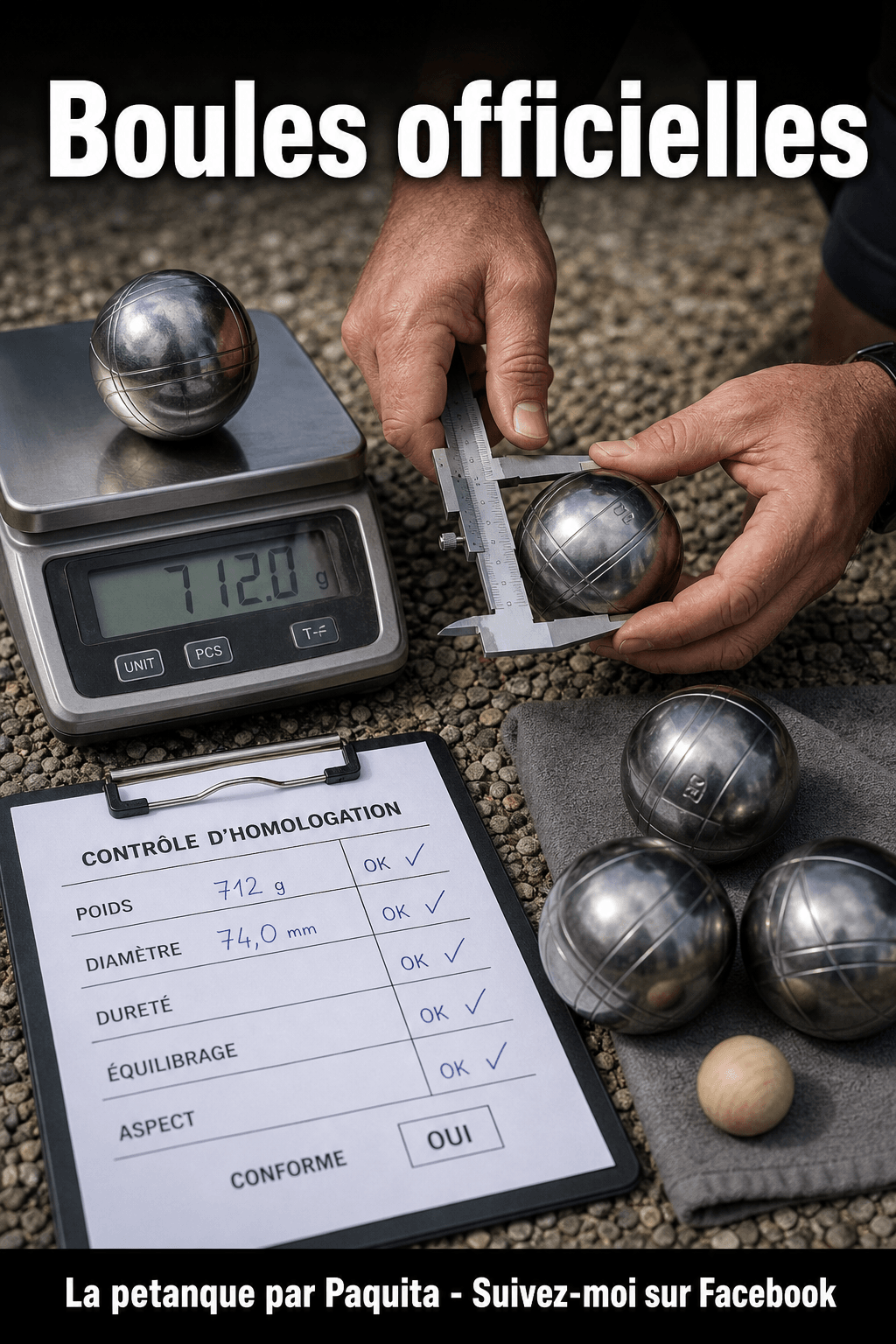
Pétanque boules: weight, size and approval according to the rules

A boule can feel pleasant in the hand and yet be non-compliant in competition. Diameter, weight, marking and approval are not minor details.
FFPJP RulesCompetitionBy PaquitaReading time: 8 min
Equipment is often chosen by feel: a boule that sits well, a reassuring weight, a comfortable diameter. In official competition, that feeling isn’t enough. The boules must meet precise criteria for diameter, weight, manufacture, identification and approval. A non-compliant boule can create a real problem, especially if it’s challenged during an important game. It’s better to check before playing than to discover the rule in the middle of the bracket.
650
g min
common regulatory weight reference
800
g max
upper limit to know
70,5
mm min
official minimum diameter
80
mm max
official maximum diameter
In this article
  1. Why approval matters
  2. Weight and diameter: the essential references
  3. Marking, number and identification
  4. Modified or overly worn boule
  5. What to do in case of a dispute
  6. FAQ

1.Why approval matters

Approval guarantees that the boules meet common criteria. Without it, every player could turn up with equipment that’s too light, too heavy, too big, too small or modified. The competition would lose its fairness. Approved boules give all competitors a shared framework.

In competition, this detail isn't only there to avoid a penalty: it protects the fairness of the game. The better the rule is understood before the throw, the less it becomes a weapon for argument after the throw. A solid player doesn't wait for an incident to ask about the framework; they check, announce and play in a clear environment.

i

Before a competition, check the brand, the weight, the diameter and the general condition. A very worn or modified boule can become challengeable.

2.Weight and diameter: the essential references

Competition boules fall within a regulatory range of weight and diameter. These limits exist to avoid extremes: a tiny boule that’s hard to read, a very heavy boule that’s dangerous, a too-light boule with abnormal behaviour. Choosing your equipment therefore means finding your comfort within the official framework.

In competition, this detail isn't only there to avoid a penalty: it protects the fairness of the game. The better the rule is understood before the throw, the less it becomes a weapon for argument after the throw. A solid player doesn't wait for an incident to ask about the framework; they check, announce and play in a clear environment.

3.Marking, number and identification

A competition boule must be identifiable. The marking makes it possible to recognise the model and avoid confusion on the court. In a tight end, where several boules look alike, this identification prevents pointless discussions about the ownership of the boule or its compliance.

✓
Paquita's tip

Don’t choose a boule just because it “looks pro”. First check that it’s approved and readable. The best boule is the one you can play without second thoughts.

4.Modified or overly worn boule

A boule deliberately altered, filled, heated, drilled or deformed falls outside the normal framework. Even a very old boule can raise questions if it no longer has the expected characteristics. Natural wear is one thing; a modification intended to change behaviour is another.

In competition, this detail isn't only there to avoid a penalty: it protects the fairness of the game. The better the rule is understood before the throw, the less it becomes a weapon for argument after the throw. A solid player doesn't wait for an incident to ask about the framework; they check, announce and play in a clear environment.

5.What to do in case of a dispute

If an opponent challenges a boule, the healthy reflex isn’t to get worked up. Leave the equipment available, call the referee and accept the check. A challenge doesn’t automatically mean cheating: it can also come from a legitimate doubt about a model or a state of wear.

A player who knows their equipment keeps their cool. They know what they play, why they chose it and how to prove its compliance.

Good regulatory reflex vs bad habit
Prepared player
he checks, announces, then plays
Casual player
he discovers the rule after the dispute
Regulatory safety of the situation
Check before the throw · 8/10
The decision is simpler because the facts are known.
Discussion after an incident · 4/10
The longer you wait, the more the rule gets mixed up with memories.
Point to checkGood reflexFrequent mistake
WeightStay within the official rangePlay a novelty boule
DiameterChoose by hand and positionGo for an extreme size
MarkingKeep a readable identificationErase the useful references
WearCheck before a competitionWait for a challenge
PAQUITA'S GUIDE
The Complete Series - The Pétanque Training Bible

Equipment matters, but it doesn’t replace method. The full series helps connect the choice of boules, technique, strategy and progress.

Discover
FAQ - Your frequently asked questions

Approved competition boules fall within a regulatory range, commonly from 650 g to 800 g.
The official diameter generally falls between 70.5 mm and 80 mm for competition boules.
Yes if its condition calls into question its compliance or its identification. The referee can assess the situation.
Not in official competition if they aren’t approved for competition.
The referee or the competent organisation, not the players among themselves.
Related articles
EquipmentCheck the approval of the boulesGuideThe little-known rules of pétanqueSoftwarePétanqueLand competition and mêlée software

© 2026 Pétanque with Paquita · Educational article on the FFPJP rules, to be confirmed by the official umpire in competition.

Share Follow

📬 Paquita's pétanque newsletter

New articles, videos, free tools and offers — straight to your inbox.

← Previous articleThe carried jack in pétanque: allowed or forbidden according to the rules?Next article →Specific rules of the official FFPJP competition that every competitor must master
← Return to rules

About PétanqueLand

PétanqueLand.fr is the fun, practical site devoted to pétanque: videos, humour, photos & memes, free tools and news.

Find Pétanque by Paquita and join the community!

Categories

  • ⭐ Celebrities
  • 🎥 LIVE training
  • ❓ Questions & Tips
  • 🎭 Parodies
  • 🐕‍🦺 Animals
  • ⚖️ Refereeing
  • 🍻 Refreshment bar
  • 🎬 Series
  • 😂 Pétanque humour
  • 🤯 WTF moments
  • Most viewed
  • What's new

Information

  • Home
  • SHOP
    • Pétanque Book Shop
    • Pétanque Player Clothing
    • Pétanque Objects & Decor
    • Pétanque Gift Ideas
    • See all
  • ⭐ The Pétanque Software
  • Videos
  • 🏛️ OFFICIAL
    • Upcoming competitions
    • Results & calendar
    • Rules explained
  • FREE Zone
    • Free online software
    • Free tools
    • Lab
  • News by Paquita

Follow Paquita

Find Pétanque by Paquita on my social networks:

Facebook
TikTok
YouTube
Instagram
X

📸 Photos & memes
🎯 Pétanque videos
😂 Humour & WTF moments
🧰 Free tools

© 2026 PetanqueLand — The craziest boulodrome on the web. Pétanque videos, humour, refereeing & debates. Contact · Legal notice · Privacy Join me: Facebook · TikTok · YouTube · Instagram · X