Règlement FFPJP · 20 July 2026
These rules on equipment that many petanque players don't know
Boules, jack, accessories, marking and approval: the equipment rules that pétanque players often forget in competitions.1.Equipment must stay identifiable and compliant
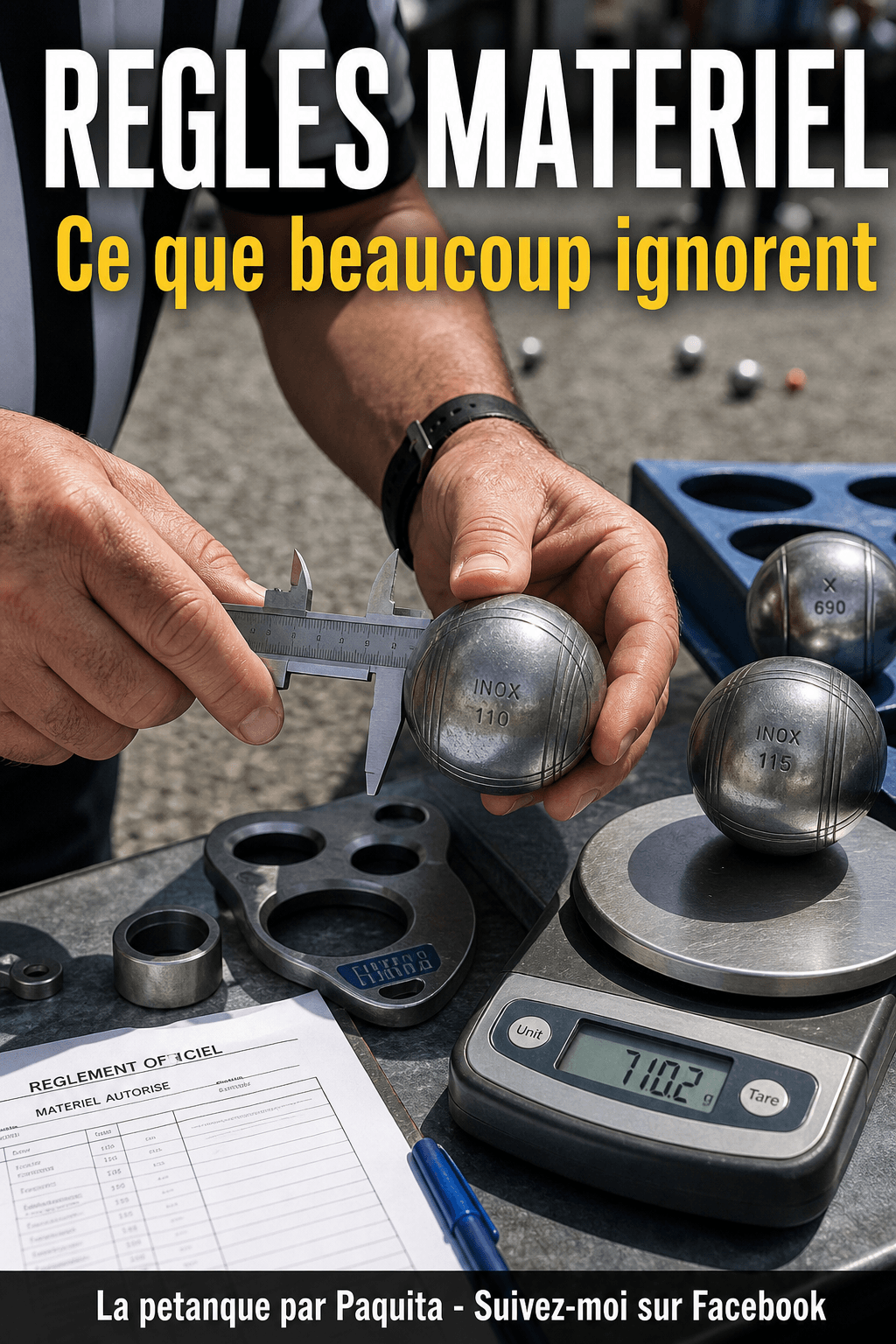
The rules seek one thing: to ensure that no one plays with an abnormal material advantage. A boule must be identifiable, checked and compared against known criteria. That is why approval, weight, diameter, grooves and marking are not mere manufacturer details.
In leisure play, a lot is tolerated. In tournaments, the question becomes stricter: the equipment affects the consistency of the game. A player who knows these rules avoids nasty surprises, but also knows how to protect their team if a piece of the opposing equipment raises a question.
Simple reference point: if you cannot explain where your boules come from, their approximate weight and their marking, you are not ready for a serious check.
2.Boules: weight, diameter and approval
Competition boules are not just any metal spheres. They must meet the accepted approval criteria: diameter, weight, hardness, manufacture and marking. The player doesn't need to recite the whole technical chart, but he must know whether his boules are made for competition or only for leisure.
Beach, supermarket or family-leisure boules are a problem: they may be too light, unengraved, filled differently or simply unapproved. They are fine for discovering the game, not for defending an official game.
| Equipment | Adapted use | Risk in competition |
|---|---|---|
| Approved boules | Competition | Weak if in good condition |
| Leisure boules | Relaxation | Refusal or contestation |
| Very worn boules | To be checked | Difficult identification |
3.Marking avoids confusion
On a crowded terrain, two sets of boules can look alike. Personal markings, grooves, initials and references help avoid confusion. A player who picks up an unidentified boule too quickly creates a needless dispute, especially when several terrains touch each other.
The right reflex is to know your boules and to observe them before picking them up. In competition, a boule moved by mistake or confused with a neighbor's can complicate a whole end.
4.The jack is also regulatory equipment
We talk a lot about the boules, less about the jack. Yet the cochonnet must also stay compliant: dimensions, visibility, approved material according to the rules and no device altering its behaviour. A novelty jack may raise a smile in a friendly, but becomes debatable in a competition.
The jack must also be marked on the ground when the situation requires it. This marking is not decorative: it allows the jack to be replaced correctly if it is accidentally moved in certain specified cases.
Always keep a simple, visible and clean jack in your bag. Gadget jacks are fun in the garden, but they bring nothing on the day the game counts.
5.Accessories: useful, but never above the game
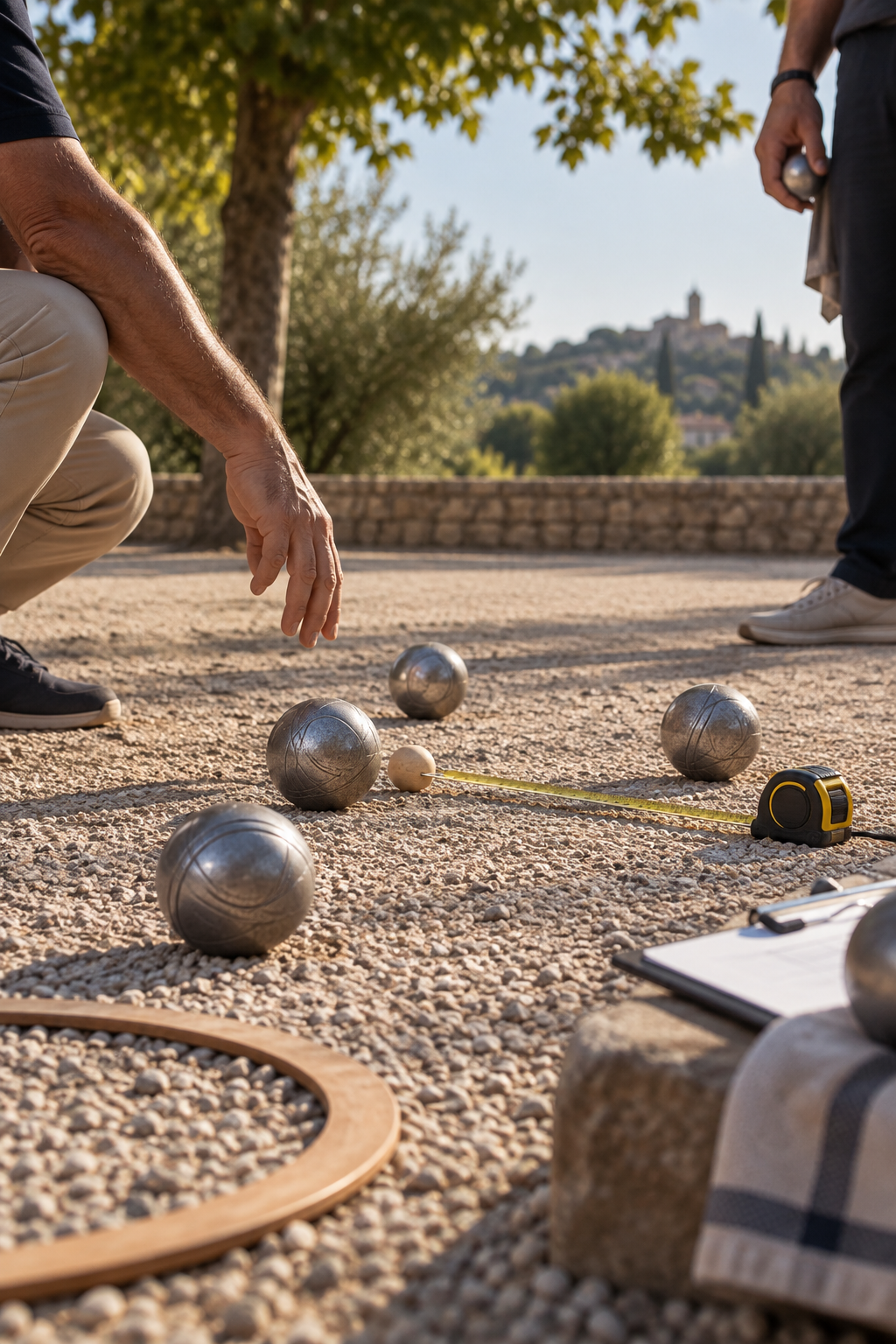
Cloth, tape measure, boule picker, circle, magnet: accessories can help. They must not disrupt the game or replace the procedure. Measuring with a personal tool is allowed as long as both teams accept the measurement; in case of doubt, the referee takes over.
The throwing circle must be used correctly. A rigid circle poorly placed, moved without reason or left too close to an obstacle can create an irregularity. The equipment helps the player, but it never dispenses with understanding the rule.
6.What to do if equipment seems non-compliant?
The wrong reaction is direct accusation. The right reaction is factual: you signal the doubt, you avoid unnecessarily touching the disputed equipment, then you request umpiring if the question has an influence on the game. Compliance is not settled by the tone of the voice.
For yourself, the simplest thing is to plan ahead: buy recognized competition boules, keep the references, check the general condition, and don't wait until competition day to discover an issue.
Control starts at home
A good habit is to check your gear before the season: readable boules, no obvious deformation, known weight, jack in good condition, working tape measure. It takes five minutes, but it avoids learning bad news in front of the opponent. Compliant equipment also brings serenity: when a game gets tense, you know this subject cannot be used against you.
Finally, you have to distinguish between normal wear and dubious equipment. A boule scratched by years of play is often still perfectly usable; a boule that has become illegible, too damaged or impossible to identify deserves a check. Common sense and refereeing serve precisely to separate these two situations.
To improve technically while keeping clear fundamentals on the game, the full series gathers the basics useful for regular players.
Discover