Actualités · 24 April 2026
Why you always miss your first boule (and how to fix it)
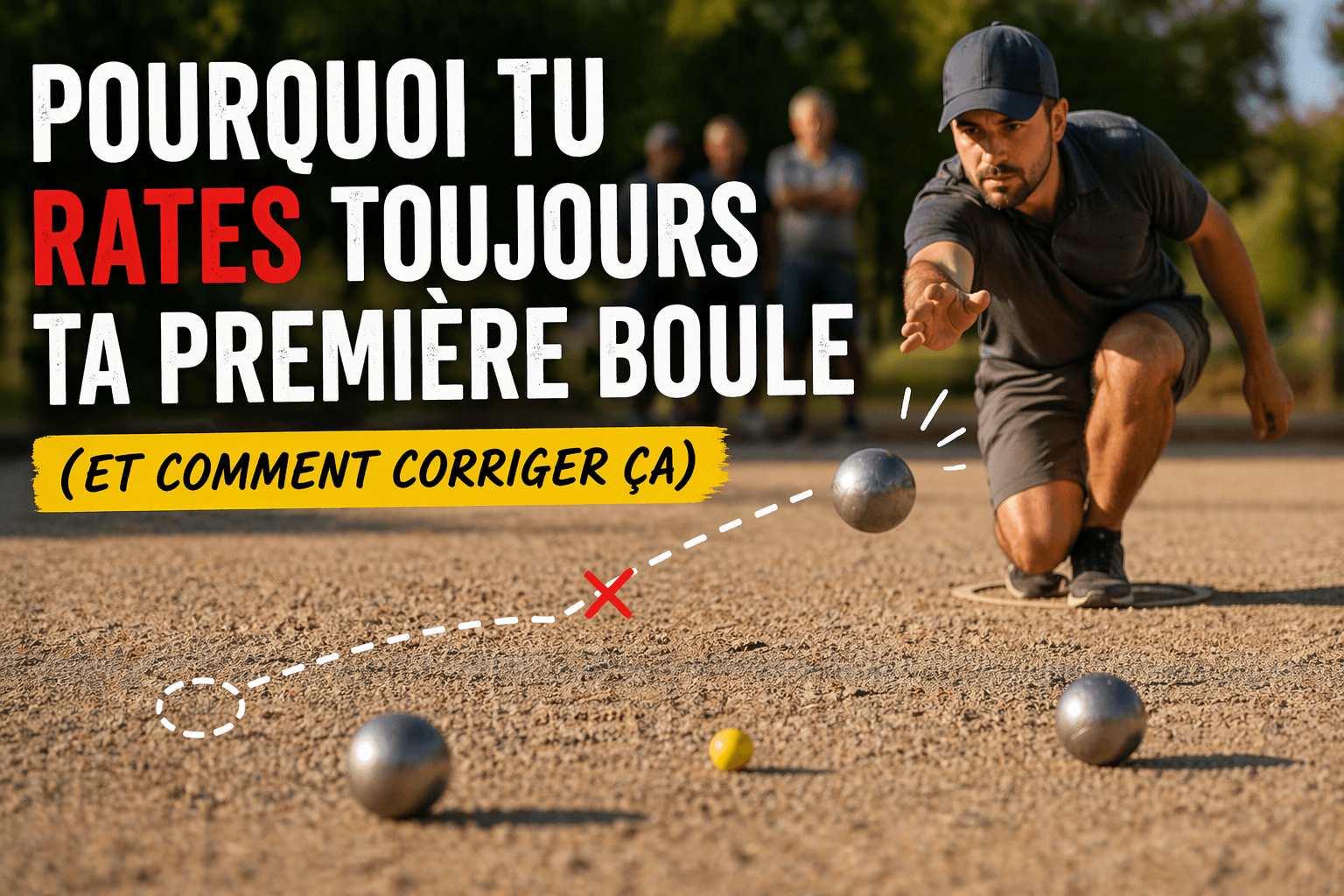
You recognize the scenario: first lead, first ball — it falls 40 cm too short or deviates to the left. Second ball: good. Third: still good. You think “I wasn’t hot”. You were moving on. But it starts again on the next lead, and on the next one. The first ball misses significantly more often than the others. It's not a coincidence and it's not a question of level. It is a phenomenon documented in sports biomechanics and movement neuroscience —Why the brain misses the first boule — the physiology
Throwing a pétanque boule is a precision ballistic movement — a motion where the hand releases the object at a precise moment, with a precise speed and angle, to produce a precise trajectory toward a target at a precise distance. To execute this motion correctly, the brain needs up-to-date information on several parameters.
🧠 MOVEMENT NEUROSCIENCES What happens in the brain before the first throw The central nervous system coordinates the pétanque throw via a motor program — a sequence of muscular instructions stored in procedural memory. This program has been built and refined through thousands of repetitions. But it has one crucial characteristic: it is not absolute — it is relative to the sensory conditions of the moment.Before throwing, your brain needs to know: what exactly is the distance to the target? What is the perceived resistance of the boule (grip, temperature, humidity)? What is the state of my muscles (temperature, tone)? What is the slope of the terrain?
This information is collected via your sensory receptors — the eyes for distance, the mechanoreceptors of the fingers for grip, the muscle proprioceptors for the state of the muscles, the vestibular system for balance. The problem: at the start of an end, some of these receptors have not yet been "updated" by an actual throw. The distance is estimated visually, not confirmed by recent muscular feedback. The grip is felt but not yet calibrated by the bounce of a previous throw. The brain throws on the basis of estimates — not of measurements.
From the second throw on, it has the sensorimotor feedback from the first — and its program has been updated. Precision leaps. 🎯
This phenomenon — the need to calibrate the gesture with a first throw before being accurate — is documented in other precision sports. In bowling, the best players systematically take a "reading boule" in the first frame. In golf, the first putt on an unfamiliar green is almost systematically over- or under-estimated. In darts, experts throw a "test" dart before an important match. Pétanque is no different — it just has less of a culture of prior calibration.
The 5 identifiable causes
The root cause is the same for everyone: a lack of calibration of the sensorimotor system. But it manifests in five different ways depending on the player, the situation, and the end. Identifying which one applies to you personally is the first step toward correcting it.
1 Distance estimation — the eye alone is not enough The distance to the cochonnet varies with every end — sometimes 6 metres, sometimes 9.5 metres. The eye judges this distance, but the eye alone is imprecise for intermediate distances (6–10 metres). The first boule is a distance measurement as much as a throw. The brain generates a motor command based on its visual estimate — which can be off by 5 to 15%. Over 8 metres, a 10% error represents an 80 cm difference. This is why so many first boules are "too short" or "too long" even when the direction is correct. ✓ Correction: intentionally mark the cochonnet in your visual field before throwing, by shifting your gaze back and forth between cochonnet and landing zone. Mentally simulate the trajectory before stepping into the circle. 2 Muscle tone — cold muscles contract differently Between two ends, the arm has not moved for 2–5 minutes. The muscles of the forearm, wrist, and shoulders have cooled slightly and their tone has varied. A slightly "colder" or "stiffer" muscle produces a slightly different force for the same neurological command. The brain compensates automatically — but this compensation takes one throw to adjust. This is why first boules are often short: the arm produces less force than expected because the muscles have not yet regained their optimal tone. ✓ Correction: 3–4 active arm swings (without a boule) between each end, just before stepping into the circle. Wake the muscles up, don't exhaust them — small, wide, fluid movements. 3 Transition time — the brain is still in the previous end The end has just ended. You may have lost two points, discussed with your team, looked at the scoreboard. The next end begins while your attention has not yet fully returned to the gesture to be produced. The result: a throw executed with partial attention, a motor program activated without complete verification of the parameters. Direction errors (left or right) are often linked to this partial inattention rather than to a poor distance estimate. ✓ Correction: create a mental micro-transition between the end of the previous end and the first throw. A slow breath, a gaze held on the cochonnet for 2 seconds, an inner word ("now"). This routine signals to the brain that "play" mode is resuming. 4 Opening anxiety — the pressure of the first impression The first boule of an end carries a symbolic weight: it sets the context for the entire end. A good first boule puts pressure on the opponent. A bad one leaves the initiative to the other team. This symbolic weight can create a slight opening anxiety — an extra tension that alters muscle tone and disrupts the release. Tension in the fingers produces a premature release; tension in the shoulders reduces the amplitude of the pendulum swing. ✓ Correction: mentally reframe the first boule. It is not "the boule that defines the end" — it is "the calibration boule". Its function is to inform the ones that follow. Missing the first boule is not a failure — it is data. 5 Cochonnet variability — every end is a new problem The cochonnet is never in the same place. Distance, lateral angle, local terrain conditions — every end is a fresh problem for the sensorimotor system. The players who do well from the first boule are those who take the time to consciously analyse the cochonnet before throwing. The players who systematically miss the first boule "throw too early" — before they have truly analysed the specific cochonnet of that end. ✓ Correction: before every first boule, take 5 seconds to consciously analyse the cochonnet — estimated distance, lateral position, desired landing zone. These 5 seconds are the most profitable investment of the end.What the following boules have that the first one does not
❌ FIRST BOULE — Degraded conditions →Distance estimated visually, not confirmed by motor feedback →Muscle tone uncalibrated — arm at rest since the end of the previous end →Fresh grip — no recent sensory feedback on the boule →Attention potentially still on the previous end →Motor program activated on estimates, not on measurements →High symbolic weight — "don't miss the first one" ✓ FOLLOWING BOULES — Optimal conditions →Distance confirmed by the sensory feedback of the first throw →Muscle tone calibrated — an active throw has just "woken up" the chain →Adjusted grip — the fingers "know" how to hold this boule →Attention fully focused on the gesture to be produced →Motor program updated by the feedback of the first boule →Reduced symbolic pressure — the end is already underway 🎙️ Paquita on the first boule "It took me years to understand why my first boule was systematically worse than the ones that followed — and yet I trained as much as anyone. It wasn't a lack of technique. It was a lack of protocol. When I started treating my first boule as a calibration boule — and not as a boule I had to succeed with — two things happened at the same time. First, my success rate on the first boule clearly increased. Second, when I still missed it, it no longer destabilised me — because I knew it was planned for in my system and that the following ones would be better." — PaquitaYour error profile — identify which one applies to you
The five causes described above do not manifest in the same way. Identifying the symptom of your first boule tells you which cause is dominant.
⬇️ Boule systematically shortThe first boule regularly falls short of the target zone. Over several ends, the pattern is reproducible.
Cause: muscle tone or underestimated distance ⬆️ Boule systematically longThe first boule regularly overshoots the target zone. The feeling of having "forced it too much" without intending to.
Cause: overestimated distance, opening anxiety ↩️ Boule always to the leftThe direction is systematically deflected to the left on the first boule, whereas the following ones are straight.
Cause: partial attention, axis unchecked before throwing ↪️ Boule always to the rightReproducible lateral deviation to the right on the first boule. Premature release due to tension or divided attention.
Cause: tension, opening anxiety, premature release 🎲 Random errorThe first boule misses but never in the same direction — sometimes short, sometimes long, sometimes lateral. No stable pattern.
Cause: attention on the previous end, program not activated 🌀 Good direction, wrong distanceThe boule arrives in the right lane but never at the right depth. The axis is good, the force calibration is not.
Cause: distance estimation, muscle toneThe case of the pointer and the shooter
📍 POINTER — The short first bouleThe pointer is the first to play — which means their first boule is also the first boule of the end, often after the discussion about the cochonnet and the placing of the circle. They have the least recent sensory context. Their main problem: the short boule, because their arms cool down between each end and their estimate of the landing zone is still fresh.
The second trap specific to the pointer: they point from a specific position (throwing circle) with a precise viewing angle. If this circle is placed in a slightly different position from the previous end, all their visual calibration must be rebuilt.
✓ The pointer: before setting foot in the circle, consciously estimate the distance, identify the landing zone, do 2 arm swings without a boule. Step into the circle only once the mental boule is already "placed". 💥 SHOOTER — The first shot off targetThe shooter has a different problem: they aim at a specific opponent's boule, at a variable distance, in a position that changes with every end. Their first error is often lateral rather than of distance — the shooting axis is slightly deflected because their gaze on the target boule is not yet as stable as on the following shots.
The shooter is also affected by the delay between their last boule (often the final boule of the previous end) and the first boule of the new end. If the previous end was long or stressful, the shooter's nervous system is in a residual emotional state — which affects the accuracy of the first shot.
✓ The shooter: "rinse" the emotional state of the previous end with a slow breath before stepping into the circle. Fix the target boule for 2–3 seconds before throwing — not "approximately", really fix it on the desired impact point.The timeline of an end — where the mistake slips in
The first-boule error does not occur at the moment of the throw — it builds in the 30 to 60 seconds that precede it. Here is the typical timeline of an end and the critical moments.
–60sEnd of previous end Point counting — attention on the score The player is focused on the score, the boules, possibly a dispute. Their attention is external to the gesture. "Game analysis" mode takes over from "gesture preparation" mode. –45sDanger Team discussion, moving around — inactive arm The player talks, walks, gathers their boules. Their arm has not moved for 1 to 3 minutes. Muscle tone gradually drops. This is where the tone deficit that will produce the short boule is created. –20sDanger Placing the cochonnet and the circle — visual estimation The cochonnet is placed, the circle defined. The visual estimation of the distance begins here — but it is not yet confirmed by a throw. The brain generates its "provisional program" based on this unverified estimate. –10sCritical Entering the circle — without a calibration routine The player steps directly into the circle without a preparatory transition. They throw with an uncalibrated motor program, a cooled arm, and an attention partially still on the previous end. All the conditions for a missed first boule are met. 0sThrow First boule thrown — random result The throw is executed. Without preparation, the result is random — often incorrect. But this boule now provides the missing sensory feedback. The motor program updates. The following boules are better. +20sCalibrated Second and third boule — accuracy restored The brain now has the feedback from the first boule. The distance is confirmed. The muscles have been activated. The motor program is up to date. Accuracy returns — too late for the first boule, but the following ones benefit from it.The 90-second routine — the universal fix
The principle is simple: if the first boule misses because the system is not calibrated before throwing, the solution is to calibrate the system before throwing. Here is a 5-step routine that accomplishes exactly that in under 90 seconds — and is perfectly compatible with the one-minute rule (the time running from the moment it is your turn to play).
⏱️ PRE-FIRST-BOULE ROUTINE — 5 STEPS / 90 SECONDS MAX Deliberately exit "end of end" mode 5 sec A slow, deep breath in, eyes closed. This gesture signals to the nervous system that "analysis/discussion" mode is over and "motor execution" mode is beginning. Simple but fundamental — without this transition, attention remains partially on the previous end. Consciously analyse the cochonnet 10 sec Look at the cochonnet without dropping your eyes. Estimate the distance in a low voice ("about 8 metres"). Identify the desired landing zone. Mentally simulate the ideal trajectory of the boule — not vaguely, precisely. Close your eyes for 1 second while "seeing" this trajectory. This process loads the motor program with more precise data. Activate the throwing muscles 10 sec Before stepping into the circle: 3 to 4 swings of the throwing arm without a boule, at normal playing speed, in the plane of the throw. These swings "wake up" the muscles, restore tone, and activate the neuromuscular pathways that will be used during the actual throw. Small but essential. Set your feet in the circle — one-beat pause 3 sec Step into the circle and stop for one full second before throwing. This pause forces the confirmation that everything is ready — boule in hand, stable position, gaze on the cochonnet. Players who throw in the same motion as they step into the circle skip this confirmation and increase the probability of error. Throw with the "calibration first" intention — Mentally reframe the function of this first boule: its mission is to confirm the distance and inform the following boules, as much as to place itself well. This reframing reduces the opening anxiety (you are no longer playing "the decisive boule" but "the calibration boule") and paradoxically increases accuracy — because a less tense gesture is more fluid. ⏱️ Compatibility with the one-minute ruleThe one-minute rule applies from the moment it is officially your turn to play. Steps 1 to 3 of this routine are done before it is officially your turn — while the cochonnet is being placed, while the circle is being defined. Only steps 4 and 5 are done in the circle. In total, the steps in the circle take less than 15 seconds — well within the regulatory time limit.
Drills to anchor the calibration
01 The ghost-boule exercise 📍 Training ⏱️ 15 min 🎯 Pre-throw muscle calibrationThe goal is to develop the habit of preparatory swings until they become automatic before every first boule.
Place a cochonnet at 7 metres. Hold your boule in your hand. Before every throw, perform 3 complete arm swings (normal amplitude, same rhythm as a real throw) without releasing the boule. Feel the muscles activate. Throw the real boule immediately after the 3rd swing. Observe the difference in accuracy vs throwing without preparation. Repeat 20 times, changing the distance (6m, 7m, 8m, 9m) with each set of 4 throws. The goal: anchor the "swing → throw" reflex in procedural memory. Phase 2: add the pause in the circle between the swings and the throw. Step in, stop for 1 second, throw. This timing must become natural. 02 The variable-distance protocol 📍 Training ⏱️ 20 min 🎯 Distance estimation and visual calibrationTrain distance estimation specifically — the most frequent cause of a short or long first boule.
Ask a partner to place the cochonnet at an unknown distance (between 6 and 10 metres) without letting you look. You turn your back. You turn back around, look at the cochonnet for exactly 3 seconds, then estimate the distance out loud before throwing. "I say 7.5 metres." Throw your first boule with the complete calibration routine (swings, pause in the circle). Measure the actual distance to the cochonnet and the distance of your boule. Compare with your estimate. After 20 throws, your visual estimate will be significantly more accurate. 03 The first-boule series — measuring your progress 📍 Training or competition ⏱️ Over a game 🎯 Progress trackingThis exercise is a measurement as much as a training drill — it gives you a precise indicator of your progress on the first boule.
Over a complete game (training or competition), note only the result of your first boule of each end : B (good — in the target zone), M (bad — out of zone), D (wrong direction), F (wrong force). Total at the end. Play without the calibration routine for 5 games and note your success rate on the first boule. This is your baseline score. Introduce the complete calibration routine (5 steps described above) for 5 more games. Compare with the baseline score. The difference measures exactly the impact of the routine. Most players see a 20 to 40% improvement on first boules from the first 2–3 games with the routine. 📖 PAQUITA'S BOOK 100 exercises to anchor a precise and consistent gesturePre-throw routine, muscle calibration, first-boule management, work on consistency... Paquita's book structures a complete technical progression with 100 exercises numbered by level.
📦 Order on AmazonFAQ — Your frequent questions
Is it normal to miss your first ball more often in competition than in practice? + Yes, and it is documented in sports psychology. In competition, two additional factors are added to the usual physiological causes. First, performance anxiety — the real stakes of the competition increase muscular tension and impair release, particularly on the first ball which is perceived as symbolically important. Second, the new environment (unfamiliar terrain, unknown opponents, spectators) demands part of the attention that should be devoted to the gesture. The calibration routine is even more important in competition than in training — because it creates a space for deliberate focus in the midst of a stimulating environment. If I am the second to play in the end, do I suffer from the same problem? + Yes — but to a lesser extent. The second player has additional information from the first opposing ball: he saw a ball thrown on this field at this distance. His nervous system can use this observation as a partial calibration. But he still hasn't made a recent throw himself — the muscle tone in his arm isn't yet activated. The calibration routine (preparatory swings + pause in the circle) remains useful even for the second player, with perhaps one less step on the distance estimation (already partially calibrated by the first observed opposing ball). Can the calibration routine help me in training, not just in competition? + Yes — and that is even where it must be learned. The routine must be practiced in training until it becomes automatic and unconscious. If you're trying to learn a new competition routine for the first time, the cognitive load of "thinking about the routine" is added to the load of performing — which can temporarily degrade performance. The correct order: learn the routine in training over 10 to 15 sessions, then apply it naturally in competition when it is anchored in procedural memory. Some players never have this first ball problem — why? + Two main reasons. First, they developed a natural calibration routine over the years — without having theorized it, they instinctively adopted effective pre-throw behaviors (prolonged glances at the jack, arm swings, pause before the throw). This routine was formed by the accumulation of experience, not by a conscious decision. Second, some players have more sensitive proprioceptors and a shorter time constant motor memory — their system recalibrates more quickly, sometimes almost instantly. These players are rare and their ability is probably innate as much as acquired. 📎 Related articles Rules The one-minute rule — playing within the allotted time Equipment Choosing your boules — weight, hardness, grip Video Why changing bowls does not change your level Tools Free PetanqueLand tools Equipment Top 3 best shooter boules 2026 Competitions Official 2026 calendar — training through competitions© Pétanque by Paquita — petanqueland.fr ·
📖 Paquita's book on Amazon
The quantitative estimates presented (–40% accuracy, 3–5 throws to calibrate...) are indicative approximations based on the general principles of movement neuroscience. They vary from one individual to another.