Actualités · 7 May 2026
Why do some boules go out of play without apparent reason? (Pétanque)
A boule shot at the right height that disappears from the terrain. A jack that flies into the bushes after a clean impact. These situations seem incomprehensible — yet each has a precise explanation. Paquita reviews them all.What is "going out of play" — exact regulatory definition
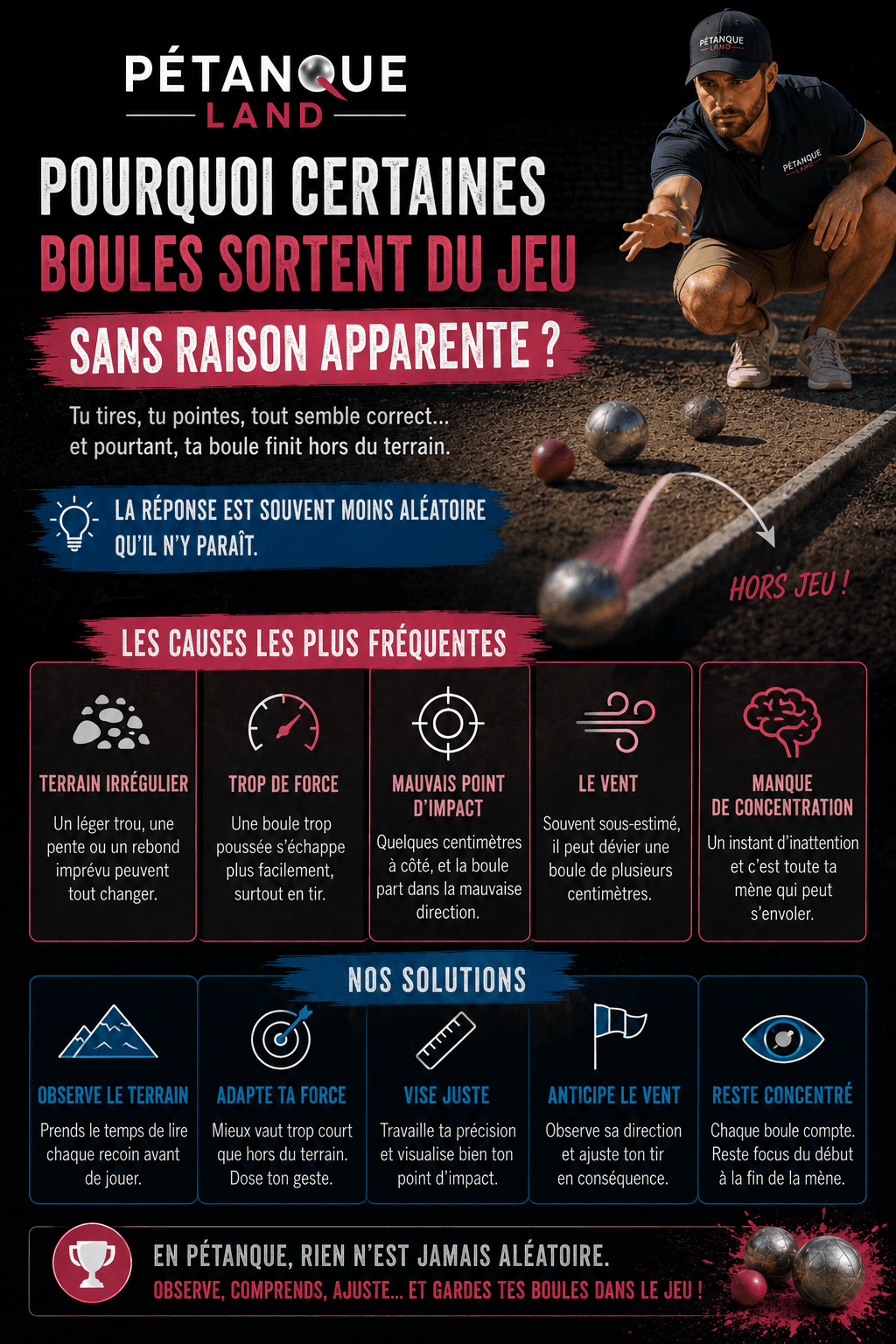
📋 FIPJP RULES — ARTICLES 10, 19 AND 20 A boule is considered out of the terrain when it crosses the limits defined by the players at the start of the game (ropes, drawn lines, natural boundaries). A boule that has gone out is definitively out of play and does not count, unless both teams had agreed that it could come back into play (closed terrain). A jack that has gone out is dead in most cases — unless only one team still has boules to play, in which case it scores as many points as there are valid boules remaining. These rules apply in competition; in a friendly game, local variations exist. 🎙️ Paquita on incomprehensible outs "The thing with boules that go out 'for no reason' is that the reason always exists — you just don't see it. Either because you were watching the boule and not the spot where it landed. Or because you didn't know that part of the terrain. Or because the physics of a metal-on-metal or metal-on-stone bounce is more complex than it looks. Once you understand why your boule went in that particular direction, you say to yourself 'obviously'. Before you understand, it looks like bad luck. Afterwards, it's just physics you hadn't read." — PaquitaThe 7 real causes of an unexpected exit from play
These causes apply equally to shot boules and pointed boules, and to the jack. They are often combined — an unexpected exit rarely results from a single isolated cause.
📐 ① The angle of impact on the ground — the most underestimated factor Applies to the lobbed shot, the semi-lobbed shot, and pointing with too much heightA boule that hits the ground at a steep angle of incidence (a high-arc lobbed shot) bounces upward and forward with lateral momentum that is hard to predict. The more vertically the boule falls, the higher and more unpredictable the bounce. A boule shot from 40 cm height at a near-vertical angle can bounce up to 1.5 m high and go sideways depending on the exact composition of the ground at the precise point of impact.
⚙️ Physics The vertical kinetic energy is partly converted into bounce energy, partly into friction energy with the ground. The proportion depends on the hardness of the ground and the angle of impact — on hard ground, the bounce is livelier; on soft ground, the energy is absorbed. → How to anticipate it: on hard terrain, a lobbed shot at standard height can bounce 2 to 3 times before stopping. If the target boule is close to the edge of the terrain, the probability of an exit increases with the shooting height. Lower the height or favour the rolling shot on hard terrain near the limits. 💥 ② The metal-on-metal impact — non-intuitive energy transfer The most frequent case of an "unexplained" exit on a successful shotWhen one boule strikes another, the transfer of kinetic energy depends directly on the angle of impact between the two boules. A centred impact (carreau): the shot boule stops and the target boule goes along the line of the shot. An off-centre impact: the target boule goes in a direction linked to the contact angle, often lateral, sometimes perpendicular to the line of the shot. It is this off-centre impact that sends boules in unexpected directions.
⚙️ Physics Conservation of momentum applies. For an impact 30° off the main axis, the target boule goes at about 60° from that axis — which can easily exceed the limits of a standard terrain. → How to anticipate it: mentally visualise the likely impact angle before the shot. If the target boule is off-centre to the right, anticipate a departure to the left. Take this direction into account when placing your own protection boules. 🪨 ③ The invisible irregularities of the ground — stones, cracks, edges Particularly frequent on natural terrains and old boulodromesAn apparently flat terrain often hides microscopic irregularities — a small buried stone surfacing, a crack in the concrete, a variation in hardness between two zones. A boule rolling at moderate speed can be spectacularly deflected by an obstacle only 3 to 5 mm high. These deflections seem incomprehensible because the obstacle is invisible from the throwing area.
⚙️ Physics A 700 g boule rolling at 2 m/s that hits a 4 mm obstacle with tangential contact can be deflected by 15 to 25° depending on the contact angle — enough to leave a 4-metre-wide terrain in less than 3 metres of rolling. → How to anticipate it: observe the terrain before playing. Watch the opponents' boules roll during the first ends and note any unusual deflections. These deflection zones are often recurrent — they form a memory of the terrain to build up over the first ends. 📉 ④ The invisible slope — the terrain that "pulls" towards the edges Often imperceptible to the naked eye, decisive over long rolling distancesA terrain can have a slight transverse slope of 1 to 2° — visually imperceptible, but enough for a boule rolling over 8 to 10 metres to deviate 30 to 50 cm sideways. This cumulative deflection regularly sends boules or jacks towards the limits without the player understanding why "it pulls to the right".
⚙️ Physics A 1° incline over an 8-metre roll generates 14 cm of lateral drift. On a terrain 3 metres wide, a boule thrown along the central axis can reach the edge before stopping if the slope is regular. → How to anticipate it: spot the slope from the first end by observing where boules naturally roll after impact. Play slightly to the opposite side of the slope to compensate. On a sloping terrain, a jack placed at the top of the slope favours the team that shoots — one placed at the bottom favours the pointer. 🌀 ⑤ The boule's own spin — backspin or sidespin Produced by the throwing motion or by an off-centre impactA boule spinning on itself reacts differently to the ground and to other boules depending on the direction and intensity of that spin. A shot with a slight unintentional lateral spin (sidespin) deflects after contact with the ground. A point with too pronounced a backspin can go backwards after touching the ground. These spin effects are often unintentional — produced by a slightly rotating motion or by an unstable grip.
⚙️ Physics The Magnus effect: a spinning boule in the air undergoes a deflection of trajectory. On contact with the ground, the spin creates asymmetric friction that can reverse or amplify the rolling direction — explaining why a boule "comes back" after touching the ground. → How to anticipate it: if a boule systematically goes off to one side despite straight aiming, check the direction of spin on release. An examination of the grip and the release of the fingers often reveals an unwanted parasitic spin. Work on grip in training. 💨 ⑥ The ricochet off another boule in play — the billiard effect Frequent late in an end when the boules are numerous and clusteredLate in an end, several boules close to one another create a field of potential ricochets. A successful shot on the target boule throws that boule against a third, which in turn bounces in an unpredictable direction. The more numerous and closer the boules, the harder the secondary trajectories are to anticipate. These cascading ricochets are often the real reason for a boule going out "inexplicably".
⚙️ Physics Each metal-on-metal impact transfers a fraction of the kinetic energy in a direction depending on the contact angle. In a cascade, unpredictability increases exponentially with the number of boules involved — even the best shooters cannot calculate a 3-impact cascade. → How to anticipate it: in a dense cluster situation, consider that the shot may cause unfavourable ricochets. Sometimes, pointing into a free zone is safer than a "clean" shot that risks an uncontrolled cascade. 🔄 ⑦ The variation in ground hardness along the rolling axis Transition between a soft zone and a hard zone, a dried puddle, a damp shaded areaA boule rolling from a soft zone to a hard zone (or vice versa) abruptly changes speed and direction. On a natural terrain, these transitions are frequent and invisible: the edge of a watered zone, the boundary between a sunlit area and a shaded area, the transition from a sandy zone to a compacted one. This change in behaviour midway explains trajectories that seem impossible.
⚙️ Physics The coefficient of friction changes abruptly between the two zones. On the hard zone, the boule accelerates if it was being braked by the soft ground, and can exceed its expected trajectory by 30 to 60% depending on the hardness differential. → How to anticipate it: on a natural terrain, spot visible texture changes (colour, moisture, compactness). Play the first ends as a reading of the terrain — note where the boules accelerate or stop abruptly, and adjust distances accordingly.The physics of the bounce — why a boule goes where it goes
⚙️ MECHANICS — UNDERSTANDING BOUNCES The 5 physical laws that govern trajectories in pétanque 📐 Law of angle of incidence = angle of reflection On perfectly hard and smooth ground, a boule bounces with an exit angle equal to the entry angle. In practice, the imperfections of the ground deflect this bounce — but the law remains a useful starting approximation. A lobbed shot at 45° produces a bounce of about 45° forward — which explains high-speed exits from the terrain. 🎱 Conservation of momentum between boules During a metal-on-metal impact, the sum of the momenta is conserved. A perfectly centred impact transfers 95% of the energy to the target boule, which goes along the line of the shot. An impact 30° off-centre divides the energy between an axial component and a lateral component — creating an exit trajectory that is unpredictable for an unprepared observer. 🌀 Gyroscopic effect of the spinning boule A boule spinning on itself resists changes of direction — gyroscopic effect. On contact with the ground or another boule, this resistance can produce a surprising deflection if the direction of spin is perpendicular to the force of impact. This is one of the causes of "backwards returns" or apparently unexplained lateral deflections. 🔋 Conversion kinetic energy → heat → residual bounce A boule-ground impact does not conserve all the kinetic energy — part is converted into heat (microscopic deformation) and sound. The proportion depends on the hardness of the ground : hard ground = a lot of residual bounce; soft ground = a lot of absorption. This is why the same shot produces a bounce 3 times further on a concrete terrain than on a damp sandy terrain. ⚡ Amplification by speed — non-linear effects The effects of bounce, spin and deflection are amplified non-linearly by speed. A shot twice as fast does not produce twice as much bounce — it can produce 4 to 6 times more residual energy depending on the conditions. This is why very powerful shots on hard terrain produce spectacular exits, even when apparently well directed.The special case of the jack — specific exits and rules
The jack obeys the same physical laws as the boules — but its regulatory consequences are different, and often less well known.
📋 JACK OUT — WHAT THE RULES SAYIf the jack goes out of the terrain during an end, the end is void in most cases — the boules played do not count and the end is replayed. Exception: if one team has no more boules to play, the other team scores as many points as it has valid boules remaining.
In a friendly game:Local variations may apply — some groups play that a jack that has gone out is replaced where it went out, others that the end continues.
Useful reflex: check the local rules before a game on an open terrain. A jack that goes out can be worth 0 or 3 points depending on the rule applied — ambiguity often costs points. 🎯 WHY THE JACK GOES SO FARThe jack weighs about 30 g for a diameter of 30 mm. Against a 700 g boule, the mass ratio is 1 to 23. By conservation of momentum, even a light impact throws the jack at a very high speed — about 23 times the speed transmitted by the boule in terms of momentum.
In plain terms:A moderate shot at 10 m/s in contact with the jack can throw the latter at more than 20 m/s — which explains jacks that disappear "instantly" after an impact.
Tactical takeaway: a jack well protected by surrounding boules is much less likely to go out — the boules around it absorb part of the energy and deflect its trajectory. 🔄 THE JACK THAT "COMES BACK" — THE BOUNCE EFFECTOn hard terrain (concrete, paved boulodrome), a struck jack can bounce off the boundary panels and come back into the terrain. Under the rules, if it comes back into the terrain after crossing the limit, it is considered dead — it does not come back into play.
Exception:On a "closed" terrain (with panels that are part of the terrain), a jack bouncing off the panels can stay in play if the players agreed to it before the game.
The local rule takes precedence: check before the first end whether the terrain is "open" or "closed" — this distinction changes everything in managing impacts on the edges. ⚠️ WHEN A "PERFECT" SHOT EJECTS THE JACKA perfect carreau shot on a boule stuck to the jack can throw the jack at high speed — even if the shot boule "stops nicely". The energy transferred into the target boule is split between the target boule and the jack according to the contact points.
The at-risk situation:Target boule 3 cm from the jack, shooting angle slightly off-centre. The shot passes "between" the two — it fragments the energy and can send the jack out of the terrain.
Tactically: shooting a boule very close to the jack increases the risk of ejecting the jack. Sometimes intentional, often accidental — know when to avoid it.How the terrain amplifies or creates unexpected exits
🗺️ READING THE TERRAIN — BEFORE PLAYING What to observe during the first ends to minimise unexpected exits Observe the trajectory of the opponents' boules over the first 2 ends INITIAL READ — Before playing, watch where the other players' boules go: do they veer right, left? Do they accelerate mid-way? Do they stop abruptly? These observations give you an informal map of the terrain without costing you a single boule. Identify the at-risk exit zones CRITICAL ZONES — Identify the areas of the terrain close to the limits where bounces can send a boule or a jack out of play. A boule shot near an edge has a much higher risk of exit than the same boule shot in the centre. Take this geography into account when placing the jack. Test the hardness with the first throw GROUND TEST — The first point of the game gives information on the hardness of the terrain: does the boule bounce a lot? Does it stop quickly? This information calibrates the height and force of subsequent throws. A hard terrain calls for lower shots and longer points compared to a soft terrain. Identify the transverse slope in the first ends TOPOGRAPHY — Observe whether the boules systematically drift to one side after rolling 5 to 6 metres. A constant drift indicates a slope. Adjust the placement of the jack so that the slope works in your favour: placing the jack on the low side of the slope forces the opponent to point against the slope. Memorise the unpredictable bounce zones TERRAIN MEMORY — Certain zones produce unusual bounces every end — a surfacing stone, a ground transition, a flush board. These zones form a "memory of the terrain" to build up actively over the first ends. Avoid shooting important boules there at the end of the game when the stakes are highest. 🔑Most "unexplained" exits become explicable in retrospect — but the real skill is to anticipate them before before they happen. A player who reads their terrain during the first 2 ends gives themselves a map that their opponent may not have. This information is free — it just requires observing actively instead of playing in your own bubble.
Table: situation → likely cause → applicable rule
| Useful response | Likely cause | Applicable rule | How to anticipate it |
|---|---|---|---|
| Shot boule goes out at high speed after a clean impact | Lobbed shot on hard ground + steep impact angle | Dead boule — out of play | Lower the shooting height on hard terrain near the edges |
| Target boule goes sideways after the shot | Off-centre impact — non-centred contact angle | Dead boule if it goes out | Visualise the likely angle before shooting, anticipate the direction |
| The jack disappears quickly after impact | Boule/jack mass ratio — transmitted velocity | The end is void if the jack goes out | Protect the jack with surrounding boules |
| The boule deviates from its path with no visible obstacle | A flush stone or a variation in hardness | Dead boule if it goes out | Read the terrain by observing the opponents' trajectories |
| The boule "skids" then accelerates abruptly | Transition soft ground → hard ground | Dead boule if it goes out | Spot the changes in texture and adjust the force |
| The boule drifts systematically to the left/right | Cross-slope of the terrain | The boule is valid if it stays within the limits | Compensate for the drift by aiming to the other side |
| A cascade ricochet off several boules | A chain of metal-to-metal impacts | Boules are dead if they go out | In a dense situation, prefer to point into a free zone |
| The jack comes back onto the terrain after hitting the edge | Rebound off the boundary board | Dead (open terrain) / Valid (closed terrain) | Clarify the local rule before starting |
A boule that goes out "for no reason" always has a reason. The next time it happens, don't move on to the next end without having identified the likely cause. Look at the exact spot where the boule landed, the exact direction it went off in, and the state of the ground at that spot. 30 seconds of analysis turns "bad luck" into usable information for the rest of the game — and for future games on that terrain.
Exercises to read bounces better and anticipate exits
01 Active terrain mapping 📍 Usual playing terrain ⏱️ First 2 ends of each game 🎯 Build a physical read of the terrain before playingTurn the first two ends into a structured observation session — not to vaguely "feel out the terrain", but to build a precise mental map of the ground's physical behaviour.
During the first end, observe 4 parameters on every boule played (including the opponents'): (1) bounce after ground impact, (2) lateral drift after rolling, (3) acceleration or braking zone, (4) behaviour at metal-to-metal impact. Don't note things mentally in a vague way — identify precisely "at 5 metres from the throwing zone, the boules drift 15 cm to the left". From end 2 onwards, adjust 3 concrete parameters of your game: the shooting height (hard ground → lower it), the pointing force (accelerating ground → gauge it more gently), the placement of the jack (slope → place on the slope or against the slope depending on the advantage). These adjustments must be explicit, not instinctive. At the end of the game, assess: how many unexpected outs or deviations had been anticipated thanks to the read from the first two ends? And how many took you by surprise despite the read? The latter are the priority learning areas for the next session on that terrain. Variation: on a well-known terrain, do the mapping out loud in a low voice with your partner — "I think it'll drift to the left there, do you agree?" This cross-checking of reads develops both players' precision of observation simultaneously. 02 The directed shooting session — understanding your own impacts 📍 Solo or 2-player training ⏱️ 20 min 🎯 Master the rebound direction after impactDevelop the ability to predict where a boule will go after the shot — not just whether the shot succeeds, but where the boules involved end up in every possible scenario.
Place a target boule at 7 metres. Before each shot, announce in a low voice the direction you think the target boule will go off in — left, right, straight on — and at what estimated distance. Shoot, then observe. The gap between prediction and reality is the information to analyse. Deliberately vary the impact angle: shoot once centred, once slightly to the left, once slightly to the right. Observe how the target boule's exit direction changes according to this small change of angle. This awareness of the effect of the angle is the basis of the physical understanding of rebounds. Shoot the same boule at different heights (high lob shot, half-height shot, rolling shot) and observe how the post-impact behaviour changes. On hard ground: note the difference in rebound height of the shooting boule. On soft ground: note the difference in absorption. These observations tailor the physics to your usual terrain. Final phase: place 3 boules in a triangle at 7 metres (simulating a dense end situation). Shoot at the central boule and predict where the two side boules will go off. This is the hardest exercise — and the most directly applicable to real high-stakes end-of-end situations.FAQ — Your frequent questions
If my ball goes out of bounds after being moved by an opposing ball, is it dead too?+ Yes — a ball that goes out of bounds as a result of impact with another ball is considered out and therefore dead, regardless of how it came out. The FIPJP regulations do not make a distinction on the cause of the exit — only the fact of having crossed the limits counts. Exception in certain local rules of friendly games: check before starting whether specific rules apply on this particular field. In official competition, there is no ambiguity: ball out = ball dead. Can you deliberately aim in such a way as to send an opponent's ball out of bounds?+ Yes — and it's a completely legal tactical strategy. Shooting an opponent's ball by calculating the angle so that it goes out of bounds is normal play. The difficulty is that the exact angle needed for a ball to come out depends on many factors (position of the target ball, hardness of the ground, distance from the edge) — making deliberate execution difficult to master. Some experienced players incorporate this dimension into their tactics: rather than shooting a ball out of a dangerous area, they shoot it so that it goes out of bounds — eliminating the threat once and for all. My jack was moved by a passerby or an animal — what do the rules say?+ The FIPJP regulations (article 18) provide for the case of a jack being moved by a non-playing third party or by an animal: if the two teams agree on the initial position, the jack is replaced. If no agreement is possible (unknown or contested position), the round is canceled and replayed. In practice on open fields, this situation is common — it requires both teams to agree in good faith on what they have seen. Prevention: never lose sight of the jack being played on public land, to have a reference position in the event of a dispute. Can an official competition field have these ground irregularities?+ In principle, official competition fields (FFPJP approved) must respect surface standards which limit the grossest irregularities. In practice, even approved terrain retains variations in texture, slight slope, and hardness that produce unexpected bounces — just in less proportion than on natural terrain. The greatest shooters in the world also play on terrains that have their own characteristics. The difference isn't that competitive courts are perfect — it's that high-level players read these characteristics faster and incorporate them into their adjustments from the first ends. 📎 Related articles TerrainAdapting your play to an uneven terrain TacticsReading an end in a few seconds: a simple method TacticsAttack or secure: making the right choice at the right time EquipmentBowl diameter: why the wrong choice penalises you RulesRegulatory playing distances 2026 ToolsFree PetanqueLand tools© Pétanque by Paquita — petanqueland.fr · 📖 Paquita's book on Amazon