Actualités · 17 May 2026
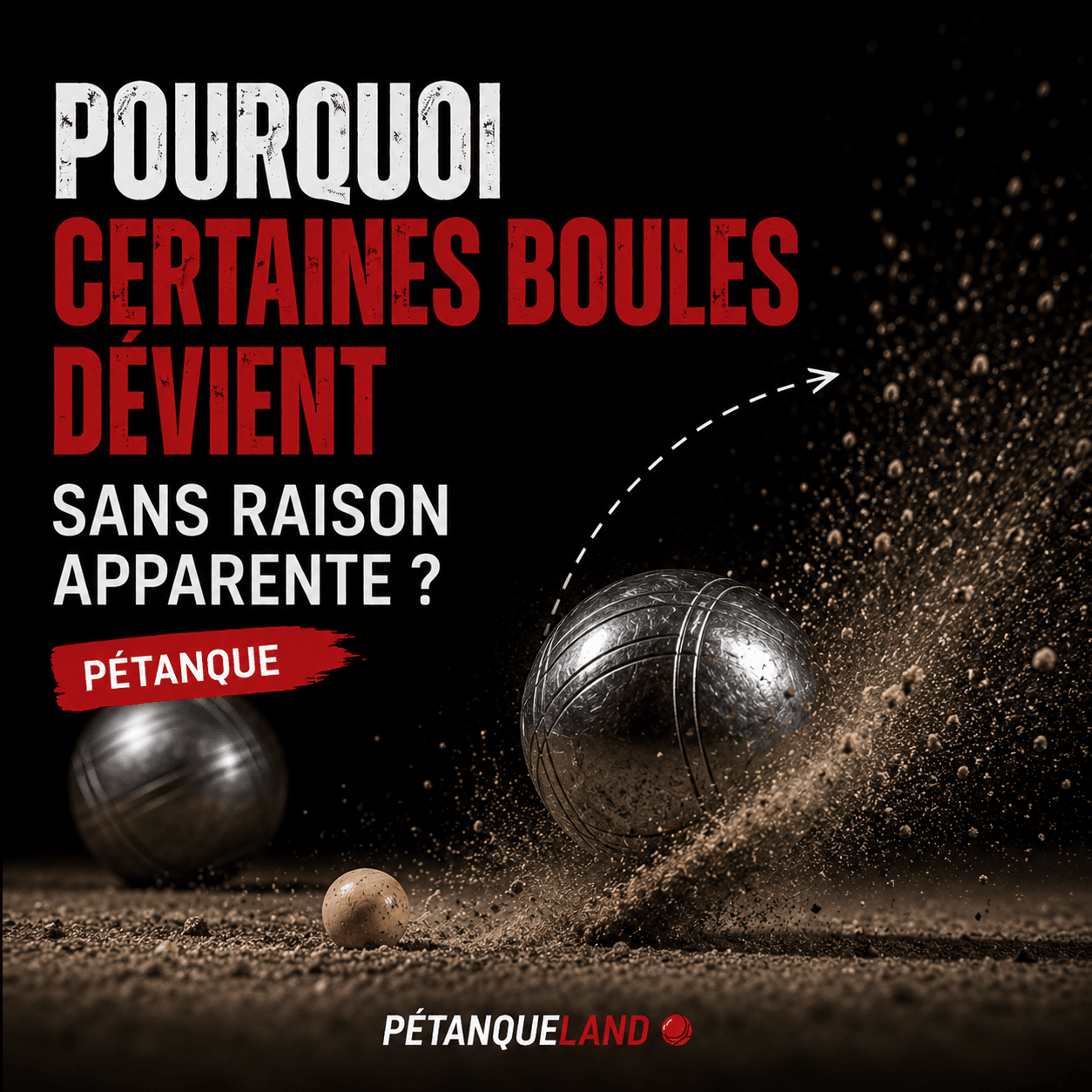
Why do some balls deviate for no apparent reason? (Petanque)
The boule rolls perfectly, then veers right over the last 2 metres. TheDeviation matrix — symptom → likely origin
📊 READ THIS TABLE: OBSERVE THE SYMPTOM, FIND THE ORIGIN SYMPTOM OBSERVED LIKELY ORIGIN CONFIRMING SIGNAL PRIORITY TO INVESTIGATE Always deviates right Delivery — left spin at release or asymmetrical stance Occurs with different boules on different terrains Finger position at release, stance symmetry Always deviates left Delivery — right spin at release or arm opening out Reproducible regardless of terrain Arm axis at release, shoulder position Variable deviation, left then right Terrain — cross-slope or multiple irregularities Changes side depending on the area of terrain played Read the slope, test the same boules on flat ground Deviation only at the end of the run Terrain or equipment — surface transition or worn boule Deviation always starts at the same point of the trajectory Inspect the terrain at the point of deviation, test the boule Identical deviation with 2 different boules Delivery — mechanical cause in the throw Equipment is ruled out if two different boules deviate the same way Analyse the delivery alone: spin, axis, symmetry 🎙️ Paquita on unexplained deviations "I have a simple test to tell whether a deviation comes from the delivery or the terrain. I play the same boule 5 times in a row from exactly the same position. If all 5 boules deviate in the same direction at the same distance, it's my delivery. If they go off in different directions, it's the terrain or the boule. This test takes 3 minutes and it has solved mysteries players had been carrying for months. The 'no reason' deviation always becomes 'a precise reason' once you run this test honestly." — PaquitaParasitic spin — the no. 1 cause and the least admitted
Parasitic spin is an involuntary rotation of the boule around its vertical or horizontal axis, produced at the moment of release. It is invisible to the naked eye in the first few seconds — but its effects build up with rolling time, producing increasingly pronounced deviations at the end of the run.
↩️ LEFT EFFECT(Right sidespin)
The boule spins on its vertical axis clockwise (viewed from above). It starts straight but gradually curves towards the left as it rolls.
Delivery cause: left fingers holding onto the boule longer than the right ones at release — imparts a clockwise spin. ✅ NEUTRAL ROLL(Clean axis)
No parasitic spin. The boule rolls only on its transverse axis, in the exact line of the throw. A perfectly straight trajectory from release to stop.
Produced by: a symmetrical release with the fingers letting go simultaneously, an arm axis in the exact plane of aim. ↪️ RIGHT EFFECT(Left sidespin)
The boule spins anticlockwise. It starts straight but gradually curves towards the right as it rolls — often mistaken for a slope in the terrain.
Delivery cause: arm opening slightly outward at the end of the swing, or right fingers holding onto the boule longer. 🔑Parasitic spin builds up with the distance travelled — which is why deviations often appear "at the end of the run". A boule with a slight spin can roll 6 metres straight before deviating over the last 2 metres. This delay in appearing is exactly what makes you think the deviation comes from the terrain — when in fact it comes from the release.
The 7 detailed causes of deviation
🌀 ① Parasitic spin at release — sidespin effect DeliveryPhysics MECHANISM At release, the fingers don't leave the boule simultaneously. The last finger in contact imparts a slight spin. This effect is invisible over the first few metres but builds up with every revolution of the boule, creating a growing deviation at the end of the trajectory. IDENTIFICATION Play 5 identical boules on flat ground. If they all deviate in the same direction over the same final metres, it's a systematic spin at release. Test with different boules — if the deviation persists, it's the delivery, not the equipment. ⚙️ Physics: the Magnus effect. A spinning boule in a fluid (air) experiences a force perpendicular to the axis of rotation. On the ground, asymmetric friction produces the same effect. → Correction: work on the release with a simultaneous letting-go of all the fingers. A useful exercise: throw holding the boule only with the fingertips, which forces a naturally symmetrical release. 📐 ② Misaligned arm axis — the shoulder that opens out Delivery MECHANISM The arm swing must be in the exact vertical plane of aim. If the shoulder opens slightly at the end of the delivery (torso rotating to the right for a right-hander), the arm follows and the boule is sent slightly off line. A 3° deviation in the arm axis produces 50 cm of offset at 10 metres. IDENTIFICATION Film yourself from the front or ask a partner to watch whether your throwing shoulder rotates during the delivery. Also check whether your feet are aligned with the throwing line — a poor foot placement systematically creates an opening of the shoulder. ⚙️ Physics: the throwing motion sends the boule along the exact axis of the arm at the moment of release. If that axis isn't in the plane of the target, the boule goes off to the side, no matter how good the aim. → Correction: visualise a line on the ground from your front foot to the target and check that the swing stays in that plane. A ground marker (stick, string) helps to make the alignment objective during training sessions. ⚖️ ③ Asymmetrical stance in the circle — the unbalanced base DeliveryPhysics MECHANISM If both feet don't bear the same weight or aren't in a stable plane, the torso compensates with a slight tilt. This tilt carries through into the arm axis and the final direction of the boule. On slightly sloping ground, this phenomenon is constant and produces systematic deviations that are hard to spot unless you think about it. IDENTIFICATION Watch whether deviations get worse on the sloping areas of the terrain. Play a throw with your feet in a slightly different position and see whether the direction changes. If simply changing your foot placement alters the trajectory, the stance is the cause. ⚙️ Physics: the kinetic chain of the throw starts from the ground. A 2° tilt at the base carries through the whole chain — the deviation at the end of the arm is proportional to the imbalance at the base. → Correction: take 1 second to feel the symmetrical weight on both feet before starting the swing. On sloping ground, accept that the boules will drift downhill and compensate by aiming slightly to the opposite side. 🔩 ④ Boule with flat spots or loss of sphericity EquipmentPhysics MECHANISM A boule whose surface has developed flat spots (areas slightly flattened by impacts) doesn't roll on a perfect sphere — it rolls on a slightly irregular shape. With every revolution, it microscopically "bounces" on the flat spot, creating a micro-deviation that builds up over the whole trajectory. IDENTIFICATION Roll the boule slowly on a flat surface (tiled floor) — a boule with flat spots has a slightly bumpy roll and drifts off its straight line. Test the 3 boules of the set individually — if only one deviates systematically and differently from the other two, it has flat spots. ⚙️ Physics: a 0.5 mm flat spot on a 71 mm sphere creates a roll irregularity visible at 6–8 metres depending on the initial speed. → Correction: check the condition of your boules regularly with the flat-surface roll test. Boules with significant flat spots can't be corrected — they must be replaced or sent to the manufacturer for checking. 🏔️ ⑤ Undetected cross-slope on the terrain TerrainPhysics MECHANISM A 1 to 2° cross-slope is imperceptible to the naked eye but produces a lateral drift of 15 to 25 cm over 8 metres of rolling. This drift is constant and reproducible — it doesn't vary from one throw to the next on the same area of the terrain, which sometimes leads to it being confused with a parasitic spin from the delivery. IDENTIFICATION Play from two symmetrical positions relative to the central axis of the terrain. If the deviation reverses (left from one side, right from the other), it's a slope. If the deviation stays in the same direction from both sides, it's the delivery or the boule. ⚙️ Physics: on a 1° slope, the lateral gravitational component is about 0.17 m/s² — enough to deflect a boule rolling at 1.5 m/s by 14 cm over 8 metres. → Correction: identify the slope by watching the first few ends, then compensate by aiming slightly "up the slope". On steeply sloping ground, the player who places the jack in a favourable position (downhill for the shooter) has a significant tactical advantage. 🪨 ⑥ Hidden obstacle or surface transition Terrain MECHANISM A 3 mm protruding stone, a crack, a root flush with the ground — a tangential contact is enough to deflect a boule by 10 to 25° depending on the speed and angle of contact. These obstacles are often invisible from the throwing circle, especially at the end of the day when there's no low-angle light. IDENTIFICATION The boule deflects abruptly (not gradually) and the deviation can't be reproduced precisely. Inspect the terrain at the point of deviation after playing. If a boule always rolls straight except on one specific area, a fixed obstacle on that area is the likely cause. ⚙️ Physics: a 3 mm stone with tangential contact on a 700 g boule at 1.5 m/s can produce an angular deflection of 15 to 20° depending on the elasticity of the contact. → Correction: visually inspect the trajectory before playing an important boule. On natural ground, ask for visible obstacles to be cleared (a regulatory right in some configurations) or go around the known problem area. 💧 ⑦ Worn or clogged grooves — the boule that "skids" EquipmentTerrain × Ground MECHANISM Grooves that have worn away or filled with soil particles reduce the friction between the boule and the terrain. The boule rolls "on top of" the ground instead of biting into it. On ground with a slight slope or irregularity, a low-friction boule is far more sensitive to deviations than a boule with functional grooves — even a small slope produces a large deviation. IDENTIFICATION The boule deviates more on dry ground than on slightly damp ground (moisture partially compensates for the loss of groove friction). The deviations are greater with this boule than with the others in the set which still have functional grooves. ⚙️ Physics: the coefficient of friction of a grooved versus smooth boule can range from 0.35 to 0.15 depending on the terrain — a variation that doubles the drift distance caused by an identical slope. → Correction: clean the grooves regularly (soft brush + water) to remove clogged particles. If the grooves are structurally worn, consider regrooving or replacement depending on the quality of the boules.How to tell delivery, equipment and terrain apart
🔍 IDENTIFICATION PROTOCOL 3 tests to isolate the cause in under 10 minutes 🔄 Test 1: reproducibility — same boule, same position, 5 times Play the same boule 5 times exactly from the same position. Observe the direction and size of the deviations. If all 5 boules deviate in the same direction at the same distance : systematic cause → delivery or boule. If the deviations vary (left, right, right): random cause → terrain or one-off obstacle. → Systematic deviation = dig into the delivery or equipment. Variable deviation = dig into the terrain. 🔁 Test 2: change of boule — same position, different boule Play exactly the same throw with a different boule (another boule from the set or a borrowed boule). If the deviation disappears or changes direction : the cause is in the boule tested first (flat spots, wear, grooves). If the deviation persists unchanged: the cause is in the delivery or the terrain. → Deviation disappears with another boule = equipment problem. Identical deviation = delivery or terrain. ↔️ Test 3: change of side — same boule, mirrored position Play from the opposite side of the terrain (mirror position). If the deviation reverses (was to the right, becomes to the left): the cause is the terrain (slope). If the deviation stays in the same absolute direction: it's the delivery or the boule. This test perfectly distinguishes a cross-slope from a deviating delivery. → Reversed deviation = slope of the terrain. Identical deviation = delivery or boule.The complete diagnostic protocol
🔬 PROTOCOL — IDENTIFY YOUR CAUSE IN 4 STEPS From the observed deviation to the identified cause — a systematic method Observe and describe the deviation precisely OBSERVATION — Before any diagnosis, document: in which direction (left/right/variable), at what distance from the throw (start, middle, end of the run), with what magnitude (5 cm, 20 cm, 50 cm). A deviation "to the right over the last 3 metres of about 20 cm" is a precise symptom that already points to 2 or 3 possible causes. Apply the reproducibility test (test 1) SYSTEMATIC TEST — 5 identical throws. The result indicates whether the cause is systematic (delivery/equipment) or random (terrain/obstacle). This is the first fork in the diagnosis. Apply the change-of-boule test (test 2) EQUIPMENT TEST — If the cause is systematic, change boule. If the deviation disappears: equipment problem. Inspect the boule (roll on a flat surface). If the deviation persists: delivery problem. Film yourself or have a partner watch. If a terrain cause is suspected: apply the symmetrical-position test (test 3) TERRAIN TEST — Play from the mirror position. If the deviation reverses, it's a slope. Identify the slope by watching the trajectories over several ends and build the compensation into your usual jack placement and aim.Exercises to correct delivery-related deviations
01 The rolling lane — visualise and correct the line 📍 Flat ground or indoor ⏱️ 20 min 🎯 Identify and correct parasitic spinCreate a visual marker that immediately reveals whether the boule has parasitic spin — with no need to film or have a partner watching.
Mark two parallel lines on the ground (chalk, string or sticks) 15 cm apart — slightly wider than the diameter of a boule (7 cm). These two lines form a lane in the exact line of the throw. A boule with no parasitic spin should roll within this lane from start to finish of its trajectory. Play 10 boules towards the jack placed on the line of the lane. Watch where the boule leaves the lane if it leaves it: an immediate exit (first metre) = strong spin at release. An exit halfway = moderate spin. An exit only in the final metres = slight residual spin, probably acceptable. For each exit, note the side (left or right). If the exits are systematically on the same side: parasitic spin in the same direction on every throw — analyse the release (which finger is last to leave the boule). If the exits alternate sides: variable spin — analyse the overall consistency of the delivery. Targeted correction: practise the release alone (without a full throw) standing up, examining which fingers leave the boule first. Goal: feel all the fingers let go at the same time. This release-isolation work is more effective than hours of full throws for correcting parasitic spin. 02 The cross-diagnostic session — terrain, boule, delivery 📍 Usual playing ground ⏱️ 30 min 🎯 Definitively identify the source of your recurring deviationsFor players who have a recurring deviation they can't pin down — this cross-protocol gives a clear answer in a single session.
Set A: play 10 boules from your usual position with your usual boule. Measure and record the deviations (direction + distance where they appear). Work out the average deviation. Set B: play 10 boules from the same position with a borrowed boule (known grooves and condition, different). Compare the deviations with set A. If set B is clearly different from A : boule A had an equipment problem. If the two sets are similar: the problem is in the delivery or the terrain. Set C: play 10 boules from the mirror position (opposite side of the terrain) with your usual boule. Compare with set A. If the deviation reverses : terrain (slope). If the deviation stays similar: delivery. Cross-assessment of the 3 sets: the combination of the results of sets A, B and C unambiguously identifies the main source. Record the result and target your training at the identified source rather than blindly correcting every parameter at once. 🔍 The golden rule of deviation diagnosisNever correct a deviation before first assigning it to a precise source. Correcting your delivery when the problem comes from the terrain changes nothing. Regrooving when the problem comes from the delivery is a waste of money. Five minutes of diagnosis with the 3 tests above is worth more than hours of blind correction. Rigour in identification is the first skill of a player who is genuinely improving.
📚 PAQUITA'S BOOKS Improve at pétanque — Paquita's guides 🎯 TACTICS — TERRAIN — TECHNIQUE Play anywhere — from technique to terrain tactics Trajectories, reading the terrain, managing slopes, adapting to the surface... The complete guide to playing methodically on every terrain. 📦 Amazon 💥 SHOOTER — LINE — DELIVERY Become a fearsome shooter Arm alignment, symmetrical release, correcting deviations, parasitic spin — the specialist guide to building a precise and repeatable shot. 📦 Amazon 🎳 POINTER — TRAJECTORY — CONSISTENCY The art of pointing — precision and consistency Pointing trajectories, reading slopes, compensating for terrain deviations, delivery consistency on every type of surface. 📦 Amazon 🧠 METHOD — DIAGNOSIS — PROGRESS Pétanque by method Diagnostic protocols, identifying the causes of errors, targeted exercises — to progress with intent rather than blindly. 📦 Amazon