Actualités · 7 May 2026
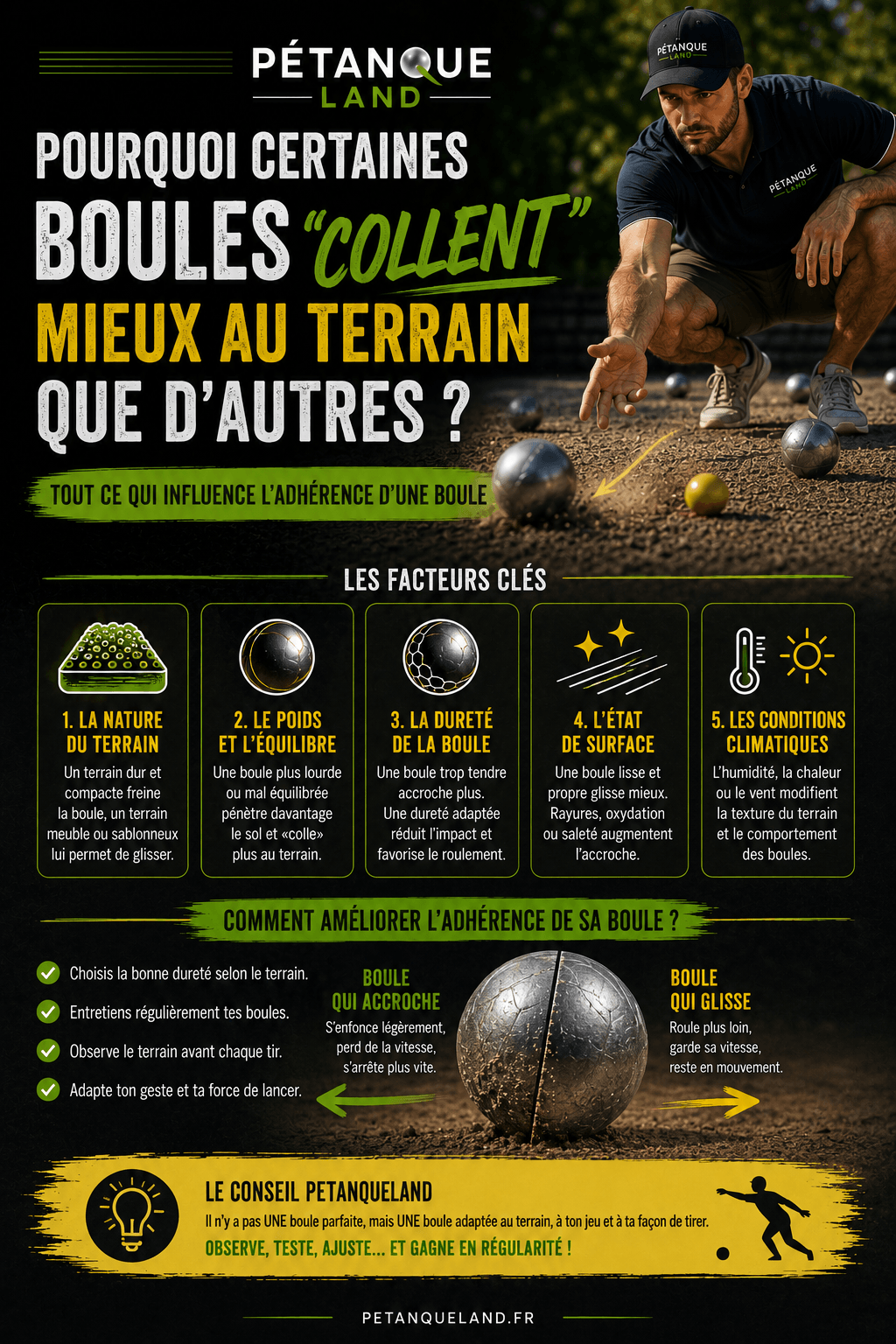
Why do some boules "grip" the terrain better than others? (Pétanque)
Some boules seem toWhat "sticking" means physically
A boule that "sticks" is one that absorbs a significant part of its kinetic energy on first contact with the ground, then rolls as little as possible before stopping. This behaviour depends on two simultaneous physical phenomena: the microscopic deformation of the boule's surface on ground contact, and the friction between the boule and the terrain during rolling.
🎙️ Paquita on boules that stick "Everyone talks about soft or hard boules as if it were a matter of taste. In reality it is a matter of terrain. On a well-compacted concrete boulodrome, a soft boule will absorb the impact and stop quickly — exactly what we want for pointing. On a damp sandy terrain, that same boule will sink slightly on impact and go off in any direction. It is the same boule — but the terrain has changed the rules. The best players I have seen, they have two or three sets of boules depending on where they play. Not to show off — because it really makes a difference." — Paquita 🔑"Sticking to the terrain" is not an absolute property of a boule — it is a property relative to the terrain on which it is used. A boule that sticks perfectly on one terrain is not necessarily the best on a different terrain. The ideal choice starts with knowing your usual playing terrain, not with a brand's reputation.
The hardness of the steel — the main factor
The hardness of a pétanque boule is measured by a Rockwell index (HRC) — the higher the index, the harder the steel. In practice, pétanque boules range from about 18 HRC (very soft, highly deformable steel) to 60 HRC (very hard, almost non-deformable steel). The common commercial range sits between 20 and 55 HRC.
🔩 HARDNESS SCALE — FROM SOFT STEEL TO HARD STEEL VERY SOFT18–25 HRC SOFT
26–34 HRC INTERMEDIATE
35–44 HRC HARD
45–54 HRC VERY HARD
55–60 HRC VERY SOFT Crushes slightly on impact. Maximum absorption. Sticks very well on hard terrain. Risk of visible deformation after repeated impacts. SOFT Good absorption/resistance balance. Ideal for hard to intermediate terrains. The most common profile among pointers. INTERMEDIATE All-round. Works across a wide range of terrains. Less stick on hard concrete, more stability on soft terrain. HARD Lively bounce on hard terrain. Holds its shape better over time. Suited to shooters on intermediate to soft terrains. VERY HARD No absorption — the boule bounces on hard terrain. Reserved for very soft terrains or shooters seeking maximum power.
The 4 factors that determine ground grip
Hardness is the main factor, but it does not act alone. These 4 parameters work together — changing one without considering the others can produce an unexpected result.
① The hardness of the steel — shock absorption on impact This is the parameter most directly linked to the "stick" effect. A soft boule deforms microscopically on each contact with the ground — this deformation absorbs kinetic energy and reduces the bounce. A hard boule barely deforms — the energy is conserved and translates into bounce or roll. The chosen hardness must match the hardness of the terrain: hard terrain demands a soft boule (absorption necessary), soft terrain can tolerate a hard boule (the ground itself absorbs part of the energy). ⚙️ The microscopic deformation creates an enlarged contact zone between the boule and the ground — which increases friction and reduces the post-impact rolling speed. → Pointer on concrete terrain: aim for a hardness between 25 and 35 HRC. Shooter on sandy terrain: 40 to 55 HRC acceptable. ② Grooving — friction during rolling The grooves engraved on the boule's surface increase friction with the ground during rolling. A heavily grooved boule on granular terrain creates micro-grips that slow down the progress. A smooth boule on the same terrain rolls much further. Grooving partially compensates for an unsuitable hardness — but cannot replace the right hardness choice on a terrain very different from its optimal zone. ⚙️ The grooves increase the effective contact surface with the ground particles — each groove creates an extra fulcrum that consumes rolling energy. → On sandy or gravel terrain: pronounced grooving essential. On smooth concrete: moderate grooving is enough, excessive grooving can grip unevenly. ③ The surface finish — polished, satin or raw Beyond grooving, the overall surface condition of the boule influences its behaviour. A polished (mirror) finish reduces friction to almost zero on a smooth surface — the boule skids. A satin (slightly rough) finish maintains moderate friction without creating grips. A raw forged finish maximises friction on rough terrains. These finishes fade with wear — a raw forged boule that has seen a lot of use gradually behaves like a polished boule. ⚙️ The surface micro-roughness determines the coefficient of static friction — the one that prevents the boule from sliding sideways after the initial impact. → Do not buy very polished boules for pointing. The satin finish is the best balance for the vast majority of terrains and styles. ④ Weight — inertia and impact depth A heavier boule has more inertia — it is harder to stop but also sinks further into soft terrains on impact, which creates stronger stopping friction. On hard terrain, the difference in behaviour between 650 g and 750 g remains small. On sandy terrain, a heavy boule that sinks into the ground on impact sticks better than a light boule that bounces on the surface. The optimal weight therefore also depends on the terrain — not just on hand comfort. ⚙️ On soft terrain, the impact pressure (force / contact surface) determines the depth of sinking, which in turn determines the amount of energy absorbed by the ground. → On soft and heavy terrain: favour boules close to the maximum weight (720–750 g). On hard terrain: the impact of weight is less decisive than hardness.Grooving in detail — which for which terrain
🔍 GROOVING GUIDE The types of grooves and their effect on each type of terrain 〰️ Standard horizontal grooving MOST COMMON Parallel grooves around the sphere, perpendicular to the rolling axis. The most all-round — works correctly on the vast majority of terrains. Creates regular friction during rolling without creating unpredictable grips. It is the reference grooving for players who play on several types of terrain. ✳️ Crossed grooving — meshed SOFT TERRAIN Crossed grooves that form a grid across the entire surface. Maximum grip in all directions — ideal on sandy terrain, fine gravel, or damp beaten earth. On hard terrain, this grooving can create random grips and unexpected lateral deviations. Reserved for soft or damp terrains. ▬ Wide and shallow grooving HARD TERRAIN Spaced grooves, shallower than the standard. Moderate friction suited to hard terrains such as concrete or compacted surfacing. On soft terrain, these grooves do not penetrate the ground particles enough to create effective friction — the boule rolls too far. This grooving suits indoor boulodromes and well-compacted terrains. 🔘 Dot grooving — studs SPECIALISED Small raised dots rather than continuous grooves. Used by some manufacturers for shooting boules — reduces the flat contact surface (less parasitic drag in flight for high shots) while maintaining sufficient ground grip. Uncommon, reserved for highly specialised boules for certain shooting styles. ⭕ Smooth surface — no grooving TO BE AVOIDED FOR POINTING Minimal friction on all terrains. The smooth boule rolls very far regardless of the steel hardness. Some leisure boules or very old, heavily worn boules behave like this. Completely unsuited to pointing — the trajectory after the first bounce is almost uncontrollable on dry terrain. Can be used for shooting on very soft terrain where the ground itself creates all the necessary friction.Terrain-boule matching — choosing according to where you play
The same player, with the same technique, will get radically different results depending on the match between their boules and the terrain. Here are the 3 main terrain categories and the matching boule characteristics.
🪨 HARD TERRAIN Concrete, indoor boulodrome, compact compacted surfacingOn hard terrain, the impact is almost elastic — the boule bounces a lot if it is too hard. The terrain absorbs nothing itself: it is the boule that must absorb the energy.
SOFT Recommended hardness: 20–35 HRC Ideal profile:Soft steel, standard horizontal or wide-spaced grooving, satin finish. The softness of the steel absorbs energy on impact and reduces post-contact roll.
⚠️ Pitfall: boule too hard on concrete = very high unpredictable bounces, no stick, erratic trajectories. 🌿 INTERMEDIATE TERRAIN Dry beaten earth, compacted fine gravel, standard outdoor boulodromeThe most common terrain in France. The ground absorbs part of the energy, but not enough to compensate for a boule that is too hard. All-round versatility is the key.
INTERMEDIATE Recommended hardness: 30–45 HRC Ideal profile:Intermediate steel, standard horizontal grooving, satin finish. This profile covers 80% of classic outdoor boulodrome terrains — it is the default choice for anyone who plays on several different terrains.
⚠️ Pitfall: choosing a very hard "shooter's" boule as your only set — correct for shooting, mediocre for pointing on this type of terrain. 🌱 SOFT TERRAIN Fine sand, uncompacted gravel, grass, damp earthThe terrain itself absorbs a large part of the energy — the risk is no longer bounce but sinking and random deviation on contact. A hard boule resists this sinking better.
HARD TO MIXED Recommended hardness: 40–55 HRC Ideal profile:Hard to intermediate steel, crossed or pronounced grooving, high weight (720–750 g). The crossed grooving creates the grip that compensates for the reduced friction linked to the high hardness of the steel.
⚠️ Pitfall: boule too soft on sandy terrain = sinks on impact, unpredictable trajectory, chaotic behaviour on every boule.Boule wear — how they change over time
A new boule and the same boule after 2 to 3 intensive seasons no longer behave the same. This change is rarely identified by players — yet it explains some progressive degradations in accuracy that seem linked to technique when they actually come from the equipment.
📉 WHAT CHANGES WITH WEARThe grooving gradually fades under the effect of repeated impacts — the grooves fill with ground particles or flatten. The surface goes from a satin finish to an increasingly smooth finish.
Direct consequence:The boule that "stuck" on intermediate terrain starts to roll further after impact. The player compensates by changing their height or force — which degrades consistency.
Warning sign: if your boules systematically roll further than expected for a few months, check the state of the grooving before looking for a technique problem. 🔧 HOW TO CHECK THE CONDITION OF YOUR BOULESRun your finger over the grooves — if they are still sharp and well defined, the boule is in good condition. If the edges of the grooves seem rounded or filled in, the wear is significant.
Practical test:Place the boule on a slightly inclined flat surface and observe whether it sets off immediately or stays stable. A well-grooved boule stays stable much longer than a smooth boule.
Some manufacturers offer to send the boules back to the factory for re-grooving — often cheaper than buying a new set, especially for quality boules. ⚠️ IMPACT MARKS — FLATS AND CRATERSSoft boules develop "flats" — slightly deformed zones after repeated metal-to-metal impacts. These zones alter the sphericity and create asymmetric behaviour when rolling.
Consequence:A boule with flats rolls slightly bumpily and deviates unpredictably depending on its orientation on impact. This defect is progressive and sets in over months.
Check: roll the boule on a very flat surface. If it traces a perfectly straight line, it is in good condition. If it wobbles or deviates, it has flats. 🔄 LIFESPAN ACCORDING TO PLAYING PROFILEAn intensive shooter wears out their boules faster than a pointer — repeated metal-to-metal impacts deform and erode the steel more quickly than ground-to-metal contacts. The higher hardness of shooter boules partially compensates for this wear.
Estimate:Standard quality boules: 2 to 4 years of regular use. Superior quality hard steel boules: 5 to 8 years. These durations vary greatly depending on playing intensity and terrain type.
Good practice: test your boules on a standardised terrain every year or two to detect progressive degradation before it affects play in competition.Selection table: terrain → recommended characteristics
| Terrain type | Recommended hardness | Grooving | Weight | Strictly avoid |
|---|---|---|---|---|
| Concrete / indoor boulodrome | Soft 20–30 HRC | Standard or wide-spaced | Free | Very hard steel — uncontrollable bounces |
| Hard compacted surfacing | Soft to intermediate 28–38 HRC | Standard horizontal | Free | Smooth surface — rolls too far |
| Standard dry beaten earth | Intermediate 32–44 HRC | Standard horizontal | 650–720 g | Crossed grooving — unpredictable grips when dry |
| Compacted fine gravel | Intermediate 35–48 HRC | Standard or moderate crossed | 680–740 g | Surface too smooth — loses all grip |
| Sandy or soft terrain | Hard to intermediate 42–55 HRC | Pronounced crossed | 700–750 g | Very soft boule — sinks, chaotic trajectory |
| Grass / natural terrain | Hard 45–55 HRC | Crossed or studs | 720–750 g | Smooth grooving — slides on grass, no stick |
| Wet terrain after rain | Intermediate 38–48 HRC | Crossed — water evacuation | 700–740 g | Very soft boule — too much absorption on soft ground |
| Variable terrain (play on several surfaces) | Intermediate 35–45 HRC | Standard horizontal | 680–720 g | Either extreme (too soft OR too hard) — bad compromise |
Before buying boules, a single question: "What type of terrain do I play on 80% of the time?" The answer to this question determines the hardness, grooving and weight profile to look for. Buying boules "to play everywhere" amounts to buying boules that are averagely suited to each terrain. If you regularly play on 2 very different terrains, two different sets is the most honest option — and often the least costly in the long run.
Exercises to test and compare your boules
01 The comparative roll test 📍 Usual playing terrain ⏱️ 15 min 🎯 Objectively measure the stick of your boules vs othersThis test turns a vague intuition ("my boules don't stick enough") into measurable data — and lets you objectively compare two different sets.
Throw your usual boule from a fixed standardised height — about 30 cm above the ground — from a standing position with your arm extended downwards, without a swing. Observe where the boule stops after the first contact. Measure or note the post-impact roll distance. Repeat 5 times to get an average. Repeat the same test with a borrowed boule of different hardness (softer or harder depending on what you suspect). Compare the average roll distances. A boule that rolls 40% less far after impact on this terrain sticks clearly better. A boule that rolls 20% less far can represent a significant accuracy gain over several ends. Repeat the test with a higher height (80 cm) and note whether the order changes. Sometimes a boule sticks better at low height but bounces more at high height — useful information for calibrating the optimal pointing height according to the equipment available. After the test, play a full game with the alternative boule if the results suggest a better match. The physical test confirms the theory — the game confirms whether the benefit is real in playing conditions. Do not conclude solely on the basis of the roll test without verification in real conditions. 02 The wear diagnosis — auditing your current boules 📍 At home or at the boulodrome ⏱️ 10 min 🎯 Assess whether your current boules are still suitableIdentify whether a recent decline in play comes from the boules rather than the technique — in 4 simple checks.
Visual inspection of the grooving: look at the grooves under good direct light. Are the edges of the grooves still sharp and well defined? Are there areas where the grooves seem filled in or flattened? Uniform wear is normal. Areas of vanished grooves signal a preferential contact point — often linked to a technique flaw. Sphericity test — straight-line rolling: gently roll the boule on a flat surface (tiles or table) launching it into a corridor delimited by two books. If the boule rolls straight without deviating, it is still spherical. If it wobbles or regularly deviates in one direction, it has flats or a deformation. Comparison with an identical new boule: if possible, compare the behaviour of your boules with those of a player using the same model recently purchased. The differences in behaviour directly reveal the state of wear — without the need for measuring equipment. Decision: if the grooving is heavily worn and the boules have more than 4 years of regular use, consider re-grooving (sending to the manufacturer) or replacement. If the grooving is still in good condition but the behaviour has changed, look for a technical cause first before investing in new equipment.FAQ — Your frequent questions
Do “stainless steel” balls stick better than carbon steel balls?+ Stainless steel and carbon steel do not directly denote hardness — they are different chemical compositions that allow for different hardness ranges. Stainless steel is more resistant to corrosion and can reach high hardnesses, making it often the choice of shooters. Carbon steel can be very soft (ideal for pointers on hard terrain) or very hard depending on heat treatment. The effective hardness (HRC) is the criterion to look at, not the type of steel itself. In practice, serious manufacturers indicate the hardness in their technical sheets — it is this value that allows you to make an informed choice. Can you improve the glue on your balls by maintaining them differently?+ To a certain extent, yes. Regularly cleaning the streaks (water + soft brush) to remove the soil particles which gradually fill them allows the coefficient of friction to be maintained for longer. Avoid applying oils or protective products that reduce friction. On matte finish balls, light sanding with very fine sandpaper (2000 grit) can refresh the surface micro-roughness — but this operation is delicate and can be counterproductive if poorly done. Professional stripping remains the only truly effective intervention for balls whose striping is really worn. Is a ball that sticks well on point necessarily bad on shooting — and vice versa?+ Not necessarily, but there is a real tension. A very soft ball which sticks perfectly to the point on hard ground gradually deforms under the impacts of the shot - which creates flat spots and degrades the sphericity. A very hard ball ideal for shooting bounces too much on hard ground to allow controlled aiming. The "middle" compromise (35-45 HRC) addresses this tension in a way acceptable to players who do both. Players who have a well-defined role in a duo benefit from specializing their equipment — soft ball for the pointer, hard ball for the shooter. Does the weather affect how balls stick to the court?+ Yes, significantly. Rain temporarily hardens soft pitches (the surface compacts) and makes them smoother, which favors softer balls temporarily — but also makes the pitch more slippery, reducing the effectiveness of streaking. Drought softens sandy soils (fine dry sand behaves differently from slightly clumped wet sand). Dry heat can crack certain clay soils, creating areas of varying hardness. These weather variations are an additional reason not to have a single set of bowls for the whole year, especially if you play on natural terrain. 📎 Related articles EquipmentBowl diameter: why the wrong choice penalises you PhysicsWhy some boules leave the game for no apparent reason TerrainAdapting your play to an uneven terrain EquipmentChoose your boules according to your level and style TacticsAttack or secure: making the right choice at the right time ToolsFree PetanqueLand tools© Pétanque by Paquita — petanqueland.fr · 📖 Paquita's book on Amazon