Actualités · 16 April 2026
Pétanque: Adapting to impossible terrains (dirty tricks)
An 8% slope, stones, roots, tall grass, fine sand, concrete... Tricky terrains exist in every outdoor competition. Those whoThe philosophy of adaptation — what difficult terrains reveal
A perfect terrain doesn't differentiate players — everyone plays well when the surface is ideal. A difficult terrain, on the other hand, reveals exactly a player's real level: their ability to adjust their action, to read the deviations, to accept the unexpected without losing their cool. Impossible terrains are the best trainers there are in pétanque.
🎙️ Paquita on tricky terrains "I played a competition on a terrain with a 6% cross-slope and stones the size of a fist. The opposing team spent the first three ends protesting to the organising captain. We spent those three ends testing where to place the jack so that the slope deflected their boules and not ours. By the fourth end, we'd found the setup. They were still protesting. We won 13–5. The terrain wasn't unplayable — it was just different. Different for both. The question was always: who adapts first?" — PaquitaThe 2-end protocol — observe before correcting
🔍 HOSTILE TERRAIN OBSERVATION PROTOCOL The first 2 ends as a terrain laboratory 1 End 1 — throw without changing your usual game Play normally, without trying to correct. The aim is to observe the real behaviour of the terrain on "normal" boules. Which boules deviated? By how much? In which direction? At what point in their trajectory? Memorise this information. 2 End 1 — analyse the opposing boules too The opposing boules are information too. Observe how their boules behave on this terrain — their deviations confirm or contradict your own reading. If their boules also deviated to the left, it's the terrain (slope). If yours deviated but theirs didn't, it may be your action or your playing zone. 3 Between ends 1 and 2 — share observations as a team 30 seconds of collective debriefing between the first and second end. "The slope pulls to the right in the jack zone." "The stone at mid-terrain deflects the boules to the left." "The terrain is soft in the first half, hard in the second." These shared observations let every player on the team adjust. 4 End 2 — apply the first corrections Build in a simple first adaptation — compensate the aiming angle, change the landing zone, adapt the force. Observe whether the correction works. Don't change two things at once — if you change both the angle and the force at once, you won't know which of the two improved or worsened the result. 5 End 3 and beyond — use the terrain against the opponent From the third end on, you know the terrain. The opponent does too, or is still adapting. Use what you know to place the jack where the terrain favours you — in the slope that pulls their boules, near the stone that deflects in your favour, in the soft zone that favours your style of pointing.Steeply sloping terrain
⛰️ STEEPLY SLOPING TERRAIN (4%+) The slope changes everything — distance, aiming axis and jack-placement strategy Longitudinal Cross-slope Combined Difficulty: WHAT CHANGES FOR THE POINTER On a longitudinal downhill: the boule speeds up after the landing and overshoots. Reduce the force, land further ahead. Uphill: the boule brakes sharply — increase the force. On a cross-slope (lateral): the boule drifts progressively at the end of its run. Aim to the opposite side from the slope — if the slope pulls to the left, deliberately aim to the right so the boule finishes in the centre. WHAT CHANGES FOR THE SHOOTER Downhill: the opposing boule that is "behind" the jack (uphill side) is protected by the slope — dislodging it calls for a higher trajectory. Uphill: the opposing boules resist displacement more (they fall back onto the slope). On a cross-slope: the impact of a shot shifted by the slope can send the opposing boule in an unexpected direction — anticipate it. JACK PLACEMENT Use the slope to your advantage — place the jack where the slope favours your technique. If you're better on uphill terrain (boules that stop well), place the jack in the uphill zone. If you master cross-slope compensation better than the opponent, place the jack in the tilted zone. MENTAL TRAP The slope often creates frustration because the boules "don't do what they should". The trap is to correct the force when the problem is the axis, or to correct the axis when the problem is the angle. Identify which variable is wrong before correcting — and correct only one thing at a time. KEY STRATEGY ON SLOPING TERRAIN Place the jack so that the cross-slope pulls the opposing boules towards the exit and your boules towards the target. A well-placed jack on sloping terrain can turn the slope into an ally — the opposing boules "roll" away from the jack naturally.Stony terrain
🪨 STONY TERRAIN Every stone is an unpredictable bounce — and a tactical opportunity Random bounces Iron shot favoured Terrain knowledge = advantage Difficulty: WHAT CHANGES FOR THE POINTER The roll after the landing is unpredictable — a stone can deflect the boule by 15–20 cm in any direction. Favour the lobbed point at a higher angle which lets you "fly over" the stones and land more cleanly. The rolling point is almost impossible to control. Find the least stony zones of the terrain for the final roll. WHAT CHANGES FOR THE SHOOTER The iron shot is less affected than the point by the stones — the boule arrives at high speed and the stones deflect it less. On the other hand, the opposing boule that has bounced off a stone can end up in a position that complicates the shot (hidden behind other stones). The rolling shot, on the other hand, benefits from the stones as guides — it "navigates" between them rather than suffering from them. KNOWING THE KEY STONES Quickly identify the 2–3 high-impact stones in the playing zone — the ones big enough to deflect a boule significantly and reproducibly. These stones can become allies: deliberately sending an opposing boule against a well-placed stone can propel it out of the critical zone. THE TRAP OF ACCEPTED IMPRECISION On stony terrain, the temptation is to lower your standards — "the stones will deflect the boules anyway". That's a costly mental error. Keep aiming precisely — the stones affect the boules that roll after the landing, not the landing itself. A precise throw onto a good landing zone remains superior to an approximate throw. KEY STRATEGY ON STONY TERRAIN Identify the "clean" zones (without major stones) and place the jack in these zones as a priority. Your two partners and you know where these zones are — the opponent discovers them by playing. This information advantage is worth points.Terrain with roots and bumps
🌳 ROOTS, BUMPS AND LOCAL IRREGULARITIES Fixed obstacles are also fixed landmarks — learn to use them Local bumps Surface roots Recurring hollows Difficulty: THE KEY FEATURE Unlike stones, which can change position, roots and bumps are fixed and reproducible. A root that deflects a boule to the left will deflect it to the left on every pass. This reproducibility is an opportunity: once identified, the irregularity can be anticipated, avoided or exploited. MAP THE TERRAIN From the first ends, mentally identify the position of the major obstacles: "the big root at 4 metres deflects to the right", "the hollow at 6 metres stops the boules", "the bump at 5 metres bounces to the left". This mental map of the terrain is valuable — every observation enriches the precision of subsequent throws. ADAPT THE LANDING ZONE On terrain with identified irregularities, choose the landing zone that avoids the major obstacles. If the root is at 4 metres and the jack is at 7 metres, two options: land before the root (at 3.5 metres) and roll over it, or land after the root (at 4.5 metres) to avoid contact. Test both during the first ends. USE BUMPS AS SPRINGBOARDS A well-placed bump can be used deliberately as a springboard to bounce a boule in a calculated direction — notably to reach an opposing boule hidden behind other boules. It's an advanced technique that assumes precise knowledge of the bump and the angle of impact. KEY STRATEGY WITH ROOTS AND BUMPS Place the jack in the zones you've mapped and the opponent hasn't yet observed. If you know the hollow at 6 metres on the left side stops the boules — place the jack there. Your boules rolled into that hollow stop well. Theirs do too, but you knew it before them.Sandy or gravelly terrain
🏖️ FINE SAND OR LOOSE GRAVEL The boule stalls, the magnet picks up debris, the jack buries itself — and the boules stop where they want High absorption Rolling point impossible Increased force needed Difficulty: WHAT FUNDAMENTALLY CHANGES Sand absorbs the boule's energy massively — friction is very high. The roll after the landing is almost nil. The boule "stalls" on the spot on impact. You have to land very close to the jack and significantly increase the force so the boule reaches its target zone. Any rolling point is ineffective — the lob is the only viable technique. THE ADVANTAGES OF SAND Sand has advantages too: the boules stop and stay in place — no unwanted roll that displaces your boules. A good point on sandy terrain is very stable. The iron shot leaves boules in place more easily (less post-carreau bounce). The opposing boules don't "slide" far from their position. THE JACK THAT BURIES ITSELF On fine sand, the jack can sink slightly into the ground with each boule impact. A partially buried jack is harder to aim at visually and can change the way the boules interact with it. Clearing it slightly from the sand before the next end is allowed — ask the umpire or agree on the rule in advance. MAGNET AND BOULE CLEANING On sandy terrain, the pickup magnet accumulates metallic particles from the sand that cling to the surface of the boules. These deposits in the grooves change the friction behaviour. Cleaning the boules regularly with the brush is essential on this type of terrain — see our article on the survival kit. KEY STRATEGY ON SANDY TERRAIN Play a direct, precise game — no rolling tactics or subtle placement. On sand, the closest boule wins and won't move again. It rewards pure release precision, not rolling strategy.Muddy or waterlogged terrain
💧 MUDDY OR WATERLOGGED TERRAIN After the rain, everything changes — maximum absorption, footprints and trajectories impossible to predict Very strong absorption Footprints in the ground Boules that slip in the hand Difficulty: THE BOULE IN THE MUD Mud acts as an extreme brake — the boule can stop almost instantaneously on impact. The roll is nil or negative. You have to land literally on the jack or very slightly before it. The traditional technique becomes: an almost direct point, at a very reduced height, with much more force than usual. FOOTPRINTS AS LANDMARKS Mud keeps the footprints of previous boules. These footprints create reproducible micro-irregularities that can deflect the following boules. But they also give information: you see exactly where the previous boules landed and how they rolled (or didn't). Reading the marks is a unique source of information on muddy terrain. GRIP — WET BOULES On muddy terrain, the boules become slippery — wet mud on the steel drastically reduces grip friction. Systematically clean each boule before throwing it with the cloth from your bag. A muddy boule in the hand alters the release unpredictably and uncontrollably. It's a non-technical adaptation that has as much impact as any adjustment to your action. SHOOTING IN THE MUD The iron shot on muddy terrain loses much of its effectiveness — the mud absorbs the shot's energy and the opposing boule resists displacement more. A shot at normal force may not dislodge the opposing boule. Compensate by shooting slightly harder. The carreau is almost impossible — aim instead for the displacement of the opposing boule. KEY STRATEGY ON MUDDY TERRAIN Play a game of pure precision — no rolling strategy or elaborate placement. The closest boule stays the closest. Avoid overly risky shots (success probability reduced by the mud). Clean the boules before every throw — it's non-negotiable.Concrete, synthetic and very hard surfaces
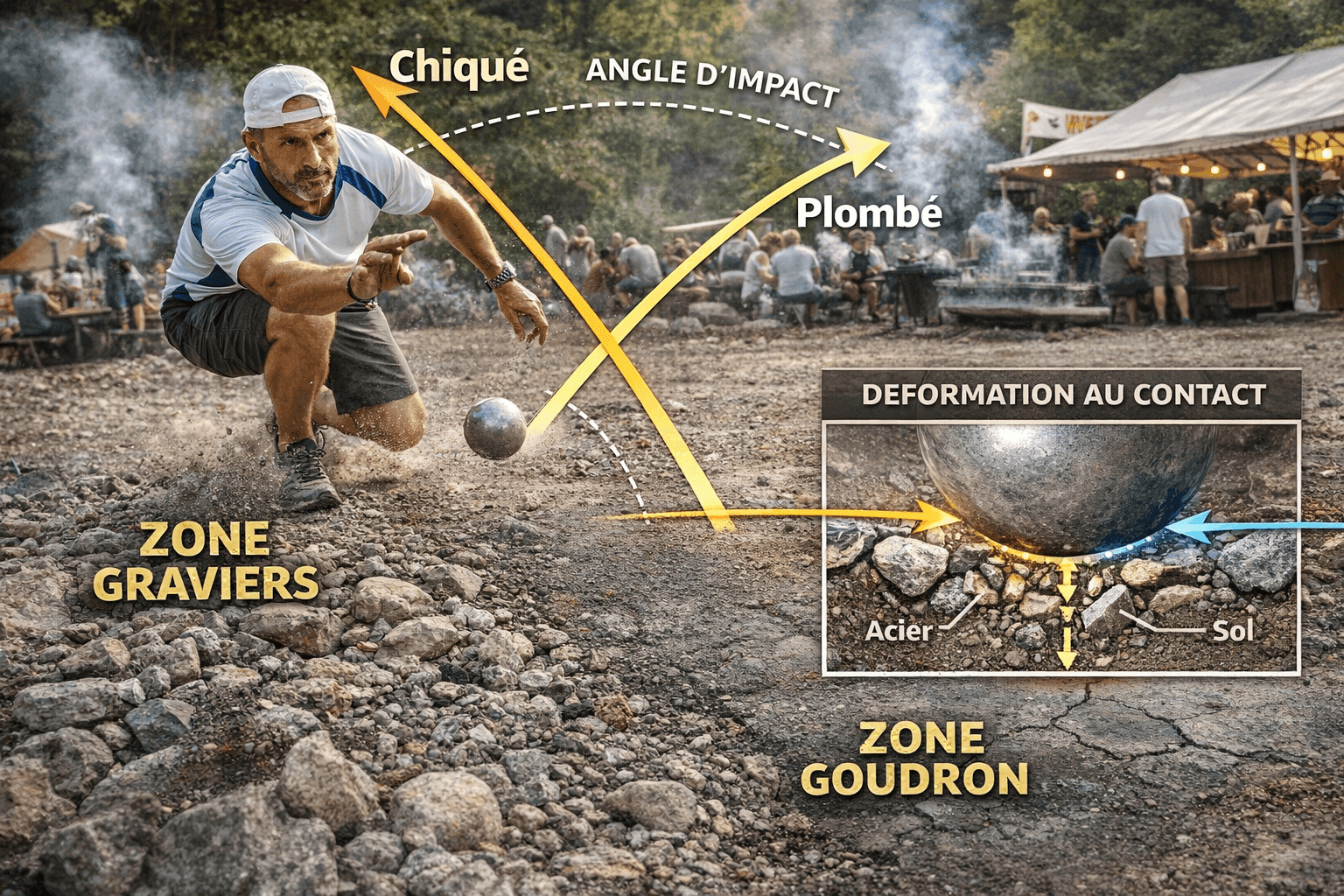
🏗️ CONCRETE, TARMAC OR HARD SYNTHETIC Maximum bounce, boule that vibrates on release, extreme precision required Very strong bounce Long roll Half-soft boule recommended Difficulty: THE EXTREME BOUNCE Concrete has a coefficient of restitution of 0.60–0.75. A standard launch angle (25–35°) produces a bounce that propels the boule far forward. You have to radically reduce the angle of attack — a very low release, an almost skimming trajectory, to minimise the vertical component on impact. It's the terrain that demands the most drastic change of technique. ENDLESS ROLL Even with a skimming angle, the boules roll very far on concrete — friction is low. Land very far ahead of the jack (60–100 cm) to compensate. The notion of "landing zone" changes completely — you land halfway between the circle and the jack in extreme cases. HALF-SOFT BOULE — CONCRETE ADVANTAGE If you have half-soft boules available, this is the terrain to use them on. The elastic deformation of the half-soft boule on impact will absorb more energy than your usual hard boule — significantly reducing the bounce. The difference can be 15–20 cm of residual roll depending on hardness. NOISE AND VIBRATION On concrete, the boules resonate loudly on impact — an intense metallic sound. This sonic vibration is unpleasant but has no consequence for the boule. On the other hand, the vibration transmitted to the hand at the moment of the shot (if the boule strikes another boule on concrete) can be more intense and uncomfortable. Mentally prepare for this sensory difference. KEY STRATEGY ON CONCRETE Placing the jack very far away (9–10 metres) forces even longer landings and even stronger bounces — avoid it if you haven't calibrated. Prefer 6–7 metres to reduce the post-bounce roll length. Playing short is more controllable on concrete.Tall grass or uneven lawn
🌿 TALL GRASS OR UNEVEN LAWN The boule slows quickly, the jack disappears, the blades of grass orient the trajectories High friction Oriented roll Jack hard to see Difficulty: THE LIE OF THE GRASS Grass isn't symmetrical — it grows in a dominant direction. A boule that rolls with the direction of the grass blades meets less resistance. A boule against the grain brakes harder. Observe the direction of the grass in the playing zone — it's concrete tactical information about the direction of the favourable roll. JACK AND VISIBILITY In tall grass, the natural wooden jack is hard to see from the circle. Use a coloured jack (red, bright yellow) if available. Otherwise, locate its position relative to a fixed landmark (a particular tuft of grass, a boundary). The reduced visibility of the jack increases stress and can disrupt aiming. INCREASED FORCE NEEDED Grass brakes hard. The same force that would give a good boule on clay produces a short boule on grass. You have to increase the force by 15–25% depending on the height of the grass. The classic mistake on tall grass: underestimating the friction and having systematically short boules for the first two ends. ADVANTAGES OF A GRASS TERRAIN Grass has advantages: the boules stay where they stop (no parasitic roll away from the target). The playing zone is more acoustically "muffled" — less impact noise. And the boules "hold" in place better — a good point on grass is stable, little exposed to bounce variations. KEY STRATEGY ON GRASS Play with the direction of the grass blades when possible — the boule rolls more easily. Place the jack in the shortest-grass zones if you find any — less friction, more control. Paint your jack if you play regularly on grass.Summary table — adaptations by terrain
| Terrain type | Power adaptation | Angle adaptation | Jack strategy | Technical advantage |
|---|---|---|---|---|
| ⛰️ Downhill slope | Reduce | Land further ahead | Place where the slope favours your style of play | Knowledge of slope compensation |
| ⛰️ Uphill slope | Increase | Land closer | Uphill zone = stable boules | Very stable boules once placed |
| ⛰️ Cross-slope | Normal | Aim to the opposite side from the slope | A slope that pulls the opposing boules towards the exit | Using the slope as a weapon |
| 🪨 Stony | Normal | More lobbed (fly over) | Clean zones identified | Knowledge of the key stones |
| 🌳 Roots / bumps | Normal | Adapt according to the bump | Zones mapped in advance | Reproducibility of the deflections |
| 🏖️ Sand / gravel | Increase | Land very close to the jack | More compact zones if available | Stable boules — no roll |
| 💧 Muddy / waterlogged | Increase strongly | Low angle, direct landing | Avoid the softest zones | Footprints reveal the trajectories |
| 🏗️ Concrete / synthetic | Reduce | Very skimming | Short jack (6–7m) | Half-soft boule if available |
| 🌿 Tall grass | Increase | Normal or slightly low angle | Short-grass zones | Play with the direction of the blades |
The mindset — turning trickiness to your advantage
🎓 A difficult terrain is the best teacherPlaying only on perfect terrain creates fragile players. Difficult terrains force an awareness of the action and an adaptability that easy terrains don't teach. Every impossible terrain is an accelerated training session.
⚖️ The trickiness is symmetrical — never one-sidedThe difficult terrain applies to the opponent in the same conditions. When you complain about the terrain, the opponent suffers it too. The one who complains loses mental energy. The one who adapts preserves it for the game.
🔬 Curiosity over frustrationReplace frustration with curiosity: "how does this terrain work?" instead of "it's unplayable". This question turns a problem into a puzzle to solve — which is mentally stimulating rather than exhausting.
🏆 The best players cherish bad terrainsA technical player on perfect terrain doesn't stand out from the average player. On horrible terrain, the player who adapts in two ends and exploits it gains a real advantage over the destabilised opponent.
📋 Accept the temporary loss of precisionOn difficult terrain, your usual precision isn't available for the first ends — that's normal. Accepting this temporary loss without stress frees up your attention for observation and quick adaptation.
🎯 Aim for "good enough", not "perfect"On impossible terrain, a boule 15 cm from the jack is an excellent boule if the opponent is at 20 cm. The goal isn't absolute perfection — it's doing better than the opponent in the same degraded conditions.
🏅 The real definition of a good playerA good player isn't one who plays well on perfect terrain — it's one who plays correctly on every terrain. Developing adaptability to difficult terrains is one of the most durable and most underestimated progressions in pétanque. Seek out bad terrains in training. You'll be formidably comfortable on the good ones.
Myths about difficult terrains
❌ BELIEF ✓ REALITY ❌"This terrain is unplayable — nobody can play on that." ✓If the opponent plays on the same terrain and manages it, the terrain isn't unplayable — it's difficult. The difference between "unplayable" and "difficult" is often the speed of adaptation. ❌"The stones cost me the end — it should be banned." ✓The stones probably cost the opponent boules too. If you lost the end, it's because the opponent managed the terrain better overall — not because the stones alone decided the result. ❌"I'd play better if the terrain were decent." ✓Everyone would play better on perfect terrain. What matters in competition is relative performance against the opponent in the given conditions — not absolute performance in ideal conditions. ❌"Complaining about the terrain helps manage the frustration." ✓Complaining consumes mental energy that could be devoted to adapting. It can also give the opponent information about your mental state. Keep your observations for the team — not for the opponent. 📖 PAQUITA'S BOOK Play everywhere, all the time — the complete guideTerrain, weather, pressure, fatigue... Paquita's book prepares you for every condition with 100 numbered exercises and adaptation protocols to stay performant whatever the circumstances.
📦 Order on AmazonFAQ — Your frequent questions
Can we ask to move the jack if the terrain is really too difficult in one area? + No — in an official competition, the placement of the jack is decided by the team that won the previous end, in the regulation zone (6–10 meters, visible). The opponent or the referee cannot force a move simply because the area is difficult. On the other hand, if the jack lands in an area where it is not visible from the throwing circle (hidden by a fixed obstacle), it can be relocated according to the specific rules of the obstacle. In a wild or friendly tournament, we can of course agree in advance on rules adapted to the particular conditions of the field. How to train your adaptability to difficult terrain outside of competitions? + Deliberately seek out difficult terrain in training. Ask to play on the least used grounds of the bowling alley (often the most irregular). Play on unusual surfaces: grass in the garden, gravel in a parking lot, sloping ground in a park. Each session on difficult terrain develops adaptability permanently. Some coaches ask their players to train with their eyes half-closed on flat ground after a normal session — to break the habit of dependence on perfect visibility and develop proprioception of the gesture. Should we change boules depending on the type of terrain in competition? + It's possible and legal - nothing prohibits having several sets of boules and choosing according to the terrain. In practice, few club players make this choice due to lack of availability. The main useful adaptation: have semi-soft balls for very hard surfaces (concrete, synthetic) if you play there regularly. On all other types of terrain, adapting the gesture is more effective than changing the ball. How to manage the home/away advantage on difficult terrain — the opponent is playing on his usual terrain? + The opponent who knows his difficult terrain actually has a real advantage — his compensations are automatic while yours are still under construction. To reduce it: carefully observe the opponent's first balls before throwing yours. If their balls seem "straight" on a pitch that deflects yours, they are compensating for something — watching their aim and technique to understand the correction they are applying. The home advantage generally disappears from the 3rd or 4th lead when you have calibrated the field. 📎 Related articles Rules Ground marks — landmarks allowed on terrain Rules The one-minute rule — deciding fast on difficult terrain Equipment Choosing your boules — adapting to the terrain Rules Playing distances 2026 — regulatory on any terrain Equipment Stainless steel vs carbon — behavior on varied terrains Tools Free PetanqueLand tools© Pétanque by Paquita — petanqueland.fr ·
📖 Paquita's book on Amazon
The adaptations described in this article are based on general physical principles and field experience. The precise effects vary according to the exact conditions of each terrain.