Actualités · 6 June 2026
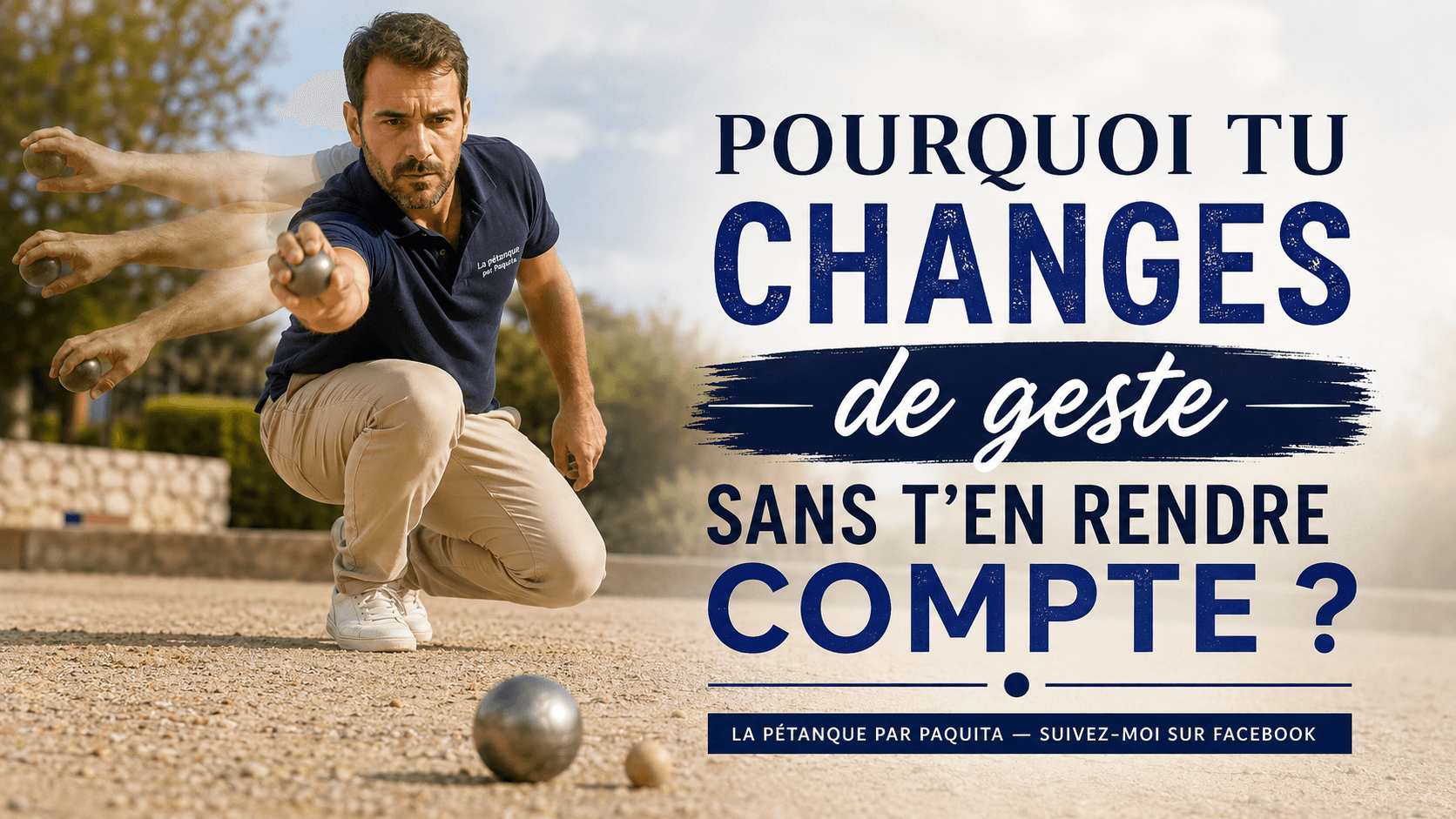
Pétanque. Why do you change your action without realising?
The action that worked perfectly at the start of the game gradually deteriorates. NoThe timeline of drift — how it starts
📉 TYPICAL TIMELINE OF A MOTION DRIFT OVER A GAME 🎯 ENDS 1–3 Reference motion. Regular results. The player is relaxed, focused, their motion from the week's training is intact. MOTION INTACT 😐 ENDS 4–6 Slight tension due to the score or an error. The motion starts to speed up slightly. Results still acceptable but less regular. EMERGING DRIFT 😤 ENDS 7–9 The drift sets in. The motion has changed on 1 or 2 parameters. Errors increase. The player corrects without knowing what to correct — sometimes making it worse. DRIFT ESTABLISHED 😩 ENDS 10–13 Motion significantly different from the start of the game. The player "tries to find their motion" with no method. The corrections often make the situation worse. MOTION DEGRADED 🔄 WITH METHOD A player who knows their drift mechanisms can interrupt the process as early as ends 4–5 and return to their reference motion before the deterioration sets in. POSSIBLE! 🎙️ Paquita on motion drift "The player who tells me 'I don't know what I'm doing anymore' in end 10 was playing very well in end 2. Something happened between the two. Rarely a sudden technical error — often an accumulation of small changes that no one saw coming. The fatigue that shortens the pendulum. The frustration that rushes the release. The opponent who plays well and whom we unconsciously try to imitate. That player hasn't 'forgotten how to play' — they've changed their motion gradually and no longer know which one they're making. The solution isn't to 'find your motion' — it's to go back to your routine, which hasn't changed." — PaquitaThe 6 main causes of motion drift
😴 ① Muscular fatigue — the progressive shortening PhysicalFatigue THE MECHANISM The muscles of the arm and shoulder tire progressively over 2 to 3 hours of play. In response to this fatigue, the body automatically reduces the range of motion — the pendulum shortens imperceptibly end after end. This shortening reduces the boule's initial speed, which makes it land short. The player compensates by "forcing" — which alters the fluidity of the motion. ⚙️ Neuromuscular mechanism: the brain reduces the motor signal to the tired muscles to avoid injury. This reduction is automatic and requires no conscious decision. THE SIGNALS Boules progressively shorter over 3 to 5 consecutive ends. A slight feeling of heaviness in the arm. The tendency to "force" on throws to compensate — which creates a less fluid and less regular motion than simply lengthening the pendulum. → Warning sign: if your last 3 boules are all shorter than usual on the same terrain, it's fatigue — not the terrain. Lengthen the pendulum slightly rather than forcing. 😤 ② Frustration — the accelerated release EmotionFrustration THE MECHANISM After an error or a badly lost end, the autonomic nervous system triggers a mild stress response. This activation shows up in the motion as an involuntary acceleration of the pendulum and a premature release — the boule leaves the hand 0.2 seconds too early. This change in timing alters the height and angle of the throw unpredictably. ⚙️ Cortisol and adrenaline, slightly raised under stress, speed up the motor tempo — the player "sees" their motion in slow motion but executes it faster than usual. THE SIGNALS A motion that seems "livelier" than usual. Boules that go off in varied directions with no consistency. The player feels that "it isn't working" without being able to identify what has changed. The variability of the results increases suddenly after an error. → Warning sign: if your boules are suddenly scattered after a bad end, it's the tempo that has changed — not the technique. Consciously slow down the start of the pendulum (not the whole motion, just the initiation). 🪞 ③ Unconscious imitation of the opponent ImitationUnconscious THE MECHANISM The human brain has mirror neurons that activate motor representations when observing a motion. Watching an opponent play regularly with a style different from your own progressively contaminates the internal representation of the motion. The player starts to "adopt" elements of the opponent's style without noticing — often the height, the tempo or the range. ⚙️ The mirror neurons in the premotor cortex activate during the observation of a movement — this activation can alter the player's motor programme if they observe for a long time without recalibrating. THE SIGNALS The motion changes subtly after watching several of the opponent's boules. The opposing team's pace of play becomes "the normal pace" for the player. This phenomenon is particularly marked against an opponent with a very different style (very high pointing vs very low, very slow shooting vs very fast). → Warning sign: if your motion changes every time you play against styles very different from your own, you are sensitive to imitation. Actively anchor your routine before watching the opponent play. 🔧 ④ Overcompensation — correcting too hard CorrectionReaction THE MECHANISM After a throw that is too short, the player increases their effort — often excessively. The next boule is too long. They correct again — and overcompensate in the other direction. This cycle of overcompensation creates a growing oscillation around the right value, without ever reaching it. The motion becomes more and more unpredictable with each correction. ⚙️ Overcompensation is a classic problem in control systems — correcting too hard produces an error in the other direction, which is then over-corrected in turn. The size of the corrections grows with each cycle. THE SIGNALS Boules that alternate short/long/short/long without finding the middle zone. The spread of the results increases with each end rather than converging. The player "looks for their motion" by changing a parameter on every boule — instead of fine-tuning a single parameter at a time. → Warning sign: if your boules alternate short and long with no progress, you are overcompensating. Reduce the size of your corrections by 50% — if you think "much harder", try "slightly harder". 🎯 ⑤ Unintentional adaptation to the result AdaptationAutomatic THE MECHANISM When the boules land well, the brain naturally reproduces the motion that worked — including the slight unintentional variations that accompanied that good result. These "accidentally good" variations gradually become part of the motion and can alter the reference motion in ways that are both useful (adapting to the terrain) and problematic (dependence on specific conditions). ⚙️ Positive reinforcement encodes the behaviours that precede a good result — including those that were not really the cause of it. This heuristic is normally useful, but can lock in bad habits. THE SIGNALS A motion that works perfectly on one terrain then collapses on a different terrain — without the player understanding why. Form depends strongly on specific conditions (terrain, weather, opponent) rather than a stable and transferable technique. → Warning sign: if your performances vary enormously depending on the terrains and conditions, your motion has adapted to specific conditions rather than staying stable. Train on varied terrains to rebuild stability. 👁️ ⑥ Score pressure — the "trial" motion PressureScore THE MECHANISM On high-stakes boules (decisive end, close score), some players lose confidence in their usual motion and consciously try to "control better" their throw — which paradoxically degrades the automatic action. The consciously controlled motion is less fluid and less accurate than the automatic motion. This is the well-known "yips" in precision sports. ⚙️ "Paralysis by analysis": conscious attention on an automated motion interrupts the automatic neural circuits and forces a less efficient voluntary circuit. This is documented in every precision sport. THE SIGNALS A motion that deteriorates specifically on the important boules. The quality of the throw is inversely proportional to the perceived stakes. The player "forces" control on the decisive boules — and misses them precisely because they are trying too hard to control them. → Warning sign: if your errors are concentrated on the "important" boules, it is pressure disrupting the automatic action. Develop a pre-throw routine that brings attention back to the process (the target, the breathing) rather than the result.The signals that reveal a drift is under way
📉Progressive deterioration of results Not an isolated error — a trend over 3 to 5 consecutive boules. The boules are systematically worse than usual, in a constant direction (all short, all off-line). An isolated error is normal variability. A trend is a drift. → Test: if 3 boules in a row are worse than your usual average, look for the drift — don't correct blind. ⏱️Throwing rhythm changed The tempo has speeded up without a conscious decision. The throws follow each other faster. The preparation is shorter. An attentive partner notices this change of rhythm before the player themselves — it is one of the few situations where an outside comment is genuinely useful. → Test: mentally time two consecutive boules. If the 10th is thrown noticeably faster than the 2nd, the rhythm has drifted. 💪Feeling of "forcing" The throw takes more effort than usual for the same distance. The arm "works" where it should "swing". This feeling is often the first perceptible internal signal of a drift — even before the results visibly deteriorate. → Test: if you feel you are "sending" the boule instead of "letting it go", something has changed in the range or the timing. 🌀Inconsistency between the boules of the same turn The 3 boules of the turn behave very differently in the same end — one short, another long, the third to the left. This inconsistency signals that the motion varies between two throws — often because the player tries to correct with no method between each boule. → Test: if your 3 boules in the same end are more than 30 cm apart from each other, the motion is no longer stable — identify the variable that changes between the throws. 🔑Motion drift is a normal phenomenon in all players — including the best. The difference between a player who manages drift and a player who suffers it is the speed of identification. A player who detects the drift by the 5th end can recalibrate before the damage is serious. A player who only detects it by the 10th end is often too far into the spiral to recover their reference motion before the end of the game.
Correction vs overcompensation — the crucial difference
✅ EFFECTIVE CORRECTIONAn effective correction changes a single parameter at a time, by an amount proportional to the observed gap, and leaves 2 to 3 boules to assess the effect before correcting again.
Example:Boule 25 cm short → slightly raise the release height → watch the next 2 boules → adjust if necessary. One change, not two. One assessment before the next correction.
Absolute rule: never correct two parameters at the same time. The result will be unpredictable and the analysis impossible. ❌ OVERCOMPENSATIONOvercompensation changes several parameters at once or changes a single parameter excessively. It produces a growing oscillation around the right value without ever reaching it.
Example:Boule short → "I'll throw much harder and higher and lean further forward". Result: boule very long. Next correction: too short again. The cycle gets worse.
Sign of overcompensation: if your corrections make the situation worse instead of better, reduce the size of your corrections by 50% and go back to your basic routine. 🔄 RESET — WHEN CORRECTING DOESN'T HELPWhen repeated corrections don't improve the results, it is often a sign that the motion has drifted too far to be corrected parameter by parameter. The solution is a complete reset — going back to the basic routine and playing without correcting for 3 boules.
The reset:Mental stop. Full routine. Aim at the target. No intentional correction. Throw. These 3 "no-correction" boules often let the motion stabilise naturally around an acceptable position.
Useful paradox: sometimes, "not correcting" is the best correction available. The degraded automatic motion is often better than the consciously over-corrected motion. 🛑 THE CORRECTIONS NEVER TO MAKE DURING A GAMESome corrections require too many cognitive resources to be made during a game — they systematically degrade results in the short term even if they are technically justified.
To avoid in tournaments:Changing the finger grip (too fundamental, too long to adapt to), changing the pointing style (rolled vs half-lob), altering the general posture. These corrections belong in training — not in a tournament.
In tournaments: only correct the fine parameters (height, range, foot orientation). Never the fundamental parameters of the motion — which take weeks to integrate.Resetting the motion during a game
🔄 RESET PROTOCOL — WHEN THE MOTION HAS DRIFTED TOO FAR 5 steps to recover your reference motion without changing technique 🛑 Mental stop — acknowledge the drift Explicitly acknowledge that the motion has drifted — not that "something is wrong", but "my motion has changed and I don't know exactly where my routine is at". This non-judgemental acknowledgement is the trigger for the reset. No panic — the drift is reversible. 🧘 Physically slow down the rhythm Walk deliberately more slowly towards the circle. Pick up your boule slowly. This physical slowing signals to the brain an exit from reactive mode. Physical slowness breaks the rushing cycle that often accompanies emotional or frustration drifts. 📝 Reconnect with 2 or 3 physical reference points Mentally or in a very low voice, name 2 or 3 reference sensations of the good motion: "feet flat, pendulum up to the shoulder, eyes on the target". These proprioceptive cues recalibrate the motor programme more effectively than complex analytical corrections. 🎯 Play 2 boules "with no intention of correcting" On the next 2 boules, focus only on the target and the routine — not on the result, not on the correction. The aim of these 2 boules is solely to recover fluidity, not accuracy. Accuracy returns naturally once fluidity is recovered. 📊 Assess and fine-tune if necessary After 2 "fluidity" boules, observe the results. If the motion has returned to its reference stability — even with imperfect results — resume normal micro-adjustments. If the motion is still unstable, restart the protocol from step 1.Exercises to develop awareness of the throwing motion
01 The "with and without pressure" session — measuring emotional drift 📍 Solo or 2-person training ⏱️ 30 min 🎯 Identify whether and how pressure alters the motionObjectively measure the difference between the motion under a neutral condition and the motion under a simulated pressure condition — to identify which drift mechanisms affect you personally.
Neutral series: play 10 boules in a relaxed state, with no stakes, simply focusing on the routine. Measure the average distance from the jack. This is your "neutral baseline". Pressure simulation: announce out loud before each boule "this is the decisive boule, it's 12-12". Observe whether the motion changes — rhythm, height, tension in the arm. Measure the average distance from the jack under this simulated pressure. Compare the two series. If the gap under pressure is significantly larger, you are sensitive to pressure on the motion. Identify which part of the motion changes — the timing, the height, the direction — to target your resilience work precisely. Repeat the series under pressure by deliberately applying the reset protocol before each boule. Measure whether the gap shrinks. This train → identify → correct → measure loop is the heart of developing resistance to emotional drift. 02 The "3 physical reference points" — anchoring your reference motion 📍 Training + tournaments ⏱️ To build over 3–4 sessions 🎯 Create a personal proprioceptive "reset code"Develop 3 personal physical reference points that represent your reference motion — and that you can "recover" in 5 seconds when the motion has drifted.
During a training session where the motion is working very well, identify 3 precise physical sensations that characterise this good motion : a sensation in the feet (symmetrical support, firm ground), one in the arm (fluid pendulum up to shoulder height), one in the hand (unrestricted release). These 3 sensations are personal — they vary from one player to another. Name these 3 sensations explicitly — write them down if necessary. Examples: "firm ground under the left foot", "arm tipping without effort", "fingers opening on their own". These formulations must be concrete and bodily — not abstract ("I am relaxed") but physical ("the shoulders haven't risen"). During the following sessions, start each series by deliberately "recovering" these 3 sensations before throwing the first boule. This 3-cue routine becomes the anchor of the motion — usable during a game when the motion has drifted. In tournaments, when a drift is identified, use the 3-cue routine as a reset protocol: "I've recovered my 3 sensations → I throw". These 5 seconds of proprioceptive reconnection effectively replace minutes of technical analysis under pressure. 🎳 The golden rule against motion driftYou cannot prevent the motion from drifting — it is a normal biological process. What you can do is detect the drift earlier and have a reset protocol available. A player who detects it by the 4th end and recalibrates in 3 boules does not lose the game. A player who only detects it by the 11th end tries to recover their motion under maximum score pressure — and often fails. The skill of early detection is more valuable than absolute technical perfection.
📚 PAQUITA'S BOOKS Improving at pétanque — Paquita's guides 🎯 TACTICS — MENTAL — MOTION Play everywhere — from technique to on-terrain tactics Awareness of the motion, detecting drift, reset routine, managing the mental side in tournaments — the complete guide to improving in every dimension. 📦 Amazon 💥 SHOOTER — MOTION — CONSISTENCY Become a formidable shooter Stability of the shooting motion, detecting drift in shooting, reset routine under pressure, building a reproducible shoot in every condition. 📦 Amazon 🎳 POINTER — AWARENESS — CUES The art of pointing — precision and consistency The 3 proprioceptive cues of pointing, detecting drift, micro-adjustments vs overcompensation — the guide for the pointer who masters their motion over time. 📦 Amazon 🧠 MENTAL — ROUTINE — METHOD Pétanque by method Reset protocols, managing motion drift, developing automatic actions — improve with method to be better under pressure. 📦 Amazon