Actualités · 16 April 2026
Weather & Steel: Playing in the heat or cold
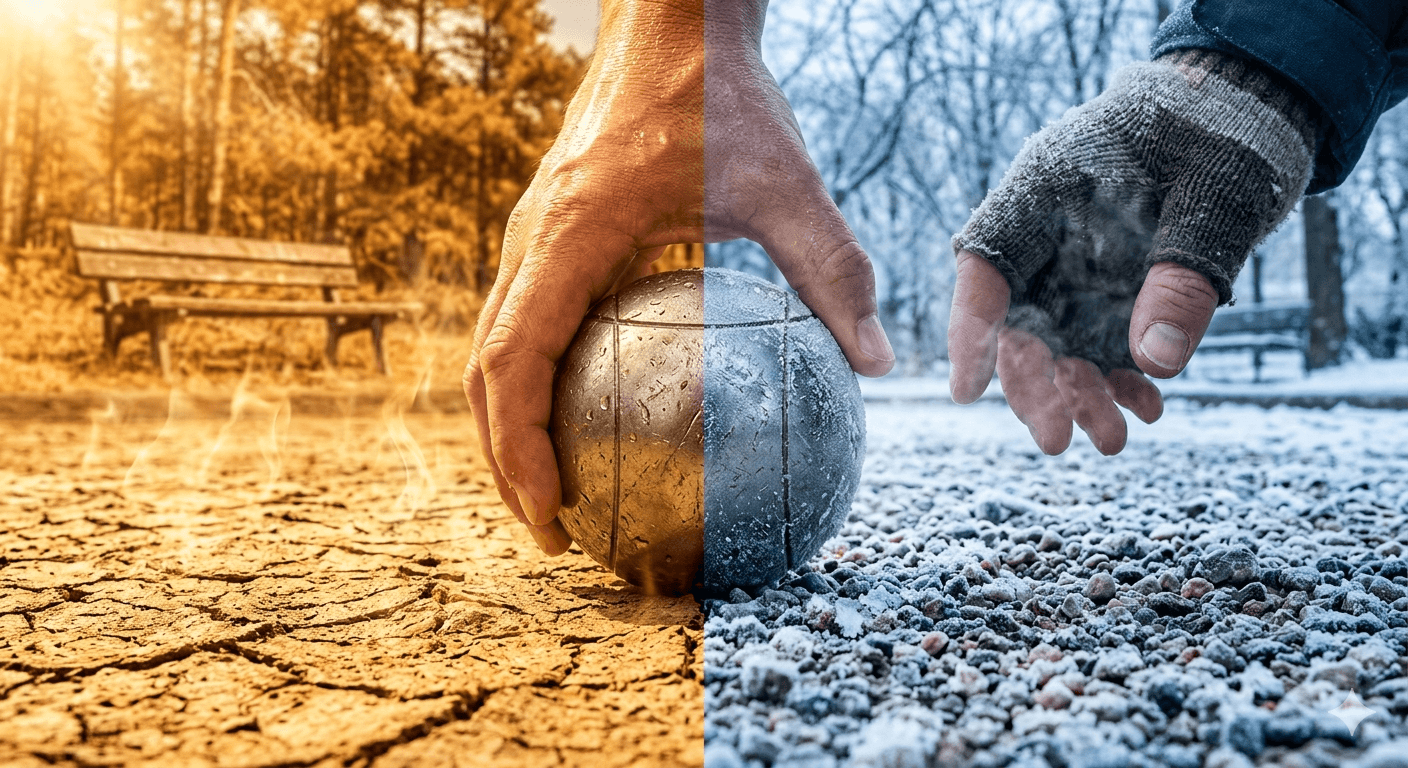
40°C in full sun or 5°C in the rain — the weather changes everything: the behaviour of your boules, your action, your precision, and your body. Paquita dismantles the☀️ Heatwave — the effect on your boules and the terrain
🔥 +35°C to +42°C Extreme heat changes the steel and the earth Measurable physical effects on every parameter of the game 🔩 THERMAL EXPANSION OF STEEL Steel expands with heat. At 38°C, a 70 mm diameter boule gains roughly 0.05 to 0.08 mm in diameter compared to 15°C. It's imperceptible to the hand — but it means that the boule is technically outside manufacturing tolerances on an intense heatwave day. In practice, the effect on performance is negligible, but it illustrates that steel is not an inert material when it comes to temperature. 🌡️ BOULE SURFACE TEMPERATURE Exposed in full sun at 38°C, a steel boule can reach 55 to 65°C at the surface. That's enough to be uncomfortable to hold bare-handed for several minutes. At the moment of the throw, the hot boule alters grip — the fingers tend to "feel" the release less well on a hot surface, and the release can be slightly altered by the pain-withdrawal reflex. 🌍 DRY AND CRACKED TERRAIN The heatwave dries out the terrain. The beaten earth becomes harder and more friable on the surface. The bounce coefficient increases — a boule bounces harder on very dry terrain than on normally damp terrain. Surface cracks and fissures create additional irregularities that deflect rolling trajectories unpredictably. 🌬️ DRY ATMOSPHERE AND TURBULENCE In intense heat, upward micro air currents (thermals) form above overheated surfaces. These micro-turbulences, imperceptible to the macroscopic wind, can slightly affect the boules' trajectory over long distances (9–10 m). The effect is marginal but real on highly exposed terrains and long-distance precision shots. HEATWAVE SUMMARY — BOULES AND TERRAIN Livelier bounce on dry terrain, hot boule uncomfortable to hold, possible micro-turbulences over long distances. The direct effects on steel are negligible — the indirect effects (harder terrain, uncomfortable hand) are the real problems.☀️ Heatwave — the effect on your body and your motion
☀️ PHYSIOLOGICAL EFFECTS OF HEAT 💧Sweating hands — altered grip on the boule, frequent premature release 💧Progressive dehydration — degradation of concentration and precision 💧Increased muscle tension — warm muscles contract differently, may tremble 💧Reduced blood pressure — possible dizziness after standing for a long time 💧Premature fatigue — the body spends energy thermoregulating, leaving less for the game 💧Irritability and lack of concentration — heat degrades mental resilience 🎯 EFFECTS ON THE THROWING MOTION 🎯Premature release from clammy hands — the boule leaves too early and falls to the right 🎯Less fluid swing — hand tension (hot boule) reduces amplitude 🎯Pre-shot routine shortened by discomfort — less concentration, more approximation 🎯Force variations — heat fatigue makes distance calibration inconsistent 🎯Unsteady gaze — sweat in the eyes causes stray blinks during the shot 🎯Progressive degradation — the first 3 games are fine, the last ones heavily affected 🎙️ Paquita on the heatwave "I played a competition at 41°C in August. My boules were literally burning hot between ends — I'd set them in the shade but they'd heat right back up in my hand. Sweat ran into my eyes at the moment of release. By the 6th game, I looked at my hands and they were trembling slightly — not muscle fatigue, just the heat and dehydration. I'd drunk water but not early enough. The rule I apply since: start drinking before you're thirsty, keep the boules in the shade between ends, and accept playing slightly more softly." — Paquita☀️ Heatwave — practical adaptations
☀️ CHECKLIST BEFORE A COMPETITION IN A HEATWAVE 🧴Apply sunscreen to your hands and forearms before the competition — not just your face 💧Start hydrating the day before — don't arrive at the game with a water deficit 💧Plan at least 2 liters of water + a drink with electrolytes (salt, magnesium) for a 6+ hour day 🧢Cover your head — wide-brim cap or light sun hat 👕Light, breathable technical clothing (white or light color) — not cotton, which traps sweat 🕶️Sunglasses — reduce glare for a steady gaze on the landing point 🧤Small cloth in your bag to dry your hands before each throw ☁️Keep the boules in the shade between ends — bag in the shade or a wet cloth over them ⏱️Respect the midday break — don't play in the midday sun without a cool-down break 🖐️ Managing clammy hands — the cloth technique Keep a small clean cloth (microfiber preferably) in your pocket or bag. Before each throw, quickly wipe your fingers and palm. This 3-second gesture restores friction and prevents premature releases. The best summer-competition players all carry this cloth — few beginners think of it. 🌡️ Cooling the boules between ends Place your boules in your bag in the shade between each end, or on a cool surface (damp grass if available). A wet cloth laid over them speeds up cooling by evaporation. A boule at 25°C vs a boule at 55°C — the difference in grip is significant and the release is more precise on the cool boule. 📏 Adapting your delivery on very dry terrain Ultra-dry terrain bounces harder. For the pointer, slightly reduce the throwing angle or increase the delivery distance to compensate for the increased bounce. Boules stop less easily on cracked terrain. For the shooter, boules can rebound further after impact — anticipate this effect for post-carreau placement. 💧 Hydration between ends — the protocol Don't wait until you're thirsty — it's already too late. Drink 150 to 200 ml every 20 to 25 minutes, even without feeling thirsty. Alternate plain water with water plus electrolytes. Avoid very sugary drinks that create a spike then a crash in energy. The one-minute rule theoretically lets you drink between each throw if needed.❄️ Deep cold — the effect on your boules and the terrain
🧊 +2°C to +8°C Cold contracts the steel and hardens the terrain Effects opposite to heat — but just as impactful 🔩 THERMAL CONTRACTION OF STEEL Steel contracts in the cold — the reverse effect of heat. At 4°C, a 70 mm boule loses about 0.04 mm compared to 20°C. Again imperceptible — but the cold boule has a slightly different coefficient of restitution : cold steel is slightly stiffer, which can imperceptibly alter the bounce. The practical effect is minimal but real for players very sensitive to their boule's behavior. 🌡️ COLD BOULE IN HAND A boule at 4°C held in a hand at 36°C creates a thermal shock that rapidly cools the fingers and reduces tactile sensitivity. The proprioception of the release — that ability to "feel" the right moment to let the boule go — is directly altered by the cooling of the skin's mechanoreceptors. That's the major problem of playing in deep cold. 🌍 FROZEN GROUND AND BLACK ICE Below 0°C, the terrain can freeze. The surface becomes hard as concrete — maximum bounce. On frozen ground, every delivery becomes extremely hard to control. Residual water in the earth solidifies and creates new and unpredictable irregularities. Usually soft zones become zones of intense bounce. 💧 DAMP AND MUDDY TERRAIN In cold temperatures with humidity (rain, fog), the terrain is damp and absorbent. Boules stop quickly after their delivery — mud and water absorb the energy. Premature releases (linked to cold fingers) fall too short. Rolling is virtually nonexistent. You have to play with much more force than in normal conditions. DEEP COLD SUMMARY — BOULES AND TERRAIN Loss of tactile sensitivity in the fingers (the main problem), frozen or wet terrain with opposite extreme behaviors, cold boule that cools the hands between ends. Unlike heat, cold is more insidious — its effects on the motion set in gradually.❄️ Deep cold — the effect on your body and your motion
❄️ PHYSIOLOGICAL EFFECTS OF COLD 🧊Reduced tactile sensitivity — the fingers' mechanoreceptors work less well below 10°C 🧊Muscle stiffness — cold muscles have less amplitude and fluidity 🧊Involuntary trembling — below 5°C without proper equipment 🧊Reduced grip strength — the finger flexor muscles are less effective in the cold 🧊Reduced fine coordination — the brain processes proprioceptive signals more slowly 🧊Mental discomfort — the pain of cold creates a constant mental distraction 🎯 EFFECTS ON THE THROWING MOTION 🎯Release hard to control — the cold boule "sticks" or "slides" depending on surface conditions 🎯Reduced swing amplitude — stiff muscles don't allow full amplitude 🎯Degraded release precision — reduced finger sensitivity alters the timing 🎯Stray trembling — in deep cold, the motion can have micro-tremors 🎯Longer warm-up — the first ends are always degraded, it takes more time 🎯Reduced reaction speed — the decision time between each throw can lengthen❄️ Deep cold — practical adaptations
❄️ CHECKLIST BEFORE A COMPETITION IN DEEP COLD 🧤Pétanque-specific playing gloves — or thin technical gloves that let you hold the boule 🧥Layered clothing (thermal base + mid layer + windbreaker) — keep the muscles warm 🧦Thermal socks — cold feet send discomfort up to the legs and break your focus 🔥Pocket hand warmer in your bag — warm your hands between ends 🔥Keep the boules in a pocket or your bag (against your body if possible) — reduce cooling ☕Hot drinks in a thermos — tea, coffee, broth. A warm body keeps the extremities better perfused 🏃Active warm-up between games — walk, rub your hands, rotate your shoulders 📏Expect the first 2 ends to be warm-up — don't panic over degraded early results 🍫Sweet snacks on hand — the body burns more calories in the cold to maintain temperature 🧤 Pétanque gloves — an underused piece of equipment There are gloves specific to pétanque — thin, letting you hold and throw the boule normally while protecting against the first effects of cold. For players reluctant to wear gloves, mittens between ends + throwing bare-handed is an effective compromise. Hands cool mainly during the breaks between ends — protecting them then maintains sensitivity during throws. 🔥 Warming the boules — strategy and limits Keeping the boules in a closed bag, ideally against the body (under the arm), reduces their cooling between ends. Never heat the boules with an artificial heat source (oven, radiator) — this can create thermal stress in the steel that alters its properties over the long term. Body heat is the only acceptable source. 📏 Adapting your delivery on wet or frozen terrain On wet-muddy ground: significantly increase the force (mud absorbs the energy), throw closer to the jack (rolling is almost nil), accept that the boules won't roll as usual. On frozen ground: treat it like a hard surface (concrete) — reduce the throwing angle, throw very far ahead to compensate for the extreme bounce. 🏃 The pre-competition warm-up — essential in the cold In cold weather, the first "cold" throw of a cold muscle is always of lower quality. Plan 10 to 15 minutes of active warm-up before the first end: shoulder rotations, wrist flexions, a few light throws. In competition, this preparation can be worth the 2 or 3 first ends that unwarmed-up players systematically lose.Summary table — conditions and adaptations
| Parameter | ☀️ Heatwave (35°C+) | ❄️ Deep cold (–8°C) | Priority adaptation |
|---|---|---|---|
| Grip | Sweaty hands — premature release | Numb fingers — imprecise release | Dry cloth / Gloves + mittens |
| Boule in hand | Hot boule (55–65°C surface) | Cold boule cools the fingers | Boule in the shade / Boule in the bag |
| Ground | Dry, hard, cracked — strong bounce | Damp/frozen — absorption or extreme bounce | Adapt the delivery |
| Throwing muscles | Overheated, thermal fatigue | Stiff, reduced range of motion | Slower play, hydration / Active warm-up |
| Concentration | Degraded by thermal discomfort | Degraded by cold pain | Reinforced pre-throw routine |
| Day-long endurance | Drop around the 5th–6th game | Maintained if well equipped | Electrolytes, cooling breaks |
| Recommended boule hardness | Semi-hard or half-soft (cushioned) | Semi-hard or hard (stable behaviour) | No abrupt change |
| Recommended boule weight | Reduce by 10–20g if fatigued | Maintain or increase slightly | Adapt if conditions worsen |
Whatever the extreme weather condition, the first two ends are always adaptation ends — not scoring ends. In intense heat, your body is not yet into its compensation rhythm. In intense cold, your muscles are not yet warm enough. Consciously use these first two ends to calibrate — observe the bounce of the terrain, feel the behaviour of your boules, adjust your force. Players who treat the first end as a normal end in extreme conditions often lose points needlessly.
Health — the limits not to cross
🏥 WARNING SIGNS IN EXTREME HEAT — STOP IMMEDIATELYDizziness, nausea, sudden headaches, confusion, hot and dry skin (lack of sweating despite the heat), severe muscle cramps — these symptoms signal heatstroke or hyperthermia. Immediate stop, move to the shade, hydration and call the emergency services if symptoms persist. Pétanque can wait. Heatstroke cannot.
🏥 WARNING SIGNS IN INTENSE COLD — MONITORIntense and uncontrollable shivering, pale and cold skin, blue lips, confusion, extreme fatigue — signs of early hypothermia. Continuous trembling of the hands that does not go away after warming up signals that the body temperature is too low to continue playing. Going back inside to warm up is the only option. Some players play in temperatures that are too low for their clothing preparation — competitive stubbornness never justifies a health risk.
ℹ️The players most vulnerable to extreme weather conditions are veterans (less efficient thermoregulation), players on medication (certain medicines affect thermal regulation), and players little used to local conditions (a northern player in a southern heatwave or a southern player in a winter northern competition). Adapting your equipment and your limits to your personal situation is just as important as adapting your game.
📖 PAQUITA'S BOOK Playing in all conditionsTechnique, mind, equipment, terrain, weather — Paquita's book covers all the dimensions of the complete player. 100 numbered exercises to ingrain a technique that holds whatever the temperature.
📦 Order on AmazonFAQ — Your frequent questions
Can we use magnesia (anti-sweat powder) on the hands in official competitions? + The FIPJP and FFPJP regulations do not explicitly prohibit the use of magnesia (magnesium carbonate) on the hands — it is a product commonly used in other sports (climbing, weightlifting) to improve grip. In practice, its use in pétanque remains uncommon but is not punishable. Check the specific competition rules if you have any doubts. The simple and universally accepted alternative is a dry cloth. Do the balls really change their behavior depending on the temperature or is it psychological? + Both. The direct physical effect on the balls (expansion/contraction of the steel) is real but very marginal — of the order of a few hundredths of a millimeter. On the other hand, the indirect effect is very real: the hot ball which alters grip in heat, the cold ball which numbs the fingers, the terrain modified by the temperature (dry/cracked or wet/frozen) - these factors have a measurable impact on the results. The psychological part also exists - a player who knows that he is playing in difficult conditions can over- or underestimate the effects. The truth is that the effects are mainly indirect (terrain, body, grip) and not on the steel itself. Should we change the hardness of the balls depending on the season? + For the vast majority of club players, no — changing hardness depending on the season is an expert-level adaptation. What matters more: adapting your throwing angle (slower on hard, dry summer terrain, more pronounced on wet autumn terrain) and your force calibration. Players who play intensively on very different pitches depending on the season can indeed benefit from a summer game (semi-hard on hard pitches) and a winter game (hard on wet pitches which provide a lot of cushioning) — but it is a significant investment and adaptation which is justified especially at the regional/national level. Does the one minute rule apply if a player takes time to dry their hands between throws? + Yes — the one-minute rule applies as soon as it's officially your turn to throw, and it covers everything you do before throwing, including wiping your hands. Concretely, drying your hands takes 3 to 5 seconds – this poses no problem with the one-minute rule which allows 60 seconds. The habit of rag does not significantly slow down the game. See our full article: The one-minute rule. Is it reasonable to organize or participate in a competition in extreme temperatures? + The reasonable limit is generally considered to be between 36°C and 38°C for healthy adults who are well hydrated, with access to shaded areas and water. Above 38°C with direct sunlight, the risk of heat stroke becomes significant and some organizers cancel or postpone competitions to cool hours. For the cold: below 0°C with wind, the risk of hypothermia and frostbite of the extremities warrants serious consideration. The Nordic winter competitions (Belgium, Switzerland) adapt with tents, hot drinks, and frequent rotations in the warm. There are no FFPJP rules on temperature limits — it is at the discretion of the organizers and the personal judgment of the players. 📎 Related articles Equipment Choosing your boules — complete guide 2026 Rules The one-minute rule — managing your time in all weather conditions Rules Mandatory equipment 2026 — sportswear Equipment Top 3 best shooter boules 2026 Equipment Stainless steel vs carbon steel — resistance to extreme conditions Tools Free PetanqueLand tools© Pétanque by Paquita — petanqueland.fr ·
📖 Paquita's book on Amazon
The physiological effects described in this article are general observations — they vary depending on the individual, their physical condition, age, and acclimatisation. If you have any doubts about your condition when playing in extreme conditions, consult a healthcare professional.