Règlement FFPJP · 23 June 2026
How to measure bowls in pétanque: the official method explained
The official FFPJP method for measuring boules in pétanque: permitted tools, order of measurement, precautions, special cases. The complete step-by-step guide.1.When are you allowed to measure?
First fundamental rule, often forgotten: you do not measure during an end. The FFPJP regulations are clear — measuring takes place when a team has played all its bowls or when there is doubt to decide who must play the next bowl. A team that gets the tape measure out after every bowl to "check" is in the wrong, and an umpire can penalise this practice.
In practice, you measure in two cases: during an end to determine which team must play (article 27 FFPJP — the one that does not have the point), and when the end is over to count the points scored by the team holding the point. Any untimely measurement is considered a waste of time.
⏱️Quick reminder: the regulations also provide for a playing time of 1 minute per bowl (article 16 FFPJP). Measuring too often means wasting everyone's time and risking an official warning. Measure only when it is useful for the decision.
2.Who should measure according to the regulations?
Second key principle: "the one who disputes measures". The official regulations specify that it is the team that played the last bowl that measures first, or more generally the team with an interest in doing so. If one team claims to have the point and the other disputes it, it is up to the challenging team to prove it by measuring.
In practice, in an official tournament, an umpire is called as soon as a disagreement persists. The umpire is the only one authorised to decide: their decision is final. In friendly play, the two teams can agree on a neutral player to carry out the measurement.
3.The authorised official tools
The FFPJP regulations only authorise "suitable" tools for measuring. In practice, here is what is officially recognised on tournament terrains:
The rigid or tape measure
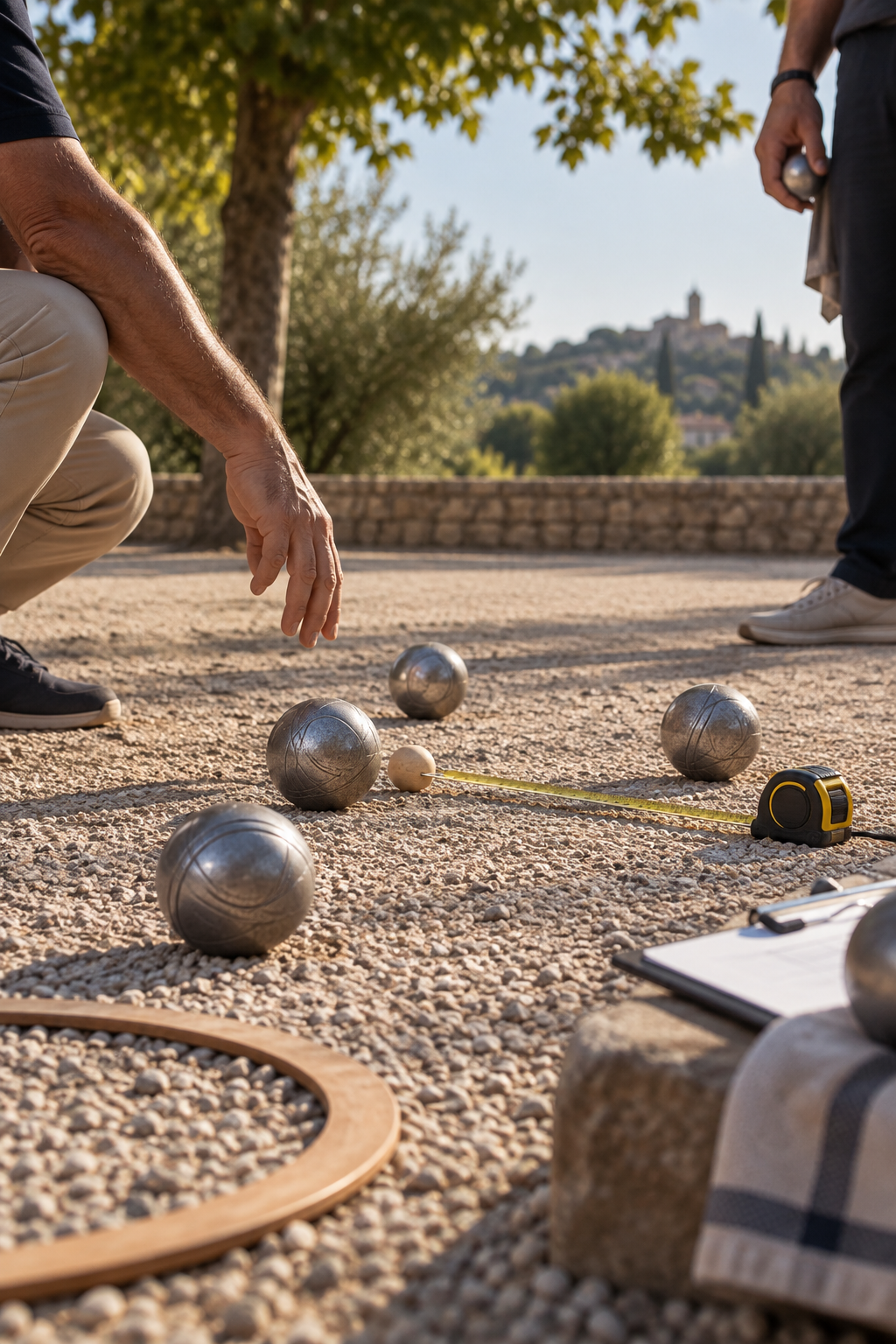
The basic tool. It must be rigid on its useful portion to avoid bending that distorts the measurement. A flexible fabric tape is tolerated in free play but not recommended: it stretches and gives imprecise results. Prefer a short metal tape measure (2 to 3 metres is enough).
The pétanque callipers
Specialised tool made up of two adjustable points. Ideal for very small gaps (a few millimetres) that the tape measure cannot read precisely. The callipers are the reference tool of official FFPJP umpires.
The straight edge or flat ruler
For bowls that are touching or very close, a straight edge is used, slid between the bowl and the jack. If the straight edge passes between the two: no contact. If it catches: the bowls are touching (carreau).
📐 Paquita's tipInvest in a real pair of pétanque callipers (15 to 25 € in a specialist shop). It is the tool that prevents 90% of disputes over gaps of a few millimetres. A tape measure alone is no longer enough once you start playing seriously, even in club play.
4.The official method step by step
Here is the exact FFPJP procedure, in order, to follow to avoid any dispute:
Step 1 — Stability of the terrain
Before any measurement, make sure the bowls concerned are marked on the ground (a line with the finger or with the heel in front of each bowl). This is compulsory if an intervening bowl has to be moved to measure. Without marking, in the event of accidental movement, the bowl is lost for its team (article 13 FFPJP).
Step 2 — Identifying the two bowls to compare
Clearly identify team A's bowl and team B's bowl closest to the jack. If a third bowl gets in the way of the tape measure, move it after marking.
Step 3 — Measuring bowl A then bowl B
Measure the distance between the edge of the bowl and the edge of the jack (not centre to centre). Note the distance of the first bowl, then measure the second without altering the tape measure if possible.
Step 4 — Announcement and agreement
The person measuring announces the result. Both teams validate it. In case of doubt, start again with another tool (callipers if the tape measure was used).
5.Summary table of tools
Which tool to use depending on the situation? The table below summarises the official recommendations:
| Situation | Recommended tool | Precision |
|---|---|---|
| Visible gap (> 5 cm) | Tape measure | Sufficient |
| Gap of a few cm | Rigid measure | Good |
| Gap of a few mm | Pétanque callipers | Very good |
| Bowls almost touching | Straight edge / flat ruler | Excellent |
| Gap invisible to the eye | Umpire + calibrated callipers | Official |
| Measurement while moving | Forbidden | Bowl on the ground compulsory |
6.In the event of a disagreement or an impossible measurement
What happens when the measurement does not allow a decision, or when both teams dispute the result? The FFPJP regulations provide for several levels of resolution.
First recourse: redo the measurement with a more precise tool (callipers if the tape measure was used). Second recourse: call an umpire, whose decision is final. Third recourse, in the absence of an umpire and if the measurement remains impossible: the end is void (article 28 FFPJP), no team scores, and you start again by picking up all the bowls.
Reliability of the measurement according to the tool used Official FFPJP callipers · 9/10 Reference tool of official FFPJP umpires. "By eye" measurement · 3/10 Source of the majority of disputes on amateur terrains.7.Common mistakes to avoid
Here are the pitfalls that turn a measurement into a source of conflict:
Measuring without marking the bowls — any bowl moved accidentally and unmarked is lost for its team. Touching a bowl before the decision — merely brushing a bowl to "adjust" can be considered a deliberate movement. Measuring centre to centre — the official rule is edge to edge. Using a flexible tape — it stretches and gives variable results. Refusing the umpire — in a tournament, the umpire decides, and refusing them is liable to a penalty. To go further, check out our little-known rules and our free tools.
📘 PAQUITA'S BOOK The Ultimate Guide to Pointing in PétanqueTo point so close to the jack that no opponent will come to contest the measurement: lob, half-lob, ground reading and millimetric precision. The complete guide for the pointer who wants to make the difference.
📗 Discover the bookFAQ — Your frequent questions
Can we measure as soon as we play our ball?+ Yes, but only to decide which team should play the next ball (the one without the point). Any other untimely measure is considered a waste of time and may be sanctioned by the referee according to the FFPJP regulations. Who should measure in case of doubt?+ The official rule is: “to the one who disputes to measure”. The team that claims to have the point can do so, but it's usually up to the doubting team to prove otherwise. In competitions, we appeal to the referee, whose decision is final. Can we move a ball to measure?+ Yes, provided you mark it on the ground beforehand (a line on your finger or heel in front of the ball). Without marking, in the event of movement, the ball is lost for the team (article 13 of the official FFPJP regulations). What to do if the measurement is impossible to decide?+ If the measurement, even with a compass, does not make it possible to decide, the end is declared void: no team scores and we start again by collecting all the balls (article 28 FFPJP). This situation remains rare with a calibrated compass. Is the cell phone allowed to measure?+ No. The official FFPJP regulations only authorize dedicated tools (meter, compass, wand). The use of a smartphone application, an unapproved laser rangefinder or any other electronic device is not recognized for making an official measurement. 📎 Related articles RulesThe little-known rules of pétanque ToolsFree PetanqueLand tools HomePétanque by Paquita© Pétanque by Paquita — petanqueland.fr ·
📘 Discover my books on PetanqueLand
Article based on the official FFPJP regulations for pétanque. To be adapted according to local club customs, which may add clarifications without contradicting the federal rules.