Actualités · 6 May 2026
Reading an end in a few seconds: a simple method — Pétanque
How many points are at stake? Who holds the end? Which boule is closest? Most players lose 15 seconds fumbling before each boule. Paquita gives the method to read a whole end in under 5 seconds.Why reading an end correctly changes everything
Reading an end is not a preliminary formality to the decision — it is the decision. A player who reads an end poorly makes the right decision for a situation that does not exist. They can play technically very well and still lose points because they had misunderstood what they had to do.
🎙️ Paquita on reading an end "I saw a player, excellent technically, shoot a boule perfectly — the opposing boule flew 3 metres, clean, neat. Except it wasn't the boule to shoot. There was another one 4 cm from the jack that he hadn't seen because it was in the shade. We lost 2 points on an end we should have won. His shot was perfect. His reading was wrong. And it was the reading that counted." — Paquita 🔑Reading an end is the only tactical skill that precedes all the others. Attack or secure, choose your target, decide on the shot: none of these decisions is valid if the reading of the situation is incorrect. It is the foundation — not a detail.
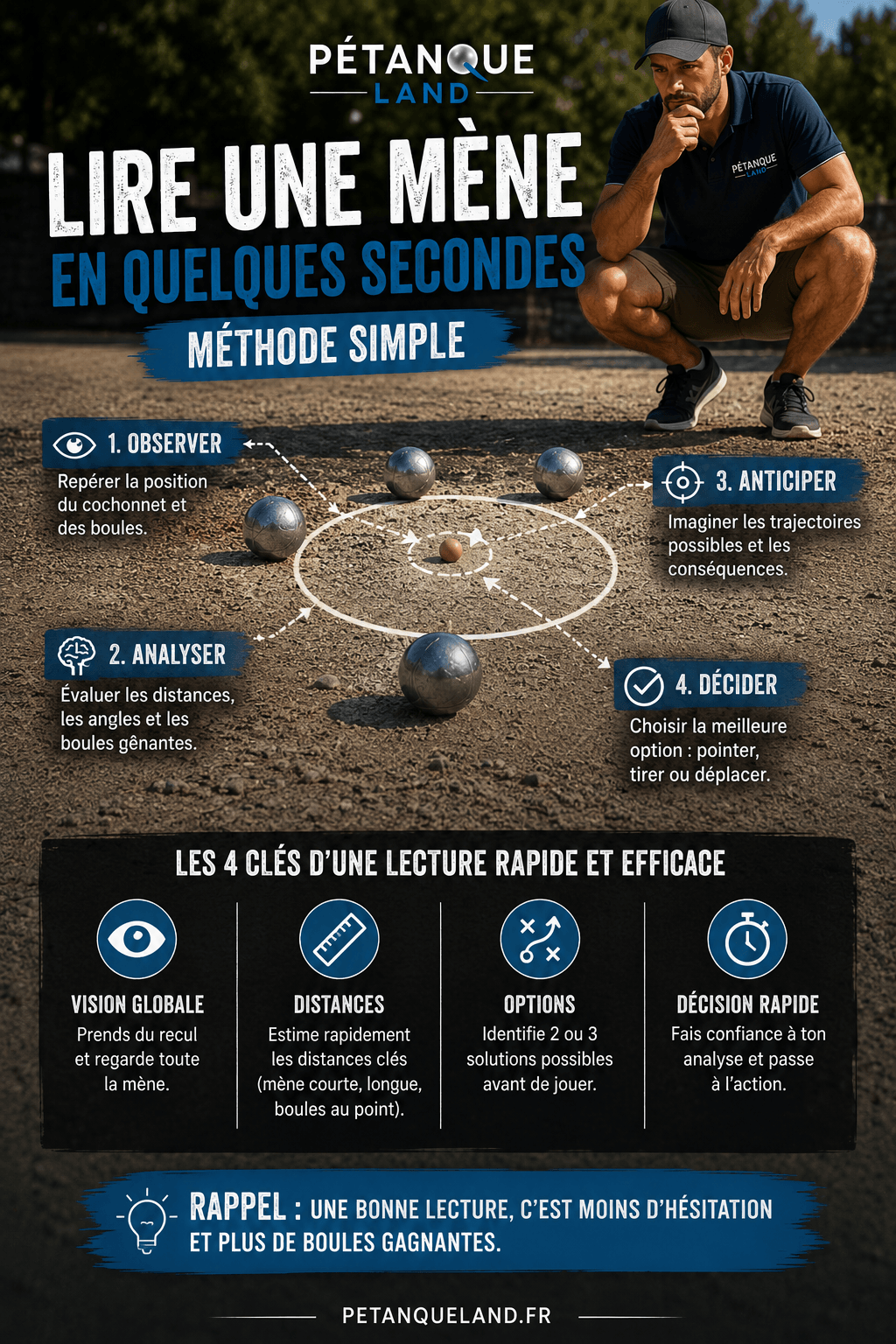
The 4-question method — read them in order
These 4 questions are asked in this precise order. The order is not arbitrary — each answer conditions the usefulness of the next. Skipping a question or asking them out of order produces incomplete readings.
① 1st question Who is holding? — identify the boule closest to the jack Before anything else: which team has the boule closest to the jack? This information is the foundation of everything else. Don't assume — check. A boule that seems close from the throwing zone may be behind another. Physically approaching the terrain, on the jack side, is sometimes necessary to settle it. Exact question to ask: "Is the boule closest to the jack ours or the opponent's?" — answer this single question before looking at anything else. ② 2nd question How many points are at stake? — count the holding team's consecutive boules Once the holding team is identified, count how many of its boules are currently holding — that is, how many of its boules are closer to the jack than the first opposing boule. This number defines what is truly at risk. Shooting the first opposing boule when 3 opposing boules are holding behind it changes nothing — the end stays lost. Exact question: "How many opposing boules are closer to the jack than our best boule?" — this number is the number of points lost if we do nothing. ③ 3rd question What is the decisive boule? — identify the target that changes the end Among all the boules in play, which is the priority target — the one whose displacement or elimination changes the situation the most? It is not always the closest boule. Sometimes, shooting the second opposing boule frees 2 points at once. Sometimes, pointing close to the jack changes the end without any shot being needed. The decisive boule is the one that, played correctly, produces the greatest change in the situation. Exact question: "If I played a single boule perfectly right now, which one would change the end most in our favour?" — that is your priority target. ④ 4th question How many boules does each team have left? — the remaining resource The number of boules still available on both sides determines the margin of correction available. If the opponent has no boules left, an unfavourable situation is locked in — you have to secure. If they still have 3, the situation can go either way. This context directly changes the urgency of the decision. Exact question: "How many boules do they have left? How many do we have left?" — two numbers to read on the terrain before deciding. 👁️ The reading habit in one sentenceBefore each boule, mentally form this complete sentence: "We / They are holding by X points, their decisive boule is [position], they have X boules left, we have X left." Five seconds. This formulation forces you to answer the 4 questions in order — and makes the decision obvious in 80% of cases.
The angle of view — where to stand to read it right
The position from which you read an end radically changes what you see. The majority of reading errors come from a reading made from a bad angle — usually from the throwing zone, 7–9 metres from the jack, with a depth perspective that tricks the eye on distances.
📐 READING FROM THE THROWING ZONEThe natural angle of view — you are behind the circle, looking towards the jack. Advantage: an overview of the boules along the line of play. Limit: distances in depth are very hard to judge — two boules at 5 cm and 15 cm from the jack can look identically close from 8 metres.
When to use it: to estimate overall distances and count the boules in play. Insufficient to settle doubts about proximity. 📐 READING FROM THE SIDE — 90° ANGLEMove perpendicular to the line of play to read the distances across the width. From this point, a boule at 5 cm and a boule at 20 cm become immediately distinct. It is the most precise angle to settle doubts about proximity.
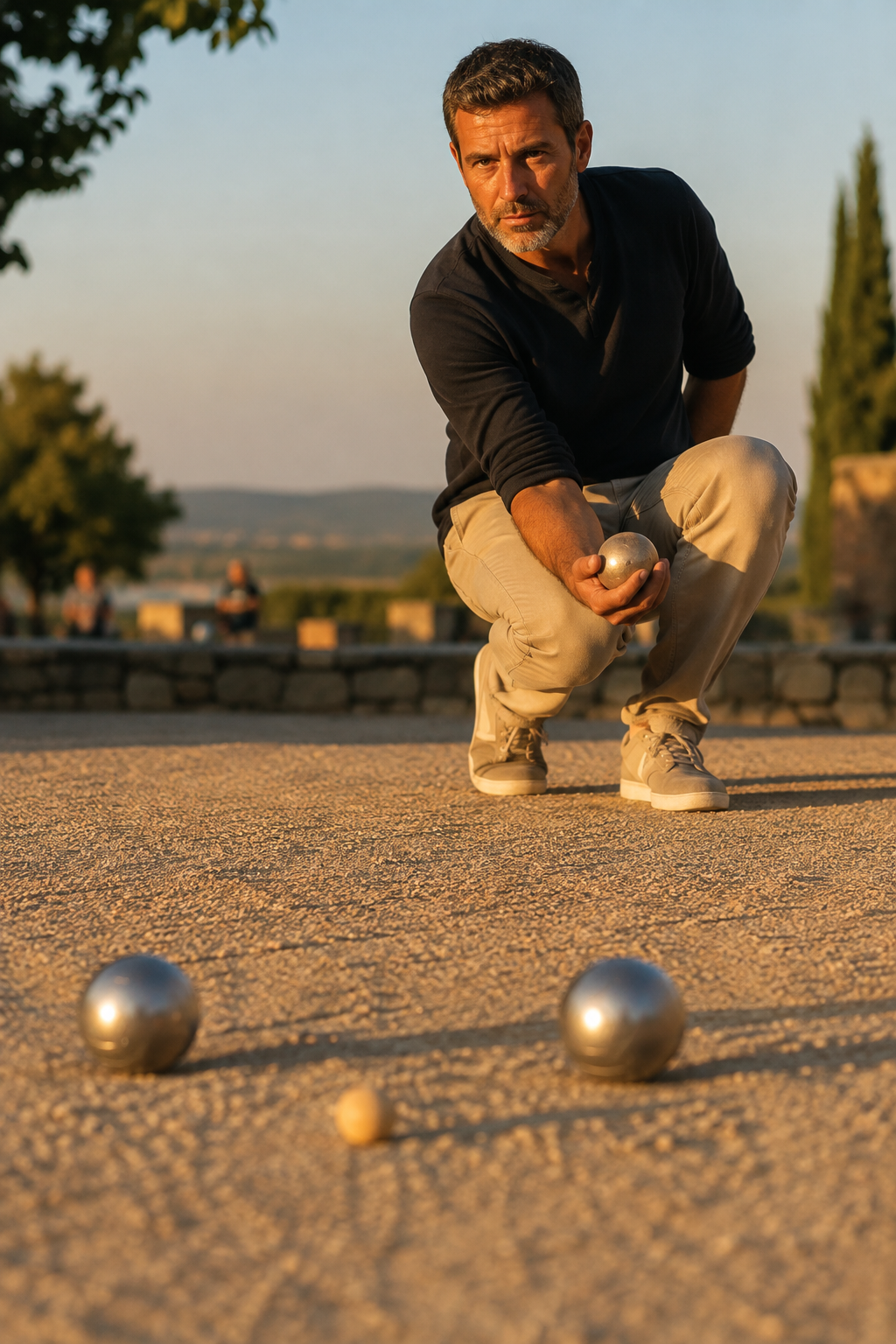
When to use it: as soon as doubt arises over "who is holding" or the number of holding boules. 10 seconds of lateral movement avoids a costly misread. 📐 GROUND-LEVEL READING — CROUCH DOWNCrouching down to ground level near the jack lets you see the boules from their own level. Boules hidden behind others become visible. Contact distances become obvious.
When to use it: for very tight situations (a boule potentially in contact, doubt over a boule hidden behind another). Essential for distance measurements before a shooting decision. 📐 READING FROM THE JACK — FACING YOUPosition yourself on the jack side and look toward the throwing circle. This reverse perspective reveals the boules that overlap along the axis — the ones you can't see well from behind because they are hidden by others.
When to use it: to identify a boule "behind" another — often invisible from the throwing circle and yet closer to the jack than the visible boule.The 6 typical situations and how to read them quickly
🎯 PRACTICAL GUIDE — COMMON SITUATIONS Recognize the situation at a glance, phrase the read in one sentence 1️⃣ A single opposing boule, close to the jack, none behind it Full read: "They're holding by 1 point, their decisive boule is the only one, we have X boules." Simple situation — either point better, or shoot this boule if our success rate justifies it. → The common mistake: shooting without having checked whether a good point wouldn't be enough to take the end. 2️⃣ Two tight opposing boules, our boule 20 cm behind Full read: "They're holding by 2 points, decisive boule: the closer of the two, we have X boules." A situation that calls for a decision — shoot the closest boule (resolves 1 point), point in front of both (may not be enough), or shoot the second one if the first is protected. → The common mistake: pointing between the two opposing boules hoping to "split" them — rarely achievable and often counterproductive. 3️⃣ We're holding by 1 point, opposing boule 15 cm behind ours Full read: "We're holding by 1 point, their main threat at 15 cm, they have X boules left." Priority depending on their remaining boules: if 3+ opposing boules remain, secure our position or protect our boule. If no opposing boules remain, the point is ours — don't do anything risky. → The common mistake: shooting the opposing boule "to be safe" when they have no boules left — pointless and risky. 4️⃣ Muddled situation — 4 or 5 boules close to the jack, mixed colors Full read: requires a lateral physical approach — no read is possible from 8 metres away. Move to 90° from the line of play, identify the boules one by one, moving outward from the jack. Phrase the result before going back to throw. → The common mistake: reading from the throwing circle by assuming the situation — and getting the decisive boule wrong. 5️⃣ Our boule seems to be holding but there's doubt over a nearby opposing boule Full read: don't assume — check physically. Move closer, crouch down to ground level beside the jack, read the distance from that level. This movement takes 15 seconds and avoids playing a boule on a wrong assumption about the situation. → The common mistake: "looks fine to me" from the throwing circle — and playing a needless boule or, worse, missing a real threat. 6️⃣ We're holding by 3 points, 2 boules left for each team Full read: "We're holding by 3, they have 2 boules left, we have 2 left." The situation is favourable but not settled — 2 well-placed opposing boules can turn the end. Secure it with the first boule, then assess whether the second is needed. → The common mistake: letting your attention slip because you're holding by 3 — and letting the opponent play freely with their 2 remaining boules.The most common game-reading mistakes
These mistakes come up systematically — they are not tied to technical level but to reading habits that can be corrected independently.
⚠️ READING MISTAKES — THE COSTLIEST ONES Recognizing these mistakes is already no longer making them Counting your own team's boules but not the opponent's VERY COMMON — You know you have "two boules near the jack" but you don't know how many the opponent has. The real situation is often different from what you assume. Confusing "who is holding" with "which boule is the most visible" DECEPTIVE ANGLE — The most visible boule from the throwing circle isn't always the closest to the jack. A boule behind another, smaller, darker, can be significantly closer. Reading the end at the start and not re-reading it after every boule played STATIC READING — The situation changes with every boule played. A correct read at the start of a turn is obsolete after 2 boules. The method must be applied dynamically — re-read before every throw, not just once per turn. Forgetting to count the opponent's remaining boules IGNORED CONTEXT — Securing a point when the opponent has no boules left is crucial information. Attacking when the opponent still has 3 boules to answer radically changes the risk equation. Not moving when the read is doubtful MISPLACED COMFORT — Staying in the throwing circle and assuming the situation "by eye" is the costliest comfort mistake. 15 seconds of lateral movement or moving toward the jack gives precise information where a guess can lead to the wrong decision.Quick reading table — situation → what to see
| Visual situation | What to check first | Reading angle | Read phrasing |
|---|---|---|---|
| 1 boule from each team in play | Which one is closest? | Axis or side | "Them/us holding by 1, X boules remaining" |
| 3+ close boules, mixed colors | Count from the jack outward, one by one | 90° mandatory | "Them holding by X, decisive boule = [position]" |
| Boule seems to be in contact with the jack | Is it really in contact or 2–3 cm away? | Ground — crouch down | Physical measurement before any decision |
| Our boule seems to be holding, slight doubt | Is there an opposing boule hidden behind ours? | Jack side, facing you | Confirm before doing nothing |
| Us holding by 2, opponent has 3 boules | Are our 2 boules protected or exposed to shooting? | Axis + side | "Us holding by 2, X opposing boules remaining, exposed/protected position" |
| End of the end — final count | List the close boules in exact order before announcing | Ground + side | Count out loud starting from the jack |
| Opposing shot — boules have moved | Re-read fully — positions have changed | Full re-read | Start the method over from question 1 |
Exercises to automate reading an end
01 Reading out loud 📍 2-player drill ⏱️ 1 full game 🎯 Automate the 4 questions in orderMake the reading process visible and controllable so it anchors as an automatic reflex.
Single rule: before every boule, phrase the full read in a low voice using exactly this structure — "Them/Us holding by X points, decisive boule [description], they have X boules left, we have X left." No shortcut, no summary. The full phrasing every time. The partner doesn't correct the read in real time — they mentally note any mistakes. After the end, both players compare their reads: was there a disagreement? What was it about? It's often over the number of points at stake or the count of remaining boules. After 3 to 5 games with this drill, the phrasing becomes automatic and silent. The final goal is for this read to happen internally in under 5 seconds — which can't happen without first having practised it out loud many times. Advanced variant: the partner can set up a specific situation with the boules laid on the ground and ask "read the end". The other must read it in under 10 seconds. This is the reading drill outside any emotional context — easier to correct than during a real game. 02 The outside observer game 📍 Watch a game — without playing ⏱️ 30 min 🎯 Develop reading without the pressure of playWatch an ongoing game without taking part, with the sole mission of reading each end before the players throw.
Position yourself to the side of an ongoing game, at 90° to the line of play. Every time a player is about to throw, mentally phrase the full read of the end — before they play. Then observe whether their decision matches a correct read or not. Identify the moments when players seem to have misread the end — they shoot a boule that wasn't the most threatening, or protect a point they didn't have. These observations build reading awareness without the stress of your own decision. Also practise reading from the line of play then moving to 90° to compare — note the situations where the two angles gave different information. These cases are the situations where the viewing angle is decisive. After 30 minutes, notice how quickly the read becomes fluid without playing pressure. Then bring this fluidity back into your own games — pressure-free reading automatises faster than reading under direct pressure.FAQ — Your frequent questions
How long can one take to read a story without violating the one-minute rule?+ The one-minute rule (article 27 of the FIPJP regulations) applies to the time between the moment when a boule comes to rest and the moment when the next player throws his or hers. Moving to read the lead is an integral part of the playing time — it is not punishable as long as the player remains within this overall time limit of one minute. In practice, a well-controlled reading takes 5 to 15 seconds, including lateral movement — well within the rule. The problem is not the reading time but the absence of a method that makes you search without finding. What to do when you don't agree with your partner on who is being led?+ A reading disagreement between partners is valuable information — it signals that the situation is ambiguous and requires physical verification rather than a decision on guesswork. The procedure is simple: approach the jack together, bend down to ground level, read the distances factually. If in doubt, measure with a tape measure or ask the competition referee for a decision. Never resolve a reading disagreement by authority or rank — always by verification. Is it useful to know exact distances, or is visual estimation enough?+ For everyday tactical decisions, visual estimation from a good angle is enough — knowing that a ball is 5 cm away versus 20 cm allows you to decide without measuring. The exact distances in centimeters are only necessary in two cases: the final counting of points at the end of the end (when two balls are very close), and the decision to attempt a shot on a ball almost in contact with the jack (risk of passing the jack). In these two cases, the physical approach and measurement are essential. How to manage reading when the field is cluttered and the balls are difficult to distinguish (same color)?+ Same-colored balls are a real difficulty, especially in tight situations. The method remains the same but requires more rigor: approach physically, read ball by ball from the jack outwards, identify the brand or engraving of each ball to associate it with your team if necessary. On crowded terrain, 90° lateral movement is non-negotiable — never reading from the throwing zone in this case. Managing confusion is a skill in itself: players who stay calm in a complex game often gain an advantage over those who rush. 📎 Related articles TacticsAttack or secure: making the right choice at the right time TacticsPlaying against a stronger opponent: the mistakes to avoid TerrainAdapting your play to an uneven terrain RulesThe one-minute rule — official playing time RulesRegulatory playing distances 2026 ToolsFree PetanqueLand tools© Pétanque by Paquita — petanqueland.fr · 🎯 Become a formidable shooter — on Amazon