Actualités · 23 April 2026
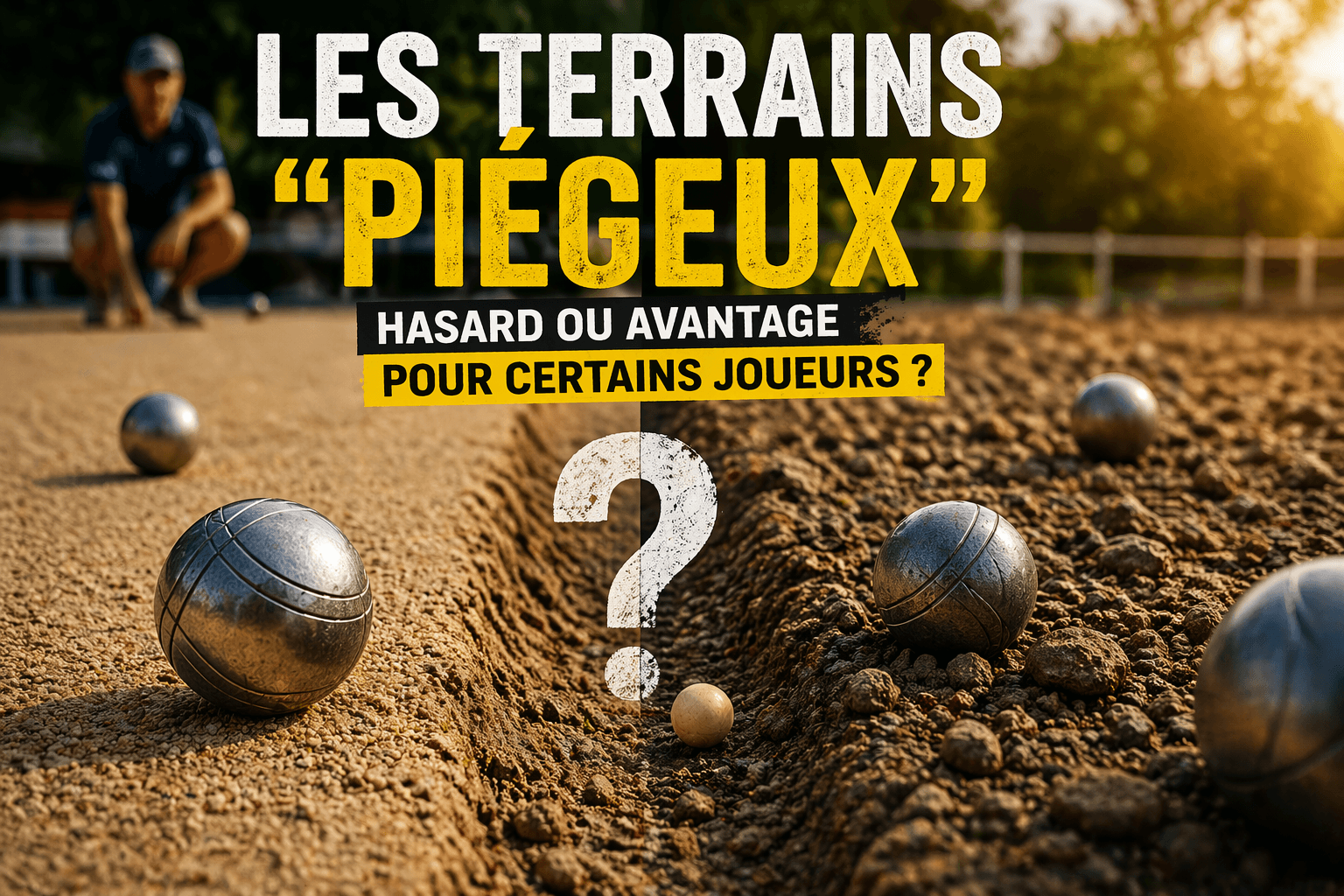
"Tricky" terrains: chance or an advantage for certain players?
The previous article explained how to adapt to impossible terrain. This one asks a different, deeper question: Are these difficult terrains really fair? Or do certain profiles of players – through their technique, their experience or their psychology – find a structural advantage that others do not even perceive? The answer, based on physics and sports psychology, is clear: tricky terrains are not neutral. They redistributeThe direct answer — it is not chance
🔍 ANALYSIS Tricky grounds create reproducible structural advantages Let's start by demolishing the idea that difficult grounds are "fair because both teams play on them". It is true in absolute terms — both teams face the same surface. But the effects of this ground vary radically depending on the playing style, the technique mastered, the experience accumulated and the mental state of each player.Concrete example: a very stony ground. Two teams play on it. One consists of a powerful direct-hit shooter and a pointer who plays rolled points. The other has a lofted pointer and a rafle shooter. On this stony ground, the second team is objectively advantaged : the lofted points pass over the stones, the rafle uses them as guides. The rolled points and the direct-hit shooting of the first team are more disturbed by the stones. It is not luck — it is physics.
This advantage is structural : it exists independently of the individual technical level of the players. An average lofted pointer can beat an excellent rolled pointer on a stony ground simply because their technique is better suited to the conditions. 🎙️ Paquita on "fair" grounds "We often hear 'it's the same ground for everyone, so it's fair'. That is a reasoning error. A muddy ground is fair in the same way that a swimming race in a pool half-filled with mud would be fair — technically both swimmers have the same conditions, but the swimmer who learned to swim in murky water has a real advantage over the one who has only ever swum in perfect pools. The difficult ground is the true leveler — it levels down those who have never practiced on it and levels up those who have made it their playing ground." — Paquita
The 7 profiles that benefit from tricky grounds
1 The lofted pointer — an advantage on any uneven ground The lofted point (high trajectory, strong-angle landing) makes the boule "fly" above the surface irregularities. On a stony, bumpy or root-filled ground, the boule passes over the obstacles instead of interacting with them. The rolled pointer, on the other hand, sends the boule skimming along the ground over the whole trajectory — every stone, every bump is a potential disturber. On a perfect ground, both techniques are equivalent. On a difficult ground, the lofted point dominates. → Systematic advantage on: stony, bumpy, root-filled ground, tall grass 2 The rafle player — stones as guides, not as obstacles The rafle shooter sends the boule rolling up to the target. On a stony ground, a first reflex would be to think that the stones hinder the rafle as much as the rolled point. That is wrong. The rafle, slower and lower than the direct-hit shot, "navigates" between the stones — the small obstacles guide it rather than deflecting it abruptly. Moreover, the opposing boule that has been shifted by previous impacts with the stones often ends up in a position more exposed to the rafle than to the airborne shot. → Systematic advantage on: stony ground, uneven ground in general 3 The experienced player — the library of difficult grounds A player who has played hundreds of competitions on varied grounds has developed a mental library of ground behaviors. Faced with a cross-slope ground, they have already seen this behavior and intuitively know which compensation to apply — without needing two ends of observation. This pattern recognition is a tacit skill that is not learned from a book but from repeated experience. On a perfect ground, experience advantages little. On a difficult ground, it is decisive. → Systematic advantage on: all difficult grounds compared to less experienced players 4 The player with strong mental resilience — the nastiness does not destabilize them Difficult grounds generate frustration — well-thrown boules that deviate, unpredictable results, a sense of injustice. Players with a low tolerance for frustration see their level drop on a difficult ground — their throwing motion tightens up, their decisions get rushed. Players with high mental resilience maintain their quality of play in the same conditions. This psychological gap creates a real advantage, independent of the initial technical level. → Systematic advantage on: all difficult grounds, particularly in the final ends of a tense competition 5 The "conservative" player — less exposure to hazards A player who plays a conservative game — close and safe points, shots only when the target is well exposed — takes fewer risks and is therefore less exposed to the ground's hazards. An "aggressive" player who attempts difficult shots at 8 meters on a stony ground multiplies their exposures to disturbers. On a tricky ground, a conservative strategy rewards more than an aggressive strategy — the hazards penalize aggressiveness more than caution. → Systematic advantage on: grounds with strong hazards (stones, bumps, irregularities), compared to aggressive styles 6 The ambidextrous player — access to all angles on a slope On a cross-slope ground, certain angles of attack are naturally better than others. A player who can point with both hands chooses the optimal angle according to the configuration — they can always play "with the slope" rather than "against the slope". The one-handed player is limited to the angle of their dominant hand and must correct for the slope by aiming compensation — less precise and less natural than simply changing the angle of attack. → Systematic advantage on: grounds with a significant cross-slope 7 The local player — knowledge of the specific difficult ground Playing on your usual ground — even a horrible ground — represents a considerable structural advantage. The cross-slope at the 7th meter, the stone that deflects left at 5 meters, the soft zone in the first third of the ground — the home team knows them by heart and has automatic compensations. The opposing team discovers them in real time. This information advantage is particularly strong on tricky grounds: the more difficult the ground, the more prior knowledge is worth. → Systematic advantage on: all home competitions on a specific difficult groundTerrain × player profile matrix
This matrix summarizes who is advantaged and disadvantaged on each type of tricky ground. It does not replace the analysis of each concrete situation but gives a general orientation.
| Tricky ground | Lofted pointer | Rolled pointer | Direct-hit shooter | Rafle shooter | Experienced player | Conservative style |
|---|---|---|---|---|---|---|
| ⛰️ Steep slope | Advantage | Disadvantage | Neutral | Neutral | Strong advantage | Advantage |
| 🪨 Stony | Advantage | Strong disadvantage | Neutral | Strong advantage | Advantage | Advantage |
| 🌳 Bumps / roots | Advantage | Disadvantage | Neutral | Advantage | Advantage | Advantage |
| 🏖️ Sandy | Advantage | Strong disadvantage | Disadvantage | Disadvantage | Advantage | Advantage |
| 💧 Muddy | Neutral | Strong disadvantage | Disadvantage | Disadvantage | Strong advantage | Strong advantage |
| 🏗️ Hard concrete | Disadvantage | Advantage | Neutral | Advantage | Advantage | Advantage |
| 🌿 Tall grass | Advantage | Disadvantage | Neutral | Disadvantage | Advantage | Advantage |
Reading this matrix reveals something important: the lofted pointer and the experienced player are advantaged on almost all types of difficult grounds. It is not chance — the lofted point is the most "universal" technique because it minimizes contact with the ground, and experience creates the pattern-recognition library. The rolled point, on the other hand, is systematically disadvantaged on any uneven ground.
The home advantage — known vs unknown difficult ground
🏠 HOME TEAM — KNOWN difficult ground ✓The compensations are automated — no extra cognitive effort ✓The mental map of key stones, bumps and slopes is internalized ✓The jack-placement strategy exploits the favorable zones ✓No adaptation time — every end is productive from the first boule ✓Mental serenity in the face of irregularities — "I know this ground, I know what it does" ✓The advantage accumulates — the more difficult the ground, the more knowledge is worth ✈️ OPPOSING TEAM — UNKNOWN difficult ground ✗2 ends of observation needed before calibrating — 2 ends potentially lost ✗High cognitive load — playing AND observing simultaneously ✗The first corrections are often imprecise (over-correction or under-correction) ✗The opponent places the jack in their favorable zones — the visitors discover them ✗Anxiety about the unforeseen — "what is this ground going to do next?" ✗The advantage reverses progressively — but the first ends are often lost 🏠 Home team strategy on a difficult groundIf your club ground is particularly difficult — slope, stones, irregularities — do not try to have it fixed. It is your home advantage. Every team that comes to play away loses their bearings there during the first ends. You, you have been playing on it for years and your compensations are automatic. A perfect ground takes this advantage away from you. Learn to cherish your difficult ground — and train to exploit it deliberately.
Concrete scenarios — who wins on which ground
⛰️ Steep-slope ground — powerful shooter vs technical pointer LOFTED POINTER ADVANTAGETwo teams face off on a ground with a 5–6% cross-slope. The first team relies on a dominant shooter who usually wins the ends through shooting. The second has a technical lofted pointer who creates stable boules close to the jack.
On this ground: the lofted pointer places their boules cleanly, compensating for the slope with an offset axis. The shooter must also correct the axis at the moment of the shot — and the opposing boule is in a zone influenced by the slope. Every missed shot leaves the opposing pointer's boule holding the point, and the slope can shift the boules after impact.
ANALYSIS The slope reduces the effectiveness of offensive shooting play (post-impact unpredictability) and advantages precision lofted-point play (less interaction with the ground). The team with stable points is objectively advantaged on a sloping ground. 🪨 Stony ground — two teams of equal level, different techniques RAFLE SHOOTER AND LOFTED POINTER ADVANTAGETwo teams of comparable theoretical level. One plays mainly rolled points and direct-hit shooting. The other consists of a lofted pointer and a shooter who often uses the rafle. On a perfect ground, the performances would be similar.
On a stony ground: the rolled points of the first team deviate on every stone crossed. Their direct-hit shots bounce unpredictably. The opposing team: the lofted points pass over the stones, the rafles navigate them. At an equivalent technical level, the second team wins on this ground.
ANALYSIS This scenario perfectly illustrates the structural advantage of technique. On a stony terrain, a technically inferior player with the right technique can beat a superior player with the wrong one — because the terrain drags bad technique down and amplifies good technique. 💧 Muddy terrain — beginner vs expert EXPERT ADVANTAGE AMPLIFIEDA seasoned player with 15 years of experience plays against a good-level but less experienced player. On a perfect terrain, the gap between them is real but not huge. They play on waterlogged terrain after morning rain.
The seasoned player has played on many muddy terrains. He immediately knows that the force must be increased by 20–30%, that the jack sinks into the ground and must be aimed at directly, and that the boule must not be damp. He applies these corrections from the very first end. His opponent discovers these effects gradually — he reaches the same conclusion in the third end, but with 2 ends lost along the way.
ANALYSIS A difficult terrain amplifies the skill gap between players of different experience. On a perfect terrain, an intermediate player compensates with his technique. On a muddy terrain, it is the mental library of experience that decides — and there, the expert is unbeatable. 🏗️ Concrete — calm player vs easily frustrated player PSYCHOLOGICAL ADVANTAGETwo players of identical technical level play on a concrete surface. The first is known for his composure — unexpected bounces don't faze him. The second is more emotional — unpredictable results irritate him and affect his technique.
On concrete, the bounces are strong and sometimes spectacular. Both players miss boules they would have made on clay. But the difference: the first absorbs the misses without affecting his next throw. The second gradually tenses up — his throws become less fluid, his decisions more hasty. From the 5th end onward, the gap in results widens.
ANALYSIS When two players of equivalent technical level find themselves on a difficult terrain, it is psychological resilience that decides. A tricky terrain is an amplifier of mental differences — it creates the conditions for emotional breakdown in less stable players.The psychological dimension — why it is half the battle
🧠 Threat as a disruptive factorA tricky terrain creates a threat of unpredictable result — the boules can deviate at any moment. This permanent threat generates an additional mental load that degrades concentration. Players accustomed to difficult terrains have learned to switch off this mental threat.
🎯 Attribution of failuresWhen a boule deviates off a stone, the player must decide: is it my technique or the terrain? A player who systematically attributes deviations to his own technique tries to correct something that isn't broken. A player who correctly identifies the external cause changes nothing about his technique — he adjusts his line.
⚡ Frustration as a cascadeThe frustration from a boule deviated by the terrain can contaminate the next boule through tension. This frustration cascade — one miss leads to another miss through degraded technique — is well documented in sports psychology. Experienced players break it after each boule.
🌊 The terrain as a preemptive excuseSome players unconsciously use the difficult terrain as a preemptive excuse — "if I miss, it's the terrain". This ego protection shields them from the feeling of failure but defuses the motivation to adapt their game. The opponent who refuses this mental way out adapts better.
🏆 The "I'm in control" effectThe player who has identified an effective compensation on a difficult terrain feels a sense of mastery — "I've figured out this terrain". This feeling has a positive effect on confidence and the accuracy of subsequent throws. It is the exact opposite of the frustration spiral.
🔄 Variability as trainingPlayers who have regularly played on varied and difficult terrains have developed a tolerance for variability — their technique is robust because it was forged in instability. A technique trained only on a perfect terrain is fragile when faced with the unexpected.
Using a tricky ground deliberately
If you are the player or team that benefits from a tricky terrain — whether through your technique or your knowledge of the terrain — how do you make the most of it?
♟️ ADVANCED STRATEGY Maximizing your advantage on a known tricky terrain 1. Place the jack in the zones that amplify your advantage. If you have an excellent lob pointer and the terrain is stony, place the jack in the stoniest zone of the terrain. Your boules will fly over them. Theirs will roll into them.2. Don't reveal your compensations. When you compensate for the slope or the stones, do it discreetly. If the opponent notices that you systematically aim to the right of the jack on this terrain, he can copy your compensation. Keeping your adjustments to yourself is a form of informational advantage.
3. Vary the placement of the jack to use several tricky zones. If your terrain has a slope on the left side AND stones on the right side, alternating between the two zones forces the opponent to recalibrate his compensations constantly — which increases his mental load and his error rate.
Ethical limit: exploiting a difficult terrain that you know is legitimate tactics. Deliberately worsening a terrain to make it unplayable (smashing stones into shards, digging holes) would be contrary to the spirit of the game — and above all to the rules. 📖 PAQUITA'S BOOK Technique, terrain and psychology — the complete trio
Terrain reading, tactical adaptation, mental resilience, mastery of the lobbed point... Paquita's book covers every dimension of the complete player with 100 numbered exercises.
📦 Order on AmazonFAQ — Your frequent questions
Is it ethical to deliberately exploit difficult terrain against a less experienced opponent? + Yes — exploiting the conditions in which we play is legitimate sports tactics, not cheating. A tennis team that chooses to play on clay because it is better there is not cheating. In pétanque, placing the jack in a difficult area that you know better than the opponent is a valid tactical decision. The only limit: deliberately modifying the state of the ground (adding stones, digging the ground) would be against the rules. Using the land as it is, including its defects, is perfectly regular. Is the lifted point always greater than the rolled point on difficult terrain? + On irregular terrain (rocks, bumps, roots), yes — the point raised is systematically superior because it minimizes contact with irregularities. There is one notable exception: on concrete or a very hard surface, the raised point suffers from the strong post-give rebound. In this case, it is the rolled point (very grazing angle, trajectory at ground level) which performs better — the ball "grazes" the surface without significant bounce. The general conclusion remains that the pointer who masters both techniques (lifting AND rolling) adapts to all terrain, where the specialist in only one is limited. How to develop psychological resilience in the face of difficult terrain? + Three concrete approaches. 1) Progressive exposure : deliberately training on difficult and irregular terrains. Tolerance for variability develops through repeated exposure — each session on a difficult terrain raises your frustration trigger threshold. 2) Mental reframing : after each boule deviated by the terrain, say mentally (or in a low voice) "information about the terrain" rather than "miss". This reframing changes the causal attribution of failure and prevents the frustration cascade. 3) Reset routine : a micro-routine between each ball (breathing, hand gesture, looking towards a fixed point) allows you to erase the emotional state of the previous ball before throwing the next one. Should federations impose minimum standards for field quality in competitions? + The FFPJP and the FIPJP define minimum criteria for approved fields used in major official competitions (French championships, international competitions) — particularly on dimensions, the absence of dangerous obstacles and visibility. For club competitions and local tournaments, the requirements are much more relaxed. This is deliberate: pétanque is historically an outdoor game that is suitable for all terrains. Imposing it on controlled surfaces only would fundamentally change the nature of the game and would remove precisely this dimension of adaptability which enriches the competition. The debate exists but the current regulatory trend is not towards strict standardization of surfaces. 📎 Related articles Equipment Choosing your boules — adapting to the terrain Rules The one-minute rule — deciding quickly on any terrain Rules Ground marks — authorized reference points Equipment Stainless steel vs carbon — behavior on varied terrains Tournaments Official 2026 calendar — find tournaments Tools Free PetanqueLand tools© Pétanque by Paquita — petanqueland.fr · 📖 Paquita's book on Amazon