Actualités · 6 June 2026
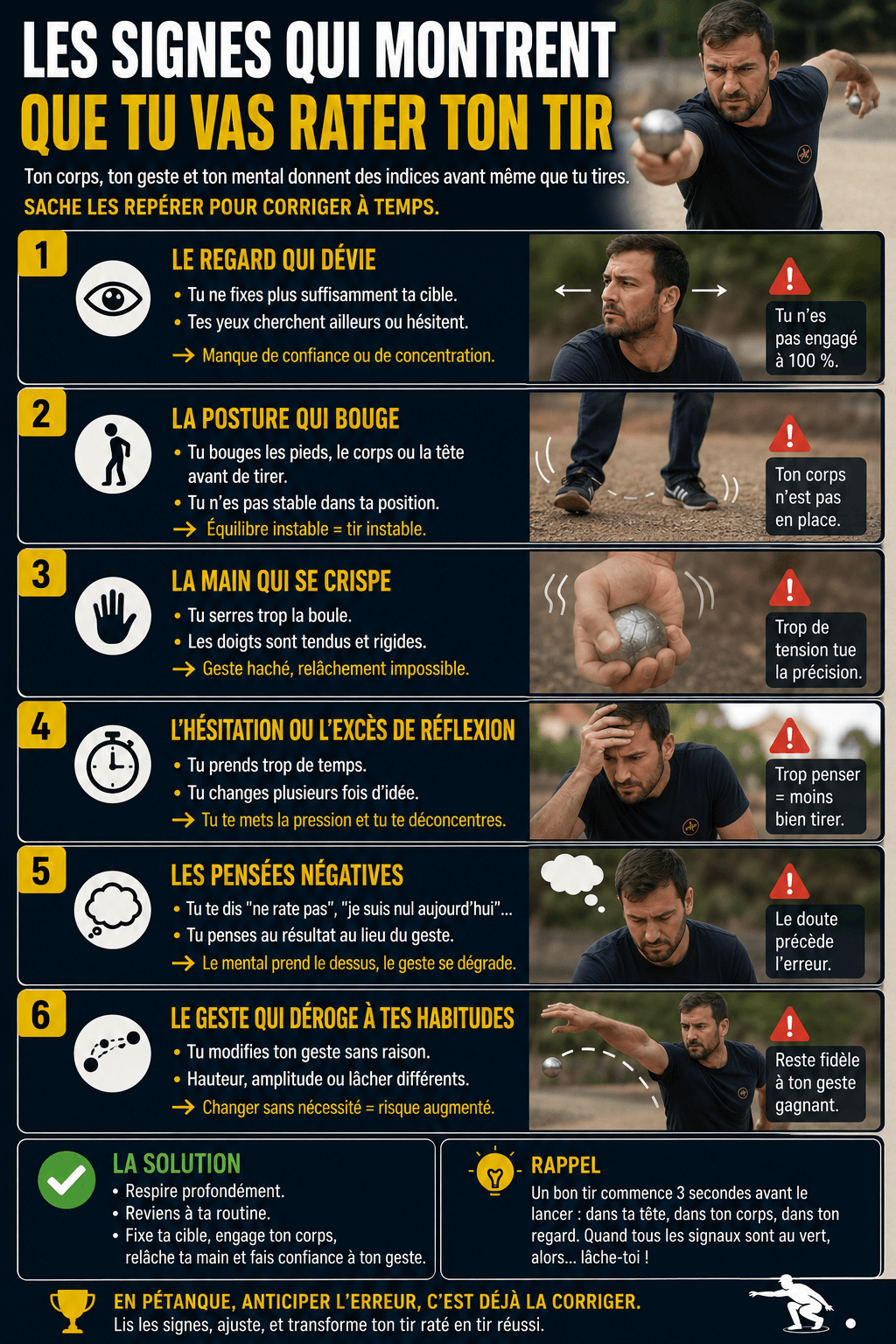
The signs that show you're going to miss your shot
Even before the boule leaves, certain signals clearly indicate the shot will miss. Body, mind, decision, action: Paquita identifies the 7 warning signs of a miss and how to spot them in time so you don't lose the boule.Why detect the signals before — not after
⏱️ THE WINDOW OF INTERVENTION — WHAT IS STILL POSSIBLE DEPENDING ON THE MOMENT 🔍 BETWEEN ENDS Analysis of previous shots. Identify miss patterns to prepare corrections. Wide window for mental work and resetting. WIDE WINDOW ✅ BEFORE ENTERING Check of physical and mental state. If a negative signal is present, this is the moment to recalibrate before entering the circle. Optimal window. OPTIMAL WINDOW ⚠️ IN THE CIRCLE Signal detected in throwing position. Still possible to step out of the circle to recalibrate. Takes more time and discipline — but remains possible. NARROW WINDOW 🤔 PENDULUM IN MOTION Signal detected during the swing. Very hard to correct without completely stopping the gesture. Trying to correct mid-gesture often produces a worse miss. ALMOST IMPOSSIBLE 💥 AFTER THE RELEASE Signal detected at the moment of release or after. No correction possible. Only use: information for the next shot — if the player was able to observe what happened. TOO LATE 🎙️ PAQUITA ON THE SIGNS OF A MISS "Good shooters don't miss less than others because they have a better gesture. They miss less because they shoot less often in bad conditions. They feel when it's not right — the arm not warm, the decision not clear, the focus elsewhere — and they give themselves the right not to shoot. Or to step out of the circle to recalibrate. A boule saved because you felt the miss before making it is a boule won." — PaquitaThe 7 warning signs of a missed shot
💪 1. Tension in the arm or shoulder even before entering the circle BODY TENSION HOW TO DETECT IT Before entering the circle, do a test swing of the arm empty. If the arm doesn't swing freely from the shoulder — if the movement requires a perceptible effort, if the shoulder is high and rigid, if the fingers grip the boule tighter than usual — the arm is tense. This tension can have several origins: muscular fatigue, emotional tension, cold, or simply a heightened state of alertness linked to the stakes of the shot. → Action before shooting: release the boule in the hand, discreetly shake the arm to loosen it, let the shoulder drop. Repeat the swing test. If the tension persists, step out of the circle and wait 10 seconds. WHY TENSION MAKES THE SHOT MISS Shooting in petanque is a pendular gesture — its effectiveness relies on a fluid movement from a relaxed shoulder. A tense arm alters the pendulum mechanics : the motion loses its natural amplitude, the release comes too early or too late, and the axis shifts slightly compared to the reference motion. The boule then leaves off the intended axis, short in distance or laterally — with a characteristic imprecision of "forced" shots. → Rule: an arm that doesn't swing freely empty won't shoot accurately with the boule. The quality of the empty swing is the first indicator of the state of your motion. 👁️ 2. The gaze wavering between the opponent's boule and the jack GAZE DECISION WHAT THIS GAZE REVEALS In shooting position, the gaze should be fixed on the target boule — single and stable. If the gaze keeps drifting between the boule to shoot, the jack, the other boules on the terrain, or back to your own arm, it is a sign that the decision is not yet settled. The player is still deciding at the moment when he should be executing. This hesitation of the gaze is one of the most readable signatures of a shot about to miss — it almost always precedes a boule sent without conviction. → Action: step out of the circle, resume reading the terrain, decide clearly on the target boule. Then enter the circle with the gaze already fixed on the target — and not leave it until after the release. THE DIFFERENCE BETWEEN LOOKING AND SEEING There is a distinction between "looking at the target boule" and "seeing the target boule" — in the first case, the eyes are pointed in the right direction but the attention is elsewhere (on the arm, on the feared result, on the stakes). A successful shot requires the attention to be entirely on the target, not just the eyes. A wavering gaze reveals that neither the eyes nor the attention are fixed yet — that's the worst state to shoot in. → Simple test: ask yourself mentally — "what is my gaze fixed on right now?" If the answer isn't "on my target and only on it", the shot isn't ready. ⚡ 3. The motion that speeds up — the rush that precedes the miss RHYTHM MOTION THE SIGNAL OF ACCELERATION A shooting pendulum that accelerates beyond its usual rhythm — particularly in the final phase before the release — is one of the surest signs of a compromised shot. This acceleration almost always comes from emotional tension or perceived urgency : the arm "wants to get it over with" before doubt takes over completely. The rushed gesture is the gesture of anxiety — and it misses for the same reasons as the tense gesture. → Action: if you feel the pendulum go faster than usual on the first swing, stop. Deliberately slow down. A second test swing at the right speed before throwing. If the acceleration returns, step out of the circle. HOW TO RECOGNIZE YOUR NORMAL SHOOTING SPEED Every shooter has an optimal pendulum speed — the rhythm in which his gesture is the most reproducible. In training, without pressure, this rhythm is natural. In competition, under pressure, it tends to accelerate. Knowing your normal speed lets you detect accelerations — the gap between "my usual rhythm" and "what I feel right now" is perceptible with experience. This work of rhythm awareness is done in training, deliberately, not in a stress situation where perception is already altered. → Rule: if the shot leaves faster than usual, anxiety has taken control of the motion. A rushed motion is an uncontrolled motion — and an uncontrolled motion produces a miss, regardless of the shooter's technical skill. 🤔 4. The last-second decision — shooting without having decided to shoot DECISION HESITATION HOW THIS SIGN ARISES The player enters the circle without having fully decided to shoot — still hesitating between shooting and pointing, or between shooting that boule and another. The final decision is made at the last second, often at the moment of the first swing, from a state of hesitation rather than conviction. A shot launched from hesitation is almost always insufficient in force (the arm under-invested in energy because the conviction wasn't there) or poorly aimed (the aim is modified at the last moment at release). → Action: step out of the circle. The decision to shoot is made before entering it — not inside. If the decision is not settled when entering the circle, take 5 seconds outside to settle it clearly, then enter. CONVICTION AS A CONDITION OF THE SHOT A technically well-executed shot starts from conviction — the certainty that the shot is the right one at this moment. This conviction is not certainty of success (no one is 100% sure of making a shot) — it's the certainty that it's the right tactical decision in the situation. A convinced shooter can miss their shot technically. A hesitant shooter will almost always miss their shot — technically AND tactically. → Test: when entering the circle, answer mentally "why am I shooting?" If the answer is immediate and clear, the conviction is there. If the answer is vague or absent, the decision hasn't been made — don't enter the circle. ⚖️ 5. Instability of the center of gravity — feeling off-balance in the circle BALANCE POSTURE HOW TO DETECT INSTABILITY In the circle, the body weight should be stable and centered over the supports. If the player feels he must "find his balance" during preparation — micro-shift of the feet, slight oscillation of the torso, feeling that the weight is too far forward or back — it is a signal that the postural base is not stable. A shot launched from an unstable position produces unconscious compensations in the arm to maintain balance — and these compensations alter the axis. → Action: step out of the circle, reposition yourself with the feet well oriented and the weight centered. Consciously drop the shoulders and feel both supports on the ground before re-entering. This exit/re-entry takes 10 seconds and can save the shot. THE PARADOX OF FORCED BALANCE Trying to correct instability from inside the circle without stepping out often makes the situation worse — the micro-adjustments of position during preparation disrupt concentration and change the body's axis several times before the throw. It is paradoxically more effective to step out of the circle, reposition yourself properly, and come back to it than trying to find your balance in a rush. Leaving the circle is seen by some as a sign of weakness — it's actually a sign of mastery. → Baseline test on entering the circle: feel both feet on the ground, weight centered, knees slightly bent. If any of these three elements isn't in place, stop and correct it before engaging the pendulum. 🧠 6. The intrusive thought — thinking about the result during the motion MENTAL ANTICIPATED RESULT THE THOUGHT THAT KILLS THE SHOT During shot preparation or the pendulum itself, a thought pops up: "if I miss, the opponent will point", "it absolutely has to go in", "the end is lost if I miss". This intrusive thought turns the attention from the gesture to the result — and depriving the gesture of the attention it requires is enough to alter it. A well-executed shot is a gesture that occurs in the immediate present. The intrusive thought spreads awareness into an uncertain future — and the present gesture degrades as a result. → Action: if a result-thought invades the shot preparation, step out of the circle, exhale slowly, "erase" the thought through active focus on the target only. Re-enter when the attention is entirely on the boule to shoot, not on its consequences. DISTINGUISHING THE INTRUSIVE THOUGHT FROM CONCENTRATION Thinking intensely about the target during the shot is not an intrusive thought — it is concentration. The intrusive thought is distinguished by its temporal content : it concerns the future (potential result) or the past (previous missed shot) rather than the present (the boule, the target, the motion in progress). Learning to distinguish the two types of thoughts — a mindfulness skill applied to sport — is a condition for maintaining shot quality under pressure. → Pre-shot awareness rule: "is my thought on the target or elsewhere?" If "elsewhere" — don't throw. A shot with attention divided between the target and its consequences is a shot without full concentration — and without full concentration, the result is random. 😤 7. The urge to "avenge" a previous missed shot — shooting to compensate, not to win EMOTION PARASITIC MOTIVATION THE MECHANICS OF EMOTIONAL REVENGE After a missed shot, a strong impulse kicks in: "make up for" the error on the next shot, prove the miss was an anomaly. This emotional revenge impulse is one of the most reliable sources of missed shots in a row. The player enters the circle from the frustration of the previous miss — his emotional state is degraded, his attention is partly occupied by the past error, and the pressure he puts on himself to "recover" amplifies precisely the mechanisms that cause misses. → Action: identify this revenge impulse before entering the circle. Explicitly give yourself permission to "start from zero" on this shot. The previous shot no longer exists — only the present shot counts. MISSES IN A ROW — HOW IT HAPPENS A first missed shot → revenge impulse → second shot from the degraded emotional state → second missed shot → amplified revenge impulse → third miss. This cycle of misses in a row is a well-known pattern among shooters who have no emotional recovery protocol between shots. Breaking the cycle requires not giving in to the revenge impulse — taking the time needed to return to a neutral state before the next shot, even if this time seems to "lose momentum". → Critical test: after a missed shot, honestly ask yourself "do I want to shoot right away to make up for it?" If the answer is yes, wait. This immediate urge is almost always a sign that the emotional state is not yet ready for a good shot. 🔍 Stepping out of the circle is not giving up — it is preservingThe decision to step out of the circle to recalibrate when a negative signal is detected is one of the hardest decisions to make in competition — because it looks like weakness, when it is precisely the opposite. A shooter who steps out of the circle in time preserves his boule for a shot in better conditions. A shooter who ignores the signal and shoots "anyway" sacrifices his boule on a shot announced as a miss. Those ten seconds of recalibration can save a decisive resource at the end of an end.
Stop or continue — how to decide
✅ THE SITUATIONS WHERE STEPPING OUT OF THE CIRCLE IS THE RIGHT DECISIONPersistent physical signal: tension in the arm or postural instability that doesn't resolve within 3 seconds of relaxation in the circle. A signal that persists after an attempted quick correction calls for a full exit.
Hesitation on the target: the gaze keeps moving after 5 seconds in the circle — the decision is not settled. Continuing to shoot without having fixed the target is pointless.
Overwhelming intrusive thought: a result- or revenge-thought takes up a significant part of the attention. Stepping out of the circle lets you mentally "clear out" and come back focused on the target.
Feeling "that it's going to miss": a diffuse but persistent feeling of discomfort before the shot. This proprioceptive sensation is often reliable — the body perceives something before the conscious brain does.
→ Step out of the circle, recalibrate for 10 seconds, then come back. This decision takes courage — it is worth it. ⚡ THE SITUATIONS WHERE CONTINUING IS JUSTIFIEDMild and fleeting signal: a slight tension that resolves in 2 seconds of free empty swinging in the circle. These quick micro-adjustments are normal and don't require stepping out.
Target locked and full attention: the gaze is steady on the target, attention isn't divided, the decision is settled. In this state, residual signals are usually normal and manageable.
Real tactical urgency: in rare cases (decisive end, opponent who will play last), the urgency of the situation can justify shooting even with less-than-optimal conditions — while consciously accepting the risk of a miss.
Signal vanished during self-correction: the signal was present on entering the circle but vanished spontaneously after releasing the shoulders and checking the stance. Continuing is appropriate.
→ Continue only when the state is sufficiently stable — not because you "have to shoot at some point". 💪 THE PHYSICAL SIGNALS TO WATCHArm: free and fluid swing vs short and rigid swing. Force required to swing vs natural fluidity.
Hand: normal grip on the boule vs excessive squeezing of the fingers (a sign of increased tension).
Shoulder: low and relaxed vs high and rigid. It's the first place where physical tension settles.
Feet: stable and centered stance vs a feeling of instability or imbalance.
Knees: slightly bent and absorbing vs locked straight (a sign of rigidity).
→ These physical signals are all detectable in 3 seconds if you've built the habit of looking for them. 🧠 THE MENTAL SIGNALS TO WATCHGaze: fixed on the target vs wandering between several elements. The stability of the gaze is the mirror of the stability of the decision.
Decision: "I'm shooting this boule for this reason" vs "I'm shooting because it's my turn". Conviction is a mental signal.
Thought: focused on the target vs split between the target and its consequences. Full attention on the target is the best state for shooting.
Desire: shooting to build vs shooting to make up ground. The motivation of revenge is a signal of a degraded emotional state.
→ These mental signals are subtle but detectable with the habit of asking yourself: "what state am I in right now?" 🔑All these signals have one thing in common: they are detectable before the throw if the player has built the habit of looking for them. Most shooters don't look for them — they enter the circle "on autopilot" and discover the miss afterwards. The shooter who builds the habit of a 5-second pre-shot check — state of the arm, gaze, decision, dominant thoughts — turns these signals into actionable information rather than post-miss observations.
The subtle signals that only experienced shooters perceive
🌡️The boule "not at the right temperature" An experienced shooter recognizes the feel of a boule "snug in the hand" — at the right temperature, with the right grip, in the exact position that is familiar to them. When the boule isn't sitting exactly where it should in the hand — too high, slightly off-kilter — it's a subtle signal of discomfort that can indicate a suboptimal release. Some shooters pick their boule up a second time to find the exact grip before throwing. → Test: before each shot, take a second to feel whether the boule is "snug in the hand" — in the familiar position of your usual shooting grip. 🎵The pendulum rhythm "out of tempo" Every shooter has an optimal pendulum tempo — a rhythmic cadence in which their motion is most fluid. A first swing that isn't "in the tempo" — too slow, too fast, with a pause at the top that lasts too long — is a proprioceptive signal of desynchronization. Experienced shooters feel it from the very first swing and stop to start over if the tempo isn't right. → Test: compare the feel of the first swing to your usual swing. Is the rhythm "the same as in practice" or noticeably different? 🎯The target that "shrinks" under pressure Under maximum pressure, some shooters experience a perceptual distortion: the opposing target boule seems smaller than usual. This feeling of a "shrunk target" is a neurological signal of high stress — the field of vision narrows and the target is perceived as smaller. This signal, well known in sports psychology, indicates that the stress level is too high for an accurate shot. Recognizing it lets you take measures (breathing, stepping out of the circle) rather than suffering its effects. → Test: if the target boule seems "different from usual" before shooting, it's often a signal of high stress — not a vision problem. Breathe and slow down before throwing. 💭The "survival mode" — pointing in your head during a shot A subtle but revealing moment: during shot preparation, a thought pops up — "or else I'll point". This "escape route" thought signals that the conviction in the shot isn't total. Actively considering pointing during shot preparation is a sign that the decision to shoot wasn't firmly made. A shot launched from this state of open doubt almost always produces an under-committed motion. → Test: if you're thinking "or I could point" during your shot preparation, the decision to shoot wasn't settled. Step out and decide first.The verification protocol before shooting
🔍 PRE-SHOT CHECK — 5 CHECKS IN 5 SECONDS From picking up the boule to entering the circle 🎯 1. The decision — "I'm shooting this boule because..." Is the decision to shoot settled with an identifiable tactical reason? If yes, enter the circle. If no (hesitation between shooting and pointing, or no clear reason), stop outside the circle and decide first. 3 seconds of pausing outside is better than a shot born of hesitation. 💪 2. The arm — free empty swing On entering the circle, make a half empty swing. Does the arm swing freely from the shoulder with no perceptible effort? Low shoulder, fluid motion → continue. Stiffness or noticeable effort → release and start over. If the stiffness persists → step out and shake out the arm. ⚖️ 3. The balance — stable feet, centered weight Feel both feet on the ground with the weight on the middle of each foot (neither on the toes nor on the heels). Slight bend of the knees. A feeling of stability under the weight. If something is off in the stance → step back out and reset properly. This check takes 2 seconds. 👁️ 4. The gaze — fixed only on the target Is your gaze stable on the target boule? Not wandering between the target and the jack, between the target and your own boules, or toward the ground. If the gaze isn't fixed on the target, attention isn't fully there — wait until it is before throwing. 🧠 5. The dominant thought — target or outcome? What is the thought at the forefront right now? "The boule I'm aiming at" → throw. "What will happen if I miss" → wait. This last check is the hardest but the most important — a shot with the thought entirely on the target has the best probability of success.Exercises to develop pre-shot awareness
01 The "verbalized check" — naming the signals before each practice shot 📍 Solo or 2-person practice ⏱️ Integrate immediately 🎯 Develop awareness of the 5 signals before each shotOver 3 to 5 practice sessions, verbalize the 5 elements of the pre-shot check in a low voice before each boule. This verbalization feels tedious at first — it becomes automatic and silent with practice.
Before each practice shot, state the 5 checks in a low voice: "decision OK — arm free — stance stable — gaze fixed — thought on the target". If one of the 5 elements isn't in place, stop and correct before throwing. This verbalization forces an awareness that isn't natural at first. Compare the results of shots with "all 5 checks complete" against shots with "1 or more checks missing". Keep a simple record : for each shot, note whether the 5 checks were in place (Y) or one was missing (N), and whether the shot succeeded or missed. Over 20 to 30 shots, the pattern is usually clear and revealing. Identify which of the 5 checks are most often missing for you. Every shooter has their weak points — for some it's the decision (shooting with no clear reason), for others it's the gaze (wandering before settling), for others still it's the intrusive thought. This personal pattern is the work priority. Gradually, reduce the verbalization to 2 or 3 personal keywords — the checks most critical for you. These keywords become the personal pre-shot routine : fast, silent, and focused on the real weak points. Over time, the pre-shot check takes less than 3 seconds and becomes automatic. 02 The "right to step out" drill — practicing the decision not to shoot 📍 2-person or team practice ⏱️ 1 h 🎯 Develop the ability to step out of the circle without shame when a negative signal is detectedMost shooters know in theory that it's better to step out of the circle when a negative signal is present — but never do it in practice for fear of ridicule or of "apparent weakness". This drill forces the real practice of that decision.
Play a series of games with a rule: each player has the right to step out of the circle as many times as they want before shooting, with no explanation needed. This right is formally recognized and not judged by partners. This explicit rule removes the social pressure that prevents stepping out of the circle. Observe how many times each player exercises this right — and compare the results of shots after stepping out of the circle with shots without stepping out. For the majority of players, shots after recalibration are significantly better — which validates the usefulness of the practice. This direct observation is more convincing than any theoretical explanation. Identify the situations that most often trigger the need to step out of the circle. Is it after a previous miss? Late in a game under pressure? At distances outside the comfort zone? This identification lets you predict in advance the situations where the pre-shot check needs to be especially attentive — and not wait until you're in the circle to perceive the signals. After several sessions, integrate stepping out of the circle into the normal competition routine — without needing a formal rule anymore to allow it. The player who steps out of the circle in competition when a signal is present demonstrates a mental mastery that most players don't have — and their shooting success rate shows it in the results. 🧠 The best shot is sometimes the one you don't takeThere's a form of shooting mastery that isn't measured by the success rate on attempted shots — but by the quality of the decision to shoot or not to shoot. A shooter who attempts 6 shots with 4 successful (67%) is worth less strategically than a shooter who attempts 4 shots with 3 successful (75%) — because the second recognized the 2 shots whose conditions weren't met and didn't waste them. Pre-shot awareness doesn't just improve technique — it improves shot selection, which is even more valuable.
📚 PAQUITA'S BOOKS Progressing at pétanque — Paquita's guides 🎯 TACTICS — MIND — TECHNIQUE Playing everywhere — from technique to on-court tactics Pre-throw awareness, managing emotional states before shooting, developing the ability to recognize the conditions of a good motion — the complete guide to progressing in every dimension. 📦 Amazon 💥 SHOOTER — TECHNIQUE — CONSISTENCY Become a formidable shooter The 7 warning signs of a missed shot, the pre-shot check protocol, developing proprioceptive awareness of the motion, learning to step out of the circle without losing momentum — the guide for the shooter who chooses their shots. 📦 Amazon 🎳 POINTER — AWARENESS — MARKERS The art of pointing — precision and consistency Body awareness before each throw, pre-point proprioceptive check, markers of the optimal state of play, telling positive signals from negative signals before entering the circle. 📦 Amazon 🧠 MIND — ROUTINE — METHOD Pétanque by method Managing intrusive thoughts before shooting, recovery protocols between missed shots, developing pre-throw awareness and the routines that protect the motion under pressure. 📦 Amazon