Actualités · 15 May 2026
The worst excuses after a missed shot
A missed shot lasts 0.3 seconds. The following apology can last 3 minutes. It is a universal and fascinating phenomenon: the human brain, faced with a public and immediate failure, activates in less than a second a protective mechanism which seeks an external cause, a technical explanation, or a cosmic factor. The excuse is not bad faith — it's psychology. The problem is when it becomes a reflex that replaces honest analysis. And when it disturbs the partner, the adverThe ranking of the worst excuses
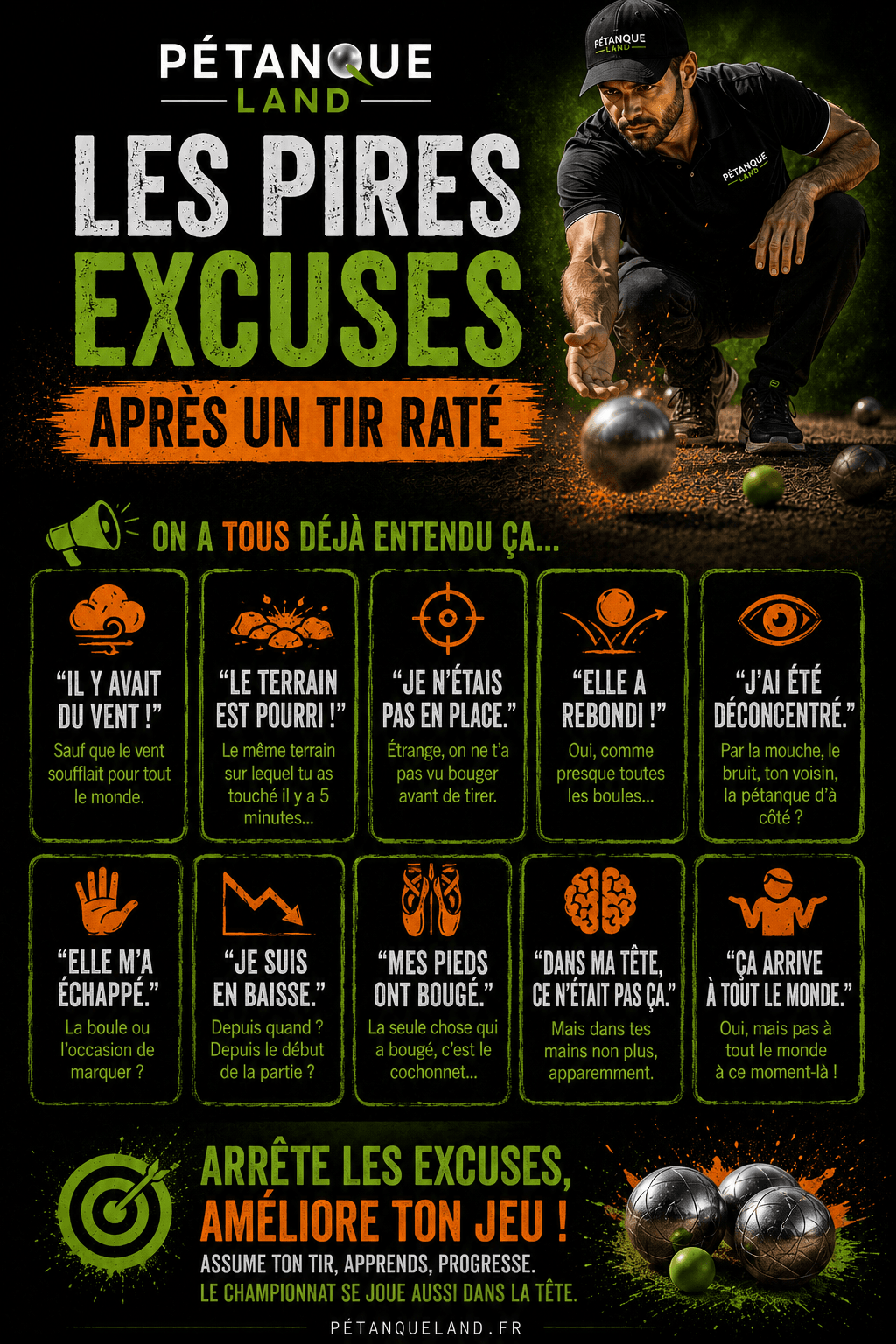
Not all excuses are equal — some are tolerable, others reach heights of creativity and uselessness. This podium is based on a combination of frequency, the degree of incredulity they provoke, and the ability to disrupt the rest of the game.
🏆 PODIUM OF THE MOST CREATIVE AND MOST USELESS EXCUSES 🥇 "I was distracted by a noise at the exact moment of the throw." The noise excuse is the Rolls Royce of the genre: it's unverifiable, personally targeted, and implies a concentration so total and so fragile that some random noise — a bird, a distant cough, a spectator's phone — was enough to bring the whole edifice down. The sophistication is inversely proportional to its credibility. EXTERNAL — UNVERIFIABLE 🥈 "My thumb slipped at the last moment." The treacherous-thumb alibi. The throw was perfect in intent — a rebel thumb ruined everything 0.1 seconds before release. No one can disprove the internal trajectory of a thumb. Anatomical genius. The body has become an independent actor that sabotages the player from within. TECHNICAL — ANATOMICAL 🥉 "That boule always pulls left — I hadn't marked it." The targeted defective boule. Among the 3 boules in the game, exactly the one just used has a precise manufacturing defect that consistently drifts left. This defect appeared only on this shot. The previous ones with this boule were good. Cosmic coincidence. TECHNICAL — EQUIPMENT 4 "I thought you wanted me to shoot the other boule." The collective excuse through tactical confusion. The missed shot is really a shared decision poorly executed — or rather, a decision the partner should have clarified. The shooter shot the wrong boule because the communication was vague. Two players, one excuse, zero individual responsibility. COLLECTIVE 5 "The jack moved just before I released." Physically possible on very soft ground with a slight slope. Physically unlikely in 98% of situations. The jack, a static object 3 cm off the ground, chose the exact moment of the throw to make a significant movement. The timing is suspect but unverifiable. EXTERNAL — ENVIRONMENT 🎙️ Paquita on excuses after a missed shot "The first time I heard 'I was distracted by a noise', I looked around me to find the noise. There was nothing. The second time I heard that excuse, I understood — the noise is a convention. It means 'I missed and I don't know exactly why'. Except that 'I missed and I don't know why' is an infinitely more useful answer because it opens the door to analysis. 'The noise' shuts everything down. You can't analyse an imaginary noise." — PaquitaExternal excuses — the geography of the culprit
"The sun was exactly in my line of aim." External — weather Universal classic FREQUENCY Spring to autumn, peak between 4pm and 7pm when the sun is low. Absent on cloudy days — which is already a giveaway. LEVEL OF CREATIVITY Low — it's the first excuse that comes to mind. Everyone thinks of it immediately. Originality: zero. But the solidity holds: the sun is real, him. WHAT IT REVEALS The player isn't wearing sunglasses (a €20 solution) and prefers to excuse 50 missed throws over a season rather than invest in the solution. The opponent was playing from the same direction. He landed 3 carreaux in a row. The sun was in exactly the same spot for him. "The terrain has a bump exactly where my boule landed." External — terrain Creative variant FREQUENCY High on natural terrains. Inversely proportional to the quality of the terrain — the flatter the terrain, the more creative it gets. CREATIVITY LEVEL Medium — but rises if the player walks over to physically point out the bump. The on-terrain demonstration adds a level of engagement that partners rarely appreciate. WHAT IT REVEALS The player hasn't read the terrain before playing. The first 2 ends are precisely for identifying these zones. The excuse reveals the absence of any prior reading. The bump was discovered exactly after the missed shot. It had been there since the start of the game. It hadn't bothered anyone before this specific throw. "Someone moved in my field of vision." External — human Spectator variant FREQUENCY Appears in the presence of spectators. Rare in games between just 2 players — oddly. The field of vision is all the more sensitive the larger the crowd. LEVEL OF CREATIVITY Variable. The movement can range from a spectator crossing their arms to someone entering within a 30-metre radius during the throw. WHAT IT REVEALS The player has no pre-throw routine that screens out environmental disruptions. A throw prepared with a set routine ignores peripheral movements. The world champion also plays with a crowd. And sometimes with a noisy crowd. Their concentration routine is independent of the movements in their field of vision.Technical excuses — "it's the boule, not me"
"My boule has too much spin right now — it's turning a lot." Technical — mysterious Creative FREQUENCY Appears in the downward phase of a session — when the shots start to deteriorate. "Right now" implies a timeframe that absolves the previous good shots. LEVEL OF CREATIVITY High — because it mobilises real technical concepts (rotation, spin) in a context where their application is questionable. The façade of expertise is impressive. WHAT IT REVEALS The rotation is produced by the gesture — not by the boule independently. A boule that "turns a lot" reveals a parasitic rotation in the release, which is indeed a gesture error. This excuse has the merit of identifying a real symptom. It has the flaw of attributing its cause to the equipment rather than the gesture — which prevents correcting what can be corrected. "I was shooting well in practice this week — I don't understand." Technical — contextual Competition universal FREQUENCY Exclusively in competition. Never in practice — logically, since practice is by definition the place where you "were shooting well". LEVEL OF CREATIVITY Low in creativity but high in emotional involvement. The player is sincerely surprised — which is often true and makes this excuse more touching than the others. WHAT IT REVEALS Playing in practice and playing in competition are two different states. Pressure alters the gesture. This excuse honestly identifies a performance problem under stress without naming it clearly. It's one of the few excuses that points to something analysable and workable — resistance to pressure. A shame it's phrased as bewilderment rather than a question.Cosmic excuses — personalised bad luck
"This kind of thing only happens to me — it's unbelievable." Cosmic — personal bad luck Universal FREQUENCY Proportional to the accumulated frustration. Appears after the 3rd or 4th mistake in a row. The "unbelievable" ramps up as the run goes on. LEVEL OF CREATIVITY None — but it makes up for it through universality. It's said with total conviction by millions of players who all believe they're statistically the unluckiest. WHAT IT REVEALS The player sincerely believes that bad luck targets them personally. This uniqueness bias — believing that our misfortunes are more frequent and more unfair than other people's — is documented in cognitive psychology. The opponent says exactly the same sentence. On the next pitch, two other players are saying it at the same time. Statistically, either everyone has bad luck — or no one is being targeted. "I had the shot — I can still feel it in my fingers — but it didn't go." Cosmic — corporeal Very creative FREQUENCY Rare — it requires an uncommon level of proprioceptive awareness (real or imagined). Reserved for players with a good technical knowledge of the gesture. LEVEL OF CREATIVITY High — it mobilises the kinaesthetic sensation as an argument. The "correct" boule existed in the fingers. The "incorrect" boule left instead. Two parallel realities. WHAT IT REVEALS The player probably missed their release timing and vaguely senses it. The "feeling in the fingers" is real — it's the perception of an incorrect execution. Honestly rephrased: "I mis-weighted the release." It's one of the excuses closest to a real piece of technical information. The problem: it's phrased as if the body had betrayed the player instead of the player having botched their gesture.The excuse bingo — how many do you know?
🎯 MISSED SHOT EXCUSE BINGO — Tick the ones you've heard (or said) "The sun was in my eyes" "My boule slipped" "The terrain is weird there" COSMIC EXCUSE "I was distracted" "I should have pointed" "That boule pulls left" "I got the force wrong" "The jack moved" TECHNICAL EXCUSE "I didn't have my swing" "He put me off" "I wasn't feeling that shot" "This only happens to me" EXTERNAL EXCUSE "I was going to shoot the other boule" "I had too much spin" "The boule isn't round" "Someone moved" COLLECTIVE EXCUSE 🔑If you've ticked more than 10 boxes thinking "I've said that at least once" — welcome to the club. Any honest player will tick at least 8 boxes. It's not a flaw — it's being human. The question isn't "have I said these things" but "do I say them after every missed shot, or only sometimes?"
What each type of excuse really reveals
🔍 DIAGNOSIS — THE PSYCHOLOGY BEHIND THE EXCUSES What we say vs what it says about us EXTERNAL EXCUSE The terrain, the sun, the noise, the spectators Reveals a difficulty accepting that the error comes from oneself. The external cause preserves self-esteem in the short term but prevents the analysis that improves the game in the medium term. A player who systematically attributes their errors to the environment will never improve their gesture because they never look at it. TECHNICAL EXCUSE The boule, the gesture, the release, the weighting Closer to honesty — it acknowledges a technical failure. The problem: it's attributed to the equipment or to a body part rather than to the player's execution. "My boule slipped" vs "I held my boule badly" — same reality, different attribution, opposite result in terms of learning. COSMIC EXCUSE Bad luck, the injustice of fate, "this only happens to me" Reveals a negative uniqueness bias — the belief that personal errors are more frequent and more unfair than other people's. This bias is comfortable in the short term and paralysing in the long term. The player who "never has any luck" never analyses their errors because they seem random and unfair, not technical and fixable. COLLECTIVE EXCUSE The partner, the communication, the shared tactics The most damaging to team cohesion. It shifts part of the responsibility for the individual error onto the whole team — which can be true (a bad collective decision was poorly executed) but is often a way of diluting personal failure into the collective. The partner who receives this implicit excuse feels it, even when it's phrased politely.The only useful response to a missed shot
❌ WHAT SERVES NO PURPOSEAny sentence that attributes the error to an external or unverifiable cause. Any technical analysis voiced immediately after the missed shot in the middle of an end. Any visible emotional reaction — swear word, gesture of frustration, look to the sky.
Why:These reactions consume the player's attention on the past shot rather than on the next one. They can also disrupt the partner and signal to the opponent an exploitable weakness.
The 3-second rule: anything said or done in the 3 seconds that follow a missed shot must meet a single criterion — does it help the next boule? ✅ WHAT WORKSTwo seconds of neutral observation of the result. Then one of these three possible responses, depending on the context:
Solo or with a close partner:"I got the weighting wrong" — honest, short identification, with no explanation. It identifies the problem without blaming the outside.
In competition:Silence — resume your stance, pick up the boules, focus on the end. Active silence is the most professional response.
Detailed analysis of the error belongs to the post-game — not to the space between two boules in an important end. 🧠 WHAT THE BRAIN ACTUALLY DOESThe brain immediately activates the self-esteem protection system after a public failure. It is automatic, fast, and universal. You cannot stop the excuse from forming in your head — you can decide not to say it.
The useful distinction:Thinking "this damn terrain" is human. Saying "this damn terrain" out loud disrupts the team, signals fragility, and anchors the excuse in shared reality.
Excuses thought but not spoken are normal emotional management. Excuses said out loud are a choice — and that choice has consequences for the rest of the game. 📈 THE ANALYSIS THAT ACTUALLY IMPROVES THINGSAfter the game, with a clear head, 3 honest questions:
(1) Was the shot justified in this context?If not: it's a tactical decision problem, not an execution one.
(2) Which part of the delivery was faulty?Timing, height, force, angle? Identify one specific variable.
(3) Does this fault appear regularly under the same conditions? If yes, it's a training issue. If no, it's normal variability. 🎯 The golden rule after a missed shotThere is only one legitimate excuse after a missed shot — and it isn't an excuse: "I missed." Two words. They identify responsibility without drowning it in an external cause. They blame no one. They don't stop the analysis — they open it. And above all, they take 0.5 seconds, leaving all available attention for the next boule.
FAQ — Your frequent questions
Is justifying yourself after a missed shot really so negative?+ A one-off justification is humane and does no harm. The problem appears when it becomes systematic — after each missed shot, each lost lead. At this stage, several cumulative negative effects set in: the player never really analyzes his mistakes and does not progress; the partner tires of the permanent defensive posture; the adversary perceives exploitable mental instability. The rule is not “never speak up after a mistake” — it’s “be aware of what you say and why you say it.” How to react when it is the opponent who systematically excuses his missed shots?+ The most effective response is total neutrality — neither acquiescence ("yes it's true, the terrain is hard"), nor contradiction ("no it was a bad shot"). Acquiescence validates the excuse and feeds the mechanism. The contradiction creates unnecessary tension. Neutrality — a minimal nod, immediate return to the game — is the posture that most quickly exhausts the opponent's need for justification. An adversary whose excuses do not resonate ends up doing without them. Are there any excuses that still contain useful information?+ Yes — many excuses point to real areas for improvement if we reformulate them honestly. “I was shooting well in training” → performance problem under pressure, workable. “I had too much spin in the ball” → parasitic rotation in the release, analyzable. “I should have pointed” → tactical decision error, avoidable. The difference between a useful apology and a useless one is not in the content — it is in whether it is reframed as a problem to be solved or an external cause to be suffered. Do the best players really make no excuses?+ The best players make excuses — but rarely out loud, rarely immediately after the mistake, and rarely with the same wording. What we generally observe among high-level players: a short moment of neutral observation of the result, sometimes a “hey” or “pass” in a low voice, then an immediate return to preparing for the next throw. Analysis comes afterwards — not in progress. It is not the absence of excuses that makes a good player, it is the ability to postpone analysis until it is useful. 📎 Related articles CultureThe phrases you hear on every terrain DuoWhen your partner makes you lose: reacting intelligently TacticsPlaying against a stronger opponent: the mistakes to avoid TacticThe key moments where a game really turns TacticsAttack or secure: making the right choice at the right time ToolsFree PetanqueLand tools© Pétanque by Paquita — petanqueland.fr · 📖 Paquita's book on Amazon