Actualités · 6 May 2026
The key moments when a game really swings (Pétanque)
A pétanque game isn't won evenly across all the ends. It swings on 3 or 4 precise moments that most players don't recognise at the time. Paquita identifies them one by one — and explains how not to miss them.The mechanics of a swing — why it happens
A swing is not a stroke of luck. It is the convergence of several small things that create momentum — a player's morale dropping, a tactical decision that snowballs, an especially well-played end that frees up one team and inhibits the other. The momentum is real and measurable: in the vast majority of games, runs of 3 consecutive ends won by the same team account for most of the final score gap.
🎙️ Paquita on the moments that make games "There are games where you look at the final score and you tell yourself 'how could we lose 13-5 when at half-time we were at 6-5?'. The answer's never in the 8-point final gap — it's in one specific end, often around a score of 6-6 or 7-6, where something happened. A big end taken, a brilliant opposing shot, a management error that could have been avoided. Those 3 or 4 points taken in a row after that moment, that's what made the game. The problem's you only realise it afterwards. The goal's to realise it in the moment." — Paquita 🔑A swing is neither inevitable nor irreversible. It can be influenced in the 30 seconds following its trigger — through a behaviour, a tactical decision, a mental repositioning. Past that window, the momentum is set and clearly harder to reverse.
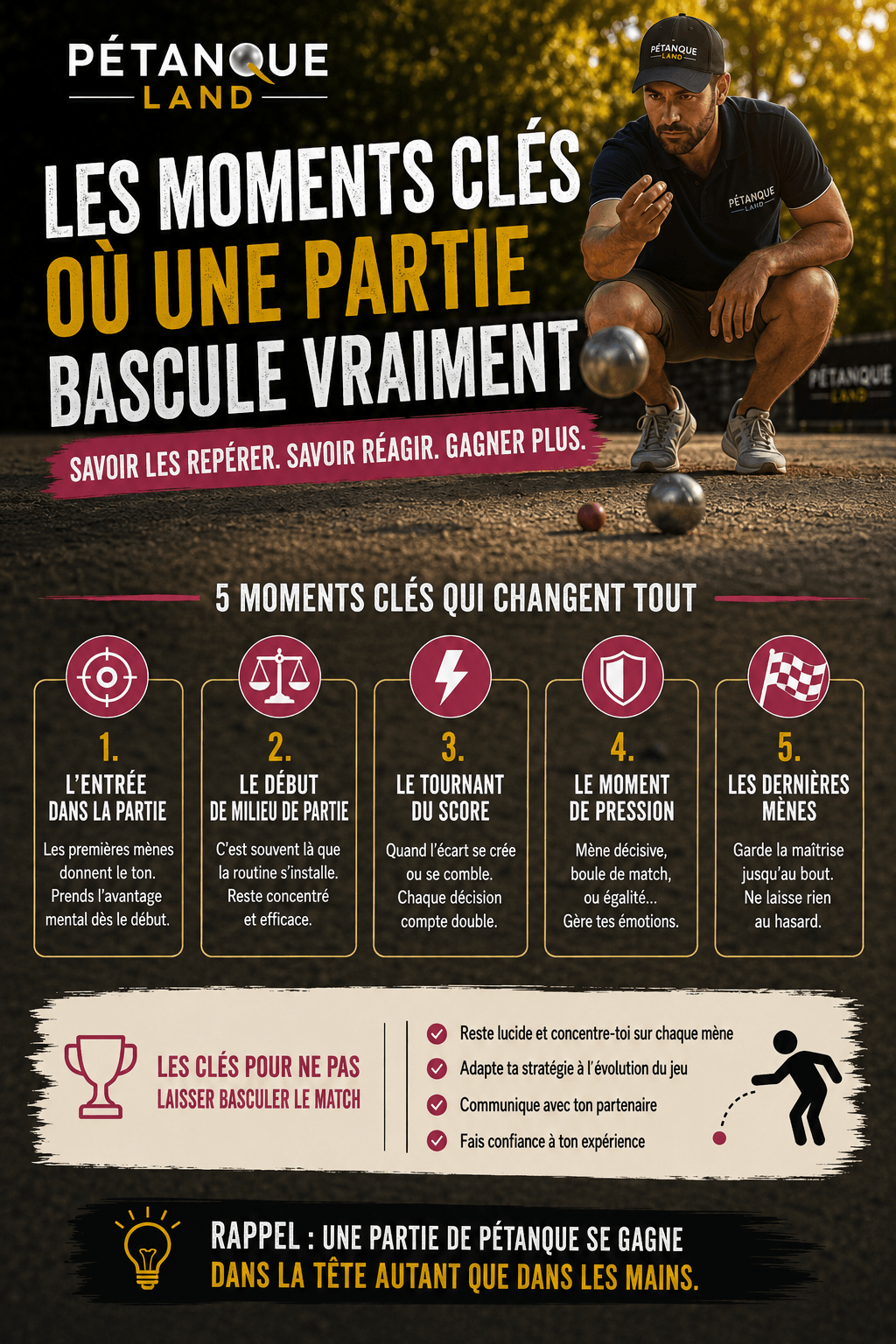
The 7 most frequent key moments
These moments were identified by their recurrence across games — not by their spectacular nature. Some of the most decisive moments in a game are imperceptible from the outside.
01 The first big end — 3 points or more at once Often occurs in the first third of the gameThe first end with 3 points or more carries a psychological weight disproportionate to its value in score. The team that takes it gets an injection of confidence. The team that suffers it receives a warning signal — and often starts changing its play, sometimes degrading it.
It is not the 3 points that make the swing — it is how each team reacts in the next 2 ends. The team that just took 3 points can consolidate its position or ease off. The team that just conceded them can tighten up its play or collapse.
⚡ Swing signal The pace of play speeding up in the team that just lost. Players throwing the jack back too fast, without checking the position. Internal communication dropping off or rising on the wrong frequencies. ✅ Smart reaction If you have just taken the big end: deliberately slow the pace, do not ease off on the next end — that is often where the opponent focuses all their reaction energy. If you have just suffered it: impose a visible reset — set the boules down, breathe, restate a precise tactical objective for the next end. Do not play the next end reactively. 02 The 6-6 or 7-6 end — the breaking end The moment when the balance tips for good in most gamesStatistically, games to 13 points are decided most often around a score of 6-6 or 7-6. It is not the geographical midpoint of the game — it is its psychological centre of gravity. Both teams feel the next end counts double. The pressure rises on both sides simultaneously.
The team that wins this end — at perfect equality or with a 1-point lead — gains a psychological advantage that translates almost always into an extra end right after. Two consecutive ends at that moment can take the score from 6-7 to 6-10 in a few minutes.
⚡ Swing signal Players play more slowly, more carefully. Tactical conversations between partners increase. Silence settles around the terrain — a sign that the spectators recognise too that the moment is key. ✅ Smart reaction This is precisely where you need to play your usual game — not an improved game, not a tense game. Players who over-analyse at 6-6 make over-control errors. Emotional mastery takes precedence over technical mastery at this precise moment. Place the jack with intent, not by reflex. 03 The brilliant shot on a well-placed boule — a moment of technical breakthrough Can occur at any moment in the gameA perfect shot on a boule that seemed well protected. A boule shot 3 cm from the jack, cleanly, that pushes the jack back into a favourable zone. These technical moments have an immediate psychological effect — they send a signal of dominance that goes beyond the strict value of the point won.
The team that pulls off this shot feels a sudden legitimacy. The opposing team starts doubting its positions — even well-placed boules no longer seem safe enough. This doubt changes the following decisions.
⚡ Swing signal The silence or the exclamations of the spectators. The shooter coming back with a different posture. The opposing team consulting loudly or, on the contrary, shutting down completely. ✅ Smart reaction If you have pulled off this shot: do not overplay it — let the moment exist without commenting on it. The confidence stays internal, not showy. If you suffer it: do not change strategy in a rush. The next boule is played exactly as if that shot had not happened. The opponent's brilliant shot only has the power you give it. 04 The end salvaged at the last moment — turning it around with the last boule One of the most energetically charged moments in pétanqueYou were about to lose 3 points. Your last boule turns the situation around — you take 1, or even 2 points instead. This type of end has a disproportionate effect on both teams simultaneously. The energy released is immediate and powerful.
For the team that just turned it around: euphoria, possible easing off, sometimes overconfidence on the following ends. For the team that just got caught back up: possible collapse if resilience is low, or — more rarely — a jolt of reaction and heightened concentration.
⚡ Swing signal Visible physical reactions — fists raised, loud exchanges, rising energy. The opponent taking time to put the boules back. The jack placed more slowly than usual. ✅ Smart reaction For the team that just turned it around: channel the energy immediately toward the next end. The euphoria lasts 30 seconds — do not let it turn into easing off. For the team that got turned over: 30 seconds of pure reset — do not mentally replay the lost end. The game is not over. Reconnect with a precise tactical objective for the next end. 05 The technical error on a simple boule — the moment of vulnerability Often underestimated in its impact on what followsA missed point on a situation that seemed simple. A missed shot at short distance. A poorly weighted boule that ends up 40 cm from a jack at 6 metres. These errors on "normal" shots carry a particular psychological charge — they create doubt about basic reliability, whereas errors on difficult shots are better accepted.
The opposing team receives this signal and can capitalise on it. The player who just missed the simple shot is most vulnerable over the next 2 boules — their attention is partly caught up by the past error instead of being fully on the current boule.
⚡ Swing signal The player looking at their hand or their boule after the error. The partner avoiding their gaze. The body closing up slightly. ✅ Smart reaction An error on a simple shot calls for immediate and honest normalisation — "it happens, next boule". No over-explanation, no analysis mid-end. For the partner: treat it exactly like an error on a difficult shot — with the same neutrality. The absence of a reaction is the best reaction. 06 The first point at 10 — match end Maximum pressure in both camps simultaneouslyAs soon as a team reaches 10 points, the game enters a different phase. Every end can be the last. Both teams know it. The one leading at 10 feels the pressure of "not losing". The one behind feels that of "no longer being allowed a mistake".
It is precisely at 10 that management errors multiply — too much caution on the leading side, too much urgency on the side being led. The ends played between 10 and 13 are often the least tactically controlled of the entire game, despite the maximum importance of each one.
⚡ Swing signal Visible change in the pace of play of both teams. Jacks placed in "usual" zones without thought, or on the contrary in surprising zones through over-calculation. Tense bodies and less fluid gestures. ✅ Smart reaction If you are at 10: play every boule as if you were at 7-7 — no rushing, no tensing up. A score of 10 is just a number. If you are at 7 or 8 facing 10: do not change strategy in a rush. Keep placing the jack with intent, keep reading each end correctly. The comeback happens boule by boule, not in one go. 07 The dispute or measuring disagreement — a break in collective concentration A non-technical moment but often decisive on what followsA disputed measurement, a disagreement over who holds the end, a discussion that drags on. These moments break the flow of the game for everyone. Concentration scatters, emotions rise, and the next end is played in a degraded mental state for at least one of the two teams.
The team that comes out of these interruptions best is the one that returns fastest to a state of concentration. It is not the one that "won" the dispute — it is the one that best managed its window of return to play.
⚡ Swing signal Tone of voice rising, broader gestures, time between the resolution of the dispute and the resumption of play. The team that resumes play too quickly after a dispute often plays the next end badly. ✅ Smart reaction After any resolved dispute — even one in your favour — impose a 15-second mini-reset before resuming. Set the boules down, breathe, mentally restate the objective of the end. This short ritual brings concentration back to where it should be: on the next boule, not on the dispute that just ended.The signals that announce an imminent swing
Certain signals systematically precede a swing. Identifying them in real time — not after the fact — is the skill that distinguishes the tactical player from the instinctive player.
📈 SIGNALS OF A SWING IN YOUR FAVOURYour team has been playing steadily for 2 ends without an error. The opponent starts changing its play — trying unusual shots, speeding up, or on the contrary shutting down. Their internal communications drop off or become tense.
What it means:You are in the swing window. The opponent feels it. Any error on your part at that moment stops the momentum dead.
Reaction: keep doing exactly what you are doing. No acceleration, no extra attempt. Consistency is the engine of favourable momentum. 📉 SIGNALS OF AN IMMINENT UNFAVOURABLE SWINGOne of your players just missed a simple shot. Your team's pace of play speeds up slightly. Communications between partners have dropped off or changed tone. You look at the score more often than before.
What it means:You are entering a vulnerability zone. The opponent may not have noticed yet — or has already started to capitalise.
Reaction: deliberately break the pace. Take 20 seconds between ends. Restate a precise tactical objective. Slowing down is the most effective response to entering a vulnerability zone. 👁️ WHAT THE OPPONENT REVEALS WITHOUT KNOWING ITTeams in difficulty give off readable non-verbal signals: unusual silences, abrupt gestures after an error, faster movements, more frequent looks at the score. These behaviours almost always precede a run of lost ends.
What it means:The opponent is in their window of vulnerability. The next 2 ends are high-potential for you.
Reaction: change nothing about your own game. Play with the same intention, without overdoing it. The opponent's momentum is managed through consistency, not through additional aggression. ⚖️ SIGNS OF A TRULY BALANCED GAMEThe ends alternate regularly. No team has taken more than 2 points in a row for several ends. Both teams are playing at their normal level with no particular signs of tension.
What it means:The game has not yet found its swing. The decisive end is ahead of you — often the one around 6-6 or 7-7.
Reaction: maintain total concentration. In a balanced game, the next key moment will be the most decisive of the entire game.How to use a favourable swing — and block an unfavourable one
🎯 METHOD — ACTING ON KEY MOMENTS The behaviours that amplify or interrupt a swing 🔥 Amplifying a favourable swing: play the next end as if nothing happened. Paradoxically, the best way to sustain a positive momentum is not to celebrate it excessively. Visible excitement gives information to the opponent and can create a let-down within your own team. 🧊 Blocking an unfavourable swing: slow down physically before it sets in. Walk more slowly to the circle, take the time to set the boules down, consciously look at the terrain before deciding. This physical slowdown produces a mental slowdown — and interrupts the behavioural pattern that feeds the opponent's momentum. 🎯 Using cochonnet placement as a swing lever. After a bad end, place the cochonnet at a distance and in a zone different from the last 3 ends. This change of context breaks the pattern and forces both teams to recalibrate — which always benefits the team that takes the initiative. 🗣️ Maintaining internal communication at the same level regardless of the circumstances. Teams that maintain their level of communication during difficult periods come out of unfavourable swings faster. Those whose communication collapses with the score let the momentum settle in more deeply. ⏱️ Imposing a deliberate tempo after every key moment — in both directions. Win or loss on an important end: systematically take 20 to 30 seconds before starting again. This intentional tempo prevents both the post-success let-down and the post-failure collapse. 🔍 Observing the opponent after a key moment — they reveal their reaction. The opposing team shows through its behaviour whether it is capitalising on an advantage or absorbing a shock. These signals are free tactical information — learning to read them gives you a head start on the next end. ⚡ The golden rule of decisive momentsIn the 30 seconds that follow a key moment — whether favourable or not — only one question matters: "How do I want to play the next end?" Not "why did that happen like that", not "what does it mean for the score". The next end. That is the only thing you can still act on.
Table: key moment → signal → reaction
| Key moment | Identifiable signal | Common mistake | Effective reaction |
|---|---|---|---|
| Big end taken (3+ pts) | Opponent's rhythm running away | Let-down or acceleration | Maintain your usual rhythm, reset before the next end |
| End at 6-6 or 7-6 | Silences, slower play on both sides | Over-analysis, stiffening of the throwing motion | Play your usual game — not a "special key moment" game |
| Brilliant opponent's shot | Doubt over the following positions | Changing your strategy in a hurry | Next boule played exactly as if the shot had not happened |
| End overturned at the last moment | Visible euphoria or collapse | Euphoria → let-down; Collapse → giving up | Channel the energy towards the next end in 30 seconds max |
| Error on a simple shot | Player looking at their boule or their hand | In-end analysis, partner reacting | Immediate normalisation, no visible reaction from the partner |
| Score at 10 points | Rhythm changing, less fluid actions | Rushing or over-caution | Play as if at 7-7 — the number 10 does not exist in the throwing motion |
| Contestation or dispute | Drawn-out discussions, voices rising | Resuming play too quickly after resolution | 15 seconds of mandatory reset after resolution, regardless of the outcome |
Drills to learn to recognise decisive moments
01 Retrospective game analysis 📍 After a game — alone or with 2 ⏱️ 10 min 🎯 Identify key moments after the factDeveloping awareness of decisive moments by identifying them after the fact — the first step before recognising them in real time.
After each game, note the score end by end if possible — or reconstruct the approximate progression. Identify the 2 or 3 ends where the score changed most abruptly in one direction or the other. These are the candidates for the key moments of the game. For each of these ends, recall: what happened just before? Was there a visible signal — a change in rhythm, an error on a simple shot, a contestation, communication dropping? This work builds your personal pattern library. Identify a reaction of your own that occurred at this key moment. Was it effective? Could it have been different? The goal is not to judge yourself — it is to build a repertoire of tested reactions. After 10 games analysed this way, the patterns start to repeat — certain moments always arrive in the same conditions. This repetition turns after-the-fact recognition into real-time recognition. 02 The tactical observer role 📍 Observe a game — without playing ⏱️ 30 min 🎯 Read the dynamics without the pressure of playWatching a game from the outside lets you see the dynamics that players do not see from the inside — and develop the reading of behavioural signals.
Position yourself at 90° to the line of play, with a view of both teams simultaneously. Observe behaviours between ends rather than the play itself — rhythm of returning to the circle, visible internal communication, body posture after each end lost or won. Mentally predict "which of the two teams will win the next 2 ends?" based solely on behavioural signals — not on the apparent technical level. Then check whether the prediction was right. With practice, the accuracy of these predictions increases significantly. Identify the exact moment when the momentum changed — not after 3 ends of delay, but at the precise end where the swing began. This moment is almost always marked by a visible change in behaviour before the score reflects it. Then reintegrate these observations into your own games: what do opponents do when they are about to swing? What does your own team do? What signals are you emitting without knowing it during your own moments of vulnerability?FAQ — Your frequent questions
Can a tilt be completely reversed once installed?+ Yes — but it is significantly more difficult after 3 consecutive lost ends than after 1. The sooner we interrupt an unfavorable dynamic, the more accessible the correction is. A dynamic established for 4 or 5 ends requires some form of “shock” — a big lead recovered, a brilliant shot, or a radical change in jack placement strategy. These ruptures are possible but often require an exceptional moment of play rather than regular management. The best strategy remains to interrupt the dynamic from the first lead of the unfavorable series, not after the third. In triplet, do these moments work the same way as in doublet?+ Yes, with amplification. In triplet, there are more balls in play — which means more opportunities for big leads, more complexity in opposing dynamics, and also more social “noise” in the team. The key moments are the same, but their effects are amplified by the number of players involved. An unfavorable shift in triplet can propagate more quickly because it affects 3 morale levels simultaneously. Managing the key moment in triplets often requires a communications leader on the team — someone who explicitly supports the collective reset. How to distinguish a real shift from a simple series of bad luck?+ The distinction is real and important. A series of pure bad luck – unpredictable terrain, unlucky opposing balls, moving jack – is not accompanied by behavioral change. If your game remains stable, your rhythm too, and you lose 3 ends due to external events, it's bad luck. A shift in dynamics is always accompanied by a behavioral change — in your team, in the opposing team, or both. If you observe the signals described in this article, it is a switch. If you don't observe them, look at the field and bowls first before looking for a mental problem. Can we deliberately cause a favorable shift, or should we wait for it to happen?+ We can create favorable conditions for a shift — it is even a legitimate strategy. The placement of the jack in an area that the opponent controls less well, a shot attempted on a well-protected ball which succeeds, an end played with unusual precision: all these elements can trigger a positive dynamic. What we cannot provoke is the adverse reaction — we can only create the conditions. A “provoked” failover remains subject to actual execution quality, not intent. The difference between provoking and forcing: provoking is creating a situation where a shift can occur naturally. To force is to take reckless risks in the hope of a shift — which often leads to the opposite effect. 📎 Related articles TacticsAttack or secure: making the right choice at the right time TacticsReading an end in a few seconds: a simple method TacticsPlaying against a stronger opponent: the mistakes to avoid DuoWhen your partner makes you lose: reacting intelligently TournamentsOfficial 2026 calendar — outdoor tournaments ToolsFree PetanqueLand tools© Pétanque by Paquita — petanqueland.fr · 📖 Paquita's book on Amazon