Actualités · 10 June 2026
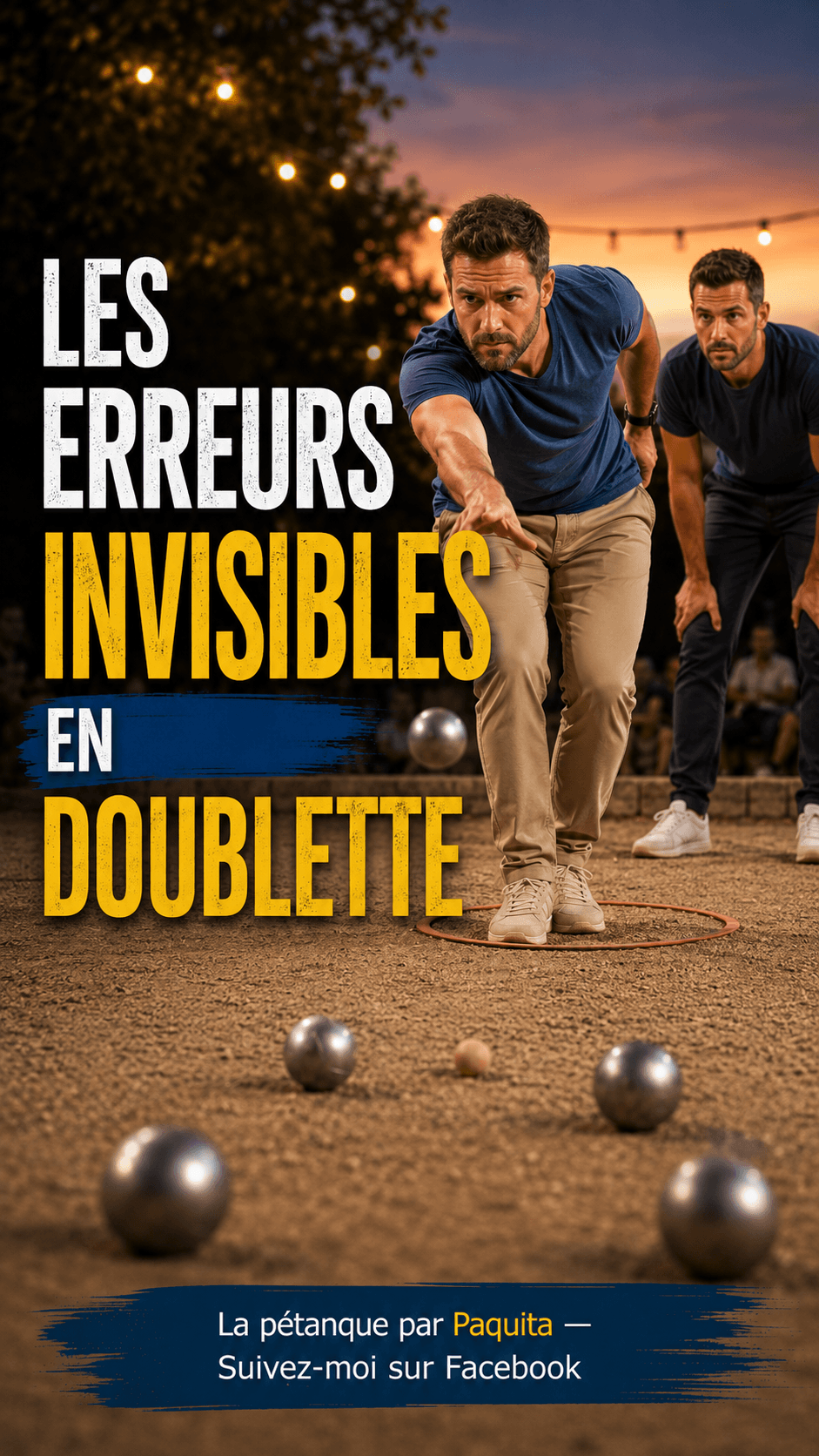
The invisible mistakes in doublette
Missed boules, everyone sees them. Bad decisions, no one — except the score. Counting the boules, choosing shooting or pointing, placing the jack, communicating: Paquita breaks down the invisible mistakes that lose doublettes.Doubles is not a small triples
It is the framing error that precedes all the others: believing that doubles is played “like a triples with two”. That is wrong, and it costs dearly.
Yet doubles and triples put the same number of boules in play — six per team. But they are not managed at all the same way. In triples, the roles are split across three players and a middle player arbitrates the choices. In doubles, there are only two of you to carry these six boules, with no middle player to decide. Consequence: everyone must be versatile and everyone must decide.
DOUBLES Boules / player3 boules each RolesVersatility: everyone points and shoots The middle playerNon-existent — nobody to umpire DecisionShared between two, live TRIPLES Boules / player2 boules each RolesSpecialised: pointer / middle / shooter The middle playerPresent — they steer the play DecisionSplit across threeWanting to freeze a « pointer » and a « shooter » as in triples deprives you of half your options. In doubles, the player who holds the situation is the one who, at that moment, has the right boule and the right shot — not the one for whom it is « the role ».
MISTAKE 1: Not counting the balls
It is the queen of invisible mistakes. At every moment of the end, one team has more, as many, or fewer boules to play than the other: this is the boule advantage. It entirely determines what you are allowed to attempt — and a great many players never follow it.
When you have the advantage, you can take risks for the big point. When you don't, every boule becomes precious and the priority changes. Playing without knowing this ratio means shooting when you should have kept your ammunition, or timidly securing when you held all the cards.
⬆️You have the advantageMore boules than the opponent? Take the initiative. Shoot the boule that is in the way, play for the big point. This is the moment to attack.
⚖️Equal boulesPlay it straight. No free risk: secure your point first, and keep a boule to answer the opponent's next shot.
⬇️The opponent has the advantageDefence priority. Secure at least one point, don't give up the end, waste nothing. Limit the damage cleanly.
PAQUITA'S TIPGet into the habit of updating the count in your head after each boule played, on both sides. « Three to two for us, we attack » or « two to three, we secure ». This silent little sentence is worth its weight in gold — it saves you half the bad decisions.
MISTAKE 2: Shooting (or pointing) at the wrong time
The choice between shooting and pointing is made on every boule, and that is where two silent faults lie hidden: shooting a boule that isn't really in the way, and stubbornly persisting in pointing where only a shot can turn the end around. In both cases, you waste a boule without seeing it.
POINT RATHER WHEN… The point is still reachable by pointing, clear ground, playable distance You have the boule advantage: secure before attacking A front boule can protect or approach without risk The opponent's boule is not holding a decisive point SHOOT RATHER WHEN… An opponent's boule holds a point you cannot beat by pointing That boule blocks access to the jack and closes off your options Removing it swings the exchange in your favour You have the boules to afford it, and your shooting arm is warmed upInvisible variant of the same fault: burning your shot too early. You spend your shooting boules on low-value targets, and when the opponent finally places the boule you absolutely have to remove, you've got nothing left. Keep a shooting boule in reserve for the closing stages of the end, as much as possible.
MISTAKE 3: Playing each in their own corner
Without a middle player to orchestrate, doubles relies entirely on communication between the two players. The invisible mistake: playing on instinct, assuming the other agrees, and only talking to each otherafter the shot — often to regret it.
A teammate who points when you thought you should shoot, two boules played on the same line without having agreed it, a last boule released without consultation: these are lost points that no one will ever attribute to a « bad gesture ». They come from silence.
- Decide before, not after. Shoot or point? Which target? Who plays this boule?
- Confirm the key moments. Especially before a shot, and before the last boule of the end.
- One plan at a time. If you disagree, make a call — don't play « in between ».
- Encourage, don't blame. The team's mood is also shaped between the boules.
Before each important boule, ten seconds of consultation are enough: « You shoot the one on the right, and if an opponent's boule remains I'll point in front. » You've just eliminated the misunderstanding before it happens. It's less glamorous than a carreau, but it wins more ends.
MISTAKE 4: Embarrassing yourself
This one is sneaky because you commit it thinking you're doing well. A boule « in front of » the jack is often excellent — it hampers the opponent's pointing. But placed on your own line of play, that same boule blocks you: you can no longer roll a boule up to the jack without hitting your own. You've closed the door on yourself.
❌ BLOCKED LANEYour support boule is right on your pointing axis. To place another boule, you have to go over your own — impossible to do cleanly. You're getting in your own way.
✅ FREE LANEThe same boule, shifted to the side: your lane stays open for pointing, and you keep a well-placed support. Same intention, zero self-blocking.
Same logic for the boule that dislodges your own point: you hold the jack with a fine boule, and you play a second one on the same trajectory « to make sure » — except it hits the first and pushes it away. When your boule is well placed, the question to ask yourself is not « how to add another » but « am I at risk of undoing what works? ».
MISTAKE 5: Offering the distance from the goal to the opponent
When your team wins an end, it is the one that throws the jack for the next — and so chooses its distance, between 6 and 10 metres. It's a real tactical lever, and most players waste it by throwing the jack « out of habit », without asking themselves who this distance benefits.
📍Short jack (~6–7 m)Favours precision pointing and clustered big points. Hampers long-range shooters. Choose it if your strength is fine pointing.
📐Medium jack (~7–8.5 m)The balance, with no marked advantage. The reasonable choice when the profiles of the two teams are roughly equal.
🎯Long jack (~9–10 m)Favours shooters and players comfortable at range. Scatters the boules and devalues short pointing. Choose it if you hit hard.
The rule is simple: place the jack where your your team is strong and where the opponent is weak. If you point short with finesse and the other side shoots at 9 metres, throwing a long jack means playing against yourself.
MISTAKE 6: Suffering to the opponent's game
Last invisible mistake, and the most human: letting the opponent dictate your play. They pull off a fine carreau, and right away you feel obliged to answer with a spectacular shot — when a placed point was enough to regain control. You played their game, not yours.
The same trap takes another form when you are well ahead: complacency. You ease off, you try free shots « because you have margin », and the margin melts away. Conversely, when behind, you panic and force desperate shots too early.
- Always come back to the boule ratio (mistake 1): it is what dictates the right shot, not the opponent's feat.
- When you're ahead, close the game down : secure, give nothing away for free.
- When you're behind, stay methodical : a point regained is worth more than a failed heroic shot.
- Play your plan, not the latest emotion on the terrain.
The missed boules, everyone sees them. The bad decisions, no one — except the scoreboard. It's there, in the invisible, that doubles are won.
— PaquitaThe pre-end checklist
Six reflexes to make the invisible visible. Run them through your head, ideally as a pair, before and during each end.
BEFORE PLAYING THE NEXT BOULE- Count the boules. Who has how many? Who has the advantage at this moment?
- Decide together. Shoot or point? Which target? Who plays this boule?
- Keep some shooting in reserve. Don't burn your shooting boules on low-value targets.
- Don't play on your own lane or on your own well-placed point.
- Choose the jack distance that serves YOU when you win the end.
- Follow your plan, not the opponent's flash of brilliance.
Tactics, reading the game, boule management, the mental side: Paquita's book gathers everything that separates a team that plays well from a team that wins — with concrete exercises and bonuses to download.
📦 Order on AmazonAvailable on Amazon.fr · Paquita — PétanqueLand
Frequently asked questions
What is the main tactical difference between doubles and triples?Both formats put six boules per team into play, but in doubles they are carried by two players (three each) and there is no middle player. Each must therefore be versatile and decide on the spot. Individual boule management and communication between the two players become far more decisive than in triples.
Should you have a fixed pointer and shooter in doubles?No, and it's even a frequent mistake. Doubles rewards versatility: depending on the situation, each player must be able to point or shoot. Freezing the roles as in triples deprives you of options — for example if « the shooter » has a boule poorly placed for shooting but well placed for pointing. The right player is the one who has, at that moment, the right boule for the right shot.
What is « the boule advantage » and why is it so important?It's the fact of having, at a moment of the end, more boules to play than the opponent. When you have it, you can attack and aim for the big point without excessive risk. When you don't, the priority becomes securing and wasting nothing. Misreading this ratio — or not following it at all — leads to the worst decisions: shooting when you should have kept your boules, or timidly securing when you held all the cards.
When is it better to shoot rather than point?When an opponent's boule holds a point you cannot beat by pointing, or it blocks access to the jack, and you have the boules to afford this shot. Conversely, shooting a boule that isn't really in the way is wasting a round. Also think about keeping a shooting boule for the closing stages of the end, rather than burning it early on an unimportant target.
Does the jack distance really change anything?Yes, it's an underused lever. A short jack favours precision pointing and clustered big points; a long jack favours shooters and range. When you win the end, it's you who throws the jack for the next one: place it at the distance that serves your team and hampers the opponent, rather than throwing it out of habit.
How can I communicate better with my teammate during a match?Decide before playing, not after. A brief consultation — shoot or point? which target? who plays? — before every important boule, and especially before a shot and before the last boule of the end. If you don't agree, decide clearly rather than playing a shot "in between". And mind the atmosphere: encourage, don't reproach. The team's mood is also built between the boules.
📎 Related articles Tactics Pointing or shooting: how to really choose Mental Playing under pressure: what really changes Tactics Place the jack well: the lever we forget Rules The rule of the minute — what every player should know Terrain Read the ground: spot the treacherous slopes Tools Free PétanqueLand Tools© Pétanque by Paquita — petanqueland.fr
📖 Order the book on Amazon