PetanqueLand
Search: Movie should be distinctly Please enter a search term in the search field.

Not to be missed

Search suggestions

Why do some boules veer off for no apparent reason? (Pétanque) Article Why do some boules veer off for no apparent reason in pétanque? PAQUITA ON PÉTANQUE STRIKE Video Pétanque: when you celebrate too soon… Video pourquoi il ne faut jamais celebrer avent la (1)-Couverture Boule diameter: why the wrong choice holds you back (Pétanque) Article Which boule diameter should you choose? The direct impact on your performance THE DIGESTION EXCUSE Video
Cart 0
EN▾
FrançaisEnglishEspañolItalianoDeutschPortuguêsNederlandsCatalàالعربية中文ไทย
PetanqueLand
  • Home
  • SHOP
    • Pétanque Book Shop
    • Pétanque Player Clothing
    • Pétanque Objects & Decor
    • Pétanque Gift Ideas
    • See all
  • ⭐ The Pétanque Software
  • Videos
  • 🏛️ OFFICIAL
    • Upcoming competitions
    • Results & calendar
    • Rules explained
  • FREE Zone
    • Free online software
    • Free tools
    • Lab
  • News by Paquita
Total articles: 193
:root { --noir: #0d0d0d; --noir-2: #141414; --card: #161616; --card-2: #1d1d1d; --border: #282828; --jaune: #f5c800; --jaune-dim: rgba(245,200,0,.08); --blanc: #f0ede6; --gris: #888; --gris-2: #aaa; --rouge: #e03030; --rouge-dim: rgba(224,48,48,.08); --orange: #f07020; --orange-dim: rgba(240,112,32,.1); --vert: #42c264; --vert-dim: rgba(66,194,100,.1); --bleu: #4aa8e0; --bleu-dim: rgba(74,168,224,.1); /* Accent : vert militaire / tactique */ --kaki: #5a8040; --kaki-dim: rgba(90,128,64,.1); --kaki-med: rgba(90,128,64,.2); --kaki-lt: #78a858; } *, *::before, *::after { box-sizing: border-box; margin: 0; padding: 0; } html { scroll-behavior: smooth; } body { background: var(--noir); color: var(--blanc); font-family: 'Barlow', sans-serif; font-size: 17px; line-height: 1.85; -webkit-font-smoothing: antialiased; } a { color: var(--jaune); text-decoration: none; } a:hover { text-decoration: underline; } strong { color: #eee; } p { margin-bottom: 16px; color: #bbb; } em { color: #ccc; font-style: italic; } /* ─── HERO ─── */ .hero { position: relative; background: var(--noir-2); border-bottom: 3px solid var(--jaune); padding: 80px 24px 64px; text-align: center; overflow: hidden; } .hero::before { content: ''; position: absolute; inset: 0; background: radial-gradient(ellipse 65% 55% at 50% 0%, rgba(90,128,64,.14), transparent 65%), radial-gradient(ellipse 30% 30% at 90% 80%, rgba(245,200,0,.05), transparent 55%); pointer-events: none; } .hero-tag { display: inline-flex; align-items: center; gap: 7px; background: var(--kaki); color: #fff; font-family: 'Bebas Neue', sans-serif; font-size: 13px; letter-spacing: 2px; padding: 5px 14px; border-radius: 2px; margin-bottom: 22px; } .hero h1 { font-family: 'Bebas Neue', sans-serif; font-size: clamp(2.2rem, 7vw, 4.8rem); letter-spacing: 1.5px; line-height: 1.0; color: var(--blanc); max-width: 900px; margin: 0 auto 16px; } .hero h1 em { color: var(--jaune); font-style: normal; } /* Badge verdict */ .hero-verdict { display: flex; justify-content: center; gap: 0; margin: 20px auto 14px; border: 1px solid var(--border); border-radius: 8px; overflow: hidden; width: fit-content; } .hv-bloc { padding: 10px 22px; font-family: 'Bebas Neue', sans-serif; font-size: .88rem; letter-spacing: 2px; background: var(--card-2); } .hv-bloc.genie { color: var(--kaki-lt); border-right: 1px solid var(--border); } .hv-bloc.sep { color: #1e1e1e; background: var(--card); padding: 10px 10px; border-right: 1px solid var(--border); } .hv-bloc.risque { color: var(--rouge); } .hero-sub { font-size: 1rem; color: #888; font-style: italic; max-width: 640px; margin: 0 auto 14px; } .hero-meta { display: flex; justify-content: center; gap: 20px; flex-wrap: wrap; color: var(--gris); font-size: .88rem; margin-top: 14px; } .hero-meta span::before { content: '• '; } .hero-meta span:first-child::before { content: ''; } /* ─── LAYOUT ─── */ .page-wrap { max-width: 860px; margin: 0 auto; padding: 60px 24px 100px; } /* ─── INTRO ─── */ .intro-box { background: var(--card); border-left: 5px solid var(--kaki); border-radius: 0 8px 8px 0; padding: 22px 26px; margin-bottom: 48px; font-size: 1.05rem; color: #bbb; } /* ─── CHIFFRES ─── */ .key-facts { display: grid; grid-template-columns: repeat(4, 1fr); gap: 0; margin-bottom: 48px; border: 1px solid var(--border); border-radius: 10px; overflow: hidden; } @media(max-width:540px){ .key-facts { grid-template-columns: 1fr 1fr; } } .kf-item { padding: 20px 12px; text-align: center; background: var(--card-2); border-right: 1px solid var(--border); } .kf-item:last-child { border-right: none; } .kf-val { font-family: 'Bebas Neue', sans-serif; font-size: 2.2rem; color: var(--kaki-lt); line-height: 1; margin-bottom: 5px; } .kf-unit { font-size: .7rem; color: #555; text-transform: uppercase; letter-spacing: 1px; } .kf-label { font-size: .76rem; color: #777; line-height: 1.3; margin-top: 2px; } /* ─── TOC ─── */ .toc { background: var(--card); border: 1px solid var(--border); border-top: 3px solid var(--kaki); border-radius: 0 0 8px 8px; padding: 22px 26px; margin-bottom: 52px; } .toc-title { font-family: 'Bebas Neue', sans-serif; font-size: 1rem; letter-spacing: 2px; color: var(--kaki-lt); margin-bottom: 14px; } .toc ol { padding-left: 20px; color: var(--gris-2); font-size: .93rem; line-height: 2.1; } .toc ol li a { color: var(--gris-2); } .toc ol li a:hover { color: var(--jaune); } /* ─── HEADINGS ─── */ h2 { font-family: 'Bebas Neue', sans-serif; font-size: clamp(1.7rem, 4vw, 2.4rem); color: var(--jaune); letter-spacing: 1px; margin: 60px 0 22px; display: flex; align-items: center; gap: 12px; } h2::before { content: ''; display: inline-block; width: 6px; height: 32px; background: var(--kaki); border-radius: 2px; flex-shrink: 0; } /* ─── SCHÉMA COMPARATIF FER VS RAFLE ─── */ .schema-comparatif { display: grid; grid-template-columns: 1fr 1fr; gap: 12px; margin: 28px 0; } @media(max-width:520px){ .schema-comparatif { grid-template-columns: 1fr; } } .schema-box { background: var(--card-2); border: 1px solid var(--border); border-radius: 10px; overflow: hidden; } .sb-header { padding: 12px 16px; background: var(--card); border-bottom: 1px solid var(--border); font-family: 'Bebas Neue', sans-serif; font-size: .85rem; letter-spacing: 2px; } .schema-box.fer .sb-header { color: var(--bleu); } .schema-box.rafle .sb-header { color: var(--kaki-lt); } /* Terrain mini CSS */ .terrain-mini { position: relative; height: 80px; background: #060e06; overflow: hidden; margin: 12px 10px; border-radius: 6px; } .terrain-mini::after { content: ''; position: absolute; bottom: 0; left: 0; right: 0; height: 3px; background: #1a2a1a; } /* Arc FER */ .arc-fer { position: absolute; top: 8px; left: 5%; width: 45%; height: 55px; border: 2px solid var(--bleu); border-bottom: none; border-radius: 50% 50% 0 0; opacity: .7; } /* Ligne RAFLE */ .ligne-rafle { position: absolute; bottom: 4px; left: 5%; right: 22%; height: 2px; background: var(--kaki-lt); opacity: .8; } /* Boule cible */ .boule-cible { position: absolute; bottom: 3px; right: 18%; width: 12px; height: 12px; border-radius: 50%; background: var(--rouge); } /* Cercle lancer */ .cercle-depart { position: absolute; bottom: 0; left: 2%; width: 12px; height: 8px; border: 1px solid #333; border-radius: 50%; } /* Impact fer */ .impact-fer { position: absolute; bottom: 3px; right: 25%; width: 10px; height: 10px; border-radius: 50%; background: var(--bleu); opacity: .6; } .sb-legende { padding: 8px 12px 12px; font-size: .77rem; color: #555; text-align: center; font-style: italic; } /* ─── DÉFINITION TECHNIQUE ─── */ .def-box { background: var(--card-2); border: 1px solid var(--border); border-left: 5px solid var(--kaki); border-radius: 0 10px 10px 0; padding: 22px 22px; margin: 28px 0; } .def-label { font-family: 'Bebas Neue', sans-serif; font-size: .82rem; letter-spacing: 2px; color: var(--kaki-lt); margin-bottom: 8px; } .def-texte { font-size: .95rem; color: #ccc; line-height: 1.8; } .def-texte strong { color: #eee; } .def-texte em { color: var(--kaki-lt); } /* ─── SITUATIONS TACTIQUES ─── */ .situations { display: flex; flex-direction: column; gap: 12px; margin: 28px 0; } .situation-card { background: var(--card-2); border: 1px solid var(--border); border-radius: 10px; padding: 18px 20px; display: flex; gap: 16px; align-items: flex-start; } .sc-badge { flex-shrink: 0; width: 48px; height: 48px; border-radius: 10px; display: flex; align-items: center; justify-content: center; font-size: 1.4rem; } .sc-badge.oui { background: var(--kaki-dim); } .sc-badge.non { background: var(--rouge-dim); } .sc-badge.maybe { background: var(--orange-dim); } .sc-content { flex: 1; } .sc-titre { font-family: 'Bebas Neue', sans-serif; font-size: .95rem; letter-spacing: 1.5px; color: #ddd; margin-bottom: 5px; } .sc-detail { font-size: .87rem; color: #888; line-height: 1.65; } .sc-verdict { margin-top: 7px; font-size: .82rem; font-weight: 700; } .sc-verdict.oui { color: var(--kaki-lt); } .sc-verdict.non { color: var(--rouge); } .sc-verdict.maybe { color: var(--orange); } /* ─── POUR / CONTRE ─── */ .pour-contre { display: grid; grid-template-columns: 1fr 1fr; gap: 0; margin: 28px 0; border: 1px solid var(--border); border-radius: 10px; overflow: hidden; } @media(max-width:540px){ .pour-contre { grid-template-columns: 1fr; } } .pc-col .pc-header { padding: 12px 18px; font-family: 'Bebas Neue', sans-serif; font-size: .82rem; letter-spacing: 2px; border-bottom: 1px solid var(--border); } .pc-col.pour .pc-header { background: var(--kaki-dim); color: var(--kaki-lt); border-right: 1px solid var(--border); } .pc-col.contre .pc-header { background: var(--rouge-dim); color: var(--rouge); } .pc-items { display: flex; flex-direction: column; } .pc-item { padding: 12px 16px; font-size: .86rem; color: #888; border-bottom: 1px solid var(--border); display: flex; gap: 10px; align-items: flex-start; line-height: 1.55; } .pc-item:last-child { border-bottom: none; } .pc-col.pour .pc-item { background: var(--card-2); border-right: 1px solid var(--border); } .pc-col.contre .pc-item { background: var(--card-2); } /* ─── TECHNIQUE EXÉCUTION ─── */ .execution-steps { counter-reset: es; display: flex; flex-direction: column; gap: 0; border: 1px solid var(--border); border-radius: 10px; overflow: hidden; margin: 28px 0; } .es-item { display: flex; gap: 0; border-bottom: 1px solid var(--border); counter-increment: es; } .es-item:last-child { border-bottom: none; } .es-num { width: 54px; flex-shrink: 0; background: var(--kaki-dim); border-right: 1px solid var(--border); display: flex; align-items: center; justify-content: center; font-family: 'Bebas Neue', sans-serif; font-size: 1.8rem; color: var(--kaki-lt); } .es-content { flex: 1; padding: 15px 18px; background: var(--card-2); } .es-titre { font-family: 'Bebas Neue', sans-serif; font-size: .92rem; letter-spacing: 1.5px; color: var(--blanc); margin-bottom: 4px; } .es-detail { font-size: .87rem; color: #888; line-height: 1.65; } .es-detail strong { color: #ccc; } /* ─── VARIANTES RAFLE ─── */ .variantes-grid { display: grid; grid-template-columns: repeat(auto-fill, minmax(190px,1fr)); gap: 12px; margin: 28px 0; } .variante-card { background: var(--card-2); border: 1px solid var(--border); border-radius: 10px; padding: 18px 16px; border-top: 3px solid var(--kaki); } .vc-ico { font-size: 1.8rem; margin-bottom: 8px; display: block; } .vc-titre { font-family: 'Bebas Neue', sans-serif; font-size: .9rem; letter-spacing: 1.5px; color: var(--kaki-lt); margin-bottom: 5px; } .variante-card p { font-size: .83rem; color: #777; margin-bottom: 6px; line-height: 1.55; } .vc-difficulte { font-size: .75rem; font-weight: 700; padding: 2px 8px; border-radius: 3px; display: inline-block; } .diff-f { background: var(--vert-dim); color: var(--vert); } .diff-m { background: var(--orange-dim); color: var(--orange); } .diff-d { background: var(--rouge-dim); color: var(--rouge); } /* ─── TERRAINS IDÉAUX ─── */ .terrain-row-grid { display: grid; grid-template-columns: 140px 1fr 80px; gap: 0; border: 1px solid var(--border); border-radius: 10px; overflow: hidden; margin: 28px 0; } @media(max-width:540px){ .terrain-row-grid { grid-template-columns: 1fr; } } .trg-item { display: contents; } .trg-nom { padding: 11px 14px; background: var(--card-2); border-bottom: 1px solid var(--border); border-right: 1px solid var(--border); font-size: .86rem; color: #ccc; font-weight: 600; display: flex; align-items: center; gap: 7px; } .trg-desc { padding: 11px 14px; background: var(--card-2); border-bottom: 1px solid var(--border); border-right: 1px solid var(--border); font-size: .84rem; color: #888; line-height: 1.5; } .trg-score { padding: 11px 10px; background: var(--card-2); border-bottom: 1px solid var(--border); text-align: center; } .trg-val { font-family: 'Bebas Neue', sans-serif; font-size: 1.1rem; } .trg-head { padding: 10px 14px; background: var(--card); font-family: 'Bebas Neue', sans-serif; font-size: .75rem; letter-spacing: 2px; color: #444; border-bottom: 1px solid var(--border); border-right: 1px solid var(--border); } .trg-head.last { border-right: none; } .trg-nom:last-of-type, .trg-desc:last-of-type, .trg-score:last-of-type { border-bottom: none; } /* ─── ARBRE DÉCISION ─── */ .arbre { background: var(--card-2); border: 1px solid var(--border); border-radius: 12px; padding: 24px 20px; margin: 28px 0; } .arbre-titre { font-family: 'Bebas Neue', sans-serif; font-size: .85rem; letter-spacing: 2px; color: var(--kaki-lt); margin-bottom: 16px; text-align: center; } .arbre-ligne { display: flex; align-items: center; gap: 10px; margin-bottom: 8px; flex-wrap: wrap; } .arbre-question { background: var(--card); border: 1px solid var(--border); border-radius: 6px; padding: 8px 14px; font-size: .86rem; color: #aaa; flex-shrink: 0; display: flex; align-items: center; gap: 8px; } .arbre-flèche { color: #2a2a2a; font-size: 1.2rem; flex-shrink: 0; } .arbre-oui { background: var(--kaki-dim); border: 1px solid rgba(90,128,64,.25); border-radius: 4px; padding: 4px 10px; font-family: 'Bebas Neue', sans-serif; font-size: .78rem; letter-spacing: 1px; color: var(--kaki-lt); flex-shrink: 0; } .arbre-non { background: var(--rouge-dim); border: 1px solid rgba(224,48,48,.2); border-radius: 4px; padding: 4px 10px; font-family: 'Bebas Neue', sans-serif; font-size: .78rem; letter-spacing: 1px; color: var(--rouge); flex-shrink: 0; } .arbre-indent { padding-left: 20px; } /* ─── PAQUITA TIP ─── */ .paquita-tip { background: var(--jaune-dim); border: 1px solid rgba(245,200,0,.2); border-left: 5px solid var(--jaune); border-radius: 0 10px 10px 0; padding: 20px 24px; margin: 28px 0; display: flex; gap: 16px; align-items: flex-start; } .paquita-tip .pt-emo { font-size: 2rem; flex-shrink: 0; } .paquita-tip .pt-label { font-family: 'Bebas Neue', sans-serif; font-size: .95rem; letter-spacing: 2px; color: var(--jaune); margin-bottom: 6px; } .paquita-tip p { font-size: .93rem; color: #ccc; margin-bottom: 0; } /* ─── DIALOGUE PAQUITA ─── */ .dialogue-paquita { background: var(--card-2); border: 1px solid var(--border); border-radius: 10px; padding: 22px 24px; margin: 28px 0; } .dp-label { font-family: 'Bebas Neue', sans-serif; font-size: .82rem; letter-spacing: 2px; color: var(--kaki-lt); margin-bottom: 10px; } .dp-text { font-size: 1.02rem; font-style: italic; color: #ccc; line-height: 1.7; border-left: 4px solid var(--jaune); padding-left: 16px; } .dp-sign { font-family: 'Bebas Neue', sans-serif; font-size: .85rem; letter-spacing: 2px; color: var(--jaune); margin-top: 12px; } /* ─── INFO / ALERT ─── */ .info-strip { background: var(--card); border: 1px solid var(--border); border-left: 5px solid var(--kaki); border-radius: 0 8px 8px 0; padding: 16px 22px; margin: 28px 0; display: flex; gap: 14px; align-items: flex-start; } .info-strip .emo { font-size: 1.6rem; flex-shrink: 0; padding-top: 2px; } .info-strip p { font-size: .93rem; color: #aaa; margin-bottom: 0; } .alert-box { background: var(--rouge-dim); border: 1px solid rgba(224,48,48,.22); border-left: 5px solid var(--rouge); border-radius: 0 8px 8px 0; padding: 18px 22px; margin: 28px 0; } .alert-label { font-family: 'Bebas Neue', sans-serif; font-size: .95rem; letter-spacing: 2px; color: var(--rouge); margin-bottom: 8px; } .alert-box p { font-size: .93rem; color: #ccc; margin-bottom: 0; } /* ─── EXERCICE ─── */ .exo-card { background: var(--card-2); border: 1px solid var(--border); border-radius: 12px; overflow: hidden; margin: 18px 0; } .exo-header { background: var(--card); border-bottom: 1px solid var(--border); padding: 16px 20px; display: flex; gap: 14px; align-items: flex-start; } .exo-num { font-family: 'Bebas Neue', sans-serif; font-size: 2.8rem; color: var(--kaki-lt); line-height: 1; flex-shrink: 0; width: 48px; text-align: center; } .exo-meta { flex: 1; } .exo-nom { font-family: 'Bebas Neue', sans-serif; font-size: 1.15rem; letter-spacing: 1.5px; color: var(--blanc); margin-bottom: 6px; } .exo-tags { display: flex; flex-wrap: wrap; gap: 6px; } .exo-tag { font-size: .76rem; font-weight: 700; padding: 2px 9px; border-radius: 4px; } .tag-lieu { background: var(--bleu-dim); color: var(--bleu); } .tag-temps { background: var(--jaune-dim); color: var(--jaune); } .tag-obj { background: var(--kaki-dim); color: var(--kaki-lt); } .exo-body { padding: 18px 20px; } .etapes { counter-reset: et; display: flex; flex-direction: column; gap: 9px; margin: 12px 0; } .etape-item { background: var(--card); border: 1px solid var(--border); border-radius: 7px; padding: 11px 14px 11px 48px; position: relative; counter-increment: et; font-size: .88rem; color: #aaa; line-height: 1.6; } .etape-item::before { content: counter(et); position: absolute; left: 10px; top: 50%; transform: translateY(-50%); width: 24px; height: 24px; border-radius: 50%; background: var(--kaki); color: #fff; display: flex; align-items: center; justify-content: center; font-family: 'Bebas Neue', sans-serif; font-size: .9rem; } .etape-item strong { color: #ddd; } /* ─── CTA LIVRE ─── */ .cta-livre { background: linear-gradient(135deg, rgba(90,128,64,.07), rgba(245,200,0,.05)); border: 1px solid rgba(245,200,0,.22); border-radius: 14px; padding: 30px 26px; margin: 52px 0; display: flex; gap: 22px; align-items: center; flex-wrap: wrap; } .cta-livre-ico { font-size: 3rem; flex-shrink: 0; } .cta-livre-content { flex: 1; min-width: 220px; } .cta-livre-label { font-family: 'Bebas Neue', sans-serif; font-size: .82rem; letter-spacing: 2px; color: var(--kaki-lt); margin-bottom: 5px; } .cta-livre-titre { font-family: 'Bebas Neue', sans-serif; font-size: 1.4rem; letter-spacing: 1px; color: var(--blanc); margin-bottom: 8px; } .cta-livre-content p { font-size: .9rem; color: #888; margin-bottom: 14px; } .cta-livre-btn { display: inline-flex; align-items: center; gap: 8px; background: var(--jaune); color: var(--noir); font-family: 'Bebas Neue', sans-serif; font-size: .95rem; letter-spacing: 2px; padding: 11px 22px; border-radius: 6px; text-decoration: none; } .cta-livre-btn:hover { opacity: .9; text-decoration: none; } /* ─── FAQ ─── */ .faq { margin: 28px 0; } .faq-item { background: var(--card-2); border: 1px solid var(--border); border-radius: 8px; margin-bottom: 10px; overflow: hidden; } .faq-q { width: 100%; background: none; border: none; color: var(--blanc); font-family: 'Barlow', sans-serif; font-size: .97rem; font-weight: 600; text-align: left; padding: 16px 20px; cursor: pointer; display: flex; justify-content: space-between; align-items: center; gap: 10px; } .faq-icon { flex-shrink: 0; width: 22px; height: 22px; border-radius: 50%; background: var(--jaune); color: var(--noir); display: flex; align-items: center; justify-content: center; font-size: 16px; font-weight: 900; transition: transform .25s; } .faq-item.open .faq-icon { transform: rotate(45deg); } .faq-a { max-height: 0; overflow: hidden; transition: max-height .35s ease; } .faq-item.open .faq-a { max-height: 800px; } .faq-a-inner { padding: 0 20px 18px; font-size: .92rem; color: #999; line-height: 1.7; } .faq-a-inner a { color: var(--jaune); } /* ─── RELATED ─── */ .related-title { font-family: 'Bebas Neue', sans-serif; font-size: 1.8rem; color: var(--jaune); letter-spacing: 1px; margin: 60px 0 22px; display: flex; align-items: center; gap: 12px; } .related-title::before { content: ''; display: inline-block; width: 6px; height: 28px; background: var(--kaki); border-radius: 2px; } .related-grid { display: grid; grid-template-columns: repeat(auto-fill, minmax(240px,1fr)); gap: 12px; margin-bottom: 52px; } .rel-card { background: var(--card); border: 1px solid var(--border); border-radius: 8px; padding: 16px 18px; display: block; transition: border-color .2s, background .2s; } .rel-card:hover { border-color: var(--jaune); background: #1a1a1a; text-decoration: none; } .rel-cat { font-size: .75rem; font-weight: 700; letter-spacing: 1.5px; text-transform: uppercase; color: var(--jaune); margin-bottom: 6px; display: block; } .rel-card .rel-title { font-size: .95rem; color: #ddd; font-weight: 600; line-height: 1.4; } /* ─── FOOTER ─── */ .art-footer { border-top: 1px solid #222; padding-top: 28px; text-align: center; color: #555; font-size: .85rem; } .art-footer a { color: var(--jaune); }
🎯 Tactics — Shooting technique

The rolling shot:
a stroke of genius?

✓ A real tactical weapon vs ✗ A crutch for the poor shooter The bowl that rolls to the target rather than flying. Despised in some clubs, used by the shrewdest tacticians. A complete decode of an unfairly overlooked technique. Shooting technique Advanced tactics By Paquita Read time: 9 min
"Il fait des rafles parce qu'il ne sait pas tirer." Cette phrase, on l'entend dans presque tous les clubs. Elle dit quelque chose de vrai sur le tir à la rafle — et elle dit aussi quelque chose de faux. Vrai : certains joueurs utilisent la rafle comme substitut faute de maîtriser le tir aérien. Faux : la rafle est une technique à part entière, avec ses propres situations d'usage, ses propres avantages tactiques, et ses propres exigences de maîtrise. Les meilleurs joueurs ont la rafle dans leur arsenal. Ils ne l'utilisent pas toujours — mais ils l'utilisent quand c'est la meilleure option. Ce sont deux choses très différentes. 0 hauteur La boule ne quitte pas ou quasiment pas le sol pendant la rafle +15% de réussite sur terrain chaotique vs tir aérien selon les observations de terrain 3 variantes rafle directe, rafle demi-portée, rafle en biais — techniques distinctes 1 règle d'or La rafle est une arme tactique choisie — jamais un aveu d'impuissance
📋 Contents
  1. Exact definition — what the rolling shot is and isn't
  2. High shot vs rolling shot — the two trajectories explained
  3. The real tactical advantages of the rolling shot
  4. The limits — when the rolling shot fails
  5. In which situations to choose the rolling shot
  6. The execution technique — what changes compared to the high shot
  7. The 4 variants of the rolling shot
  8. On which terrains the rolling shot excels
  9. Decision tree — high shot or rolling shot?
  10. An exercise to work on your rolling shot
  11. FAQ

Exact definition — what the rolling shot is and isn't

📖 TECHNICAL DEFINITION The rolling shot (or rolling shot) is a shot in which the bowl rolls along the ground for all or part of its trajectory before reaching the opposing bowl being aimed at. It does not follow the parabolic aerial trajectory of the high shot — it stays in contact with the terrain. The bowl "rolls" all the way to its target. The term comes from Old French rafler — to carry off, sweep, grab in passing.

The rolling shot is neither a carreau nor a front shot — c'est un mode de déplacement de la boule jusqu'à la cible, qui peut se conclure par un carreau (la boule rafle reste à la place de la boule adverse) ou par un déplacement sans carreau selon la vitesse et l'angle d'impact.

High shot vs rolling shot — the two trajectories explained

🔵 HIGH SHOT — Aerial trajectory The bowl flies, striking the target bowl in the air or at the moment of ground impact near it. 🟢 ROLLING SHOT — Ground trajectory The bowl rolls along the terrain to the target bowl with no significant aerial trajectory.

These two trajectories are not interchangeable — they answer different situations and have different effects on the targeted bowl and on the surrounding bowls. The high shot, arriving with a vertical component, generates a more "direct" impact and a straight-line displacement effect. The rolling shot, arriving horizontally, generates a flat-angle impact that displaces differently and interacts with the ground and surrounding bowls in a distinct way.

🎙️ Paquita sur le statut de la rafle "La rafle a mauvaise réputation dans certains clubs, comme si c'était un tir de second choix. C'est une erreur de catégorisation. Le tir au fer n'est pas 'mieux' que la rafle — il est adapté à certaines situations. La rafle est adaptée à d'autres. Un joueur qui ne maîtrise que le fer est moins complet qu'un joueur qui maîtrise les deux et sait quand utiliser lequel. La question n'est pas 'est-ce que je sais faire le fer' — c'est 'est-ce que le fer est le meilleur choix dans cette situation précise ?'. Parfois, la réponse est non." — Paquita

The real tactical advantages of the rolling shot

✓ REAL ADVANTAGES OF THE ROLLING SHOT 🌍Uneven terrains: on a bumpy, stony terrain or one with irregularities, the rolling shot takes advantage of the terrain instead of suffering from it. The bowl follows the ground and deflects off obstacles rather than being deflected by them after an unpredictable bounce. 🌬️Strong wind: a flying bowl is sensitive to the wind. A bowl rolling on the ground is far less so. In windy conditions, the rolling shot offers a more predictable, less disturbed trajectory. 🎳Bowl near the edge of the terrain: an opposing bowl placed near the boundary of the terrain can be protected from the usual aerial shooting angles. The rolling shot lets you arrive from a different axis, notably by skimming the boundary line. 🔄Controlled displacements: the rolling shot can be used to deliberately displace several bowls into a favourable configuration — the "horizontal" displacement produces different domino effects than the vertical displacement of the high shot. 📍Bowl behind an obstacle: if the target bowl is partially hidden behind other bowls at an intermediate height, the rolling shot can pass "under" the shielding bowls where an aerial shot would crash into them. 😌A less demanding gesture over distance: the rolling shot requires less height and angle calibration than a high shot. Over long distances (9–10 m), an imprecise high shot can miss completely; a well-executed rolling shot stays on line even with a slight variation of force. ✗ LIMITS AND DRAWBACKS ⚠️Bowls close to the jack: the rolling shot displaces everything in its path. If your own bowl is close to the jack, a poorly calibrated rolling shot risks displacing your own favourable bowls. ⚠️Reduced lateral accuracy: on uneven ground, the bowl can deviate sideways while rolling. A terrain with ruts or roots makes the rolling shot as unpredictable as the high shot on bumpy ground. ⚠️No guaranteed carreau: the high shot with good speed often leaves the bowl in place (carreau). The rolling shot, arriving horizontally, tends to displace both bowls or push the target bowl away without staying in place. ⚠️Bowls on a rise (mound): if the target bowl is on a slight rise in the terrain, the rolling shot struggles to reach it. The high shot passes over the irregularities; the rolling shot is blocked by them. ⚠️Trajectory visible to the opponent: the rolling bowl is visible from the start of its trajectory. The opponent sees the rolling shot coming and can sometimes anticipate its effect — psychologically different from the high shot, which arrives fast and hard. ⚠️Poor tactical image: dans certains clubs, jouer la rafle est perçu comme un signe de faiblesse, ce qui peut affecter la dynamique d'équipe. C'est irrationnel mais réel.

In which situations to choose the rolling shot

✅ Terrain très irrégulier — cailloux, ornières, racines Sur un terrain dont la surface est chaotique, tout tir aérien est aléatoire après le rebond. La rafle, elle, navigue le terrain en s'y adaptant — chaque caillou est un guide plutôt qu'un obstacle. Les meilleurs joueurs de terrain difficile privilégient systématiquement la rafle dans ces conditions. → Rafle fortement recommandée ✅ Vent latéral fort — terrain exposé Un vent transversal de 20–30 km/h peut décaler un tir aérien de 10 à 30 cm selon la hauteur du vol. Une rafle reste au sol — la résistance aérodynamique est minimale. Sur les terrains exposés en plein été méridional, les bons joueurs passent automatiquement en mode rafle au-delà d'un certain vent. → Rafle recommandée dès vent > 20 km/h latéral ✅ Boule adverse protégée par des boules alliées La boule cible est entourée de vos propres boules en position favorable. Un tir au fer percuterait le "mur" de vos boules avant d'atteindre l'adversaire. Une rafle peut parfois se faufiler entre les boules proches au sol, ou utiliser l'une d'elles comme tremplin calculé pour toucher la cible. → Rafle à envisager selon la configuration exacte ⚠️ Grande distance (9–10 m) — fer difficile à calibrer Sur les longues distances, la marge d'erreur d'un tir aérien augmente exponentiellement. Une rafle bien axée reste sur la ligne cible même avec une légère variation de force. Elle peut être moins spectaculaire mais plus régulière pour les joueurs dont le tir à longue distance est inconstant. → Selon le niveau et la régularité du tireur ⛔ Boule adverse close du cochonnet avec vos boules en jeu C'est la situation où la rafle est la plus dangereuse. En arrivant horizontalement et avec une large surface d'impact au sol, la rafle "balaie" souvent une zone plus large qu'un tir aérien précis. Tout ce qui est sur son chemin peut être déplacé — y compris vos meilleures boules. → Fer privilégié — risque de déplacer ses propres boules ⛔ Terrain mou, sablonneux ou trempé Sur terrain mou, la rafle ralentit très vite — le sol absorbe l'énergie de roulement rapidement. La boule n'atteint souvent pas sa cible ou y arrive sans force suffisante pour la déplacer. C'est l'inverse de ce qu'on cherche. Le fer, lui, garde son énergie jusqu'à l'impact aérien. → Fer recommandé sur terrain absorbant

The execution technique — what changes compared to the high shot

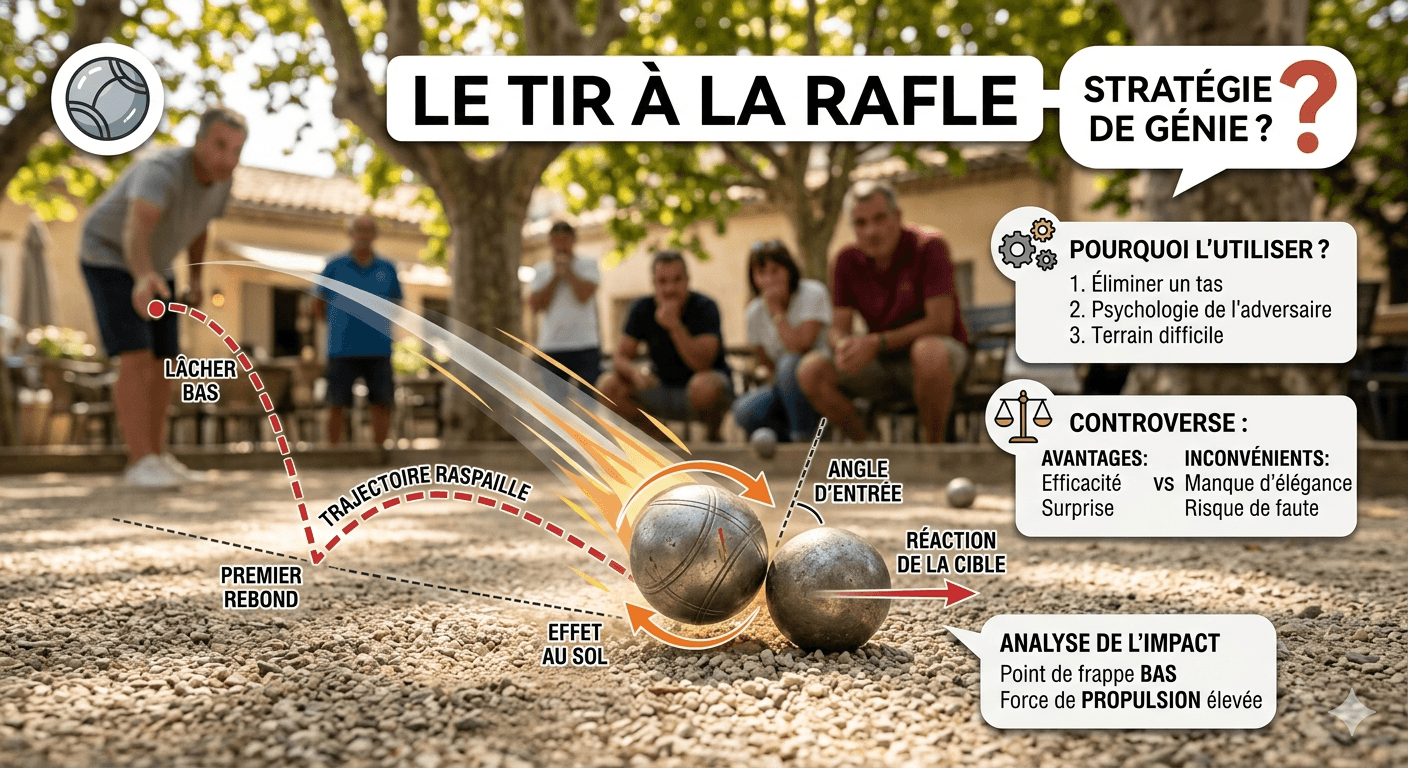
The rolling shot is not a poorly executed high shot. It's a distinct gesture with its own parameters. The four main differences from the high shot concern the release height, the speed, the aiming axis and the follow-through.

1 Very low release height Unlike the high shot, where the release is made at hip height or higher, the rolling shot requires a release low, very close to the ground — the bowl must touch the terrain within 50 cm to 1 metre after the release to start rolling immediately. A release that is too high creates too large a flight arc and the bowl bounces instead of rolling. 2 Calibrated speed — slower than the high shot The rolling shot travels by rolling, not flying — it loses energy to friction with every metre travelled. To reach the same bowl at the same distance, the initial speed must compensate for the friction loss. In practice, the rolling shot is thrown with slightly more force than intuition suggests, especially on hard terrain where the roll is long. 3 Aiming axis — aim for the edge of the bowl, not its centre For a carreau or a controlled displacement, the rolling shot generally aims at the lower side of the opposing bowl rather than its centre of mass. A bowl arriving horizontally and striking the centre tends to "push" the opponent in front of it. Striking slightly to the side generates a departure angle that moves the opposing bowl sideways — sometimes more useful tactically. 4 Follow-through — accompany toward the ground The follow-through of the high shot follows the bowl's trajectory forward and upward. For the rolling shot, the follow-through must accompany forward and slightly downward — guiding the bowl toward its skimming exit. A follow-through that is too high is often the cause of a bowl that takes off instead of rolling. 5 Position in the circle — further forward To make the low release easier, some shooters position themselves slightly further forward in the circle qu'ils ne le feraient pour un fer — cela abaisse naturellement le point de lâcher en fin de balancier. Ce décalage est subtil (5 à 10 cm) mais significatif pour la trajectoire de sortie de la boule.

The 4 variants of the rolling shot

➡️ The direct rolling shot

The bowl rolls in a straight line from the circle to the target bowl, with no noticeable bounce. The simplest and most predictable trajectory. Works ideally on hard, flat, clear terrain.

🟢 Accessible ↗️ The half-range rolling shot

The bowl follows a very short arc before touching down at mid-distance, then rolls the rest of the way. A hybrid between the short high shot and the rolling shot — lets you clear a slight obstacle halfway while still finishing with a roll.

🟠 Intermediate ↪️ The angled rolling shot

The bowl is deliberately thrown on an axis slightly offset from the target bowl, using a bounce off the ground or an allied bowl to correct its trajectory and reach the target from an unexpected angle. Demands advanced terrain reading.

🔴 Expert 🔄 The clearing rolling shot

The bowl is thrown to deliberately sweep several opposing bowls in a line. Not a targeted carreau — a zone clearance. Used when the opponent has several bowls clustered together and you want to move them all at once with a powerful shot.

🟠 Puissance

On which terrains the rolling shot excels

TERRAIN COMPORTEMENT DE LA RAFLE NOTE 🪨 Terrain sec dur et compact Roulement long et prévisible. Peu d'absorption. La rafle directe est idéale — elle garde sa vitesse jusqu'à la cible et l'impact est propre. ★★★★★ 🪨 Terrain caillouteux ou irrégulier La rafle navigue les irrégularités mieux que le fer qui rebondit imprévisiblement. Les cailloux dévient la boule mais aussi les boules adverses. Terrain typique où la rafle surpasse le fer. ★★★★★ 🌿 Herbe rase et compacte Roulement modéré avec légère friction. La rafle tient bien sa trajectoire. Légère augmentation de la force nécessaire. Terrain qui convient bien à la rafle avec calibration. ★★★★☆ 🟡 Sable fin ou gravillon Forte absorption. La rafle perd rapidement sa vitesse. Atteindre la cible à distance normale demande une force excessive qui rend le contrôle difficile. Le fer est préférable sur ce type de surface. ★★☆☆☆ 🌧️ Terrain humide après pluie La boue ralentit fortement. La rafle s'embourbe à mi-chemin. Le tir au fer est nettement plus adapté sur terrain détrempé — la boule vole au-dessus de la surface absorbante. ★★☆☆☆ ⬆️ Terrain en pente descendante La pente accélère le roulement — la rafle arrive vite et fort. Avec calibration, la rafle descendante est redoutable car la boule prend de la vitesse naturellement. Risque de dépasser si mal dosée. ★★★★☆

Decision tree — high shot or rolling shot?

🌳 DECISION TREE — CHOOSING YOUR SHOT 🌍 Is the terrain uneven or stony? → YES → ✓ ROLLING SHOT recommended NO → Next question ↓ 🌬️ Is there a strong crosswind (>20 km/h)? → YES → ✓ ROLLING SHOT recommended NO → Next question ↓ 🎳 Can the opposing bowl be reached from a ground-angle? → NO → 🔵 HIGH SHOT mandatory YES → Next question ↓ 🌧️ Is the terrain soft, sandy or waterlogged? → YES → 🔵 HIGH SHOT recommended NO → Next question ↓ ⚠️ Are your own bowls in play around the target bowl? → YES → 🔵 HIGH SHOT safer NO → ✓ HIGH SHOT or ROLLING SHOT, by preference 🏆 The complete player's weapon

The complete player doesn't ask himself "can I play the rolling shot?" — he asks "is the rolling shot the best shot for this precise situation?". That means having both in your arsenal at a high enough level to use them under pressure. Mastering the rolling shot isn't about using it often — it's about having it available when conditions demand it. The best shooters on uneven terrain are often excellent rolling-shot players. Not by default, but by adaptation.

An exercise to work on your rolling shot

01 The corridor rolling shot — working on axial accuracy 📍 Hard terrain ⏱️ 15 min 🎯 Accuracy and force

The aim is to work simultaneously on axial accuracy (the bowl rolls on the intended axis) and on force calibration over different distances. The corridor imposes the lateral constraint that forces an aligned throw.

Set up the corridor: lay out two parallel rows of bowls (or two ropes) spaced 30 cm apart, over 5 to 8 metres in length. This corridor materialises the axis of the rolling shot — the bowl must travel through it without touching the edges. Place a target bowl at the end of the corridor. Throw aiming for a low release (hand close to the ground at the moment of release) and observe whether the bowl stays in the corridor throughout its trajectory. Analyse the corridor exits: if the bowl exits to the left, the arm's axis is deflected to the left. If it exits after 3 metres, the bowl may have bounced too much (release still too high). Adjust one parameter at a time. Vary the distances: start at 5 metres then lengthen to 7 then 9 metres. The same force doesn't suit all three distances — the exercise calibrates your feel for speed for each rolling-shot distance. Measure: out of 20 throws at 7 metres, count the percentage of bowls that reach the target while staying in the corridor. Initial target: 50%. Intermediate target: 70%. Consistency is the sign that the rolling shot is ingrained. ⚠ The rolling shot is no excuse for lacking a high shot

Working on the rolling shot is legitimate and useful. But it must not become a permanent substitute for aerial shooting. A player who only masters the rolling shot is limited in situations where the terrain is soft, where the high shot is mandatory, or where surgical precision on a single bowl is needed. The goal is to master both at a level usable in competition — the context will decide.

📖 LE LIVRE DE PAQUITA Devenir un tireur complet — fer, rafle et lecture de jeu

High-shot technique, rolling-shot technique, terrain reading, the tactical decision tree, managing complex situations... Paquita's book covers it all with 100 numbered exercises and level-based protocols.

📦 Order on Amazon

FAQ — Your frequent questions

Yes, with no restriction. The FIPJP and FFPJP rules impose no constraint on the bowl's trajectory after the release — the only obligation is that the feet stay in the circle and that the bowl is thrown from that circle. The rolling shot, the high shot, the front shot, the half-high shot — all these trajectories are legal. No rule requires the bowl to fly before reaching its target. The only rule is that the bowl must leave the regulation circle. Yes, but it's less systematic than with a high shot. The carreau (the bowl stays in place of the opposing bowl) is harder to achieve with a rolling shot because the bowl arrives horizontally and tends to displace both bowls or push the opposing bowl in front of it. To get a carreau on a rolling shot, you need precise speed and a centred impact — enough force to displace the target, but not enough for the rolling bowl to bounce far away. It's technically possible and sometimes spectacular, but demands precise calibration. The best answer is the result. If your rolling shot reaches the target bowl in a situation where the high shot would have failed, no comment withstands the score. Off the terrain, it can be useful to explain the tactical reasoning — "I chose the rolling shot because the terrain is uneven and the wind might have deflected a high shot". This explicit reasoning shows it's a chosen decision, not a compensation. The cultural resistance to the rolling shot is real in some clubs — confronting objective results is the only solid argument. What is called a "rolling shot" in shooting (a roller up to the opposing bowl) corresponds in pointing to the "rolled point" — the bowl covers most of the distance by rolling rather than flying. It's the natural technique of pointers who play a "rolled" point rather than a "lofted" one. The principles are the same: low release, skimming trajectory, hard and compact terrain for it to work well. On soft terrain, the rolled point suffers for the same reasons as the rolling shot. See our article on the science of the throw. 📎 Articles liés Equipment Choosing your bowls — hardness and behaviour on the rolling shot Equipment Top 3 best shooter boules 2026 Rules FFPJP rules — what's allowed in shooting Rules The one-minute rule — don't hesitate too long Rules 2026 playing distances — rolling shot and extreme distances Tools Free PetanqueLand tools

© Pétanque by Paquita — petanqueland.fr · 📖 Paquita's book on Amazon
Share Follow

📬 Paquita's pétanque newsletter

New articles, videos, free tools and offers — straight to your inbox.

← Previous articleThe pétanque survival kit: The essential accessoriesNext article →Pointing with the left hand in pétanque: Why (and how) to train?
← Back to news

About PétanqueLand

PétanqueLand.fr is the fun, practical site devoted to pétanque: videos, humour, photos & memes, free tools and news.

Find Pétanque by Paquita and join the community!

Categories

  • ⭐ Celebrities
  • 🎥 LIVE training
  • ❓ Questions & Tips
  • 🎭 Parodies
  • 🐕‍🦺 Animals
  • ⚖️ Refereeing
  • 🍻 Refreshment bar
  • 🎬 Series
  • 😂 Pétanque humour
  • 🤯 WTF moments
  • Most viewed
  • What's new

Information

  • Home
  • SHOP
    • Pétanque Book Shop
    • Pétanque Player Clothing
    • Pétanque Objects & Decor
    • Pétanque Gift Ideas
    • See all
  • ⭐ The Pétanque Software
  • Videos
  • 🏛️ OFFICIAL
    • Upcoming competitions
    • Results & calendar
    • Rules explained
  • FREE Zone
    • Free online software
    • Free tools
    • Lab
  • News by Paquita

Follow Paquita

Find Pétanque by Paquita on my social networks:

Facebook
TikTok
YouTube
Instagram
X

📸 Photos & memes
🎯 Pétanque videos
😂 Humour & WTF moments
🧰 Free tools

© 2026 PetanqueLand — The craziest boulodrome on the web. Pétanque videos, humour, refereeing & debates. Contact · Legal notice · Privacy Join me: Facebook · TikTok · YouTube · Instagram · X