Actualités · 6 June 2026
The role of your partner's gaze in decision-making
A partner's gaze can validate, doubt, paralyse or reassure — often withoutThe mechanics of the gaze between partners
👁️ WHAT HAPPENS DURING A GAZE EXCHANGE BETWEEN PARTNERS 🎯 NEUTRAL GAZE No particular emotional content. Simple visual check of the partner's presence. Does not influence the decision of the player about to throw. NEUTRAL ✨ POSITIVE GAZE Confidence transmitted visually — a discreet nod, a calm and direct gaze. Reinforces the decision already made and stabilizes the mental state before the throw. REINFORCES 🤔 QUESTIONING GAZE Slightly raised eyebrow, slight tilt of the head. Suggests a question without asking it. Can be useful or disruptive depending on the moment and the robustness of the player's decision. AMBIGUOUS 😟 DOUBT GAZE Furrowed brows, evasive or averted gaze. Involuntarily transmits concern about the chosen shot. Can make a player who had decided change their mind — often to the detriment of the result. DESTABILIZES 😬 PRESSURE GAZE Intense, fixed gaze, sometimes accompanied by an expectant or tense expression. Turns an ordinary bowl into a "bowl not to be missed" — by creating the very pressure it seeks to avoid. PARALYZES 🎙️ PAQUITA ON THE PARTNER'S GAZE "Partners often believe they communicate only when they speak. But their eyes speak all the time — especially in the moments when they try to stay silent. A partner who watches with furrowed brows while the other prepares their throw has already said something. And that something, the player about to throw has received it. Will it help them or interfere with them? It depends entirely on what the partner sent — and whether they knew they were sending it." — PaquitaThe 6 types of gazes and their effects on the decision
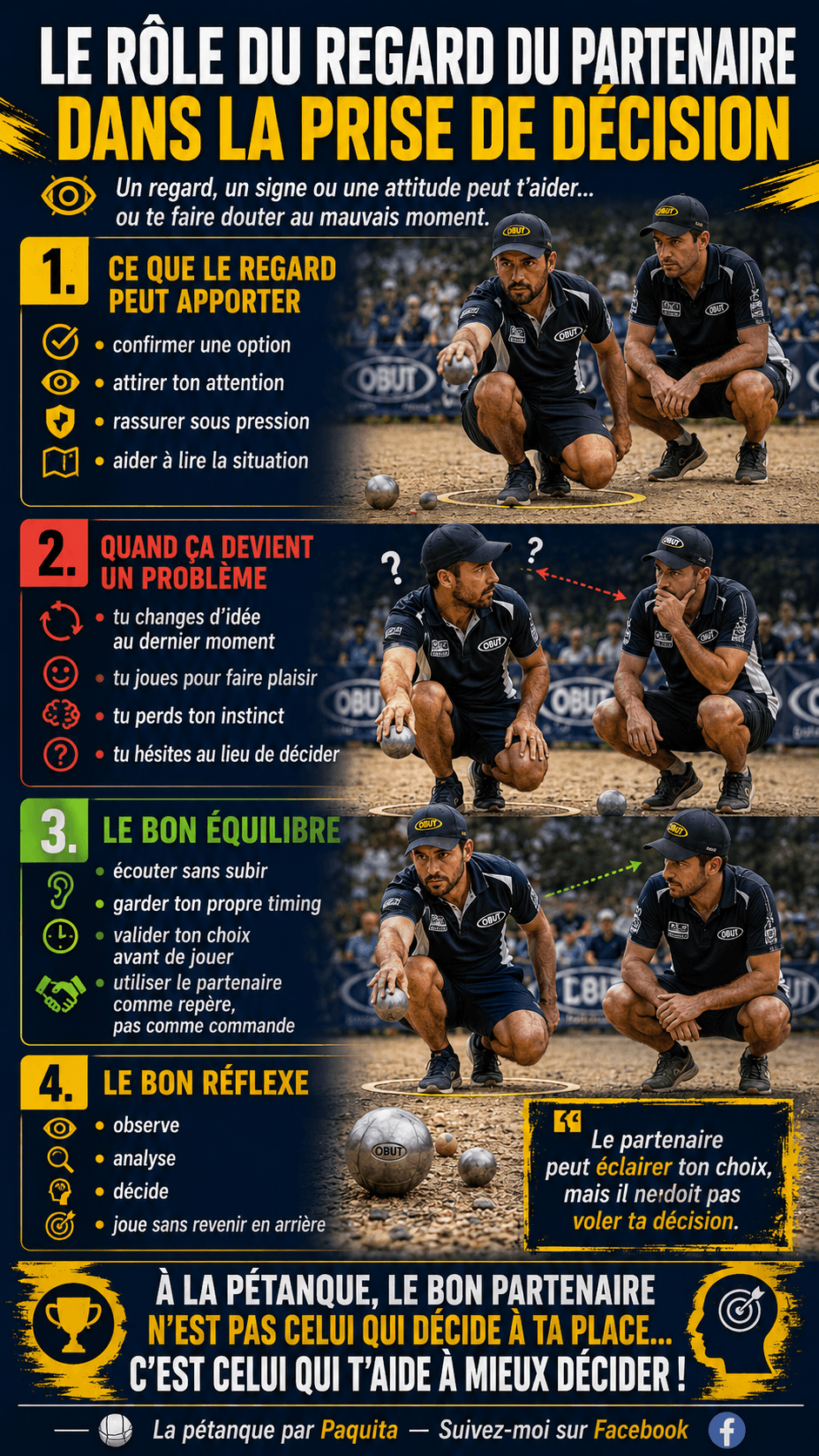
✅ 1. The validating gaze — "you're going to do just that" POSITIVE CONFIDENCE WHAT THIS GAZE TRANSMITS A calm, direct gaze, possibly accompanied by a small nod — communicates to the partner about to play that their decision is validated and that confidence in them is complete. This gaze does not judge the chosen shot — it validates the player's ability to pull it off. It's an important nuance: "this shot is good" and "you can pull off this shot" are two different messages. The validating gaze transmits the second, which is far more valuable for the pre-throw mental state. → How to send it: position yourself slightly in the partner's field of vision, hold a calm and direct gaze for 1 to 2 seconds, possibly a brief nod. No forced smile, no exaggerated expression — sobriety reinforces the credibility of the signal. THE MEASURABLE EFFECT ON THE TECHNIQUE A player who receives a validating gaze before an important throw enters the circle with a confirmed decision and a stabilized mental state. Their technique starts from a state of confidence rather than from a state of doubt — and confidence is precisely the state that allows the technique's automatism to function without conscious interference. The effect of the validating gaze is particularly strong on players who naturally tend to seek their partner's approval before high-stakes throws. → To remember: the validating gaze is the simplest and most effective form of non-verbal support — and also the most rarely used deliberately. Most partners look at the terrain rather than their teammate at the very moment this support would be most useful. 🤔 2. The doubt gaze — the concern transmitted without words NEGATIVE DOUBT TRANSMITTED HOW IT HAPPENS INVOLUNTARILY The doubt gaze is almost never intentional. It arises from an evaluation of the shot the partner is about to make — "this shot is risky", "this bowl is hard to place there" — and this evaluation shows up on the face before the player has time to filter it. Slightly furrowed brows, a gaze that slides between the target and the partner, a slight tension of the features: these signals are readable in a fraction of a second — and they are readable even without the receiver being aware of it. → Warning sign: if you find yourself mentally evaluating your partner's shot just before they enter the circle, your face is probably transmitting that evaluation without you knowing. THE EFFECT ON THE PARTNER'S DECISION A player who catches a doubt gaze from their partner at the moment they are about to play receives non-verbal information that says "I'm not sure this shot is the right one". This information can make them change their decision mid-preparation — often with no real tactical reason, purely as a reaction to the perceived signal. Yet a shot decided then modified at the last second is almost always less well executed than a shot decided and maintained. The doubt gaze creates precisely the conditions for the miss it feared. → Practical rule: if you disagree with the shot chosen by your partner, the moment to say so is before they enter the circle — not during their preparation. A clear verbal comment is infinitely better than an endured doubt gaze. 😬 3. The pressure gaze — turning an ordinary shot into a decisive one PRESSURE PARALYSIS THE MECHANICS OF PRESSURE BY GAZE The pressure gaze is more intense than the doubt gaze — it does not transmit "I'm not sure" but "you can't miss this". It is a fixed, tense, expectant gaze. It turns the shot to be played into an emotional event rather than a technical action. The player who receives this gaze physically feels the stakes rise — a tension in the arm, a tightness in the shoulders, an acceleration of the heart rate. These physiological states are precisely those that degrade the automatic technique. → Warning sign: if you look at your partner with an intensity that reflects the importance of the shot, you amplify precisely the pressure you wish they didn't have. The intention and the effect are opposite. WHY THIS GAZE IS PARTICULARLY FREQUENT ON DECISIVE SHOTS On a high-stakes bowl (last end, reduced gap), the waiting partner feels the pressure of the moment themselves — and their gaze reflects that emotional state. The waiting player involuntarily transmits their own tension to the player about to throw. The decisive bowl therefore receives an extra layer of pressure from the partner — at the exact moment when what is most needed is calm and neutrality. This is one of the mechanisms by which teams collapse collectively on important shots. → To remember: on decisive shots, the waiting partner's gaze should be as calm and neutral as possible — not the most intense. The neutrality of the gaze is an active form of support on high-stakes shots. 🔍 4. The shared-analysis gaze — reading the terrain together TEAM TACTICS WHEN THIS GAZE IS VALUABLE This gaze happens between bowls, when both players observe the terrain to decide on strategy together. It is a shared visual reading of the play — both gazes land on the same elements (opponent's bowl, jack, free zones) before briefly meeting to validate or confront the respective readings. This type of visual exchange is one of the richest forms of non-verbal communication in a team — and one of the most underused. → How to use it: deliberately look at the terrain together, then briefly cross the partner's gaze to mean "I saw the same thing" or "what do you think?". This shared gaze often replaces an entire conversation in a much quicker and more fluid way. SHARED VISUAL READING AS A TACTICAL TOOL A team that shares its visual readings of the terrain in silence develops a form of tactical synchronization that goes beyond simple verbal communication. Both players start to "see" the terrain in a similar way — which reduces disagreements on decisions, improves the consistency of choices and reinforces the feeling of being a team. It is this visual synchronization, observable in teams that have played together for a long time, that sometimes gives the impression that the partners "understand each other without speaking". → To remember: shared visual reading is trained — by verbalizing observations during training, then sharing them through the gaze in tournaments. Teams that have got into the habit of looking at the terrain together before deciding make fewer separate-reading errors. 🤝 5. The recovery gaze — erasing the mistake without a word RECOVERY SUPPORT ITS ROLE AFTER A MISTAKE Immediately after a missed throw, the player often instinctively seeks their partner's gaze — a micro-evaluation of their reaction. This gaze received in the 2 seconds after a mistake is one of the most influential signals in the game. A neutral or brief gaze, accompanied by a mini-gesture of "it's sorted, we move on", can cut the emotional spiral before it begins. A gaze loaded with disappointment or frustration, on the contrary, worsens it, often disproportionately. → How to send it: after a partner's mistake, hold a calm and brief gaze — perhaps accompanied by a very discreet "it's okay" sign. The message is "it happens, it's behind us, we play on". No excessive consolation, no coldness — just benevolent neutrality. THE DIFFERENCE BETWEEN CONSOLATION AND RECOVERY There is an important difference between consoling the partner (message: "that was hard, it's normal to miss") and allowing them to recover quickly (message: "it's done, we're moving on"). Consolation, although intentionally benevolent, keeps the player in the emotion of the mistake by giving it attention. Recovery pulls them out of it quickly by normalizing the mistake and refocusing on the next action. On important ends, quick recovery is almost always more useful than prolonged consolation. → Test: compare your partner's reaction to one of their mistakes (disappointment gaze? recovery gaze?) with the observable effect on the next bowl. The correlation is generally strong and revealing of the team's communication patterns. 👻 6. The absence of gaze — the invisible partner ABSENCE ISOLATION WHY THE ABSENCE OF GAZE IS A SIGNAL A partner who never looks at the other — neither before throws, nor after mistakes, nor during terrain analysis — sends a signal of indifference or withdrawal into themselves. It is almost never intentional — it is often the manifestation of an excessive focus on the terrain or of an internal emotional state (frustration, fatigue, worry) that diverts attention from the partner. But the effect on the "ignored" player is real: the feeling of playing alone, the loss of team dynamics, decisions made without collective grounding. → Warning sign: if you notice that your partner never meets your gaze for several consecutive ends, it's a sign that something is wrong — either in the game or in their internal dynamics. It's the moment for a short phrase to restore contact. THE TEAM THAT "PLAYS ALONE" — SYMPTOM AND CAUSE Some teams technically play together but do not form a team mentally — each player plays "in their head" with no real connection to the other. The absence of exchanged gazes is both a symptom and a cause of this phenomenon. Symptom because it reflects the lack of connection. Cause because it maintains each player's isolation in their own thoughts and emotions, depriving the team of the mutual emotional regulation that shared gazes allow. Restoring gaze exchanges can be enough to relaunch the collective dynamic. → To remember: the absence of gaze is rarely neutral in a tense game. It almost always signals an emotional state or a difficulty that words are not yet able to express — and which can often be addressed by a brief but present gaze. 👁️ The ideal partner looks at the right moment, not all the timeA partner who constantly watches the other creates as much pressure as one who never looks. The useful gaze between partners is targeted and intentional : validation before an important throw, recovery in the 2 seconds after a mistake, shared reading before a complex decision. Outside these moments, looking at the terrain rather than the partner is often the best thing to do. The quality of the gazes takes precedence over their frequency.
Using and reading the gaze as a team
✅ THE GAZES THAT STRENGTHEN THE TEAMValidating gaze before an important throw: short, calm, direct. Confirms that the decision is right and that confidence is there. Particularly useful on high-stakes bowls or after a series of mistakes.
Shared-reading gaze of the terrain: shared between the two players looking at the same element of the terrain, then crossing to validate the common reading. Builds tactical synchronization.
Recovery gaze after a mistake: neutral, brief, accompanied if possible by a micro-sign of "we move on". Prevents the emotional spiral from setting in after a miss.
→ These gazes are deliberately trained — they do not come naturally to all players. ❌ THE GAZES THAT WEAKEN THE TEAMDoubt gaze during the circle preparation: furrowed brows, a hesitant gaze — involuntarily transmitted while the partner prepares their technique. Can make them change their mind at the last second.
Pressure gaze on decisive shots: fixed, tense, expectant — creates precisely the tension it seeks to avoid. Turns the shot into an emotional event.
Disappointment gaze after a mistake: keeps the player who missed in the emotion of their mistake instead of letting them detach from it for the next bowl.
→ These gazes are almost always involuntary — identifying them in yourself requires external observation work (video or partner feedback). 🎯 HOW TO DELIBERATELY USE THE GAZEBefore an important throw: position yourself in the partner's field of vision and deliberately send them a calm and open gaze — not a forced smile, not an absent gaze. The sobriety of the signal reinforces its credibility.
During terrain analysis: deliberately look at the same elements as the partner, then briefly cross gazes to synchronize the readings.
After an opponent's mistake: immediately, a neutral and brief gaze. No visual comment on the mistake — just the neutrality that means "we move on".
→ The deliberate gaze requires attention on the partner, not only on the terrain — a change of habit for many players. 📖 HOW TO READ THE PARTNER'S GAZEIdentify your own pattern of receptivity: do you seek your partner's gaze before important throws? Does their gaze change your decision? These answers define your level of sensitivity to the opposing gaze.
Distinguish evaluation from support: is a partner who looks at you intensely evaluating the shot or sending you confidence? The distinction comes from the tension or the serenity of the gaze — not from its intensity.
Don't over-interpret: a partner absorbed in their own thoughts is not necessarily in disagreement with your decision — they may simply be focused on the terrain.
→ Reading the gaze improves with knowledge of the partner — it is less reliable in new pairings. 🔑Communication by gaze between partners is all the more influential because it is invisible to the players themselves. A doubt gaze involuntarily transmitted is not "felt" by the one who sends it — but its effect on the receiver is real. This is why work on the gaze as a team necessarily goes through external observation: training video, partner feedback, or observation by a third person. What is not seen cannot be corrected.
The gazes to watch out for — the harmful patterns
🎭The partner who "plays" the shot on their face Some partners accompany every opponent's throw with an expressive expression — raised eyebrows if the shot is risky, a grimace if the bowl goes badly, a sigh of relief if it goes in. These facial reactions are a running commentary on the partner's play — which they perceive even when they focus on their target. Over the course of a game, this constant non-verbal commentary is exhausting and destabilizing. → Test: film yourself during a training session and observe your own expressions during your partner's throws. What the video reveals is often surprising compared to the image you think you give. ↔️The gaze that flees at the critical moment Some partners look away just before the partner throws — as if they didn't want to "see" the result, or as if looking was too emotionally loaded. This visual flight at the critical moment involuntarily transmits "I'm not sure this is going to go well" — exactly the opposite of the signal that would be useful. The throwing player catches this flight and may lose their concentration on the target to seek the partner's absent gaze. → Test: on important bowls, note whether you hold your gaze in the partner's direction or instinctively look away. The visual flight is often a response to personal pressure, not a conscious decision. ⏱️The overly prolonged gaze before the throw A partner who looks too long before the other throws creates a form of surveillance that can turn the preparation into an examination. Being "looked at" too intently during your throwing routine can activate conscious over-control — exactly like when you know you are being watched and the usual technique loses its naturalism. The useful gaze is brief and targeted at the right moment — not a constant monitoring of the preparation. → Test: if you feel discomfort or slight tension during your preparation when your partner looks at you, it's the signal that their gaze is too prolonged or too intense. Communicate this observation directly. 🔄The desynchronization of gazes on the terrain Two partners looking at different elements of the terrain during the inter-end analysis will often start from divergent readings — and making a decision from two different readings produces either a suboptimal compromise or a disagreement. Visual synchronization of the terrain (looking at the same elements at the same time) is the prerequisite for good collective decision-making. It does not impose itself — it is built through the habit of looking together. → Test: after a game, exchange with your partner about what they had seen on the ends where you had disagreements. Radically different terrain readings indicate a visual desynchronization to work on.Building a team visual code
👁️ TEAM VISUAL CODE — DEFINING THE AGREED GAZES 5 visual signals to define before the game — for reliable non-verbal communication ✅ Signal 1 — Validation: "go, I trust you" A direct and calm gaze, possibly accompanied by a very discreet nod. Means: "your decision is good, I have nothing to add, do it". To be sent before important throws when the partner seems to be seeking confirmation. Agree on this signal with the partner in advance — so that it is interpreted as validation, not as indifference. ⏸️ Signal 2 — The hold: "I want us to talk about it first" A slight movement of the head or a gaze toward the partner before they enter the circle — meaning "before throwing, come let's talk". This signal prevents unvoiced doubt from becoming a doubt gaze during the preparation. It takes the disagreement out of the non-verbal channel to put it into the verbal channel, which is far more reliable. 🔄 Signal 3 — Recovery: "it's behind us" A neutral and brief gaze in the 2 seconds after a mistake — perhaps accompanied by a very small hand gesture (sweeping sideways). Means: "it happened, it's done, we're moving on". This signal is deliberately sober — no excessive consolation, no coldness. Just the quick normalization that lets the team stay in the present moment. 🔍 Signal 4 — Shared reading: "do you see what I see?" Deliberately look at the same element of the terrain as the partner (a specific bowl, the jack, a zone), then briefly cross gazes. This signal initiates a shared tactical analysis without a word. If the partner nods, the reading is synchronized. If they look elsewhere or seem uncertain, it's the signal that a short conversation is needed. 🆘 Signal 5 — The alert: "I need a moment" A brief gaze toward the partner accompanied by a discreet agreed sign (hand on chest, a discreet visible breath) — meaning "I'm struggling mentally, I need to slow down". This signal lets the player in crisis say it without words — and lets the partner deliberately slow the pace and not transmit extra pressure during recovery.Exercises to develop non-verbal communication
01 The "observed gaze" session — filming yourself to see what you send 📍 Filmed training in pairs ⏱️ 1 h + 20 min debriefing 🎯 Identify your involuntary gaze patterns during a real gameThe vast majority of problematic gazes between partners are completely unconscious. A filmed session lets you observe them objectively — often with surprising results that durably change behaviours.
Film a complete training game from a position that captures both players' faces during the throws. Do not film yourself to correct the technique (it's another exercise) — but to observe facial expressions and gaze exchanges during key moments: before throws, during preparation, after mistakes. Watch the video together, pausing after every important throw. Ask yourself three questions: what gaze was sent just before the throw? What gaze was received after the result? And: does this gaze match the intention of the player who sent it? The gap between intention and perception is often revealing. Identify the 2 to 3 most frequent gaze patterns in each — and assess whether these patterns are more reinforcing or more weakening. This identification is the most valuable work of the exercise — unidentified patterns cannot be modified. Replay a sequence of the game by deliberately applying the 5 signals of the visual code defined in this article. Observe whether behaviours change — and whether the partner receiving the new signals perceives the difference. This live test validates or invalidates the usefulness of the proposed visual code for this specific team. 02 The "silence + gaze" — playing without speaking to force visual communication 📍 Training in pairs ⏱️ 3 games of 7 ends 🎯 Develop non-verbal communication by removing the verbal channelBy temporarily removing verbal communication during training, the development of the non-verbal channel is forced — and you discover which gazes are truly informative versus which are visual noise.
Play 3 games of 7 ends with a strict rule: no verbal communication during the ends. Zero advice, zero commentary, zero "good bowl". Only gazes and body gestures are allowed. This constraint immediately forces a heightened awareness of the non-verbal signals sent and received. Observe what happens naturally: what non-verbal signals emerge spontaneously between the two players? What gazes develop to replace the usual commentary? Some teams discover that they communicate more effectively in silence than by talking — because the words often interfered with the flow of concentration. After the 3 games, a 10-minute verbal debrief: which gazes worked well? Which created confusion? Were there moments when the absence of verbal language created a real tactical problem? This debriefing identifies the gaps in the non-verbal code of the team and the situations where verbal communication remains indispensable. Return to a normal game with verbal communication — while deliberately keeping the non-verbal signals developed during the exercise. The final objective is not to play in silence but to have a rich and reliable non-verbal channel that complements verbal communication rather than ignoring it. 🤝 Two players who truly "see" each other play better togetherThe best pétanque teams are not the ones who talk the most — they are the ones whose players truly "see" each other during the game. Seeing each other means being attentive to the partner's state, not only to the terrain. Are they confident? Are they under pressure? Do they need a recovery or validation signal? This attention to the partner, which passes largely through the gaze, is what distinguishes a pairing of two individual players from a true team.
📚 PAQUITA'S BOOKS Progressing at pétanque — Paquita's guides 🎯 TACTICS — MENTAL — TECHNIQUE Playing everywhere — from technique to on-terrain tactics Verbal and non-verbal team communication, cohesion and tactical synchronization, managing difficult moments as a team — the complete guide to playing together rather than side by side. 📦 Amazon 💥 SHOOTER — TECHNIQUE — CONSISTENCY Become a formidable shooter Maintaining technique under the pressure of the opposing gaze, mental independence from the partner's signals, building a stable shooting technique regardless of the emotional environment. 📦 Amazon 🎳 POINTER — AWARENESS — MARKERS The art of pointing — precision and consistency Concentration on the target despite the partner's signals, managing non-verbal pressure in the circle, maintaining the decision in the face of doubt or pressure gazes — the guide for the serene pointer. 📦 Amazon 🧠 MENTAL — ROUTINE — METHOD Pétanque by method Non-verbal team communication, building the visual code between partners, developing mutual emotional regulation — progressing with method by cultivating collective cohesion. 📦 Amazon