Actualités · 17 May 2026
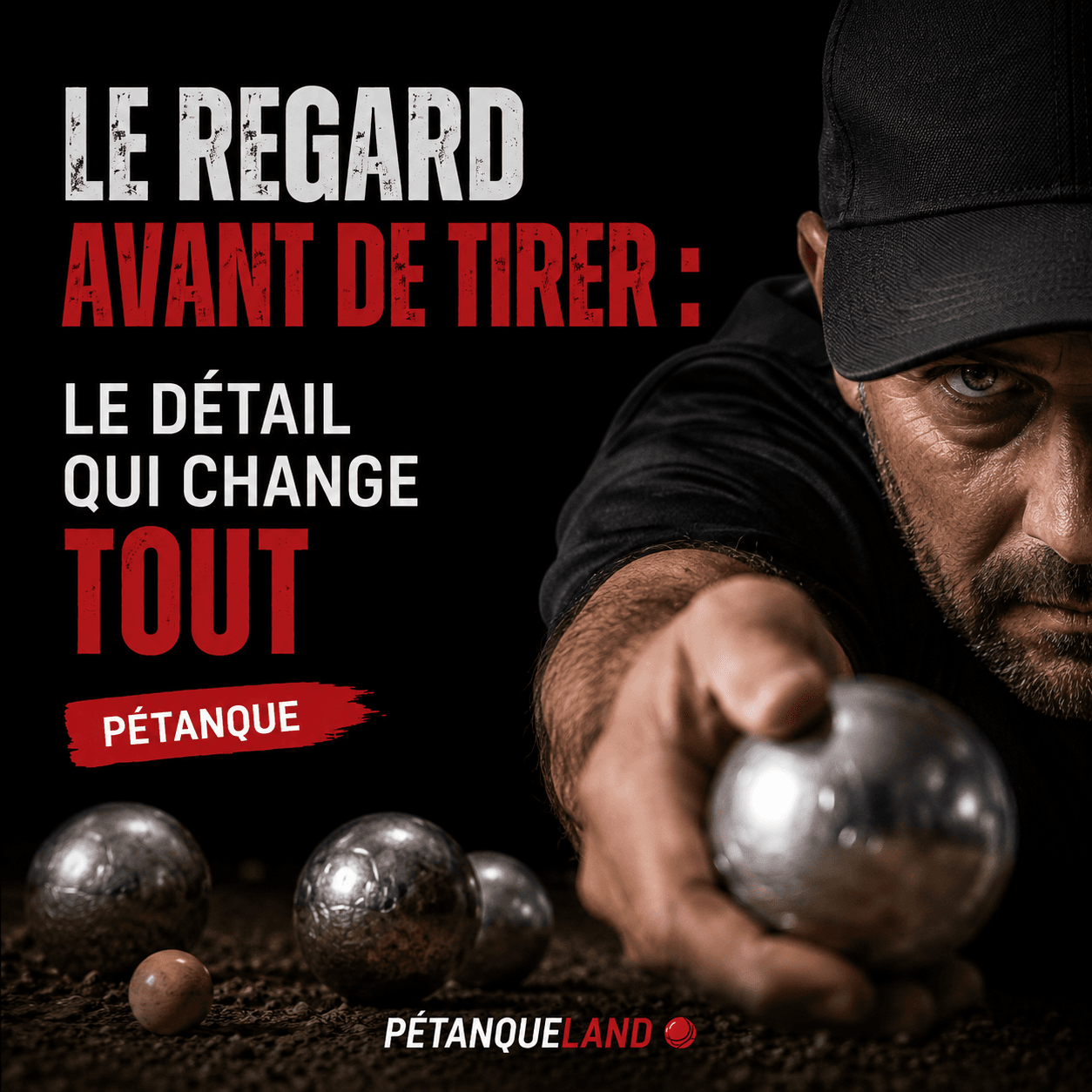
The gaze before shooting: the detail that changes everything (Pétanque)
Where exactly are you looking at the moment you shoot? The target boule? The jack? The ground between the two? Most shooters don't really know. And yet that gaze determines more than the action itself.Where exactly to look — the 3 zones and their effects
There isn't just one way to look before shooting — there are several, with very different results. These 3 zones summarize the available options and their impact on precision.
🎯 IMPACT POINT ON THE BOULE Recommended zone — maximum precisionFocus the gaze on a precise point on the surface of the target boule — the exact spot where the shot boule must make contact. This point is generally the upper or middle area of the boule visible from the throwing circle.
This precise focus forces the brain to calculate the trajectory needed to reach this exact point — and the arm executes that calculation. The more precise the target, the more precise the calculated trajectory.
✅ Result: centered shots, maximum energy transfer, consistent carreaux. This is the aim of good shooters. 🟡 THE WHOLE BOULE Frequent zone — variable resultsLook at the target boule as a whole — "aim at the boule" without a precise point. The boule is a sphere 7 cm in diameter. The eye must choose a point somewhere on this surface — if it hasn't done it consciously, it does it variably with each throw.
This is the most common gaze zone among amateur shooters. The results are correct on good days, insufficient when concentration drops — because the imprecision of the target reverberates into imprecision of the shot.
⚠️ Result: correct but scattered shots. Frequent off-center impact. Difficulty reproducing the good shots. ❌ THE JACK OR THE ZONE Error zone — systematically imprecise shotsLook at the jack behind the target boule, or a vague zone between the circle and the target. The brain sends the arm toward what the eyes fix on — if the eyes are on the jack, the boule goes toward the jack, not toward the target boule.
This is often what happens under pressure: the eyes drift toward the jack (bigger stake) or toward the desired impact zone on the ground, and the boule follows the eyes — missing the target boule with a "clean" but misdirected shot.
❌ Result: regularly deflected shots, often "off-target" despite a good motion. Frequent under pressure and on important shots. 🎙️ Paquita on the gaze in shooting "I asked several shooters to explain to me precisely where they look before shooting. The answers were all vague — 'the boule', 'the target', 'where I want to hit'. When I asked them to point with their finger at the exact point they would aim at on that precise boule in front of them, most hesitated. Some pointed at the top, others the center, others really didn't know. And yet they shot consistently. The problem: they had an approximate gaze that gave approximate results. The rare ones who immediately showed me a precise point with conviction — those were the best shooters. The correlation was perfect." — PaquitaWhy the gaze determines the trajectory — simple neuroscience
🧠 NEUROSCIENCES APPLIED TO SHOOTING What the brain does with visual information 👁️ Foveal vision — the precision center The central part of the retina (fovea) offers maximum resolution within an angle of about 2°. Everything outside this small angle is processed with less precision. For a shooter at 7 metres, this angle covers about 24 cm — that is, slightly larger than the target boule (7 cm). The fovea is able to focus on a precise point of the boule if asked to do so. 🔗 The oculomotor loop — the eyes command the arm The brain uses the position of the eyes as the main reference to guide limb movements. In a ballistic motion (shot), the arm "follows" the direction of the gaze — not the other way around. It's not a metaphor: it's a documented neurological loop. If the eyes are on the target at the moment of initiating the motion, the arm goes in the right direction. If the eyes have moved, the arm follows the eyes, not the memory of the target. ⚡ The motor programming window — the last 1.5 seconds The motor program of a throw is "locked" about 1 to 1.5 seconds before execution. What the eyes do in this window determines the program that will be executed. A gaze that moves in this window — even briefly — modifies the motor program and produces a motion slightly different from the intended one. This is why a "good motion" can give a bad result if the eyes have moved in the last second. 🎯 Target precision = shooting precision The more precise the visual target, the more precise the motor program. A shooter who aims at "the center of the boule" generates a motor program with an uncertainty of ±3–4 cm. A shooter who aims at "the upper left edge of the boule" generates a motor program with an uncertainty of ±1–2 cm. The precision of the target translates directly into precision of the motion — without needing to modify anything in the technique. 🔑The practical conclusion is clear: improving the precision of the visual target improves shooting precision without touching the technique. This is why the gaze is often the most accessible and quickest lever to work on for a shooter who is stagnating despite a good motion.
The 5 most frequent gaze mistakes
① Looking at the jack instead of the target boule The jack is the stake of the end — it naturally captures attention. Under pressure, the eyes drift toward it without the player realizing it. The shot then goes slightly "toward the jack" — meaning too far, too high, or in the wrong direction depending on the setup. ⚠️ Cause: the jack is "more important" to the brain than the boule — under stress, the eyes follow perceived importance. → Fix: place your gaze on the target boule and actively hold it there until the release. Mentally frame "I'm aiming at this boule" before initiating the motion. ② Gaze drifting toward the ground (landing point) Some shooters, especially on half-height shots, fix their gaze on the ground where the boule is meant to land rather than on the target boule itself. The result: the boule goes toward the ground with a flat trajectory, missing the target boule below or grazing it without a clean carreau. ⚠️ Cause: confusion between "where the boule will land" and "where the boule should strike". These are two different points, and the gaze should be on the second one. → Fix: mentally distinguish the landing point (ground) from the target (opponent's boule). The gaze settles on the boule, never on the ground in between. ③ Blinking or closing the eyes at the moment of release A protective reflex leads some players to blink at the exact moment of release — out of habit, fear of impact, or tension. This blinking interrupts the oculomotor loop right at the critical moment — the last fraction of a second when the eyes guide the hand. ⚠️ Cause: a protective reflex against an imagined impact, or an ingrained habit. Often unconscious — the player doesn't know they're blinking. → Fix: film yourself shooting (front and side) to check. If blinking is confirmed, a drill of slow shots at short distance with attention on keeping the eyes open will decondition the reflex. ④ Unfixed gaze — eye "wandering" over the target without locking on The player looks "toward" the target boule without ever locking onto a specific point. The eye wanders over the boule's surface, the surrounding boules, the space in between — with no stable anchor. The motor program then receives imprecise information and produces an imprecise motion as a result. ⚠️ Cause: no aiming routine that forces an anchor. The gaze follows the eye's natural sweeping motion with no imposed discipline. → Fix: give yourself a precise instruction before each shot — "I'm aiming at the top quarter of this boule" — and physically anchor your gaze there before starting the pendulum. ⑤ Anticipatory gaze — looking where the boule is going before it leaves Even before the boule is thrown, the eyes move to where the player hopes to see it land or where they imagine the impact. This anticipatory gaze literally pulls the boule in the looked-at direction — often slightly offset from the target boule, toward the jack or toward the "free" space imagined for after the impact. ⚠️ Cause: visual impatience. The brain "plays" the shot in advance — the eyes follow the mental scenario before the boule has left the hand. → Correction: force yourself to hold your gaze on the target boule until you HEAR the impact — not until you see it. Wait for the sound before looking up.Different gaze for shooting and for pointing
💥 GAZE ON THE SHOTThe main target is the opponent's boule to hit. The gaze should settle on the precise impact point — generally the visible upper or mid area of the target boule depending on the shooting angle.
Recommended sequence:Identify the target boule → choose the impact point on that boule → anchor your gaze on this point for 1 to 2 seconds → start the pendulum with your gaze held steady → release → hold your gaze until the sound of impact.
Key rule: never look at the jack while preparing a shot. It will still be there afterwards — your gaze will return to it naturally. 🎯 THE GAZE IN POINTINGThe main target is the jack or the desired landing zone. But unlike shooting, the gaze in pointing has an extra dimension: estimating the distance.
Recommended sequence:Read the distance to the jack (overall gaze) → identify the target landing zone on the terrain → anchor your gaze on the jack → start the movement with your gaze held on the jack → release while continuing to "see" the jack.
Key difference from shooting: in pointing, the gaze stays on the final target (the jack), not on an intermediate landing point. The brain calculates the trajectory toward the jack. 🔄 WHAT THE TWO HAVE IN COMMONIn both cases: the gaze must be anchored on a precise point and held steady until the throw is fully executed. No shifting of the gaze in the 1.5 seconds before the release.
The universal sign of a good gaze:The player can describe precisely where their eyes were at the moment of release. If the answer is vague, the gaze was not anchored.
Practical test: after each boule, ask "where were your eyes at the moment of release?" — if the answer comes immediately and precisely, the gaze was good. ⚠️ THE TRAP IN BOTH — THE VISUAL SPLITSome players try to "see" both the target boule AND the jack while shooting, or the landing zone AND the jack while pointing. This visual split is physiologically impossible — the eyes can focus precisely on only one point at a time.
What it produces:A blurry gaze over everything, imprecise aiming, a boule that "goes somewhere in between". The visual split is the most common gaze error among intermediate players who "think" they aim well.
The rule: one boule = one visual target = one single anchor point. Never two.The gaze protocol — step by step
👁️ PROTOCOL — THE SHOOTING GAZE IN 5 STEPS Build a reproducible gaze routine on every shot Identify the target boule READING — First of all, confirm that this is indeed the boule you want to shoot — not the visually closest one, but the boule that is the tactical priority. A boule aimed at without this confirmation is often the wrong boule. Choose the precise impact point on the boule VISUAL DECISION — Decide exactly where the shot boule should strike the target boule. Upper zone for a high-lob shot, middle zone for a rolling shot, slightly off-centre if you are trying to move the boule in a precise direction. This choice must be made before stepping into the circle. Anchor your gaze on this precise point ANCHORING — 1 TO 2 SEC — Stand in the circle, find the impact point on the target boule, and keep it on the fovea. No gaze shifting, no checking the jack, no lateral scanning. The gaze is fixed on this precise point. Start the pendulum with your gaze held steady EXECUTION — The pendulum motion begins with the gaze already anchored — not at the same time as the anchoring, but afterwards. The gaze is stable, the arm follows. Any shift of the gaze during this phase redirects the shot. Hold your gaze until the sound of impact FOLLOW-THROUGH — Do not look up before hearing the metal-to-metal contact sound. This finishing point is crucial — players who look up 0.3 seconds too early (to see whether it goes through) often alter their motion in that fraction of a second. Wait for the sound.How the gaze slips under pressure — and how to hold it
⚡ GAZE AND PRESSURE — THE DERAILMENT MECHANISMS Why important shots often miss because of the eyes 😰 The gaze that "checks" before the release On high-stakes shots (12-12, final), the brain generates a "checking" impulse — the eyes briefly move toward the jack or the impact zone to "see whether it's going to go well". This 0.2-second micro-movement is enough to derail the motor programme. The shot goes "almost well" — but the micro-adjustment caused by the moved gaze sends it slightly off. 🎯 The fear of missing that draws the eyes to the stakes Under intense pressure, the brain treats the opponent's boule and the jack as "stakes" — objects with a high emotional charge. The stakes capture the eyes despite oneself. The shooter aims at the boule but under pressure, their eyes drift toward the jack or toward the space behind the target — exactly where they do not want to send the boule. And the boule follows the eyes. 🧘 The anti-drift gaze technique under pressure A precise formulation helps to maintain the gaze under pressure. Before every important shot, formulate mentally: "I'm aiming at the upper quarter of this boule — only this boule — until the sound." This three-part instruction (where, what, until when) occupies the brain with a concrete task and leaves less room for the anticipatory or checking gaze.Exercises to train the quality of the gaze
01 The blind shot — identify your current gaze 📍 Solo training ⏱️ 15 min 🎯 Know exactly where you are looking before correctingBefore working on the gaze, you need to know what it actually does — not what you think it does. The surprise is often there.
Place a target boule at 7 metres. Play 10 shots normally. After each shot, note immediately — without thinking — in one word: "boule", "jack", "ground", "blurry" or "don't know". Do not try to remember precisely — note the first answer that comes, which is always the most honest. Count the categories. If "boule" dominates with precise and consistent impact points: the gaze is generally good. If "jack", "ground", "blurry" or "don't know" appear frequently: identify the majority category — that is the error to correct first. Revealing variant: ask a partner to observe only the eyes (not the boule) and note what they see. Outside observers often identify the blink at release, the anticipatory gaze, or the drift toward the jack that the shooter themselves does not perceive. Correction phase: play 10 shots again with the single instruction to name the impact point before when starting the pendulum — "upper-left quarter", "centre", etc. Compare the accuracy of the two series. The second is almost systematically better — a direct demonstration of the effect of the gaze. 02 The "sound before sight" shot — anchor your gaze up to impact 📍 Solo or 2-player training ⏱️ 20 min 🎯 Eliminate the anticipatory gazeCorrect the most frequent and most damaging error: looking up before the boule has reached the target.
Single rule of the exercise: look up only after hearing the sound of the metal-to-metal impact. Not "when I think the boule has arrived" — after the sound. If the sound is not audible (a missed shot or terrain that is too absorbent), do not look up before the boule is visible in its final position. The first attempts will often feel uncomfortable — the brain wants to see what is happening. This resistance is the sign that the exercise is targeting the right problem. The discomfort of "not seeing" for an extra fraction of a second is exactly the discipline that stabilises the gaze during the motion. After 20 shots with this rule, observe two things: has the accuracy of the shots changed? And has the discomfort of "not seeing" decreased over the series? If yes to both — the gaze is stabilising. If the accuracy has improved but the discomfort persists: continue the exercise over several sessions. Integration into a real game: use this rule on important shots only (decisive ends, high-stakes carreaux). Anchoring the gaze up to the sound is particularly useful under pressure, where the anticipatory gaze is strongest. 👁️ The golden rule of the shooting gazeBefore every shot, a single obligation: know precisely where your eyes are placed at the moment the motion begins. Not approximately — precisely. "On the boule" is not enough. "On the upper quarter of the white boule that is 7 metres away" — that is an anchor. A shooter who can describe their anchor point before every shot has a disciplined gaze. A shooter who cannot describe it is shooting blind — even if it looks like aiming.
Summary table — gaze → result → correction
| Gaze error | Typical result | Frequency | Immediate correction |
|---|---|---|---|
| Gaze on the jack | Shot too long, deflected toward the jack | Very frequent under pressure | Formulate "I'm aiming at the boule" before initiating |
| Gaze on the ground (landing point) | Flat shot, passes under the target or strikes low | Frequent on medium-height shots | Distinguish ground target vs boule target — always the boule |
| Blink at release | Variable imprecision, "clean" but offset shots | Often unconscious | Film yourself, open-eyes exercise at short distance |
| Unanchored / blurry gaze | Wide scatter of shots, irregular results | Very frequent among amateurs | Name the precise impact point before every shot |
| Anticipatory gaze (too early) | Shot slightly off-centre in the direction being looked at | Very frequent on important shots | "Sound before sight" rule — wait for impact |
| Visual split boule + jack | Shot "somewhere in between", imprecise | Frequent among intermediate players | One boule = one single anchor point, never two |