Actualités · 15 May 2026
Does the perfect player really exist? Pétanque
An impeccable pointer, a formidable shooter, a flawless reading of the game, a mindset ofThe portrait of the imaginary perfect player — and why it is impossible
🏆 THE PERFECT PLAYER — TWO VERSIONS What we imagine vs what we actually observe 🎭 THE IMAGINARY VERSION Points within 5 cm of the jack at every distance on every terrain Shoots with 90%+ success whatever the pressure and the stakes Reads every end instantly and always makes the best tactical decision Is never affected by their partner's errors or by the pressure of the score Adapts immediately to any terrain, any weather, any opponent Plays the 30th throw like the first, never any visible fatigue Manages their partner perfectly in every tense situation ✅ THE REAL VERSION OF THE BEST PLAYERS Consistent pointing at 10–20 cm on mastered distances, variable elsewhere Shooting at 70–80% success in their best conditions — less under maximum pressure Excellent tactical decisions on average — with occasional accepted errors Robust mindset but not impervious — feels the pressure, handles it better than average Quick adaptation but not instant — 2 to 3 ends of reading on an unknown terrain Slight decline at the end of a long game — compensated by experience Good partner management — with difficult moments like everyone else 🎙️ Paquita on perfection "I've played against players I'd been told were unbeatable. And I beat some of them. Not because I was better — but because that particular game, in that particular context, on that particular terrain, I had an advantage they didn't. The perfect player doesn't exist because pétanque doesn't exist in the abstract — it exists on this specific terrain, against this specific opponent, with this weather and this score. Absolute perfection would require being the best in all these variables simultaneously. Nobody is that. The best are simply those who maximise their advantages in the configurations that favour them — and who limit the damage in the others." — PaquitaThe paradoxical tensions — the qualities that exclude each other
What makes perfection impossible in pétanque is not only the difficulty — it's that some of the necessary qualities are in direct tension with one another. Developing one often weakens the other.
TACTICAL AGGRESSIONTaking calculated risks, attacking early, putting the opponent under pressure from the very first end. SHOOTING SPECIALISATIONBecoming a fearsome shooter takes thousands of repeated shots, a refined technique, an adapted grip. ABSOLUTE CONFIDENCEThrowing each boule with the certainty that it will place well, with no residual doubt. EMOTIONAL REACTIVITYFeel the stakes, play with intensity, be mobilized by the competition. ⚡ VS ⚡ VS ⚡ VS ⚡ VS SCORE MANAGEMENTKnowing when to play safe, avoiding unnecessary risks from a favourable position, protecting the acquired lead. POINTING VERSATILITYBeing as good a pointer as a shooter requires equivalent attention and training time — impossible at an equal level. ANALYTICAL HUMILITYAccepting that the next throw can miss, identifying one's weaknesses, staying open to correction. MENTAL NEUTRALITYNot letting yourself be affected by a missed shot, a big end lost, an opponent's decision. 🔑These tensions are not flaws of the game — they are its richness. The player who perfectly resolves the tension between aggression and caution, between confidence and lucidity, is precisely what pétanque seeks to reveal. And no one resolves it perfectly — which is exactly why we keep playing.
The 7 dimensions of excellence in pétanque
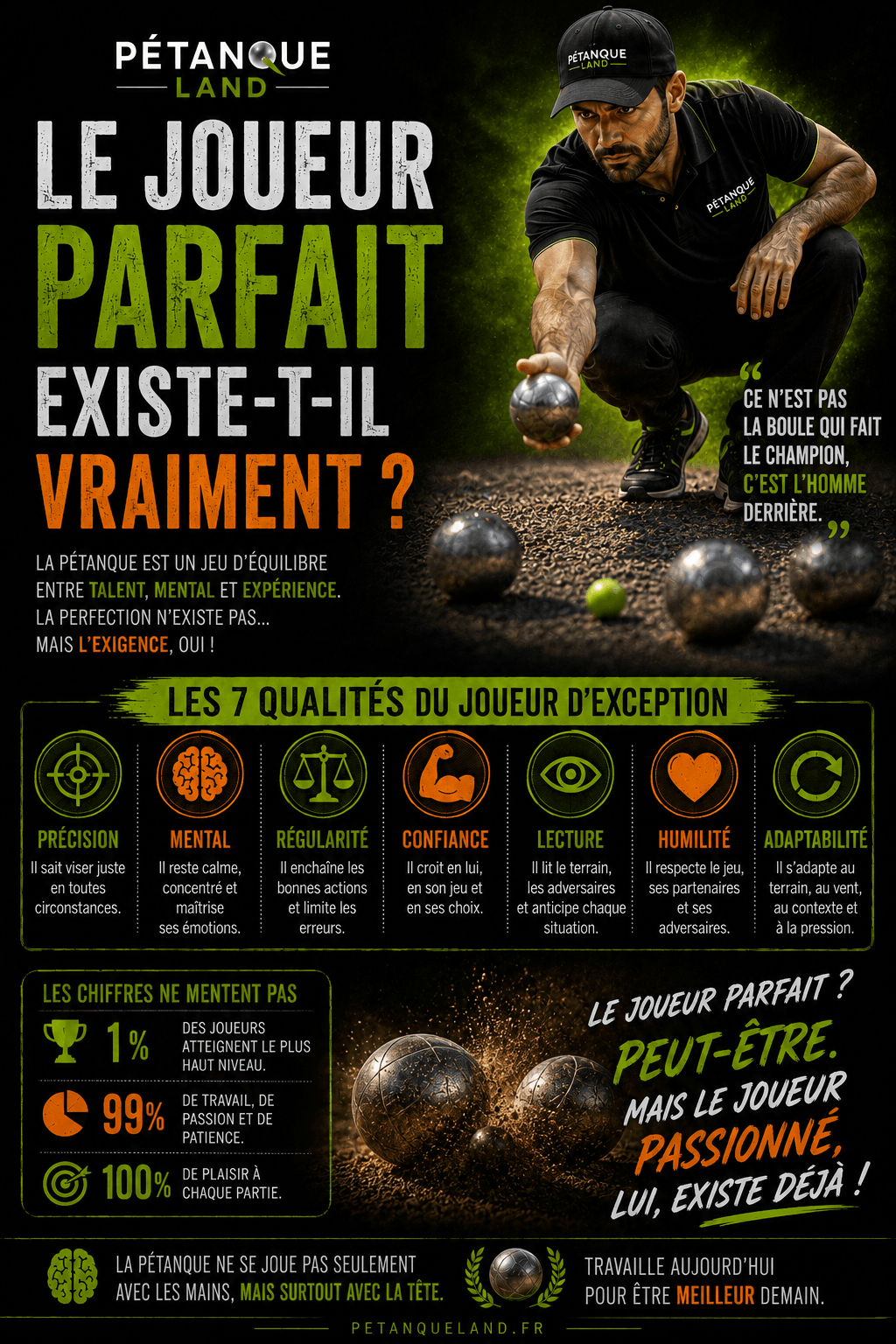
📊 THE 7 DIMENSIONS OF EXCELLENCE What we really measure in a great player — and at what level TECHNICAL POINTING ACCURACY Consistency of the throw, reproducibility of the release, precision of the weighting. Developable in training — but never 100% in all conditions. SHOOTING MASTERY Impact angle, height, speed, axis precision. The best shooters reach 75–85% in competitions — never 100%, not even world champions. REAL-TIME TACTICAL READING Reading the end, attack/securing decisions, jack placement. Improves with experience — but remains subject to cognitive biases under pressure. MENTAL SOLIDITY Management of key moments, resilience after an error, consistent performance under pressure. Varies between players — the hardest dimension to develop voluntarily. PARTNER MANAGEMENT Communication, support in adversity, collective decisions. Often neglected in training — yet decisive in doubles and triples. ADAPTATION TO THE TERRAIN AND CONTEXT Reading the terrain, adjusting to the opponent's style, changing the settings according to the conditions. Acquired gradually through a diversity of experiences. ENDURANCE AND CONSISTENCY OVER TIME Maintaining the level over 4 to 6 hours of competition, resistance to fatigue, consistency between the first and the last point. The most physical of the dimensions — often the most neglected.The 5 archetypes of excellence — each "perfect" in its own way
If the perfect universal player doesn't exist, there are nevertheless several forms of situational excellence. These 5 archetypes represent real players — each "perfect" in a specific register, less effective in others.
🎯 The exceptional pointer — the craftsman of precision His excellence lies in the absolute consistency of the throw WHAT HE DOES BETTER THAN ANYONE Placing consistently at 8–12 cm from the jack at every distance, on every terrain. His throw is identical at the start and at the end of a game — a pointing machine. WHAT HE LACKS FOR PERFECTION Shooting — often a weak point. His specialization in pointing has sometimes neglected shooting, which makes him predictable and dependent on his shooter partner. IN WHICH SITUATION HE IS "PERFECT" On a hard terrain suited to his style, with a good shooter by his side, in doubles where he can fully specialize. His excellence is contextual. His "perfection" is only accessible in conditions that play to his strengths — and an opponent who places the jack at unusual distances can cancel out his advantage. 💥 The formidable shooter — the striking power His excellence lies in the power and precision of the shot WHAT HE DOES BETTER THAN ANYONE Eliminating the opposing boules with remarkable reliability — even well-protected ones, even at difficult angles. Under pressure, his shot holds when everyone else's collapses. WHAT HE LACKS FOR PERFECTION Tactical nuance — the temptation to shoot when pointing would suffice. The exceptional shooter can sometimes be a prisoner of his own excellence and lack tactical variety. IN WHICH SITUATION HE IS "PERFECT" Facing an opponent who piles up boules close to the jack — where his shooting is the most effective weapon. His excellence is the solution to specific problems. An opponent who secures the point without ever leaving a boule to shoot can reduce his impact to almost zero — his excellence becomes unusable without suitable targets. 🧠 The strategist — the chess player of pétanque His excellence lies in reading the game and in tactical decisions WHAT HE DOES BETTER THAN ANYONE Read a game 3 ends ahead. Place the jack in the zones that maximise his advantages. Systematically make the best decision between attacking and securing. WHAT HE LACKS FOR PERFECTION Execution under maximum pressure — his reading of the game is perfect but his action can falter at key moments when the correct decision also requires flawless execution. IN WHICH SITUATION HE IS "PERFECT" In a triplette, in the middle or team-captain position, where his tactical decisions impact several players at once. His excellence multiplies with the size of the team. A perfect strategy executed at 70% is less effective than a correct strategy executed at 100% — his "genius" is sometimes tempered by the limits of execution. 🦾 The iron mindset — the unshakable one His excellence lies in consistency under extreme pressure WHAT HE DOES BETTER THAN ANYONE Play the 30th throw with the same routine as the first, at 12-12 as at 0-5. The big moments do not elevate him — nor do they make him crumble. His consistency is his superpower. WHAT HE LACKS FOR PERFECTION Occasional brilliance — his emotional neutrality can sometimes lack the intensity of big decisions. He always plays well, rarely brilliantly. Consistency is not always enough against an opponent in a state of grace. IN WHICH SITUATION HE IS "PERFECT" In long competitions, tense finals, high-pressure situations where others collapse. His excellence becomes decisive where others lose consistency. His excellence is mostly visible by contrast — when his opponent comes off the rails under pressure, his consistency becomes a major advantage that did not exist under normal conditions. 🌟 The complete player — the closest to imaginary perfection His excellence lies in the absence of any obvious flaw WHAT HE DOES BETTER THAN ANYONE He has no obvious weak point. He can point correctly, shoot correctly, read the game correctly. Hard to target tactically — no systematic area to exploit. WHAT HE LACKS FOR PERFECTION Excellence in a specific register — his versatility comes at a cost. Against the exceptional pointer or the fearsome shooter on their terrain, he can be outclassed. "Correct at everything" can be beaten by "excellent at one thing". IN WHICH SITUATION HE IS "PERFECT" On varied terrains, solo (one-on-one), in long competitions with many different opponents. His versatility is the most stable advantage in variable contexts. The hardest player to beat over time — but not always the one who impresses the most in a specific moment. It is perhaps the most underestimated form of perfection.What comes closest to perfection — the true invariants
If technical and tactical perfection is inaccessible and contextual, there are nevertheless a few qualities that systematically characterise the best players — regardless of their style, their usual terrain, or their role in the team.
🎯 THE TRUE INVARIANTS OF EXCELLENCE What all great players have in common — without exception 🔄They play the next boule — always. Whatever the previous end, the score, the error that just happened. This ability to "reset" between each throw is the most universal invariant of pétanque excellence. It is not acquired in a single game — it is built over hundreds. 🎯They know what they are doing before they do it. Every throw is preceded by a precise intention — not "point towards the jack" but "point on the left side at 10 cm". This precision of intention is the most reliable marker of the player who has reached a higher level. 📐They have internalised their limits. The great player does not attempt shots he doesn't master at 50%+. He knows his confidence range precisely — and he plays within it, not outside it. This honesty about oneself is rare and precious. ⏱️They keep the same rhythm in every situation. The same tempo before the throw at 0-0 as at 12-12. Pressure doesn't make them speed up — a sign that their routine is genuinely automated, not simulated. 🔍They really observe. They read the terrain before playing, watch the opponent's boules for tactical information (not to compare), and use what they see to adjust their decisions. Active observation is a form of excellence that is often invisible. 📈They are still improving. The best players I've met all maintain a curiosity about their own game. They don't think they've figured it all out. This openness to progress is precisely what has made them excellent — and what prevents them from regressing.From perfection as myth to progress as practice
🎭 THE PROBLEM OF AIMING FOR "PERFECTION"The player who sets "being perfect" as a goal is preparing for perpetual failure — because that goal is by definition unattainable. Every error becomes a deviation from an impossible ideal, and the resulting frustration degrades exactly the mental qualities needed for good play.
What it produces:A tense player who judges himself on every boule, unable to accept the normal variability of the game. The ideal of perfection paradoxically creates more errors than it avoids.
Perfection as a target produces tension. Progress as a target produces fluency. ✅ THE ALTERNATIVE — TARGETED PROGRESSIdentifying 1 or 2 specific dimensions to improve — not "being perfect", but "improving my pointing consistency at 8 metres" or "developing my shooting on a protected boule". These goals are measurable, attainable, and produce concrete results.
What it produces:A player focused on clear lines of progress, able to measure his improvements and adjust his efforts. Partial and measurable progress is infinitely more motivating than total and unattainable perfection.
The right question is not "am I perfect?" but "in which dimension have I progressed this season?" 🌟 WHAT THE "PERFECT" PLAYERS REALLY DOPlayers we perceive as "perfect" don't think of themselves as perfect — they have dimensions they still work on, flaws they know about. What others perceive as perfection is often an excellence in the visible dimensions, combined with an honest management of limits.
The real "secret":They know exactly what they do well and play to it. They know exactly what they do less well and avoid it as much as possible. This precise self-awareness is the closest thing to accessible perfection.
Knowing precisely one's strengths and limits is more useful than trying to have none. 💡 WHY THE QUESTION IS STILL USEFULEven if the perfect player doesn't exist, the question of his definition is useful — it forces us to name precisely what we admire in the best, and therefore what we can strive towards. The myth of perfection is a guiding ideal, not an operational goal.
The usefulness of the myth:It gives a direction. Mapping the ideal helps to choose one's progress priorities. We don't aim for the myth — we aim for a precise aspect of what it represents.
Perfection as a magnetic north is useful for navigating. It is useless as a destination — we never reach it, but we move in the right direction. ⭐ The real answer to the questionThe perfect player doesn't exist — but the player who comes closest to excellence is the one who knows his strengths precisely, honestly accepts his limits, plays within the first range and manages the second. It's not perfection — it's better. It's mastery. And unlike perfection, mastery is accessible, measurable, and progressively buildable game after game.
FAQ — Your frequent questions
Aren't some players at world level really "perfect" in their register?+ The world's best players achieve levels of excellence in certain dimensions that appear perfect from the outside — a top shooter who makes 8 out of 10 shots in a world final looks "perfect" from the stands. But this same player has periods where he misses 3 shots in a row. He has terrain that suits him less. He has moments of loss of concentration. Its “perfection” is contextual excellence at its best — not absolute perfection. What sets him apart from an ordinary player is the frequency at which he approaches excellence and the ability to maintain that frequency in difficult conditions. Can we really improve in all dimensions simultaneously?+ To some extent, yes — progress in one dimension often feeds into the others. Better aim improves shooting confidence. Better reading of leads improves investment decisions. But there is a practical ceiling on available training time — becoming an excellent shooter as well as an excellent scorer as well as an exceptional quarterback requires an investment of time that is beyond what most amateur players can devote. Partial specialization is often more effective than simultaneous progression on all dimensions. How do I identify in which dimension I should progress as a priority?+ Three complementary approaches. First: identify the dimension that has contributed the most to recent defeats — if games are lost because opponents place 3 balls close to the jack and you can't shoot, shooting is the priority. Second: Ask a partner or external observer to rate what they perceive to be the most common weakness — often more accurate than self-assessment. Third: compare your game in training and in competitions — the dimension that deteriorates the most under pressure is often the least solid and therefore the most impactful to work on. Doesn't accepting that you can't be perfect risk reducing your ambition to progress?+ The opposite question is true. Accepting the impossibility of absolute perfection releases considerable energy that was previously spent in the frustration of not achieving it. A player who "plays to be perfect" spends a lot of time suffering from not being perfect. A player who "plays to progress" spends his time doing what actually improves his game. The first posture is exhausting and not very productive. The second is energizing and measurable. Acceptance of impossible perfection is not resignation — it is a necessary condition for real progression. 📎 Related articles TacticsPlaying against a stronger opponent: the mistakes to avoid TacticsAttack or secure: making the right choice at the right time TacticThe key moments where a game really turns CultureThe phrases you hear on every terrain CultureThe worst excuses after a missed shot ToolsFree PetanqueLand tools© Pétanque by Paquita — petanqueland.fr · 📖 Paquita's book on Amazon