Actualités · 16 April 2026
The science of the bounce in pétanque: why does it jump?
Your boule lands well, then bounces back 1 metre. Why? Angle ofThe physics of impact — what happens in 3 milliseconds
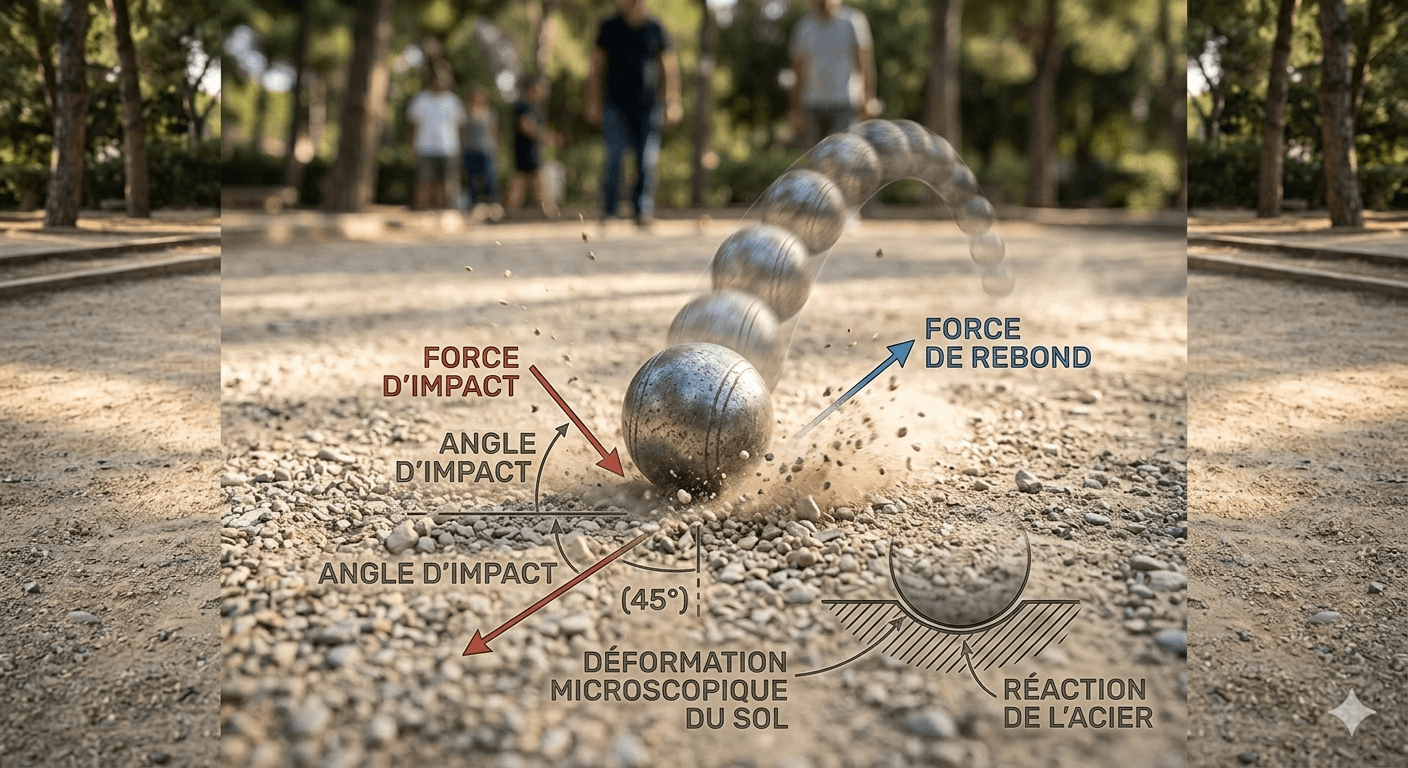
The impact of a pétanque bowl on the ground lasts around 2 to 5 milliseconds . In that span of time, four phenomena happen simultaneously: compression of the contact surface, elastic deformation of the steel and the ground, energy transfer, and reorientation of the trajectory. Understanding these phenomena lets you predict — and therefore control — where the bowl will stop.
⚡ BREAKDOWN OF FORCES ON IMPACT ⬇️ Vertical component The force directed perpendicular to the ground. It creates the compression and determines the depth of the imprint. The steeper the angle, the more dominant this component. It is what "drives" the bowl into the ground. ⚡ Energy transfer ⭐ The fraction of kinetic energy returned as motion after impact — measured by the coefficient of restitution (e). The higher the e, the further the bowl rebounds. This is the central variable of the bounce. ➡️ Horizontal component The force directed parallel to the ground. It generates the post-impact roll. It is dampened by the ground's friction. The flatter the angle, the more dominant this component — this is the principle of the rolling point. ★ Coefficient of restitution e = exit velocity / entry velocity (vertical component) 🔬The coefficient of restitution (e) is the key number of any bounce. It ranges between 0 (perfectly absorbed impact — the bowl doesn't rebound) and 1 (perfectly elastic bounce — the bowl rebounds at the same speed). In pétanque, depending on the bowl/ground pairing, this coefficient sits between 0.2 (damp sand ground + semi-soft bowl) and 0.7 (dry concrete + extra-hard bowl). This 0.5 range represents a considerable difference in behaviour in terms of final distance.
The 5 bounce factors — independent and cumulative
These five factors act simultaneously. Changing one without touching the others alters the bounce predictably. Understanding each one's isolated effect lets you diagnose and correct with precision.
1 The angle of attack — the most controllable factor The angle at which the bowl arrives at the ground relative to the horizontal. A shallow angle (10–20°, skimming trajectory) produces an impact with a weak vertical component — little bounce, long roll. A steep angle (50–70°, high trajectory) produces an impact with a strong vertical component — a bigger bounce, short roll. It is the factor the pointer controls best — via their release height. Control: release height. Lower = skimming angle = less bounce. Higher = steep angle = more bounce. 2 Impact speed — total kinetic energy The speed of the bowl at the moment of contact with the ground determines the total energy of the impact. At a constant coefficient of restitution, doubling the speed quadruples the kinetic energy (E = ½mv²). A fast bowl rebounds further than a slow bowl at the same angle — the returned energy is greater in absolute terms even if the proportion stays the same. Control: throwing force. But be careful — increasing the speed to reach the target without changing the angle makes the bounce worse. They often need adjusting together. 3 Bowl hardness — elasticity of the steel A harder bowl (extra-hard steel) deforms less on impact and returns more energy — higher coefficient of restitution = stronger bounce. A semi-soft bowl deforms slightly on impact, absorbing some of the energy — lower coefficient = dampened bounce. On hard ground, the difference between semi-soft and extra-hard can amount to 20 to 40 cm of extra residual roll. Control: choice of bowl. On very hard ground or concrete, a softer bowl compensates for the ground's naturally high bounce. 4 The state and nature of the ground — the most variable factor The ground determines a large part of the coefficient of restitution. A hard, dry ground (concrete, dry packed earth) returns a lot of energy — strong bounce. A soft, absorbent ground (damp sand, mud, thick grass) absorbs the deformation energy — weak or no bounce. This factor changes on every terrain and can even vary over the course of a single game (change in moisture, hollows dug by previous bowls). Control: reading the ground and adapting the angle + speed. The first two ends are used to calibrate the ground's behaviour. 5 The bowl's spin — backspin, topspin, neutral The bowl arrives at the ground with an (angular) spin that interacts with the ground's friction. A backspin (backward spin, towards the thrower) creates a friction force that opposes the post-impact roll — the bowl stops faster, sometimes bouncing slightly backwards. A topspin (forward spin) extends the post-impact roll. Most natural points have a moderate backspin — that's why bowls stop rather than rolling on indefinitely. Control: wrist angle and speed at release. Hard to change consciously — worked on with specific release exercises. 🎙️ Paquita on the misunderstood bounce "The classic situation: a pointer throws 10 bowls that all bounce too hard and end up long. He says 'I'm throwing too hard' and corrects the force. Result: the next 10 are too short because he changed the wrong variable. The real problem was the angle — too steep, too much vertical component, too much bounce. The fix was to lower the release, not to reduce the force. By understanding that bounce has five causes, you first look for which one is responsible before correcting at random." — PaquitaThe angle of attack — the pointer's main lever
Of all the factors, the angle of attack is the one the pointer controls best — and the one most often neglected in favour of force. Changing the release height by 10 cm can change the bounce as significantly as changing the force by 15%.
10–20° Skimming Minimal vertical component. Almost no bounce. The bowl "skids" across the ground and rolls directly. Max roll 25–40° Optimal ⭐ Ideal balance between absorption and residual roll. Controlled and predictable bounce on most terrains. Control zone 40–55° Steep Significant bounce on hard ground. Short roll but bounce hard to predict on uneven ground. Beware hard ground 60–80° Plunging Very strong bounce on hard ground — the bowl can rebound almost perpendicularly. On soft ground, it sinks in instead. Unpredictable 📐 Release height as a bounce regulatorThe most effective way to adapt your angle without changing your basic action: change the height at which the bowl is released . Releasing the bowl when the hand is lower (near the knee) produces a flatter trajectory and a shallower angle of attack — less bounce. Releasing higher (hand at hip level) produces a higher trajectory — more bounce. This adjustment takes 2 seconds and immediately compensates for a ground that bounces too hard.
The ground — coefficients that change everything
The ground is the most variable factor and the least controlled by the player. Two pétanque terrains that look alike to the eye can have very different coefficients of restitution depending on their composition, moisture and compaction.
🏗️ Concrete / synthetic Coefficient of restitution e ≈ 0.60–0.72Almost undeformable surface. Returns a maximum fraction of the energy. Very strong bounce — extra-hard bowls on concrete are particularly hard to control.
🟤 Dry packed earth Coefficient of restitution e ≈ 0.40–0.55Standard ground for most outdoor pétanque courts. Predictable and balanced behaviour. Slight deformation absorbs some of the energy.
🟤 Damp packed earth Coefficient of restitution e ≈ 0.25–0.40Damp earth deforms more and absorbs more energy. Noticeably reduced bounce — bowls stop earlier than on dry ground. Compensate by increasing the speed or reducing the angle.
🟡 Fine sand / gravel Coefficient of restitution e ≈ 0.18–0.32Sand shifts on impact and absorbs a large part of the energy. Very weak or no bounce. The bowl often "plants" on the spot. Forceful play required to compensate.
🌿 Short grass Coefficient of restitution e ≈ 0.28–0.42The grass blades flex and dampen the impact. High friction slows the post-bounce roll. Variable behaviour depending on the lawn's density and moisture.
🧊 Frozen ground Coefficient of restitution e ≈ 0.55–0.70Frost turns the surface into near-concrete. Extremely strong bounce — bowls can rebound more than a metre after impact. Pétanque on frozen ground is almost unplayable in the normal way.
The bowl's spin — topspin, backspin and their effects
The bowl doesn't arrive at the ground in pure translation — it also spins on itself. This spin, often unconscious in the pointer, significantly alters the post-impact behaviour.
🔄 Backspin (reverse)Backward spin — towards the thrower. The lower surface of the bowl moves in the opposite direction to the direction of travel. The ground/bowl friction opposes the roll — the bowl slows sharply after impact, sometimes bouncing slightly backwards.
Braked post-impact 🔃 Neutral spinSpin in agreement with the direction of travel — surface speed equal to translation speed. No parasitic friction force at the moment of contact. Natural and predictable roll after impact. The majority of natural deliveries.
Standard roll 🔁 TopspinForward spin — in the direction of travel. The lower surface moves in the same direction as the travel, faster. Friction amplifies the post-impact roll. The bowl extends its travel after landing.
Extended roll 🌀The majority of natural pétanque points produce a slight backspin — the bowl held "in a hook" and released forwards naturally generates backward spin. That's why pointing bowls "die" after the delivery rather than rolling on indefinitely. If your bowls roll far too much after impact even though your delivery is correct, you may have a parasitic topspin — check your wrist position at release.
Bounce matrix — every scenario
| Configuration | Angle of attack | Ground type | Bowl hardness | Resulting bounce |
|---|---|---|---|---|
| Rolled pointer, compact ground | 10–20° (skimming) | Dry earth | Semi-hard | Minimal — direct roll |
| Lofted pointer, standard ground | 25–35° | Normal packed earth | Semi-hard | Moderate — optimal situation |
| Pointer on concrete ground | 25–35° | Concrete | Hard | Strong — angle correction essential |
| High angle + dry ground | 50–65° | Compact dry earth | Hard | Excessive — bowl rebounds far |
| Pointer on damp ground/mud | 25–35° | Damp ground | All | Very weak — bowl often plants |
| Extra-hard on dry concrete | 30–40° | Concrete | Extra-hard | Very strong — risky combination |
| Semi-soft on dry concrete | 30–40° | Concrete | Semi-soft | Moderate — the hardness compensates |
| Sandy ground + skimming angle | 10–20° | Fine sand | All | None — the bowl plants immediately |
| Frozen ground + any angle | Variable | Frozen | All | Excessive — game almost unplayable |
Diagnosis — recognising the cause of a botched bounce
Before correcting, identify. An excessive bounce can have several different causes that call for different corrections. Correcting the wrong variable often makes the problem worse.
❌ OBSERVED SYMPTOM 🔍 LIKELY CAUSE + CORRECTION ❌The bowl bounces hard and consistently ends up long. Constant problem across all ends. →Angle too steep or ground harder than expected. Lower the release height to reduce the angle. Don't reduce the force — that would create short bowls. ❌The bowl was bouncing well at the start of the contest and starts bouncing hard from the 4th game onwards. →Ground drying out over the course of the day (heatwave) or hollowed-out areas from previous bowls creating hard surfaces. Adapt the angle gradually. ❌The bowl lands well but bounces sideways instead of going straight. →Impact on a ground irregularity (stone, bump) or parasitic lateral spin in the release. Check the ground at the spot of the delivery. If the ground is flat — check the axis of the pendulum swing. ❌The bowl bounces hard only on this terrain whereas everywhere else is fine. →Particularly hard ground (concrete, synthetic, extremely compact earth). Use a softer bowl if available, or greatly reduce the throwing angle. ❌The bowl bounces backwards (towards the thrower) after impact. →Excessive backspin combined with hard ground. The backward spin generates a friction force that exceeds the forward roll component. Correct the wrist angle at release. ❌The bowl barely bounces anymore and stops very short from the middle of the contest onwards. →Ground getting damp (evening dew, light rain) or loose sand areas appearing under the impact of previous games. Increase the speed or deliver closer to the jack.Using the bounce tactically
⚡ ADVANCED STRATEGY The bounce as a weapon — not just a problem The majority of this article treats the bounce as something to control and minimise. But the bounce can also be used deliberately by the player who understands the physics.Using the ground bump: intentionally placing your delivery point on a slight bump in the ground generates a predictable bounce that can "catapult" the bowl to the right or the left — to reach a jack protected by opposition bowls on the direct line. The player who knows the terrain uses its irregularities as trampolines.
The calculated-bounce delivery: instead of delivering as smoothly as possible without bounce (the standard approach), deliberately deliver at a steep angle on a spot of ground known for its hardness — calculate the bounce to reach the target bowl on an indirect trajectory. It's a high-level technique that assumes perfect knowledge of the terrain and the physics of the bounce.
The limit: using the bounce assumes you know it intimately. The first two ends always remain calibration ends — even for the expert player who wants to exploit the terrain's bounces.
Exercise — calibrating your bounce in 3 steps
01 The three-angle test — calibration on unknown ground 📍 Any terrain ⏱️ 10 min 📐 Bounce/terrain calibrationOn an unknown terrain, before the contest or during the first ends, carry out this test to quickly identify the terrain's effective coefficient of restitution and the optimal angle.
Skimming angle: throw a bowl with a very low release (hand at knee height). Observe the bounce: does the bowl land and roll directly (good on absorbent ground)? Or does it skid without really landing (too skimming on hard ground)? Medium angle: throw with your usual release height. Observe the height and length of the bounce. Note the distance between the delivery point and the final stopping point — this is your "reference bounce length" on this terrain. Steep angle: throw with a high release (hand at hip level). Observe whether the bounce is much more pronounced. If yes — the ground is hard and reactive. If the difference is small — the ground absorbs well and the angle matters little. Adaptation decision: based on the three tests, choose your release height for this terrain. On hard, reactive ground: low release. On absorbent ground: usual or even high release to force the delivery. Apply this decision from the first official end. 📖 PAQUITA'S BOOK Game physics — in the service of precisionBounce, delivery, pendulum swing, terrain, equipment... Paquita's book applies physical principles to the concrete game with 100 numbered exercises to anchor each concept in practice.
📦 Order on AmazonFAQ — Your frequent questions
Can you really control the rotation of your ball (backspin/topspin) deliberately? + Yes, but it's an advanced skill. Spin is determined primarily by the position of the wrist at the time of release and the way the fingers release the ball. A hand oriented "palm up" at the release with the fingers closing slightly generates a natural backspin - this is the standard grip of the point. To obtain topspin, you must push lightly with your fingers while "rolling" the ball forward upon release - this is the grip used for very long rolls. Mastering the rotation requires several weeks of specific work and can only be worked well once the basic pendulum is anchored. Is the rebound different depending on the brand of balls (Obut vs MS vs Boulenciel)? + Yes, but the main variable remains the hardness of the steel — which varies according to the models in each brand. At equivalent hardness, two balls of different brands should have a similar coefficient of restitution. Slight differences in alloy composition may create marginal variations. In practice, a player who changes brand but keeps the same hardness will observe very little difference in rebound behavior. The real variable is the hardness, not the brand. This is why it is important to know the hardness of your balls and not just their brand. Why does the bounce change between morning and afternoon on the same court? + Several simultaneous reasons: 1) The ground dries out with the heat of the day — the coefficient of restitution gradually increases. 2) Repeated impacts of the balls compact and harden the clay surface — the ground becomes progressively harder. 3) Areas where balls land consistently deepen slightly, creating irregularities that redirect bounces. 4) During a heatwave, the slight thermal expansion of the ground modifies the surface crystalline structure. These four effects accumulate and can create a noticeable difference in behavior between 9 a.m. and 5 p.m. on the same terrain. The bounce of the opponent's ball sent my ball far from the correct position — is this predictable? + Partially. Ball-to-ball (metal-to-metal) bounce is governed by the same coefficient of restitution principles — but the variables (angle of impact between the two balls, relative speeds, exact points of contact) are more difficult to control than ground bounce. What is predictable: a hard ball against a soft ball throws the soft ball more. A ball that hits from the side projects the opponent laterally. A ball hit from the front is pushed into a line. What is less predictable: the effect of the surface irregularities of the two balls (streaks, past micro-impacts) at the exact point of contact. Precision shooting on the bolt reducing these inaccuracies is the long term goal. 📎 Related articles Equipment Choosing your bowls — hardness and bounce behaviour Equipment Inox vs carbon — coefficients of restitution compared Equipment Top 3 best shooter boules 2026 Rules The one-minute rule Regulations 2026 regulation playing distances Tools Free PetanqueLand tools© Pétanque by Paquita — petanqueland.fr ·
📖 Paquita's book on Amazon
The coefficients of restitution indicated are experimental approximations — they vary according to the precise surface, moisture, temperature and bowl/ground pairing conditions. To be used as reasoning benchmarks.