Actualités · 10 June 2026
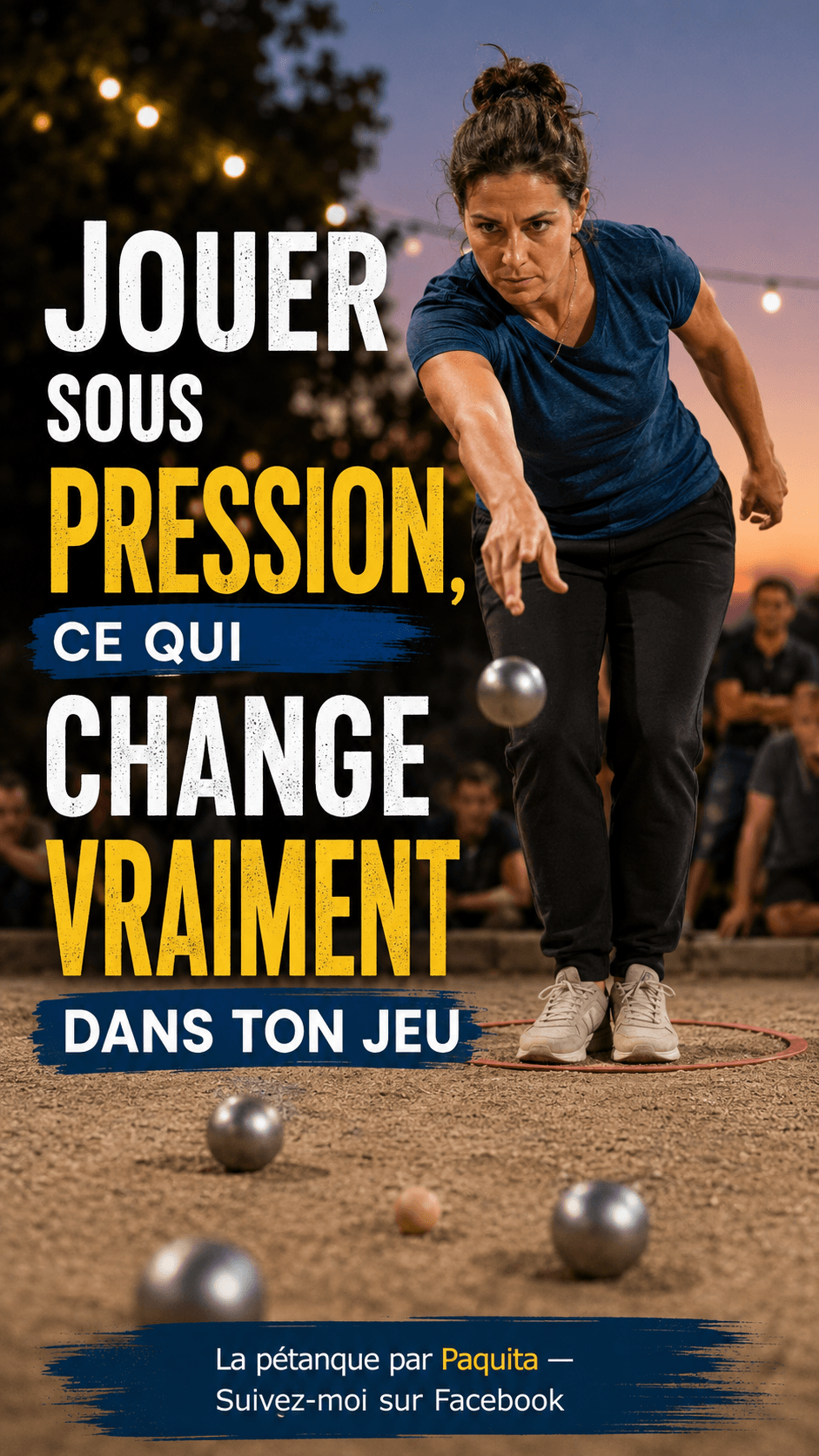
Playing under pressure: what really changes in your game
Sweaty hands, an action that tenses up, easy boules missed at the end of a game… Under pressure, your body, your action and your attention genuinely change. Paquita breaks down what's happening — and what works to take back control.We talk a lot about boules, terrain and technique. Far less about what goes on between your ears when the score is tight and everyone is watching. Yet that's often where games are won or lost. The good news: failing under pressure is almost never a technique problem. It's a problem of context — and context can be managed. Let's look precisely at what goes out of tune, and how to take back control.
120+
bpm
Your heart rate can climb well above resting on a decisive point
1
minute
The allotted time to play — which becomes a stress in its own right
2
pitfalls
Under pressure, we sabotage ourselves by playing too safe… or too rushed
100%
automatic
The most solid throwing motion is the one you let happen without controlling it
What happens in your body
Even before you think about it, your body has already reacted. An important point is interpreted by the brain as an alert signal, and the sympathetic nervous system switches into “fight or flight” mode.
Concretely, the body releases adrenaline. The heart speeds up, breathing becomes faster and higher, pupils dilate, hands sweat. Blood rushes to the large muscle groups — useful for running or hitting, far less so for the fine work of the fingers and wrist that pétanque precisely requires.
The result: fine motor control deteriorates, a slight tremor can appear, and the muscles switch into co-contraction — the antagonist muscles tense up at the same time, which stiffens the arm instead of letting it swing freely like a pendulum.
HEART RATE — BENCHMARKS OVER A GAME
At rest, before the game~65 bpm
Routine play during an end~100 bpm
Match point, last point~130 bpm
Indicative benchmarks: values vary widely from one person to another depending on fitness, age and temperament. What matters is not the exact figure, but the direction — your body is firing up, that's normal.
What pressure does to your throwing motion
This physical activation translates directly into your throwing motion, and almost always in the same direction. The most treacherous part is that it happens without you deciding it: you think you're playing your usual motion while several settings have shifted.
RELAXED THROWING MOTION
GripSupple, the boule “rests” in the hand
ArmPendulum fluid, full range of motion
TempoSteady, settled, the same as usual
ReleaseProgressive and clean, the boule “rolls” out of the hand
GazeWide: reads the ground, the landing spot, the jack
BreathingFull and low
THROWING MOTION UNDER PRESSURE
GripTense, you squeeze the boule without realising it
ArmStiff, co-contracted, shortened range of motion
TempoAccelerated, you rush — or you freeze
ReleaseAbrupt or held back, the boule leaves “thwarted”
GazeNarrowed into a tunnel on the target, you lose everything else
BreathingShort, high, sometimes held under strain
For a pointer, an arm that shortens its range means distance goes out of tune: the boule lands short (you held back) or long (you released too hard). For a shooter, an arm that tenses up means the throwing motion “brakes” at the wrong moment, and the carreau turns into a short boule or a miss.
PAQUITA'S TIP
The first sign of tensing up is the hand. Before playing, deliberately loosen your fingers once, as if releasing a grip that's too tight. A squeezed boule never leaves well — it's braked by your own hand.
What changes in your head
The body is only half the story. Attention also reorganises itself under tension, and not always in your favour.
Attention narrows
At moderate arousal, attention focuses on the right cues: that's useful. But when arousal climbs too high, the attentional field closes into a “tunnel”. You lock onto the target and stop seeing the rest — the slope of the ground, the exact position of the jack, the landing spot you were aiming for to bring the boule in. You play more tensely and with less information.
We start overthinking
A well-drilled throwing motion is largely automatic: you don't need to think about your elbow, your wrist, the angle of your arm. Under pressure, the reflex reverses — we start to consciously monitor every step of the motion, like a beginner. Yet this conscious control interferes with a movement that worked precisely because it was automatic. It's the classic “I thought about it too much”.
Worry takes up the space
In parallel, intrusive thoughts — “I mustn't miss”, “what will they think” — take up part of your mental resources. Less availability for the task means less precision and messier decisions. Time itself can seem to warp: everything goes too fast, or conversely the minute never ends.
Why we “crack”: the two mechanisms
When a player collapses on a point they pull off with their eyes closed in training, mental-preparation specialists describe two broad families of explanation. They aren't mutually exclusive: depending on the person and the situation, one or the other dominates.
- Distraction. Worries and the fear of missing monopolise attention. Less mental “bandwidth” is left to execute the throwing motion, and concentration fragments.
- Over-control. Conversely, you focus too much on the throwing motion. You take conscious control of an automated movement, and this step-by-step control breaks the fluidity. Trying too hard to do it well undoes it.
The practical takeaway matters: there's no single universal “magic fix”. If you crack through distraction, you need to bring attention back to the task. If you crack through over-control, on the contrary you need to release the mind and trust the throwing motion. Knowing which of the two concerns you changes the strategy.
The right dose: the performance zone
Contrary to a common belief, the goal isn't to be completely “zen”. A minimum of tension is useful: with no stake at all, you're soft, distracted, you play half-heartedly. Performance instead follows a bell curve — it rises with arousal up to an optimum, then drops when tension becomes excessive.
UNDER-AROUSAL
No stake, soft attention. The throwing motion lacks intent, you give away points for nothing.
OPTIMAL ZONE
Alert and engaged, but relaxed. The body is ready, the throwing motion stays fluid. That's where you play your best game.
OVER-TENSION
Tensing up, tunnel, over-control. The body fires too hard, the throwing motion freezes, the decision gets muddled.
The goal isn't zero tension — it's to come back towards the middle zone.
Keep this in mind (and it stays realistic). This curve is a teaching model, not a millimetric law. Above all, the “optimal zone” isn't the same for everyone: some players perform calm, others need more intensity to be at their best. The real work is identifying your own zone, not copying your neighbour's.
Pointer or shooter: not the same pressure
Tension doesn't strike the pointer and the shooter in the same place, because their throwing motions don't rely on the same qualities. Before that, a common decision trap lies in wait for both of them:
PLAYING TOO SAFE
You play “not to lose” rather than to win the point. The pointer plays too safe and leaves the boule a metre away; the shooter no longer dares to shoot and suffers. The fear of failure dictates the shot.
PLAYING TOO RUSHED
You want to be done fast to bring the tension down. You rush the release, attempt a low-percentage shot, you play before choosing clearly. Impatience decides for you.
On the pointer's side
Pointing lives off touch and distance control. That's exactly what tensing up destroys first. The shortened arm and clenched hand lose the sense of distance, and you forget your landing spot — the precise point where you wanted the boule to arrive. The fix: mentally come back to the landing spot, fix a clean arrival point, and keep a supple motion rather than aiming at “the jack” into thin air.
On the shooter's side
Shooting is a fast, ballistic motion that demands committing fully. Tension produces the opposite effect: the arm decelerates on impact (“you brake”), or you try to aim for too long and the motion contracts. The fix: pick a precise point on the opposing boule, commit totally, and above all don't decelerate. In shooting, hesitation costs more than boldness.
The minute that weighs
The rules allow one minute to play your boule, counted from the moment the previously played boule or jack has come to rest. That's the one-minute rule. On paper, it's comfortable. Under pressure, that same stopwatch becomes a stress factor in its own right.
Two pitfalls appear. Either you rush : you play in ten seconds to “be done with it”, without settling your breathing or choosing your shot. Or you freeze : you let the minute slip by ruminating, and every passing second adds tension instead of removing it.
The right approach is between the two: use this time to run your routine, not to ruminate. A minute is more than enough to breathe, observe, decide and play — provided you fill that time with concrete actions rather than looping thoughts.
PAQUITA'S TIP
Don't count the seconds, count your steps. Three beats, always the same: I look at the landing spot → I exhale gently → I play without stopping. A routine fills the minute far better than anxiety, and leaves zero room for doubt.
What really works to hold on
You don't eliminate pressure — you learn to play with it. Here are the best-established levers, the ones found in the mental preparation of every precision sport.
🧭The pre-throw routine
The same sequence of actions and thoughts before every boule. It's the most powerful lever: it triggers the automatic motion and chases away ruminations. Always the same, in training as in a match.
🌬️Long breathing
A slow, complete exhalation activates the parasympathetic system and brings arousal back down. One or two settled breaths, emphasising the exhalation, just before playing. Simple, and physiologically real.
🎯External focus
Focus on theeffect you're aiming for — the landing spot, the trajectory, the point on the opposing boule — and not on your body (“my elbow”, “my wrist”). Looking outward rather than inward protects the automatic motion.
🗝️The key word
A single word to anchor the right motion: “supple”, “fluid”, “give”. You say it to yourself as you play. It occupies the mind just enough to stop it drifting into intrusive thoughts.
🔁Reinterpreting the emotion
Your heart pounding, clammy hands: don't read that as fear, but as energy, the sign that your body is ready. Welcoming the tension works better than fighting it.
🎲Aiming at the process
Forget “I absolutely have to win this point”. Focus on the clean execution of the motion. You control your shot, not the result — and aiming at one frees the other.
Last point, and not the least: all this is trained. Pressure isn't managed on the day by magic. It's prepared by exposing yourself to it — by playing competitions, by putting a bit of stake into training (a challenge, a score to hold), to get your body and your throwing motion used to working even when your head is racing.
Pressure doesn't make anyone bad. It just reveals how well your throwing motion holds up when your head is racing. And that, my dear, is trained like the rest.
— Paquita
🎯 What if you played your best game when it counts?
The motion, the ground, the tactics and the mind: Paquita's book brings together everything you need to genuinely improve, with concrete exercises and downloadable bonuses.
Available on Amazon.fr · Paquita — PétanqueLand
Frequently asked questions
Is managing pressure innate or something you train?
It's trained, largely. Temperament plays a part, but the essentials are learnt: a solid routine, breathing control, and above all regular exposure to high-stakes situations. The more you play under pressure, the more your body and throwing motion get used to working despite it. No one is born “solid in the head” — you become it.
Why do I miss easy boules late in a game when everything lands in training?
Because it's not a technique problem but a context one. Under pressure, your hand clenches, your arm stiffens, your attention closes in and you start over-controlling a normally automatic motion. The “easy” motion is made in a body and head on alert — it's no longer the same motion. The technique is intact; it's the setting around it that has shifted.
Should you play faster or slower under pressure?
Neither, by reflex: you need to keep your usual tempo. Danger no.1 is rushing the release to “be done with it”. Danger no.2 is freezing and letting the minute slip by ruminating. The allotted minute should serve to roll out your routine — breathe, look, decide, play — not to ruminate. Fill that time with actions, not thoughts.
Does breathing before playing really help, or is it a cliché?
It's real, and physiological. A slow, complete exhalation stimulates the parasympathetic system, which brings the heart rate and arousal level back down. One or two settled breaths before playing, emphasising the exhalation rather than the inhalation, are enough to calm the body enough for the motion to regain its fluidity.
How do I stop “overthinking” my throwing motion at the wrong moment?
By turning attention outward rather than toward your body. Focus on the landing spot, the trajectory, the point to aim at — not on your elbow or your wrist. A single key word (“supple”, “give”) helps occupy the mind just enough. The principle: a drilled motion works because it's automatic; your job is to let it happen, not to steer it step by step.
Is a pounding heart necessarily a bad sign?
No. A certain level of activation is normal and even useful: it's what makes you alert and engaged. The problem only appears when tension becomes excessive. Better still: how you interpret these sensations matters. Reading your pounding heart as energy and availability — rather than as fear — helps you stay in the right zone instead of slipping into tensing up.
📎 Related articles
Rules
The one-minute rule — what every player should know
Equipment
Boule hardness: the complete guide
Ground
Reading the ground: spotting treacherous slopes
Equipment
Boule weight: between fatigue and precision
Video
Why changing boules doesn't change your level
Tools
Free PétanqueLand tools
© Pétanque by Paquita — petanqueland.fr
📖 Order the book on Amazon