Actualités · 6 June 2026
Playing the second boule: advantage or pressure?
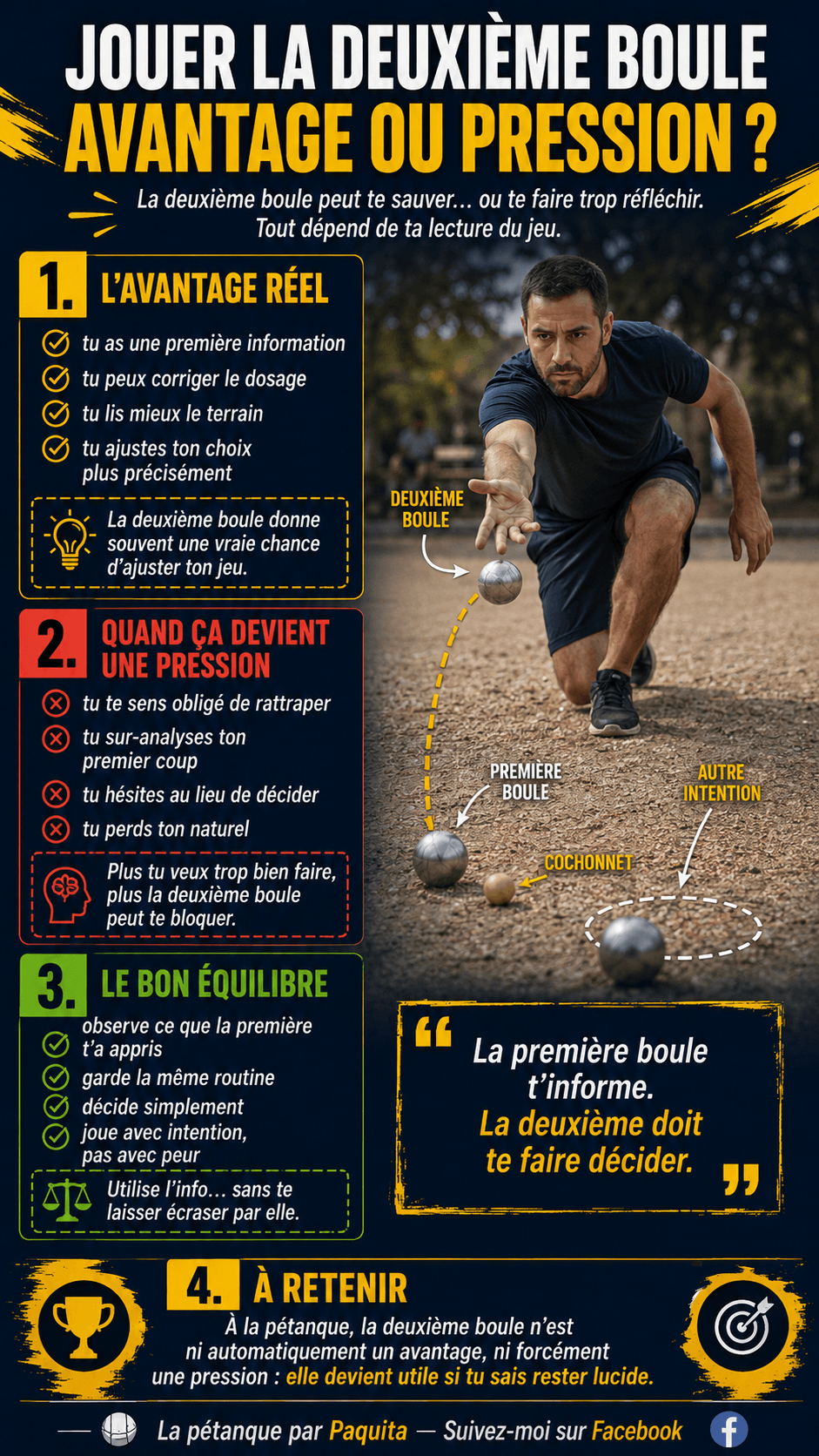
The second boule is the only one in the end played with real terrain information. An advantage to exploit or extra pressure to manage? Paquita analyses the 6 situations of the second boule and how to systematically make it an asset rather than"Better" for the second bowl is not automatic: it requires knowing how to read the information from the first and making the right adjustment — neither too much, nor too little. 6situationssix configurations of the second bowl — each with its specific advantage to exploit and its particular trap to avoid Information= real advantagethe first bowl generates information that neither the opponent's third bowl nor the next bowl of the end possess — an objective informational advantage that the attentive player exploits Adjustment= fine calibrationthe advantage of the second bowl is realised through a precise adjustment based on observation — not through an excessive correction that creates a new error in the other direction Sequence= long-term thinkingthe second bowl is not independent — it prepares the conditions for the third. A good player thinks about the sequence, not only the immediate shot
Exercises to exploit the information from the first bowlThe logic of the second bowl — what changes
🎳 WHAT EACH BOWL OF THE SEQUENCE BRINGS AND COSTS 🎯 1ST BOWL Zero prior terrain information. Pure estimate based on training and visual reading. Aim: open the end and reveal the terrain. EXPLORATION 📊 2ND BOWL The information from the first bowl is available. Adjustment possible on distance, trajectory, bounce. It is the bowl with the highest potential for improvement. ADJUSTMENT 🎳 3RD BOWL Two pieces of information available. The sequence is established. Either confirm and secure, or create a new situation if the first two were not enough. CONFIRMATION ⚡ OPPONENT'S BOWL The opponent has seen all your previous bowls. They play with your complete information — which reduces the informational advantage for the following bowls. INFORMED RESPONSE ❌ LOST BOWL A second bowl missed without exploiting the information from the first represents a missed opportunity — the informational advantage was not converted. MISSED OPPORTUNITY 🎙️ PAQUITA ON THE SECOND BOWL "The first bowl is an investment — you play it for yourself but also to get information. The second bowl is the moment when you cash in what that investment has earned you. If you don't look at what the first bowl taught you before playing the second, you waste the information. And that is a mistake good players never make. They always have their eyes on the first bowl before even picking up the second." — Paquita ✅ 1. The first bowl is well placed — confirm without the pressure of "doing better" ADVANTAGE MENTAL THE ADVANTAGE OF THIS SITUATION The well-placed first bowl creates a position of strength — the end is already advantageous, and the second bowl will either consolidate it or clear the way for the shooter. The informational advantage is maximal here : the first bowl has validated the trajectory, the distance and the landing point. The second only has to reproduce it with any micro-adjustments observed. It is the most favourable situation for the second bowl. → Exploit: reproduce the motion with a micro-adjustment if necessary (slightly shorter, slightly to the left) — without changing the general trajectory validated by the first bowl. The first bowl is the reference, not a fluke to be completely recalibrated. THE TRAP OF THE FAVOURABLE SITUATION The favourable situation creates a specific trap:wanting to "do even better" than the first bowl . This desire for improvement can push you to modify a motion that was working — introducing a useless variable into an already solved equation. A second bowl slightly less good than the first but that consolidates the position is tactically much better than an "ambitious" second bowl that misses and hands the end to the opponent. → Trap: playing the second bowl "to improve even more" rather than "to confirm". When the end is favourable, the second bowl serves to secure it — not to create an exploit. → Tactical rule: after a well-placed first bowl, the aim of the second is to "keep the advantage" — not to "amplify it". This internal change of aim produces less ambitious but more reliable motions. ↩️ 2. The first bowl is short — adjust without overcompensating CALIBRATION TERRAIN THE INFORMATION TO EXPLOIT A short first bowl reveals either an underestimation of the distance, or a more "braking" terrain than expected (soft base, grass, absorbent surface). This information is precious for the second bowl — it identifies exactly in which direction to adjust. The question is not "why is it short" but "by how much is it short" — and the answer is visible in the landing point of the first bowl. → Exploit: mentally measure the gap between the landing point of the first bowl and the desired target. Adjust proportionally — a bowl short by 30 cm requires an adjustment of 30 cm, not 80 cm "to be sure". OVERCOMPENSATION — THE MOST FREQUENT ERROR Faced with a short first bowl, the natural reaction is to "correct hard" — add a lot of force or height to "get past the error". This overcompensation produces a second bowl that is too long in the vast majority of cases. The optimal adjustment is moderate and proportional — not an emotional reaction to the previous error. Correct by 30 cm a bowl that is short by 30 cm, not by 60 cm "for safety". → Adjustment rule: the magnitude of the correction must be proportional to the observed gap — and never greater. A too-strong correction is as much an error as the original error. The right adjustment is discreet and targeted. ↗️ 3. The first bowl is long — hold back without losing fluidity CALIBRATION FAST TERRAIN WHAT A LONG FIRST BOWL REVEALS A long bowl signals a more "slippery" or "fast" terrain than expected — hard surface, slightly favourable slope, dry and compact terrain. It is information just as precious as a short bowl — it indicates the exact direction of the necessary adjustment. The second bowl fully benefits from this revelation if the player knows how to use it: reduce the force, lower the trajectory slightly, or combine the two. → Exploit: identify whether the bowl is long because it rolled well after the landing point (slippery terrain → lower the trajectory) or because it was thrown too hard (force error → reduce the force). The adjustment is not the same depending on the cause. THE DIFFICULTY OF "HOLDING BACK" Correcting a long bowl is psychologically more difficult than correcting a short bowl — because "holding back" your motion is counter-intuitive and can create a tenseness that alters the axis as well as the force. The player who tries to "brake" their throw risks altering several parameters simultaneously. The right approach is to hold back only the force (or only the height) — not to alter the whole motion. → Specific rule for long bowls: correct only one parameter — force OR height, never both simultaneously. Two simultaneous corrections create an artificial motion that is difficult to calibrate and even more difficult to reproduce. ↔️ 4. The first bowl has deviated — read the terrain or look in your motion? TERRAIN DIAGNOSIS THE CRUCIAL QUESTION BEFORE ADJUSTING A bowl that has deviated laterally can have two origins: an irregularity of the terrain (bump, rut, stone) or a motion error (poorly oriented foot, tense shoulder). These two causes call for radically different corrections. Correcting the motion for a deviation due to the terrain often makes things worse — and correcting the trajectory for a deviation due to the motion does too. Identifying the cause before adjusting is the critical work between the two bowls. → Exploit: explicitly watch the path of the first bowl on the terrain. Did it deviate at the moment of the bounce (terrain) or did it already have a lateral trajectory from the start (motion)? This 3-second observation guides the right adjustment. THE ADVANTAGE OF THE VISUAL DIAGNOSIS An attentive player who has followed the complete trajectory of their first bowl — from the throw to the stop — has a complete film to diagnose the deviation. This film is information that no one else possesses to the same degree. The opponent has seen the result; the player has seen the complete path. This difference in information is exploitable if the player has cultivated the habit of watching their bowl until it comes to a complete stop — and not looking away at the moment of the landing point. → Habit to develop: always follow the bowl with your eyes until it comes to a complete stop — even if the result is disappointing. This film of the complete trajectory is the basic data for the right diagnosis before the second bowl. 📋 5. The second bowl as a reference — preparing the third SEQUENCE LONG-TERM VISION THINKING BEYOND THE IMMEDIATE SHOT The second bowl is not only a shot to play well — it is also the reference that will serve to calibrate the third. A player who plays their second bowl "for itself" without thinking about what it will reveal for the third misses an entire dimension of the sequence. If the second bowl lands well, the third bowl has two references — doubly validated information. If it lands less well, the third still has information about what worked or not. → Exploit: after the second bowl, do not immediately think about the result — think about what it revealed in addition about the terrain that the first had not yet shown. This observation feeds the decision for the third bowl. THE SEQUENCE AS CUMULATIVE LEARNING A well-played end is a sequence of cumulative learning: the first bowl reveals, the second confirms and refines, the third exploits the complete information. This pattern applies in both teams — the opponent also learns from their own bowls. The team that extracts the most information from each bowl and integrates it most quickly into the following decisions has a growing informational advantage over the course of the end. It is a team skill as much as an individual one. → Sequence rule: each bowl played is also a terrain experiment. Always ask "what did this bowl teach me?" before thinking about the next one — even when the result is excellent. 😤 6. The emotional pressure to "make up for it" — the trap of hasty recovery PRESSURE EMOTIONAL WHEN THE FIRST BOWL TRIGGERS PRESSURE A missed first bowl creates a specific emotional pressure on the second: the need to "make up for it" — to compensate for the previous error in a single shot. This recovery pressure is one of the most common mechanisms of degradation of the second bowl. The player wants so much to "save" the end that they attempt a too-ambitious shot, or throw from an emotional state degraded by the previous error. A second bowl missed in this context is rarely due to a lack of technique — it is due to poor management of the pressure from the previous error. → Trap: playing the second bowl "against" the first (to compensate) rather than "for" the end (to build a position). These two intentions produce very different mental states in the circle. THE RECOVERY PROTOCOL BETWEEN THE TWO BOWLS Between a missed first bowl and the second, a short mental protocol makes a measurable difference. 3 steps in 10 seconds: observe what the missed bowl revealed about the terrain (information to exploit), emotionally "erase" the error with a short breath (3 seconds), decide on the second bowl from a neutral state rather than from the frustration of the error. This sequence transforms the error into information instead of letting it be a pressure. → Rule after a missed first bowl: observe, erase, decide. In this order. Never decide on the second bowl from the emotion of the first. The information from the missed bowl is useful; the emotion it generates is counter-productive. 🔍 3 seconds of observation are worth more than 30 seconds of regret After every first bowl — good or bad — the best thing to do before picking up the second is to look exactly where the first stopped and what path it took. These 3 seconds of observation are the moment when the informational advantage of the second bowl is built.
The 6 situations of the second bowl
The player who picks up their bowl looking at the ground, mouth twisted with frustration, has not extracted this information — and will play their second bowl as if it were a first.✅ AFTER A GOOD FIRST BOWL — THE RIGHT DECISIONS Aim: consolidate, not outdo.
The end is favourable — the second bowl serves to secure it. Do not change trajectory to "get even closer", do not alter the force "out of ambition". Reproduce with a micro-adjustment if necessary. Use the confidence of the good result.
A well-placed first bowl generates a state of confidence — use this state for the second by entering the circle from the fluidity of recent success, not by weakening it through over-ambition. Think about the third.
If the second bowl consolidates well, the third can serve another purpose (block an angle, occupy a zone). The second bowl opens up options for the third.→ Key word: "confirm" — the good first bowl defines the optimal trajectory and result. The second follows this definition. ⚠️ AFTER A BAD FIRST BOWL — THE RIGHT DECISIONS Observe first, correct next.
Before deciding anything, precisely identify what the first bowl revealed — terrain, distance, bounce. Decide the adjustment from this information, not from the emotion of the error. Correct a single parameter.
The first bowl missed for a precise reason — address that reason alone. An adjustment of 3 variables simultaneously is a gamble, not a correction. The effective correction is surgical. Reduce ambition.
After a missed first bowl, the realistic aim of the second is "an acceptable result" — not "a masterpiece that compensates". Reducing ambition reduces pressure and improves the motion.→ Key word: "adjust" — identify the gap, correct proportionally, regain fluidity. Not compensate, not make up for. 🎯 THE INFORMATION TO EXTRACT FROM THE FIRST BOWL Distance:
is the bowl short by X cm or long by X cm? This figure directly indicates the magnitude of the force or height adjustment needed. Deviation:
did the bowl deviate before or after the bounce? Before = motion (foot, shoulder). After = terrain (bump, irregularity). Two causes, two different corrections. Behaviour on the ground:
did the bowl bounce hard (hard terrain) or did it sink in (soft terrain)? This information guides the trajectory of the second — higher on hard terrain, lower on soft terrain. Slide:
did it slide after the bounce more than expected? On smooth terrain, the second must point shorter knowing that the bowl will slide to the target.→ The advantage of the second bowl is proportional to the quality of the observation of the first. ❌ THE SPECIFIC TRAPS OF THE SECOND BOWL Correcting without having observed:
adjusting the second bowl on an intuition rather than on a precise observation of the first. Intuitive adjustment is often excessive. Automatic overcompensation:
a short bowl → throw much harder; a long bowl → throw much softer. These automatic and excessive corrections produce oscillations around the target without ever reaching it. Changing trajectory completely:
switching from a rolling throw to a half-lob because the first rolling bowl was short. If the problem is the force, the solution is the force — not the trajectory. Playing "against" the pressure:
attempting a too-ambitious shot to "save" a difficult end after a bad first bowl.→ These traps turn the informational advantage of the second bowl into an additional handicap. 🔑 The informational advantage of the second bowl is not automatic — it is built through the active observation of the first bowl until it comes to a complete stop.
Turning advantage into reality — the two sides
A player who looks away, who walks toward the circle looking at their feet, or who is too absorbed by the emotion of the result does not capture this information. The advantage of the second bowl belongs to the attentive player, not to the player physically present on the terrain. ⚡Excessive adjustment — oscillation around the target First bowl short by 20 cm → second bowl long by 30 cm. First bowl to the left by 15 cm → second bowl to the right by 20 cm. These symmetrical oscillations around the target are the signature of too-strong adjustments. The right adjustment reproduces the observed gap, not its double. If the first was short by 20 cm, the optimal adjustment is 20 cm — not 40 "to be sure". → Test: if your first two bowls are systematically on each side of the target (one short, one long), your adjustments are too strong. Halve the magnitude. 🔄Changing several parameters simultaneously The first bowl is short and slightly to the left → the second corrects the force AND the direction AND the trajectory. Three simultaneous corrections produce an unpredictable result — it is impossible to know which of the three worked or which created a new error. One parameter at a time, an assessment, then the next if necessary. → Test: if your second bowl differs from the first on more than one aspect (trajectory, force, direction), you have corrected too many things simultaneously. Go back to a single correction. 🎭Playing the second bowl from the emotion of the first A missed first bowl generates frustration or urgency — and the second bowl is played from this emotional state rather than from the extracted information. The post-error emotional state is the enemy of precise adjustment — it pushes toward overcompensation, precipitation and excessive ambition. The time between the two bowls is a time of emotional discharge as much as of technical observation. → Test: if your second bowl leaves faster than usual after a missed first, you are playing from emotion — not from observation. Deliberately slow down before entering the circle. 👻Not watching the first bowl Turning your back to the first bowl as soon as it leaves, walking toward the second looking at the ground or talking with your partner. This behaviour guarantees that the informational advantage of the second bowl is lost.Frequent errors on the second bowl
Impossible to adjust what you have not seen. It is the simplest error to correct — and often the most impactful on the consistency of the second bowl. → Test: can you precisely describe the path of your first bowl (landing point, slide, deviation) after each end? If not, you are not watching your first bowl enough. 🔍 4-STEP PROTOCOL — BETWEEN THE FIRST AND THE SECOND BOWL From observation to adjustment — in less than 15 seconds 👁️ 1. Observe the first bowl until it comes to a complete stop Follow the bowl with your eyes from the throw to the stop — without looking away at the moment of the landing point. The complete path is more informative than the final result alone. Mental note: short? long? straight? deviated? Before or after the bounce? 🧠 2. Identify a single cause for the observed gap While walking toward the second bowl, convert the observation into a diagnosis: "short because of braking terrain" or "short because I threw below my usual trajectory". A single diagnosis — not a list. The diagnosis guides the only adjustment to make. ⚖️ 3. Decide on a single and proportional adjustment From the diagnosis, decide on a single adjustment proportional to the observed gap. "Slightly more height" if short by 20 cm. "Slightly less force"" if long by 15 cm. Never two simultaneous corrections. The adjustment is decided before entering the circle. 🎯 4. Enter the circle with the decision — not with the emotion Step 4 is mental: enter the circle from a neutral state (neither frustration if the first was bad, nor overconfidence if it was good) with a clear decision. The second bowl leaves from the decision of the adjustment — not from the emotion of the previous result.The reading protocol between the two bowls
01 The "predict before correcting" exercise — developing terrain observation 📍 Solo or 2-person training ⏱️ 30 min 🎯 Force the reading of the first bowl before playing the secondThis exercise forces active observation of the first bowl by making prediction mandatory before correction. It develops the precision of terrain reading and the calibration of adjustments.
Play the first bowl normally. Before picking up the second bowl, verbalise in a low voice (or mentally) the prediction for the second: "the first was short by 25 cm because of the soft terrain, the second should land 25 cm further if I add slightly more height". This explicit prediction forces observation and diagnosis. Play the second bowl. Compare the result with the prediction. Three possible scenarios: the prediction was right (correct observation, good adjustment), the second went in the right direction but too far (correct observation, excessive adjustment), or the second deviated differently (wrong diagnosis of the cause). Analyse the gap between prediction and reality. It is this gap that contains the learning information — not the simple result of the second bowl. If the prediction was systematically too optimistic, the adjustments are undervalued. If the results always exceed the prediction, the adjustments are too strong. Over 3 to 5 sessions with this exercise, the precision of the predictions increases — which means that terrain observation and the calibration of adjustments have improved. The sign of progress is not having better first bowls — it is that the predictions are increasingly close to the real results. 02 The "single correction" series — train surgical adjustment 📍 Solo training ⏱️ 45 min 🎯 Develop the discipline of single and proportional adjustmentPlay series of bowls with a strict rule: between each bowl, identify ONE single parameter to adjust, and stick to it. The aim is not to have all the bowls well placed — it is to build precise and measured adjustments.
Play 3 consecutive bowls applying the rule: after each bowl, a single adjustment maximum. If the bowl was good — no adjustment. If it was short — only the force or the height, not both. Write on paper or note mentally which adjustment was made and why. Observe the convergence of the 3 bowls toward the target. A well-conducted series shows progressive convergence — each bowl is slightly closer than the previous one. A series with excessive adjustments shows oscillations — sometimes short, sometimes long, never stabilising around the target. Vary the distances (5 m, 7 m, 9 m, 11 m) and the terrain conditions. The magnitude of the necessary adjustment varies with distance and terrain — the same 20 cm gap at 7 m and at 11 m requires different adjustments. Developing this sensitivity to distance is an advanced calibration skill. After the session, note the patterns: at which distance are the adjustments most precise? At which distance do they tend to be excessive or insufficient? This personal mapping of adjustment precision according to distance is precious tactical information for targeting training work. 🎓 The second bowl reveals the level of terrain readingTwo players can have the same technical motion. The one who makes better second bowls is the one who observes their first bowl better, extracts more information, and makes more precise adjustments. It is a cognitive and tactical skill — not a technical skill. It develops in training through the habit of watching, diagnosing and adjusting proportionally. At equal technical level, the player who reads their terrain best wins.
📚 PAQUITA'S BOOKS Progressing in pétanque — Paquita's guides 🎯 TACTICS — MENTAL — MOTION Playing everywhere — from technique to terrain tactics Terrain reading, exploiting information between bowls, managing the playing sequence, micro-adjustments and calibration — the complete guide to progress in all dimensions. 📦 Amazon 💥 SHOOTER — MOTION — CONSISTENCY Become a formidable shooter Exploiting the information from the first shot for the second, precise and proportional adjustments, reading the terrain to build a reliable shooting sequence in all configurations. 📦 Amazon 🎳 POINTER — AWARENESS — REFERENCES The art of pointing — precision and consistency Reading the terrain through the first bowl, micro-adjustments of the second, building the pointing sequence, cumulative exploitation of information — the guide for the pointer who progresses bowl by bowl. 📦 Amazon 🧠 MENTAL — ROUTINE — METHOD Pétanque by method Reading protocols between bowls, managing emotion after a missed first bowl, developing the discipline of single and proportional adjustment — progressing methodically on the complete sequence. 📦 Amazon